by Diego Ramirez
Last winter, my neighbor's F-150 wouldn't turn over on a Tuesday morning. Temperature had barely dipped below freezing overnight. The battery was only two years old. He'd done nothing obviously wrong — yet there he was, calling for a jump. That moment stuck with me because it perfectly illustrates how most drivers have no idea how to extend car battery life beyond just hoping for the best.
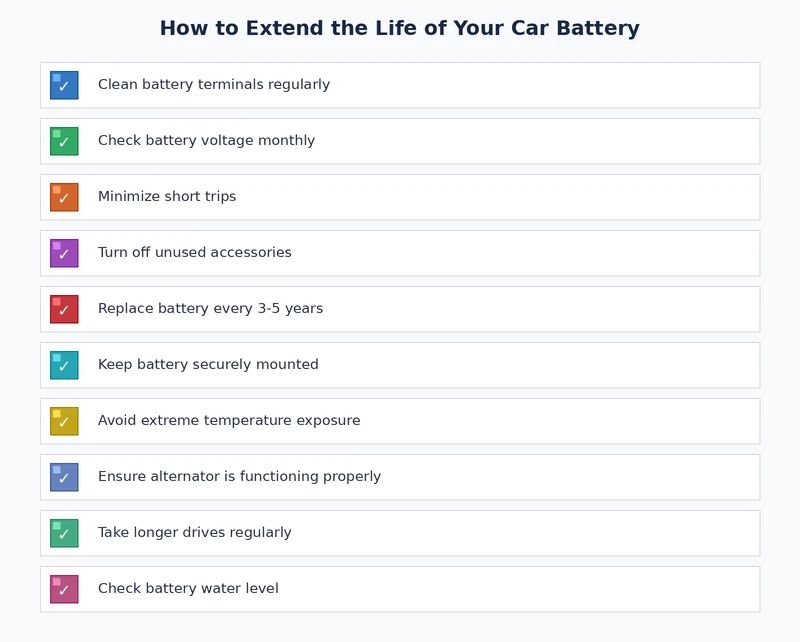
Car batteries don't last forever, but they do give you more years when you treat them correctly. Most flooded lead-acid batteries average three to five years. With the right habits, you can push that to six or seven. With the wrong ones, you're replacing it in eighteen months. Before you get into the habits, understand the full picture of what car batteries actually cost — because knowing the financial stakes makes the maintenance feel a lot more worth it.
This guide covers the science, the daily habits, the real-world scenarios, and the mistakes that shorten battery life prematurely. Whether you drive a daily commuter or a weekend-only truck, every one of these practices applies directly to you.
Contents
Before you can effectively extend your battery's life, you need to know what chemistry you're working with. Not all car batteries behave the same way or respond to the same maintenance strategy. The wrong approach for your battery type can actually do more harm than good.
Three main battery chemistries dominate the automotive market today. Each has a different tolerance for deep discharge, heat, and benign neglect. Here's exactly how they compare:
| Battery Type | Typical Lifespan | Deep Discharge Recovery | Heat Tolerance | Cold Cranking Performance | Average Cost |
|---|---|---|---|---|---|
| Flooded Lead-Acid | 3–5 years | Poor | Moderate | Good | $80–$150 |
| AGM (Absorbent Glass Mat) | 4–7 years | Good | Good | Excellent | $150–$300 |
| Lithium-Ion (LiFePO4) | 8–15 years | Excellent | Excellent | Excellent | $300–$700+ |
AGM is the sweet spot for most drivers. It handles repeated deep discharge cycles, tolerates underhood heat better than flooded chemistry, and requires zero electrolyte maintenance. If your vehicle has start-stop technology, regenerative braking, or a heavy accessory load, AGM isn't a luxury — it's a requirement. Putting a flooded battery in a start-stop application destroys it within a year.
Lithium-ion lasts the longest by a wide margin, but compatibility matters. Most factory alternators aren't calibrated to charge LiFePO4 correctly. Verify your charging system spec before making that swap or you'll damage the battery from day one.
Understanding failure modes is the real foundation of how to extend car battery life. You can follow every maintenance tip perfectly and still lose a battery early if you don't understand what's actually killing it.
Sulfation is the number one cause of premature lead-acid battery failure. When a battery sits in a partially or fully discharged state, lead sulfate crystals form on the plates. Small crystals dissolve normally during a recharge cycle. Large crystals — formed after prolonged discharge — don't. They permanently reduce usable plate surface area, cutting capacity and increasing internal resistance.
According to the Wikipedia article on lead-acid batteries, sulfation accounts for the majority of premature automotive battery failures. That's not bad luck — it's chemistry that's entirely preventable with one simple rule: never let resting voltage drop below 12.4V. A smart battery maintainer connected during long storage periods eliminates sulfation risk almost entirely.
Heat kills batteries. Cold just exposes the damage that heat already caused. At 77°F, a lead-acid battery operates at 100% rated capacity. At 32°F, it drops to roughly 80%. At 0°F, you're getting around 50% of rated CCA. That's why cold mornings produce no-starts — the battery was already marginal, and the cold just pushed it over the edge.
Meanwhile, every 15°F rise above 77°F cuts battery service life roughly in half. An engine bay that regularly hits 200°F in summer is running your battery through accelerated aging every single day. Batteries in Arizona fail faster than the same battery in Minnesota — even though Minnesota winters are brutal. The culprit is summer, not winter.
Park in the shade or a garage during summer months whenever you can. Heat is a far more destructive force on battery chemistry than cold — and most drivers have this backwards.
The biggest gains come from consistent daily behavior, not occasional interventions. These habits are simple, cheap, and compounding over time.
A fully charged battery reads 12.6–12.8V at rest. Below 12.4V, sulfation begins. Below 12.0V, you're causing measurable, cumulative damage every day it sits there. Keep these rules front of mind:
A monthly voltage check is the single highest-ROI battery habit you can build. It costs nothing and catches problems months before they become roadside emergencies.
Corrosion on battery terminals adds resistance to every circuit in your vehicle. That white or blue-green crystalline buildup means current flow is compromised. The starter motor draws more amperage to compensate. The alternator works harder. Every electrical system downstream suffers under elevated resistance.
Clean terminals every six months using a baking soda and water paste. Scrub with a wire brush, rinse with clean water, dry thoroughly, then apply dielectric grease or terminal protector spray to prevent future corrosion. Snug connections matter too — a loose cable clamp causes voltage spikes during cranking that stress battery internals on every start cycle.
Parasitic drain is current draw when the ignition is off. Every modern vehicle has some — body control modules, clocks, keyless entry systems, and telematics all pull current continuously. Normal parasitic draw is 25–50mA. Anything above 100mA is a problem that will flatten your battery within days.
Common culprits you can address directly:
If your battery drains overnight repeatedly, that's a parasitic draw diagnosis — not a battery replacement situation. Fix the draw first. Replacing the battery without fixing the draw just means you'll kill the new battery faster.
Theory is useful. But these are the real-world driving patterns and environmental conditions that actually separate batteries that last from batteries that don't.
Every cold start pulls 150–400 amps from the battery depending on engine displacement, temperature, and oil viscosity. The alternator needs 20–30 minutes of driving to fully restore that charge. If your daily commute is five minutes each way, your battery is living in chronic partial discharge — accumulating sulfation damage with every single start.
This is the silent killer for city drivers and errand runners. You're not doing anything obviously wrong, but the battery is losing capacity week by week. If your driving pattern skews heavily toward short trips, connect a smart maintainer once a week, or deliberately take a 30-minute highway run every week to top off the charge state.
Cold weather doesn't kill batteries — it reveals the batteries that heat has already weakened. If your car struggles to crank when temperatures drop, the battery is already degraded below useful capacity. That's a replacement scenario, not a maintenance scenario.
Cold-related starting failures and stalling in cold weather almost always trace back to a battery that's been operating below spec for months. Load-test your battery before winter, not after the first freeze. If it's below 75% of rated CCA, replace it before the season starts — not after you're stranded.
In hot climates, the strategy is different. Keep the battery away from direct heat sources. In flooded batteries, check electrolyte levels every three months during summer and top off with distilled water only — never tap water. If you're in a consistently hot climate and running a flooded battery, upgrading to AGM is the highest-impact single change you can make.
This is where most drivers get it wrong — in both directions. Some charge batteries that are genuinely finished. Others replace batteries that just needed a proper recharge cycle. Knowing the difference saves you money either way.
If the discharge was a one-time event and the battery is relatively new, a proper slow charge cycle (2A overnight) will recover it. Always follow up with a load test before trusting it for daily use. A multimeter voltage reading alone doesn't tell you enough.
A swollen battery is a safety emergency, not a maintenance situation. Don't charge it. Don't try to jump-start with it. Remove it immediately and recycle it at any auto parts store. Internal gas buildup in a swollen battery presents real explosion and acid burn risk.
Battery maintenance costs almost nothing compared to early replacement. The math here is straightforward and strongly in your favor.
Most battery maintenance is DIY territory with minimal tool investment. Here's the full picture:
Shop-based battery diagnostics run $20–$40. Replacement labor adds another $30–$80 on top of parts cost. AutoZone, O'Reilly, and Advance Auto Parts all do free battery and alternator testing — use that service before paying a shop diagnostic fee.
A quality flooded battery costs $100–$150. An AGM runs $150–$300. Replacing every three years instead of every five costs you an extra $30–$100 per year on batteries alone — before you factor in towing fees, emergency jump services, missed appointments, or the labor to replace a battery in a difficult-access location.
A $50 smart maintainer and a five-minute monthly voltage check extend battery service life by twelve to twenty-four months in most cases. That's not marginal — that's an entire replacement cycle avoided.
You can execute every maintenance step correctly and still lose a battery early if you're making any of these errors. Most of them feel harmless in the moment.
These seem minor. They're not — they're cumulative degradation over months and years:
Alternator output should read 13.8V–14.4V at the battery terminals with the engine warmed up and accessories at moderate load. Below 13.5V means undercharging. Above 14.8V means overcharging. Either condition accelerates battery degradation significantly. This check pairs well with your routine AC system maintenance, since the AC compressor is one of the highest electrical loads on your alternator and running a marginal charging system with max AC load is a recipe for early battery failure.
Most flooded lead-acid batteries last three to five years under normal driving conditions. AGM batteries typically push that to four to seven years. Lithium-ion automotive batteries can last eight to fifteen years. Climate, driving habits, and maintenance practices all affect actual lifespan significantly — a well-maintained AGM in a mild climate can easily outlast a neglected flooded battery by four or more years.
Yes, but only if each drive is long enough. Short trips of five to ten minutes don't give the alternator enough time to fully replenish the charge consumed by the cold start. For city drivers making mostly short trips, connect a smart maintainer once a week or deliberately take a 30-minute highway drive regularly to keep the battery properly topped off.
Disconnecting the battery eliminates parasitic drain but doesn't stop self-discharge — flooded batteries self-discharge at 5–15% per month regardless. A connected smart battery maintainer is the better solution. It compensates for both self-discharge and any residual parasitic draw while keeping the battery at optimal charge voltage without overcharging.
Heat is far more damaging. Cold reduces cranking performance temporarily, but heat causes permanent chemical degradation — accelerating plate corrosion, electrolyte evaporation, and separator breakdown. Batteries in consistently hot climates fail earlier than those in cold climates, even though cold-weather failures are more visible and dramatic. Prioritize shade parking and garage storage during summer.
Test alternator output voltage directly at the battery terminals with the engine running warm and accessories at moderate load. The correct range is 13.8V–14.4V. Below 13.5V indicates undercharging — the battery will slowly deplete over time. Above 14.8V indicates overcharging — it accelerates electrolyte loss and plate degradation. Either condition destroys batteries faster than normal use would.
Yes, for most drivers — especially those with short-trip patterns, high accessory loads, or vehicles with start-stop systems. AGM handles deep discharge better, tolerates heat better, and requires zero maintenance. The higher upfront cost is offset by a longer service life and a significantly lower chance of unexpected failure at an inconvenient time. For start-stop vehicles specifically, AGM is not optional — flooded chemistry can't handle the cycle demands.
 |
 |
 |
 |

About Diego Ramirez
Diego Ramirez is a maintenance and care specialist who has been wrenching on cars since he was sixteen. He focuses on fluid changes, preventive care routines, paint protection, and the small habits that turn a five-year-old car into a fifteen-year-old car.
Get some FREE car parts & gear.. Or check out the latest free automotive manuals and build guides here.
Disable your ad blocker to unlock all the hidden deals. Hit the button below 🚗
| | | |
