by Diego Ramirez
Tires are one of the most expensive wear items on any vehicle, yet most drivers replace them far sooner than necessary. Knowing how to make car tires last longer can save you hundreds of dollars per set and keep you safer on the road. The good news is that extending tire life comes down to a handful of consistent habits — proper inflation, routine rotation, alignment checks, and attentive driving. This guide covers everything you need to know to squeeze maximum mileage out of every set. For a broader look at keeping your vehicle in peak shape, see our Car Maintenance Schedule: Complete Checklist by Mileage.
Contents
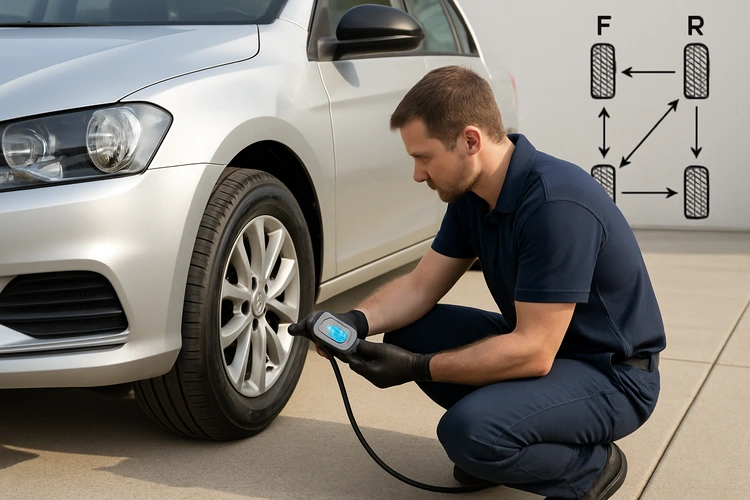
Improper inflation is the single biggest killer of tires. An underinflated tire flexes excessively, generating heat that degrades rubber compounds and causes rapid shoulder wear. An overinflated tire rides on a smaller contact patch, wearing the center tread prematurely and reducing grip. Both conditions shorten life dramatically.
Check tire pressure at least once a month and before any long trip. Tires naturally lose roughly 1 PSI per month, and temperature swings cause additional changes — pressure drops about 1 PSI for every 10°F decrease in ambient temperature. Always check when the tires are cold (driven less than a mile), because heat from driving raises pressure readings artificially.
The correct inflation pressure for your vehicle is printed on a sticker inside the driver's door jamb or in the owner's manual — not on the tire sidewall. The sidewall number is the maximum pressure the tire can hold, not the recommended operating pressure. Front and rear recommendations often differ, so check both. According to the National Highway Traffic Safety Administration (NHTSA), underinflation is a leading factor in tire failure and blowouts.
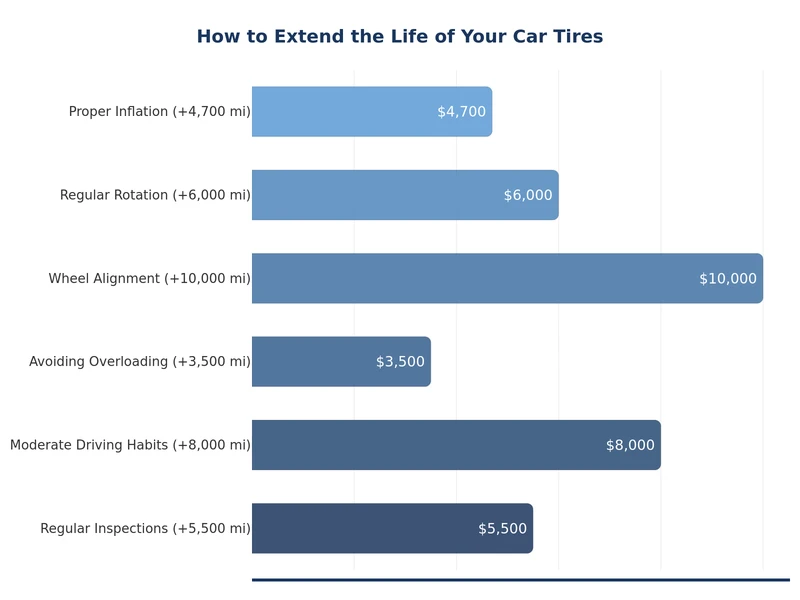
Tire rotation is one of the most cost-effective ways to make your tires last longer. Front tires wear faster than rear tires on front-wheel-drive vehicles because they handle both steering and power delivery. Regular rotation evens out that wear so all four tires reach the end of their usable life at the same time, which maximizes the mileage from every set.
The most common pattern for non-directional tires on FWD vehicles is the forward cross: fronts move straight back, rears cross to opposite front corners. For RWD vehicles, use the rearward cross. Directional tires (V-shaped tread) can only move front-to-rear on the same side. Staggered fitments (wider rear tires) may require a side-to-side swap if the tires are non-directional. Most manufacturers recommend rotating every 5,000–7,500 miles. Learn the full process in our step-by-step guide: How to Rotate Tires at Home.
| Drivetrain | Recommended Pattern | Interval | Notes |
|---|---|---|---|
| Front-Wheel Drive (FWD) | Forward Cross | 5,000–7,500 mi | Fronts wear fastest; cross rears to front |
| Rear-Wheel Drive (RWD) | Rearward Cross | 5,000–7,500 mi | Rears wear fastest; cross fronts to rear |
| All-Wheel Drive (AWD) | X-Pattern or Forward Cross | 5,000–6,000 mi | Even wear critical to protect differentials |
| Directional Tires (any) | Front-to-Rear Same Side | 5,000–7,500 mi | Cannot cross sides; tread pattern is one-way |
| Staggered Fitment | Side-to-Side (if non-directional) | 5,000–7,500 mi | Requires remounting if directional |
Even if you keep tires perfectly inflated and rotate them diligently, misaligned wheels will destroy tires prematurely. Alignment refers to the angles at which your tires contact the road. When those angles are off — even by fractions of a degree — the tire scrubs sideways with every rotation, producing feathering, one-sided wear, and rapid tread loss.
Watch for these warning signs:
Get alignment checked whenever you hit a significant pothole or curb, after replacing suspension or steering components, and at least once a year as part of routine maintenance.
Wheel balancing corrects weight imbalances around the tire-and-wheel assembly. An unbalanced wheel creates vibration that causes cupping (scalloped dips in the tread) and stresses wheel bearings and suspension parts. Have tires balanced every time they are rotated and whenever you notice steering vibration above 50 mph.
Your driving style has an enormous impact on how to make car tires last longer. Aggressive inputs — hard acceleration, late heavy braking, and fast cornering — generate intense heat and friction that consume rubber far faster than relaxed driving.
Smooth, progressive inputs are the key. Accelerate gradually from stops rather than spinning the tires. Begin braking early so you can apply pressure gradually. Take corners at reasonable speeds — lateral G-forces scrub the outer shoulder of tires rapidly. Avoid curbing wheels when parking, which cuts and scuffs sidewalls. Sidewall damage is rarely repairable, so protecting that zone is critical.
Every tire has a maximum load rating printed on the sidewall. Consistently overloading the vehicle increases flex, heat buildup, and structural stress inside the tire carcass. If you regularly haul heavy cargo or tow a trailer, confirm that your tires are rated for the load — and maintain the correct inflation pressure for loaded conditions, which your owner's manual specifies separately from normal passenger load.
Regular visual inspection lets you catch problems early — before a slow leak becomes a blowout, or minor tread wear becomes a safety hazard. Make it a habit to walk around the vehicle before every drive, glancing at tire shape and condition. If you spot a nail or screw embedded in the tread, read our guide on How to Fix a Slow Tire Leak before the situation worsens.
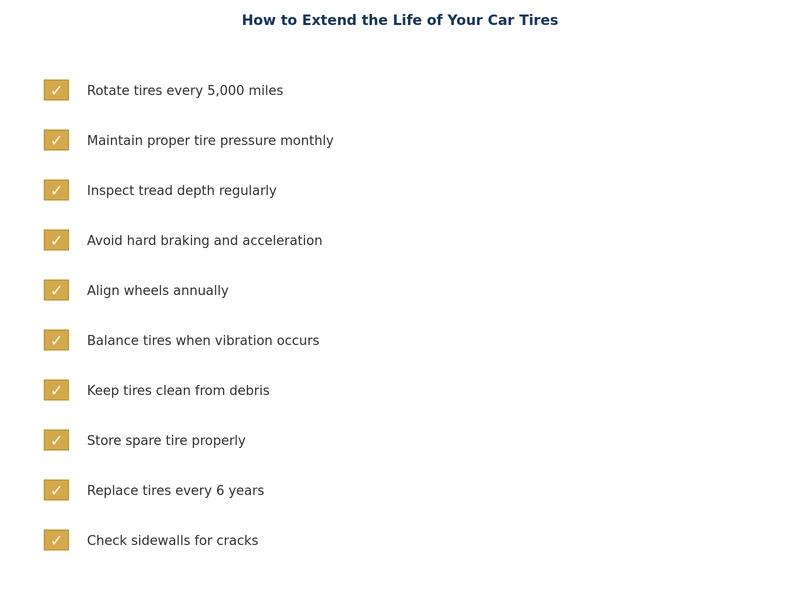
Wear patterns are diagnostic tools. Center wear points to chronic overinflation. Edge wear on both shoulders indicates chronic underinflation. One-sided edge wear signals an alignment problem (camber or toe). Feathering (tread blocks rounded on one side, sharp on the other) indicates a toe misalignment. Cupping or scalloping points to suspension or balance issues. Understanding these patterns helps you fix the root cause, not just replace the tire. Our guide on How to Read Tire Numbers and Sidewall Markings will help you decode the full data printed on your tires.
Tires become unsafe and must be replaced when tread depth reaches 2/32 inch — the legal minimum in most states. The penny test: insert a penny into the tread groove with Lincoln's head pointing down. If you can see the top of Lincoln's head, the tire is at or below 2/32 inch and needs immediate replacement. For better wet-weather safety, use a quarter instead: if you can see the top of Washington's head, you're at 4/32 inch, and replacement should be planned soon. Built-in tread wear indicators (raised bars molded into the grooves) also signal when 2/32 inch is reached.
If you run separate summer and winter tire sets, proper off-season storage preserves the rubber and ensures the tires perform correctly when remounted. Even a single set benefits from thoughtful care in extreme climates.
Follow these best practices for tire storage:
Keeping a complete maintenance log — inflation checks, rotation dates, alignment services, and inspection notes — makes it easy to stay on schedule and spot developing issues before they become expensive. Building tire care into your regular routine is the simplest answer to how to make car tires last longer over the full service life of your vehicle.
Most all-season tires are engineered to last between 50,000 and 70,000 miles under normal driving conditions. Performance tires typically last 20,000–40,000 miles because their softer compounds prioritize grip over longevity. Actual lifespan depends heavily on inflation habits, rotation frequency, alignment, and driving style — drivers who follow all maintenance recommendations often exceed the manufacturer's treadwear warranty.
Yes, significantly. Rotation is one of the highest-impact habits for making tires last longer because it equalizes wear across all four positions. Without rotation, front tires on FWD vehicles can wear out 30–40% faster than the rears. Regular rotation means all four tires reach the wear limit at the same time, so you replace a full set rather than two tires at staggered intervals.
The clearest signs are the vehicle pulling to one side on a flat road, uneven tread wear (heavier on one edge than the other), a steering wheel that sits off-center while driving straight, and vibration through the steering column. Even without obvious symptoms, alignment should be checked at least once a year or after any significant impact with a pothole or curb.
Yes. Chronic underinflation allows the tire sidewalls to flex excessively with every revolution, generating internal heat that breaks down the tire's structural layers over time. This can lead to sudden blowouts. Chronic overinflation stresses the center of the tread and makes the tire more vulnerable to impact damage. Both conditions shorten tire life and compromise safety.
Age matters as much as tread depth. Most manufacturers recommend replacing tires after 6–10 years regardless of remaining tread, because rubber hardens and develops micro-cracks with age that are not always visible. Check the DOT manufacture date code on the sidewall — the last four digits indicate the week and year of production. A tire made in week 24 of a given year would read "2424."
Generally yes. Low rolling resistance tires use harder rubber compounds and optimized tread designs that often result in treadwear ratings equal to or higher than conventional all-season tires. The trade-off is slightly reduced wet grip compared to ultra-high-performance tires. For everyday commuting, they offer a good balance of longevity, fuel efficiency, and adequate traction.
 |
 |
 |
 |

About Diego Ramirez
Diego Ramirez is a maintenance and care specialist who has been wrenching on cars since he was sixteen. He focuses on fluid changes, preventive care routines, paint protection, and the small habits that turn a five-year-old car into a fifteen-year-old car.


Get some FREE car parts & gear.. Or check out the latest free automotive manuals and build guides here.
Disable your ad blocker to unlock all the hidden deals. Hit the button below 🚗
| | | |
