by Diego Ramirez
Has anyone ever watched a dashboard temperature gauge creep toward the red and felt that slow, sinking dread set in? The answer to what's happening under the hood — and how to prevent it — is more straightforward than most people realize. Applying the right car maintenance tips for hot weather before temperatures peak is the most reliable way to avoid a breakdown, and our team has spent years documenting exactly where the risk concentrates and what consistently prevents it. Heat is a vehicle's most relentless adversary: it accelerates fluid degradation, stresses rubber and plastic, and pushes cooling systems toward their operational limits.
One of the first questions worth answering before summer arrives is whether it's safe to drive with low engine coolant — because coolant management sits at the center of nearly every heat-related failure our team has observed. The rest of this guide builds from there, covering the full spectrum of summer vehicle care from overlooked inspection points to the tools worth having on hand when the mercury climbs.
Contents
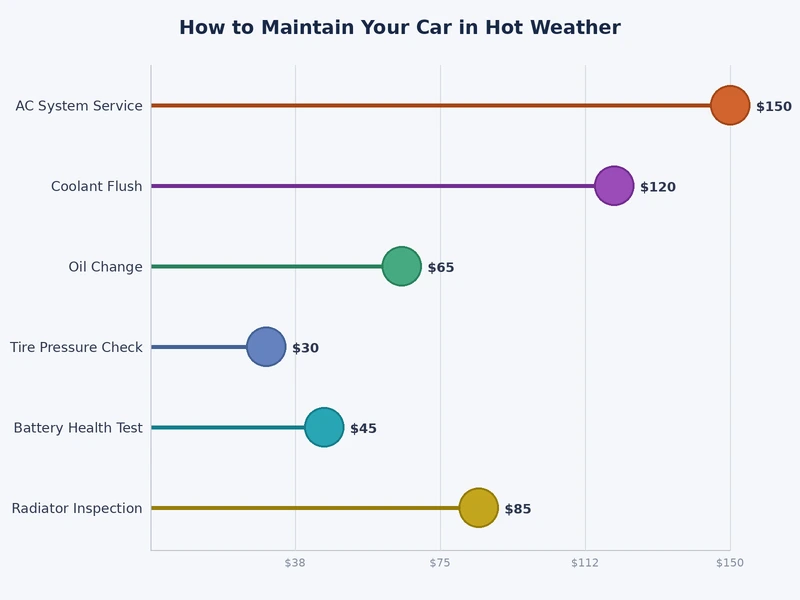
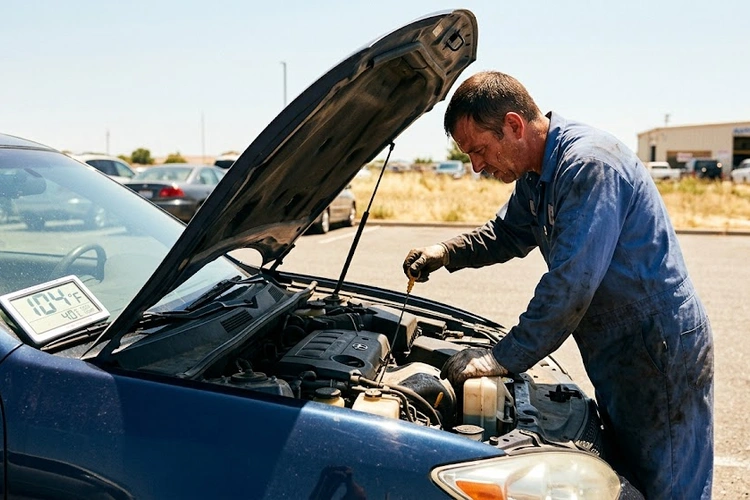
Internal temperatures inside a parked car can exceed 130°F on a hot afternoon. Engine bays during operation climb considerably higher, with exhaust component surfaces reaching past 400°F under load. That thermal environment creates a layered set of stressors that interact with each other and accelerate mechanical wear in ways that aren't always obvious until something fails at the worst possible moment.
Motor oil loses viscosity at extreme temperatures, reducing its protective film between moving metal surfaces. Coolant operates closer to its boiling threshold, leaving narrower margins for any cooling system fault. Rubber components — gaskets, seals, radiator hoses, drive belts — harden and develop microcracks that eventually widen into full failures. According to the National Highway Traffic Safety Administration, vehicle-related mechanical breakdowns spike significantly during summer months, with cooling system failures accounting for a substantial share of those incidents. Our team pays particular attention to the pre-summer window because the failures that surface in the peak heat almost always have roots in spring conditions that went unaddressed.
One pattern our team observes consistently: a cooling system that handled spring without complaint fails the moment ambient temperatures push into the high 90s. The margin for error vanishes. A hose that was 70% degraded in April becomes a failure point in the hottest weeks. A battery that was borderline in spring becomes unreliable when heat accelerates its internal deterioration.
Proactive inspection matters more in the months leading into summer than during summer itself. A slow coolant puddle forming under the car that gets ignored in spring becomes a stranding incident in August. The same logic applies to every fluid, seal, and electrical connection on the vehicle. Catching degradation early — when parts are cheap and conditions are forgiving — is the entire game. By the time peak heat arrives, the window for easy, inexpensive fixes has largely closed.
This is one of the most common assumptions our team encounters, and it's a particularly dangerous one. A full coolant reservoir confirms the static fluid level is adequate. It says nothing about the coolant's chemical condition, the thermostat's function, the water pump's flow rate, or the radiator's actual capacity to shed heat at peak demand.
Old coolant loses its corrosion inhibitors and pH balance over time, becoming acidic enough to attack aluminum components from the inside and degrade rubber seals progressively. Our team consistently finds vehicles with visually clean coolant that tests below 7.0 pH — meaning the fluid provides essentially no protection against internal corrosion. Testing with a simple strip or refractometer takes two minutes and reveals far more than any visual check. A full reservoir of degraded coolant is worse than a slightly low reservoir of good coolant, because it creates false confidence going into the season's most demanding weeks.
The AC compressor does add load to the engine, and that load generates additional heat. But a properly functioning cooling system handles that load without difficulty under normal operating conditions. The persistent belief that aggressive AC use causes overheating conflates a symptom-revealer with a root cause.
When a vehicle overheats with the AC running, the real culprit is almost always a compromised cooling system — low coolant, a failing radiator fan, a clogged radiator, or a thermostat stuck in a partially closed position. Our team has documented this pattern in depth when researching why cars overheat at idle but not on the highway — the combination of AC compressor load and reduced airflow at low speeds exposes cooling system deficiencies that normal highway driving masks entirely. The AC is a diagnostic stress-test for a weak system. It doesn't cause the underlying problem.
The radiator, water pump, thermostat, and coolant are the four pillars of heat management. Our team approaches each one separately during a summer inspection rather than treating the cooling system as a single undifferentiated unit. That distinction matters because each component can fail independently while the others appear normal.
Start with a cold-engine pressure test on the radiator cap. A cap that can't hold its rated pressure allows coolant to boil at lower-than-design temperatures — shrinking the safety margin precisely when it matters most. Caps cost a few dollars and are routinely overlooked. From there, inspect every coolant hose for soft spots, swelling, or surface cracking. A hose that should feel firm but collapses easily when squeezed is a reliable sign of internal degradation that won't survive extended summer driving at elevated temperatures.
The thermostat deserves replacement on any vehicle past 60,000 miles that hasn't had one recently. A thermostat stuck partially closed creates chronic overheating; one stuck open reduces engine efficiency and extends warm-up times, which increases wear. Neither condition is acceptable in extreme heat, and replacement is inexpensive relative to the diagnostic labor a failed thermostat eventually generates.
Our team treats the thermostat as a scheduled wear item, not a lifetime component — replacing it during major cooling system services costs almost nothing compared to the diagnostic labor and risk of addressing a failed one mid-summer on a busy road.
Tire pressure rises approximately 1 PSI for every 10°F increase in temperature. A tire correctly inflated in a cool morning garage registers noticeably higher pressure after an hour of highway driving on a 95°F day. Overinflation reduces the contact patch, reduces traction uniformity, and meaningfully increases blowout risk — particularly at highway speeds with aged rubber. This is a concrete, measurable problem, not a theoretical one.
Our standard practice is to verify inflation in the morning before the vehicle has moved. Hot-tire readings skew high and shouldn't be used for inflation adjustments. The correct reference is the OEM specification printed on the driver-side door jamb sticker — not the maximum pressure molded into the sidewall, which is a structural limit, not a target. Anyone dealing with persistent pressure warnings should review our coverage of the low tire pressure light and its causes to distinguish sensor faults from actual inflation problems before making adjustments.
Beyond pressure, sidewall condition deserves attention during any summer inspection. Heat cycles accelerate rubber oxidation, particularly in climates with wide daily temperature swings. Sidewall cracking on tires older than six years warrants replacement regardless of remaining tread depth — the internal structure may have degraded significantly even when surface wear looks acceptable to an untrained eye.
| Component | Inspection Frequency | Hot-Weather Warning Signs | Action Threshold |
|---|---|---|---|
| Coolant | Every 2 years or 30,000 miles | Discoloration, sweet smell, rust particles | Flush if pH drops below 7.0 or interval exceeded |
| Tires | Monthly and before long trips | Sidewall cracking, uneven tread, pressure swings | Replace if tread below 2/32" or sidewall visibly cracked |
| Engine Oil | Per OEM service schedule | Dark color, burnt smell, level drop between changes | Change if past interval or visibly degraded |
| Battery | Annually or when starting feels slow | Terminal corrosion, sluggish cranking, warning light | Load test if over 3 years old in a hot climate |
| Drive Belts | Every 30,000 miles | Rib cracking, fraying, glazing, squealing at start | Replace at first signs of surface rib cracking |
| Radiator Hoses | Annually before summer | Softness, swelling, visible cracking at ends | Replace any hose that collapses noticeably when squeezed |
| Brake Fluid | Every 2 years | Dark color, low level, soft or inconsistent pedal | Flush if moisture content exceeds 3% on test strip |
Motor oil degrades faster at high temperatures, and viscosity grade matters more in summer than at any other point in the year. Most modern vehicles run 0W-20 or 5W-30 multi-grade oil that handles a wide temperature range without issue. Older vehicles and high-performance engines sometimes benefit from a slightly higher-viscosity option during peak heat — worth verifying against the OEM service manual before making any change, since modern tight-tolerance engines can be sensitive to viscosity deviations.
Transmission fluid is less frequently discussed but equally critical for summer reliability. Automatic transmissions generate significant internal heat during stop-and-go traffic, sustained towing, or extended highway grades in hot conditions. Fluid that has darkened or developed a burnt odor has lost its friction-modifier properties and is no longer protecting clutch packs adequately. The symptom progression — rough shifting, delayed engagement, slipping — tends to escalate into expensive internal damage if the fluid isn't changed at the first signs of degradation.
When an oil puddle appears under the car during summer inspections, tracking down the source promptly matters more than usual. Heat-expanded seals can temporarily mask slow leaks that worsen when temperatures drop, making intermittent drips easy to dismiss — until the loss becomes significant enough to cause damage before the next scheduled oil check.
Brake fluid is hygroscopic — it absorbs atmospheric moisture continuously through the system's rubber components. As moisture content rises, the fluid's boiling point drops. In hot weather combined with demanding driving conditions — mountain descents, stop-and-go traffic with heavy loads, extended towing — degraded brake fluid can form vapor bubbles that dramatically reduce braking effectiveness. This is brake fade in its chemical form, and it's a genuine safety concern rather than an edge case.
Our team recommends testing brake fluid moisture content with an inexpensive test strip before each summer season. A reading above 3% moisture is grounds for a full system flush. Anyone noticing spongy or inconsistent pedal feel should review our detailed guide on brake fluid leak symptoms before assuming the issue is purely a fluid-condition problem — leaks and degraded fluid can produce similar pedal characteristics and sometimes coexist, requiring different remedies.
Cold weather reduces battery cranking power temporarily. Heat kills batteries permanently. High temperatures accelerate the chemical reactions inside a lead-acid cell, speeding up plate corrosion and electrolyte evaporation in ways that cannot be reversed. A battery rated for five years in a temperate climate may last three in a consistently hot one. This is well-documented electrochemistry, not folklore — and it shapes how our team thinks about replacement intervals in southern climates.
A load test on any battery older than three years before summer begins is the most reliable pre-season check available. A quick visual inspection for battery terminal corrosion — the white or blue-green crust that forms on terminals and cable clamps — is a free five-minute check that reveals both connection quality and hints at the battery's internal state. Significant corrosion increases electrical resistance and can prevent an otherwise healthy battery from delivering sufficient current to the starter, causing symptoms that mimic a dying battery when the real issue is a bad connection.
Repeated heat cycles cause rubber to lose flexibility and develop surface cracks progressively. A serpentine belt showing longitudinal cracking along the rib valleys is a replacement candidate even when no slipping or squealing has been detected. Belt failure strands a vehicle immediately and, on some interference-engine designs, can cause valve damage that converts a modest belt replacement into a major engine repair. Treating belt condition as a visual inspection item — not just a mileage interval — catches problems before they become emergencies.
Radiator and heater hoses should be firm but slightly pliable when squeezed on a cold engine. A hose that feels rock-hard has become brittle from heat cycling. One that collapses easily has degraded internally. Neither condition withstands the pressure and temperature swings of sustained summer driving reliably. Proactive hose replacement is one of the most cost-effective maintenance actions available relative to the disruption it prevents.
Car AC systems also warrant a dedicated pre-summer check. A musty or mildew odor from the vents is among the earliest signs of a system that needs attention — our guide on why car AC smells musty covers the primary causes and practical remedies that most people can address without specialized equipment.
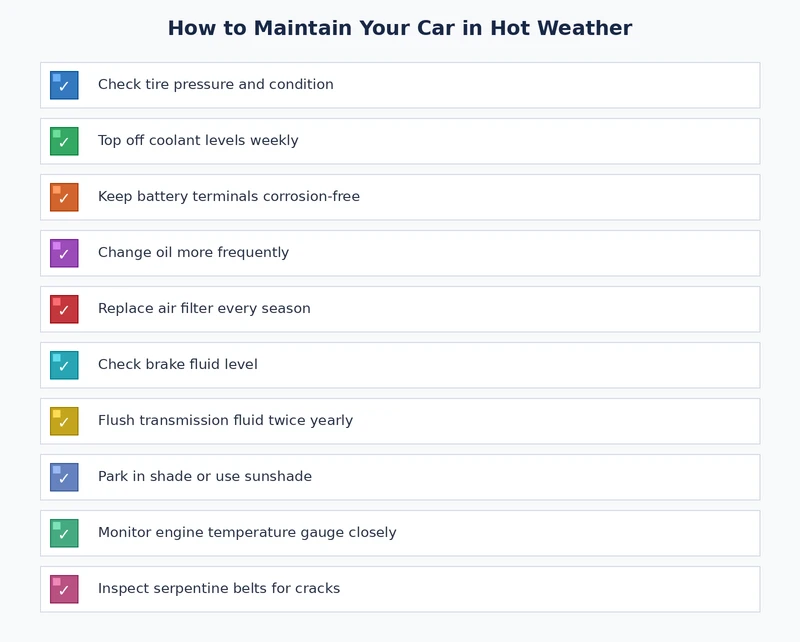
A quality digital tire pressure gauge is the single most-used tool in summer maintenance. Analog gauges lose calibration over time and introduce enough variability to matter when managing narrow hot-weather pressure windows. A good digital unit provides readings accurate to ±0.5 PSI consistently. Paired with a non-contact infrared thermometer, the combination lets the team check brake rotor temperatures after a test drive, verify cooling fan engagement temperatures, and identify hot spots on hose connections — all informative data points that visual inspection alone can't provide.
A battery load tester is the correct instrument for assessing battery condition — not a simple voltmeter. Voltage confirms the battery holds a charge at rest; a load test reveals whether it can deliver adequate cranking amperage under actual starting demand. The distinction matters because a weak battery can show 12.6V at rest and fail immediately under load. Most auto parts stores perform load tests without charge, but having one on the shop bench eliminates the trip for routine annual pre-summer checks.
A coolant refractometer measures both freeze-point protection and antifreeze concentration simultaneously, giving a fast read on coolant condition and mix ratio that a simple level check can't provide. Brake fluid test strips measure moisture content in under 60 seconds and cost almost nothing per use — a genuinely useful tool given how often brake fluid condition is assumed rather than measured. A hand vacuum pump with an attached gauge is invaluable for pressure-testing the cooling system and diagnosing vacuum leaks without needing the engine running.
Our team also keeps a UV leak detection kit available year-round. Coolant and oil leaks that are difficult to pinpoint by eye become immediately visible under UV light after adding a small amount of compatible dye to the system. For anyone working through an unfamiliar cooling system or dealing with an intermittent drip, it reduces diagnostic time considerably and avoids the guesswork that leads to replacing the wrong component first.
Most manufacturers recommend a coolant flush every two years or 30,000 miles, but hot climates accelerate the breakdown of corrosion inhibitors and pH buffers. Our team recommends testing coolant condition annually with a test strip rather than relying solely on the calendar interval — fluid that tests acidic or shows visible contamination should be flushed immediately regardless of mileage.
Tire pressure should always be checked in the morning before the vehicle has been driven, when the tires are cold. Hot tires read significantly higher than their actual adjusted pressure, which can lead to under-inflation if that reading is used as the baseline. The door jamb sticker specifies the correct cold-inflation pressure, and that figure — not the maximum pressure on the sidewall — is the proper target.
Yes. Cold weather reduces cranking power temporarily, but the damage reverses when temperatures rise. Heat causes permanent degradation — accelerating plate corrosion and electrolyte evaporation inside the cell. Battery lifespan in consistently hot climates is measurably shorter than in temperate ones, which is why our team recommends load-testing any battery over three years old before summer rather than waiting for a failure to prompt attention.
The earliest indicators are typically a temperature gauge that runs higher than normal on warm days, a sweet coolant smell from the engine bay after driving, or a small puddle beneath the radiator area. Any of these warrant prompt investigation before temperatures peak. Waiting until the gauge hits the red or steam appears means the system has already reached a failure state, which often leads to secondary damage beyond the original fault.
For most modern vehicles, the OEM-specified multi-grade oil is engineered to handle a wide temperature range, including hot climates. However, older vehicles, high-mileage engines with increased internal clearances, or vehicles used for demanding tasks like towing in high heat may benefit from a slightly higher-viscosity option — specifically a higher cold-end rating such as 10W-40 rather than 5W-30. Verifying against the service manual is the correct approach before making any change.
 |
 |
 |
 |

About Diego Ramirez
Diego Ramirez is a maintenance and care specialist who has been wrenching on cars since he was sixteen. He focuses on fluid changes, preventive care routines, paint protection, and the small habits that turn a five-year-old car into a fifteen-year-old car.
Get some FREE car parts & gear.. Or check out the latest free automotive manuals and build guides here.
Disable your ad blocker to unlock all the hidden deals. Hit the button below 🚗
| | | |
