by Diego Ramirez
Cold weather strands approximately 1 million American motorists every year, and the majority of those roadside failures trace directly to maintenance oversights that a structured winter preparation program would have prevented. Understanding how to maintain car in winter requires a systematic review of battery capacity, fluid viscosity, tire condition, brake performance, and corrosion protection — ideally completed before temperatures drop and road salt saturates every road surface within reach. Vehicles that receive disciplined cold-weather care suffer fewer breakdowns, retain stronger resale values, and deliver measurably safer performance across every winter mile.
Road salt, applied at over 22 million tons annually on American roadways, accelerates corrosion on brake lines, suspension components, and underbody panels at a rate that surprises even experienced vehicle owners. For drivers who keep cars in daily service through winter rather than following the seasonal protocols outlined in the car winter storage guide, a proactive maintenance schedule represents the single most effective defense against premature mechanical wear and repair bills that compound quietly over seasons.
Contents
The assumption that trucks and SUVs require less winter attention than compact sedans is among the most persistent misconceptions in automotive care, and it leads owners of larger vehicles to skip checks that become expensive repairs by spring. Heavy-duty vehicles carry larger batteries but also operate under greater electrical loads from trailer wiring, auxiliary lighting, and supplemental heating systems that draw power continuously on cold mornings. Four-wheel-drive and all-wheel-drive systems add transfer case fluid and rear differential oil to the maintenance roster — fluids that thicken significantly in extreme cold and require viscosity verification before winter arrives.
Vehicles driven daily through winter face continuous salt and moisture exposure on every exterior surface, while occasional-use vehicles accumulate internal moisture from repeated short cold-start cycles that never fully warm the engine to operating temperature. Short trips prevent condensation from burning off inside the crankcase, accelerating oil contamination and necessitating shorter oil change intervals throughout the cold months than the standard summer schedule would suggest.
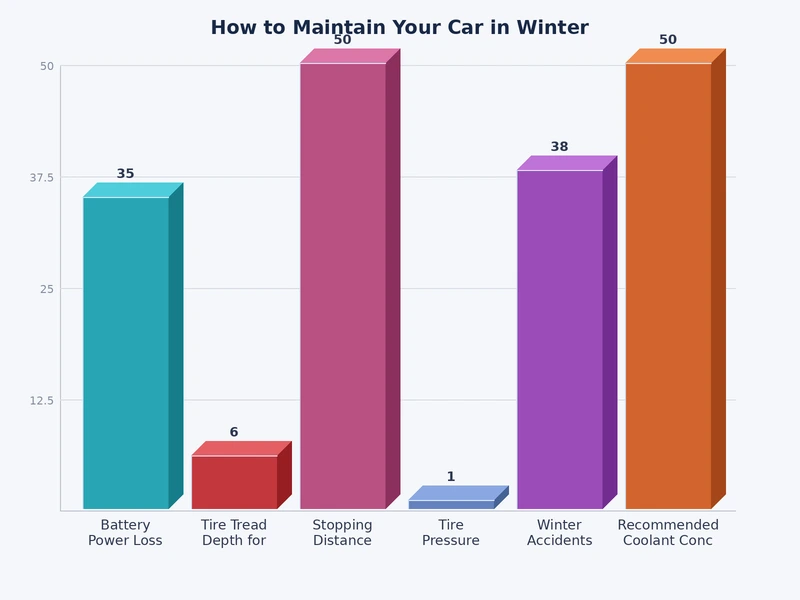
A car battery loses approximately 35 percent of its cranking power at 32°F and up to 60 percent at 0°F, according to battery manufacturers' published cold-weather specifications, which means a battery that starts a vehicle reliably in September may fail entirely on the first genuinely cold morning in January. Any battery older than three years warrants a professional load test before the first hard freeze, since a battery that passes a standard voltage check can still lack the reserve capacity to sustain a cold-weather start under real-world conditions.
Tire pressure drops approximately one PSI for every 10°F decrease in ambient temperature, meaning a tire properly inflated in early autumn may be running 6–8 PSI underinflated by midwinter, reducing traction and increasing stopping distances at the worst possible time of year. Tread depth on all-season tires should measure no less than 4/32" at the start of winter; shallower tread performs inadequately on packed snow and wet pavement regardless of manufacturer claims about all-season capability.
Pro tip: The penny test is insufficient for winter traction assessment — the quarter test is the correct standard; if the top of Washington's head is visible when inserted tread-first, the tire lacks the depth needed for safe cold-weather braking.
| Fluid | Winter Specification | Check Interval | Warning Sign |
|---|---|---|---|
| Engine oil | 5W-30 or 0W-20 per OEM specification | Every 5,000–7,500 miles | Dark, gritty texture on dipstick |
| Antifreeze/coolant | 50/50 mix protects to −34°F | Every 2 years or per label | Rust particles; sweet smell from heater vents |
| Windshield washer fluid | −20°F or lower rated formula | Check monthly | Streaking or freezing on glass after application |
| Brake fluid | DOT 3 or DOT 4 per manufacturer | Every 2 years | Spongy pedal feel; moisture contamination above 3% |
| Transfer case / differential oil | Per OEM viscosity specification | Every 30,000–60,000 miles | Whining noise under load in cold ambient temperatures |
Windshield fogging ranks among the most cited winter driving complaints, and resolving it before the season begins requires less total effort than managing the problem reactively each cold morning when schedules are already tight. The complete guide on stopping car windows from fogging up inside covers cabin air filter replacement, recirculation mode management, and anti-fog glass treatments that address the root causes systematically rather than relying on defrost cycles alone.
Salt begins attacking bare metal within hours of initial contact, making a pre-winter wax application one of the most cost-effective protective actions available before the first snowfall. A quality wax layer creates a sacrificial barrier between the paint and corrosive brine, and the detailed protocol for maintaining car paint gloss between washes provides specific product and technique guidance applicable through the coldest months. Underbody protection demands equal attention, as brake lines, fuel lines, and structural frame rails are typically uncoated from the factory and highly vulnerable to salt-induced corrosion — the complete approach to protecting the car underbody from rust outlines both DIY spray coatings and professional undercoating options at multiple price points.
A single winter without underbody protection can introduce rust to brake lines that progresses to replacement-level failure within two or three additional seasons, converting a $30 annual undercoating investment into a $600–$1,200 brake line replacement. Salt corrosion on suspension components — control arm bushings, ball joints, and tie rod ends — accelerates wear rates that manifest as alignment drift, uneven tire wear, and handling degradation that diagnostic technicians frequently attribute to worn parts without recognizing corrosion as the underlying accelerant. Removing salt deposits immediately after significant road-treatment events is essential, and the process for removing salt stains from car paint and body panels should be performed multiple times per winter rather than deferred until the season ends.
A failed battery in sub-freezing temperatures initiates a cascade of secondary problems that extend well beyond the immediate inconvenience of a no-start condition on a cold morning. Repeated jump-start attempts stress the alternator beyond its rated output capacity, voltage surges during jump-starting can damage engine control modules and transmission control units, and a battery that fails while the vehicle is in motion can cause sudden power loss to safety-critical systems including power steering and ABS. Replacing a marginal battery before winter eliminates this entire failure chain at a fraction of the potential downstream repair cost.
Substituting a heavier-viscosity oil — 10W-40 in a vehicle specifying 5W-30 — thickens further in extreme cold and forces the oil pump to work against significantly increased resistance on every cold start, starving upper-engine components of lubrication during the critical first five to ten seconds of operation when wear rates are highest. Diluting antifreeze beyond a 50/50 ratio with water to reduce cost raises the coolant's freezing point to a level that risks radiator and engine block damage during severe cold snaps, converting minor savings into major repairs.
Weatherstripping that has dried, cracked, or deformed allows cold air infiltration that forces the HVAC system to work harder to maintain cabin temperature, creates conditions for moisture intrusion that promotes mold growth in door cavities, and causes door seals to freeze solid and tear when doors are forced open after a hard overnight freeze. Conditioning weatherstripping with a silicone-based protectant before winter preserves rubber flexibility through repeated freeze-thaw cycles and prevents the tearing that requires panel disassembly for proper replacement — a repair that runs $200–$500 per door at most service centers, and represents one of the most preventable expenses in winter vehicle ownership.
Engine oil should be checked at every fuel stop during winter, or at minimum every two weeks, since cold temperatures thicken oil and short-trip driving accelerates contamination from condensation that never fully burns off in engines that do not reach full operating temperature.
The minimum CCA rating is listed in the vehicle's owner's manual, but battery experts recommend selecting a replacement battery that meets or exceeds the original equipment specification by at least 10 percent, providing additional reserve capacity for the coldest mornings without exceeding the charging system's design limits.
Winter tires should be installed when ambient temperatures consistently fall below 45°F, because all-season rubber compounds begin losing the elasticity necessary for optimal traction at that threshold — a point that typically arrives weeks before the first snowfall in most cold-climate regions.
Road salt causes direct electrochemical corrosion of steel components, and its damage is cumulative across seasons; brake lines, frame rails, suspension arms, and exhaust systems are the most commonly affected structural components, with failure timelines ranging from three to eight years depending on exposure frequency and the presence or absence of protective coatings.
Modern fuel-injected engines do not require extended idling warm-up periods, but a 30-60 second idle before driving allows oil pressure to stabilize and lubricant to reach upper-engine components before the engine is placed under load — a practice that reduces measurable wear on cam lobes and valve train components over the life of the engine.
Applying a silicone-based lock lubricant or a dedicated lock de-icer product to door lock cylinders and latches before temperatures drop prevents moisture from freezing inside the mechanism; parking in a garage, even an unheated one, reduces overnight temperature exposure significantly and is the most reliable long-term prevention strategy.
A frozen coolant system requires professional assessment before attempting to start the engine, since ice expansion can crack the block, head, or radiator; the vehicle should be moved to a heated space and allowed to thaw gradually rather than being force-started, which risks catastrophic engine damage if coolant passages remain blocked.
Cold temperatures reduce brake rotor and pad temperatures, which decreases initial stopping effectiveness until the brakes reach operating temperature; combined with the more frequent and harder braking events that winter road conditions demand, brake pad wear rates in cold climates typically run 15–25 percent higher than in warmer-weather operation, making pre-winter pad inspection especially important.
 |
 |
 |
 |

About Diego Ramirez
Diego Ramirez is a maintenance and care specialist who has been wrenching on cars since he was sixteen. He focuses on fluid changes, preventive care routines, paint protection, and the small habits that turn a five-year-old car into a fifteen-year-old car.
Get some FREE car parts & gear.. Or check out the latest free automotive manuals and build guides here.
Disable your ad blocker to unlock all the hidden deals. Hit the button below 🚗
| | | |
