by Diego Ramirez
Every tire carries a wall of numbers, letters, and symbols stamped into its sidewall. Knowing how to read tire numbers saves you from buying the wrong replacement, helps you match tires correctly across axles, and tells you whether a tire is still safe to use. The markings encode size, load capacity, speed rating, age, and traction grades — all details that matter for safe driving. Take five minutes to learn this code and you will never feel lost in the tire aisle again.
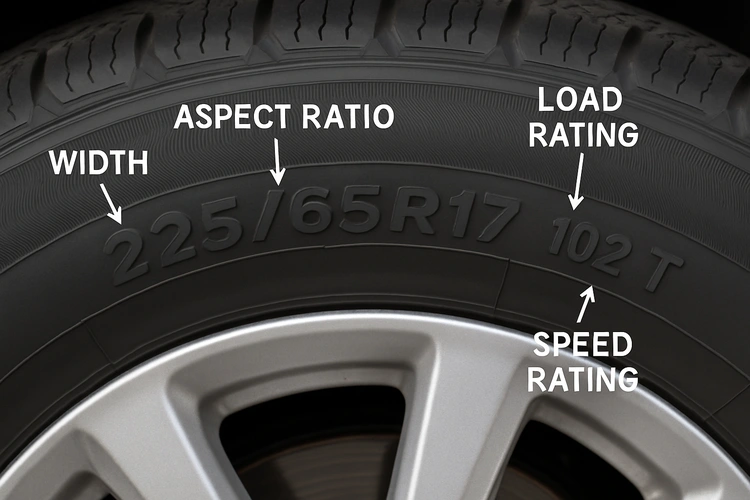
A standard passenger tire marking looks like P215/65R16 95H. That compact string tells you everything about the tire's dimensions and performance envelope. Additional codes elsewhere on the sidewall reveal when the tire was manufactured, how it handles wet roads, and whether it carries a winter rating. If you are building a complete inspection habit, pair this knowledge with our guide on how to check tire tread depth to cover every aspect of tire health.
Contents
The size code is the most prominent marking on any tire. On a passenger car it begins with a letter identifying the tire type, followed by three groups of numbers separated by a slash and a letter. Understanding each segment is the foundation of knowing how to read tire numbers correctly.
The first character sets the tire category. P stands for passenger vehicle. LT indicates a light truck tire built for heavier loads. ST marks a special trailer tire. Some tires omit this prefix entirely — these Euro-metric tires are interchangeable with P-metric sizes in most cases, though load ratings can differ slightly.
After the type letter comes a three-digit number: the section width in millimeters. This is the distance from sidewall edge to sidewall edge when the tire is mounted and inflated to the recommended pressure. A tire marked 215 is 215 mm wide.
Following the slash is the aspect ratio — the sidewall height expressed as a percentage of the section width. A marking of 65 means the sidewall height is 65% of 215 mm, roughly 140 mm. Lower aspect ratios (40–50) deliver sharper handling with less sidewall flex; higher ratios (65–80) provide a more comfortable ride over rough pavement.
Next comes a letter indicating internal construction. R — by far the most common — stands for radial construction, where cord plies run perpendicular to the direction of travel. D indicates diagonal (bias-ply) construction, now mostly found on motorcycles and vintage vehicles.
The final two digits are the rim diameter in inches. A 16 means the tire fits a 16-inch wheel. Always match this number exactly when replacing tires — fitting a tire to the wrong rim diameter is impossible without damaging both the tire and the wheel.
After the size code you will find a two- or three-digit number followed by a single letter. These are the load index and speed rating — both are safety-critical values that must meet or exceed the vehicle manufacturer's minimum specification.
The load index is a standardized code corresponding to the maximum weight a single tire can support at the correct inflation pressure. A load index of 95 equals 690 kg (1,521 lbs) per tire. The scale runs from 71 (335 kg) to 126 (1,700 kg) for passenger tires. Never fit a tire with a lower load index than specified — doing so risks sidewall failure under normal driving loads.
| Load Index | Max Load per Tire (kg) | Max Load per Tire (lbs) |
|---|---|---|
| 80 | 450 | 992 |
| 85 | 515 | 1,135 |
| 91 | 615 | 1,356 |
| 95 | 690 | 1,521 |
| 100 | 800 | 1,764 |
| 105 | 925 | 2,039 |
| 110 | 1,060 | 2,337 |
The speed rating letter defines the maximum sustained speed the tire is engineered to handle safely. Common ratings for passenger cars include:
H-rated tires cover most family sedans. Performance and sports cars typically require W or Y. Always replace with the same or a higher speed rating than the original equipment specification.
The Department of Transportation (DOT) code is a legal requirement on all tires sold in the United States. It starts with the letters DOT followed by up to 12 characters encoding the manufacturer, plant, tire size code, and production date. The NHTSA requires this code so that safety recalls can be efficiently traced and communicated to vehicle owners.
The last four digits of the DOT code are the week and year of manufacture. 1823 means the 18th week of 2023. Tires made before 2000 use only three digits in this position, making precise year identification impossible for very old stock.
Tire age matters even when tread looks fine. Most manufacturers recommend replacement after six years regardless of remaining tread depth, and treat ten years as the absolute maximum service life. Rubber compounds oxidize and crack internally over time, raising blowout risk significantly. Always check the date code when buying a used vehicle — tires are frequently overlooked during pre-sale inspections. Pairing the date code check with a review of your tire wear patterns gives a complete picture of remaining serviceability.
The Uniform Tire Quality Grading system requires three performance ratings molded into every passenger tire sidewall sold in the US.
Treadwear is a relative index. A tire rated 400 should last roughly twice as long as one rated 200 under standardized test conditions. Real-world results vary with driving style, road surface, and inflation habits. All-season touring tires typically exceed 500; high-performance summer tires often fall below 200.
Traction grades (AA, A, B, C) measure wet-road straight-line braking performance. AA is the highest grade. Most quality all-season tires earn an A or AA rating.
Temperature grades (A, B, C) rate the tire's ability to dissipate heat at sustained high speeds. Grade A is best; grade C meets the minimum legal standard. All passenger tires sold in the US must carry at least a grade C temperature rating.
Several additional stamps appear on sidewalls depending on the tire's intended use.
M+S (Mud and Snow) indicates the tread pattern meets basic all-season standards. It does not certify true winter performance. The Three-Peak Mountain Snowflake (3PMSF) — a snowflake inside a mountain outline — is the meaningful winter rating, indicating the tire passed a severe snow traction test. If you drive in genuine winter conditions, look for 3PMSF, not just M+S.
XL or Extra Load marks tires reinforced to carry heavier loads at higher inflation pressures than standard tires of the same size. These are common on SUVs and cargo vans. Do not substitute standard tires for XL-spec tires without verifying the load math.
RFT, SSR, and ZP identify run-flat tires. These have reinforced sidewalls that support the vehicle for limited distance — typically 80 km at 80 km/h — after complete pressure loss. If you regularly deal with a slow tire leak, upgrading to run-flats can give you a meaningful safety buffer.
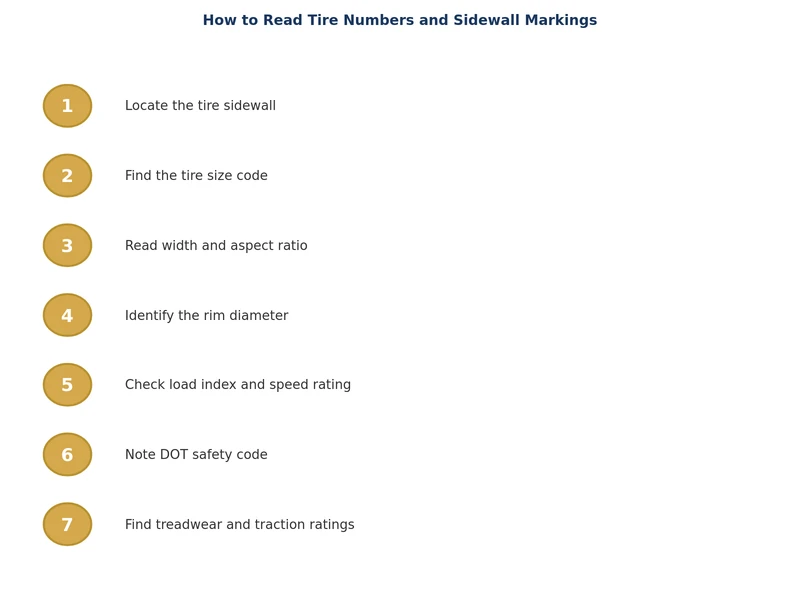
When replacing tires, start with the size code on your existing tires or on the door jamb sticker inside the driver's door. Never downgrade the load index or speed rating. Matching all four tires to the same size, construction type, and performance class keeps handling balanced and predictable — mixing radial and bias-ply tires on the same axle is dangerous and illegal in many regions.
Use the DOT date code to avoid aging stock. Tires sitting in a warehouse age just as tires on a vehicle do. If a brand-new tire shows a date code older than two years, ask the retailer for fresher inventory.
Keeping tires in good shape requires regular attention. Build a monthly habit of checking inflation, inspecting the sidewalls for cracking or bulging, and measuring tread depth. Incorporate this into your broader car maintenance schedule so nothing gets overlooked between major services. The sidewall tells you what a tire is designed to do — your inspection habit tells you whether it is still doing it safely.
The first number is the section width in millimeters, measured from sidewall to sidewall. The second number after the slash is the aspect ratio — the sidewall height as a percentage of the width. The third number after the letter R is the rim diameter in inches. In P215/65R16, the tire is 215 mm wide, the sidewall is 65% of that width tall, and it fits a 16-inch rim.
Look for the DOT code molded into the sidewall. The last four digits give the manufacture date — the first two digits are the week, the last two are the year. For example, 2419 means the 24th week of 2019. If you can only find three digits, the tire was made before 2000 and should be replaced immediately regardless of tread depth.
M+S (Mud and Snow) is a self-certification by the manufacturer indicating the tread pattern handles light mud and snow. The Three-Peak Mountain Snowflake (3PMSF) is awarded only after the tire passes a standardized severe snow traction test. For winter driving on snow or ice, the 3PMSF symbol is the only marking that provides meaningful assurance of cold-weather performance.
Minor size changes are possible — going one aspect ratio step up or down, for example — but you must keep the overall diameter within about 3% of the original to avoid affecting speedometer accuracy, ABS calibration, and clearance. Always verify load index and speed rating meet or exceed the manufacturer's minimum. When in doubt, consult a tire professional before deviating from the door jamb specification.
XL stands for Extra Load. These tires have reinforced internal structure allowing them to carry heavier loads than a standard tire of the same size when inflated to the correct higher pressure. They are commonly specified on SUVs, vans, and performance vehicles. You must not swap XL-rated tires for standard tires without rechecking that the load index still meets the vehicle's requirements.
Inspect your sidewalls at least once a month and before any long road trip. Look for cracks, bulges, cuts, or embedded objects. Sidewall bulges indicate internal structural damage and require immediate replacement — a bulging tire can fail without warning at highway speeds. Cracks that penetrate deep into the rubber, rather than just surface weathering, also signal it is time for new tires regardless of remaining tread.
 |
 |
 |
 |

About Diego Ramirez
Diego Ramirez is a maintenance and care specialist who has been wrenching on cars since he was sixteen. He focuses on fluid changes, preventive care routines, paint protection, and the small habits that turn a five-year-old car into a fifteen-year-old car.


Get some FREE car parts & gear.. Or check out the latest free automotive manuals and build guides here.
Disable your ad blocker to unlock all the hidden deals. Hit the button below 🚗
| | | |
