by Joshua Thomas
A parking lot ding, a hailstorm, or a rogue shopping cart — small dents are one of the most frustrating things that can happen to your car. The good news is that knowing how to remove dents from car panels without paint or body filler can save you hundreds of dollars. Many shallow dents can be fixed at home using simple tools and techniques. This guide covers the most effective DIY methods, what each one costs, and when it makes sense to call a professional instead.
Before you start, check whether your dent has cracked or chipped the paint. If it has, you may need to address the paint separately — our guide on how to fix paint chips on your car covers that process in detail. For dents where the paint is intact, the methods below are your best path forward.
Contents
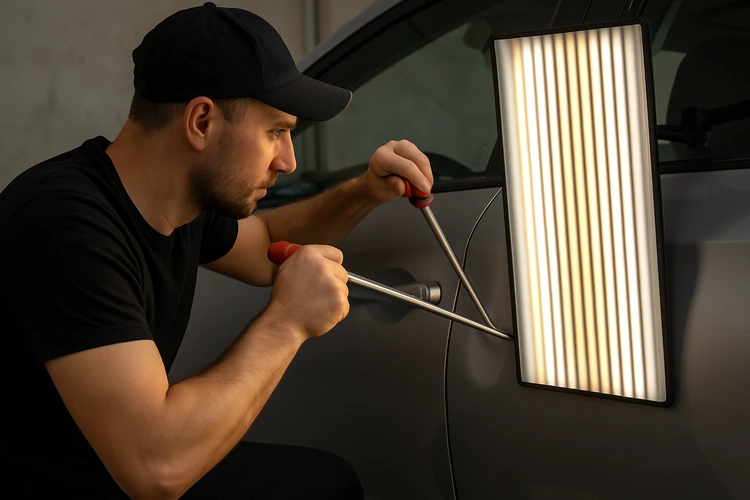
Paintless dent repair (PDR) relies on a simple principle: modern automotive steel and aluminum panels are flexible. When a dent is shallow and the paint film hasn't cracked, you can push or pull the metal back to its original position without needing filler, primer, or new paint. The techniques below are all based on this principle.
PDR works best on:
It generally does not work on creases, sharp impact points, dents on or near body lines, or any dent where the paint has cracked or flaked. If your dent also left a scuff mark from another vehicle, check our page on how to remove paint transfer from a car before attempting dent repair.
Most DIY dent removal methods require minimal investment. You may already own several of the items below.
For stubborn dents or awkward locations behind panels, professional PDR technicians use long metal rods to push from inside — this is beyond DIY unless you have training and specialized tools.
This method works exclusively on plastic bumpers — never use it on metal panels. The heat softens the plastic, making it pliable enough to push back into shape.
Tip: Work in a warm environment. Cold ambient temperatures cause the plastic to stiffen faster, reducing your working time.
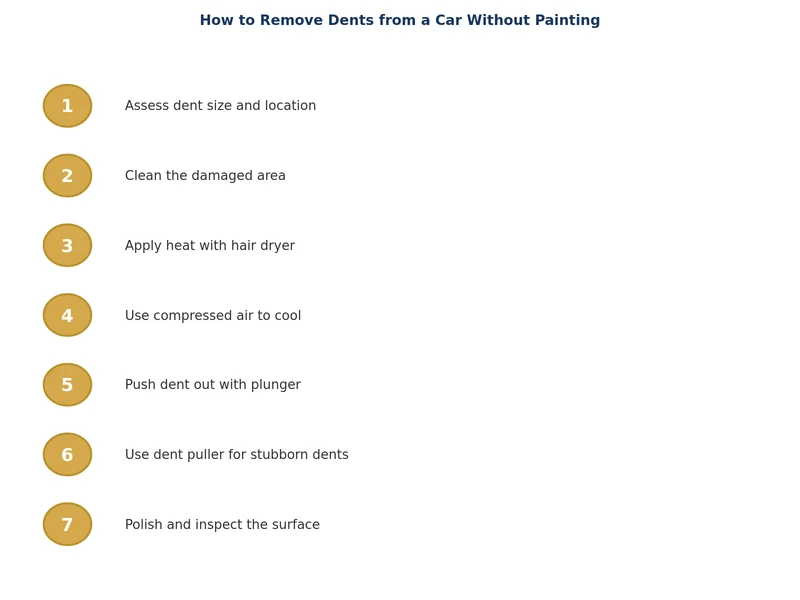
This is one of the most popular home methods for small dents on metal or plastic panels. The rapid temperature change from hot to cold causes the panel to contract and pop back out.
Caution: Excessive heat can damage clear coat or cause paint to bubble. Keep the dryer moving and don't hold it stationary over the paint. If you're concerned about paint condition, read our guide on how to protect car paint after completing the repair.
For shallow, round dents with a relatively flat profile, a suction cup puller is fast and low-risk.
Simple suction cups work best on smooth, flat surfaces. They lose effectiveness on dents near edges, body lines, or curved panels.
PDR glue-tab kits are the most versatile DIY option and work on dents that suction cups can't grip. They let you apply pulling force to a precise point on the dent.
Larger dents often need multiple tabs placed in sequence, working from the outer edge of the dent inward toward the center.
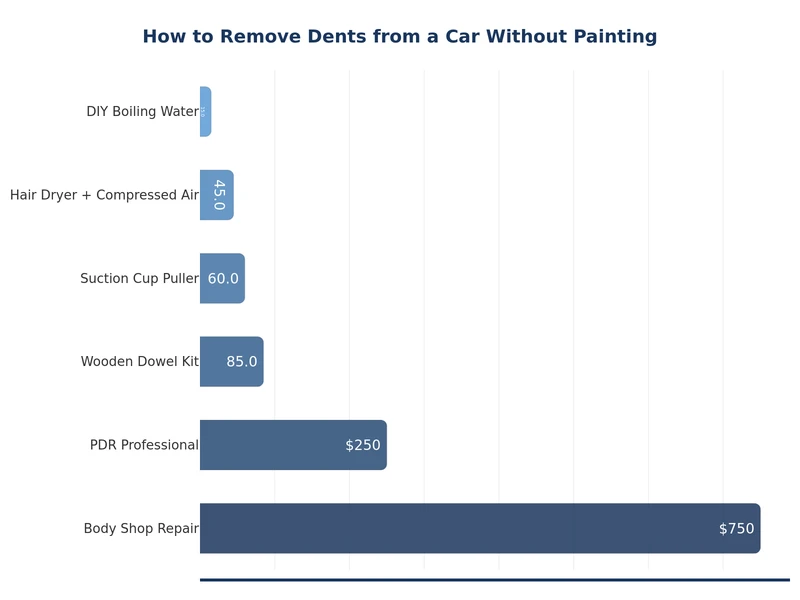
| Method | Best For | Works On Metal? | Works On Plastic? | Approx. Cost | Skill Level |
|---|---|---|---|---|---|
| Boiling Water | Bumper dents | No | Yes | $0 | Beginner |
| Hair Dryer + Compressed Air | Small round dents | Yes | Yes | $5–$10 | Beginner |
| Suction Cup Puller | Shallow flat dents | Yes | Yes | $10–$30 | Beginner |
| Glue Tab Kit | Larger or deeper dents | Yes | Yes | $25–$60 | Intermediate |
| Professional PDR | Complex or multiple dents | Yes | Yes | $75–$400+ | Professional |
DIY dent removal has real limits. Some situations require professional PDR or conventional body shop work:
A professional PDR technician can typically fix a standard door ding in 30–60 minutes. Insurance often covers hail damage, so check your policy before paying out of pocket.
Most door dings happen in crowded parking lots. Park at the ends of rows where neighboring spots are fewer, or pull through so you don't need to reverse out. Avoid parking next to large trucks or SUVs whose doors hang at different heights than yours.
Magnetic door edge guards and foam bumper strips attach to your door edges and absorb minor impacts. They're inexpensive and invisible when the door is closed. Clear paint protection film (PPF) on high-impact areas adds another layer of defense against dings and chips.
Hail is one of the most common causes of widespread dent damage. Whenever a storm is forecast, move your vehicle into a garage or use a padded car cover designed for hail protection. A single severe hailstorm can cause thousands of dollars in damage.
Yes, in many cases. Shallow dents with intact paint are good candidates for DIY repair using suction cups, glue-tab kits, or the hair dryer and compressed air method. Dents with broken paint, deep creases, or those on aluminum panels are better left to a professional PDR technician.
No. The boiling water technique only works on plastic bumpers and trim. Pouring boiling water on a metal panel will not make it pliable — and could potentially harm the paint or clear coat if the temperature is extreme enough.
A good rule of thumb: if the deepest point is more than about half an inch below the panel surface, or if the dent has a sharp crease rather than a smooth curve, it's likely too deep for reliable DIY repair. Also check for any paint cracking, which indicates the metal has been stressed beyond what simple pulling can correct.
When done correctly, paintless dent repair methods do not damage the paint. The main risks are overheating with a hair dryer (which can cause bubbling or peeling) and using too much force with a puller (which can stretch the metal). Always work slowly and check your progress frequently.
Professional PDR typically costs between $75 and $150 for a single small dent, and $400 or more for widespread hail damage. Conventional body shop repair with paint can run $500 to $1,500 or higher per panel. Many comprehensive car insurance policies cover hail damage after the deductible.
For most small, round door dings, a hot glue tab kit combined with a slide hammer or T-bar puller gives the most control and the best results. Suction cup pullers work well for very shallow dents on flat surfaces, but they can lose grip on curved panels or dents with steep edges.
 |
 |
 |
 |

About Joshua Thomas
Joshua Thomas just simply loves cars and willing to work on them whenever there's chance... sometimes for free.
He started CarCareTotal back in 2017 from the advices of total strangers who witnessed his amazing skills in car repairs here and there.
His goal with this creation is to help car owners better learn how to maintain and repair their cars; as such, the site would cover alot of areas: troubleshooting, product recommendations, tips & tricks.
Joshua received Bachelor of Science in Mechanical Engineering at San Diego State University.


Get some FREE car parts & gear.. Or check out the latest free automotive manuals and build guides here.
Disable your ad blocker to unlock all the hidden deals. Hit the button below 🚗
| | | |
