by Joshua Thomas
Oil drips from a parked car, a lawn mower leak, or a quick fluid change can leave dark, stubborn marks that seem impossible to shift. Learning how to remove oil stains from concrete driveway surfaces is a skill every homeowner needs, especially when vehicle maintenance happens at home. The good news: most stains respond well to common household products or inexpensive degreasers — if you act with the right method. If your car is leaking oil regularly, it may also be worth checking under the hood; our guide on how to clean an engine bay covers degreasing the source before it drips further.
This guide walks through every method, from fresh spills to old, set-in stains, so you can restore your driveway without hiring a pressure-washing service.
Contents
Concrete is a porous material. Portland Cement Association research confirms that concrete's capillary pores absorb liquids rapidly. When motor oil, transmission fluid, or brake fluid contacts bare concrete, it wicks into those pores within minutes. The longer it sits, the deeper it penetrates, which is why old stains require more aggressive treatment than fresh spills.
Heat also plays a role. A hot engine dripping oil onto sun-warmed concrete creates ideal conditions for deep absorption. Sealed or coated driveways resist staining far better because the sealer closes surface pores.
Before starting, gather everything. Stopping mid-process allows the product to dry or the stain to reabsorb.
A fresh spill — less than 24 hours old — is the easiest scenario. The oil has not fully penetrated the concrete matrix, so absorption and degreasing can recover most or all of the surface.
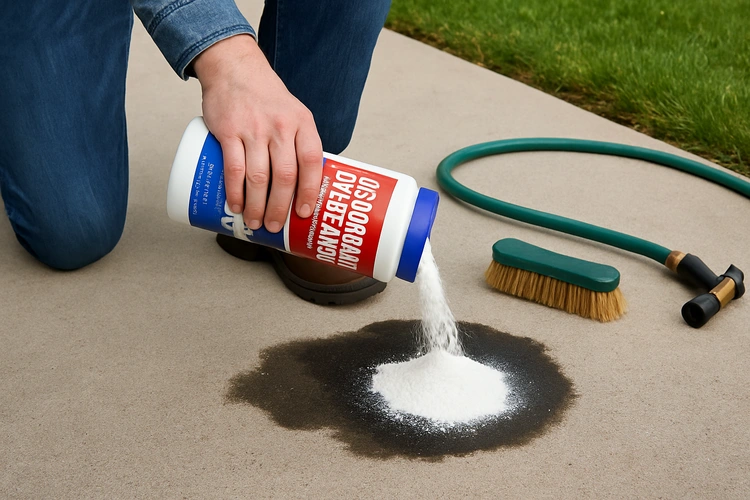
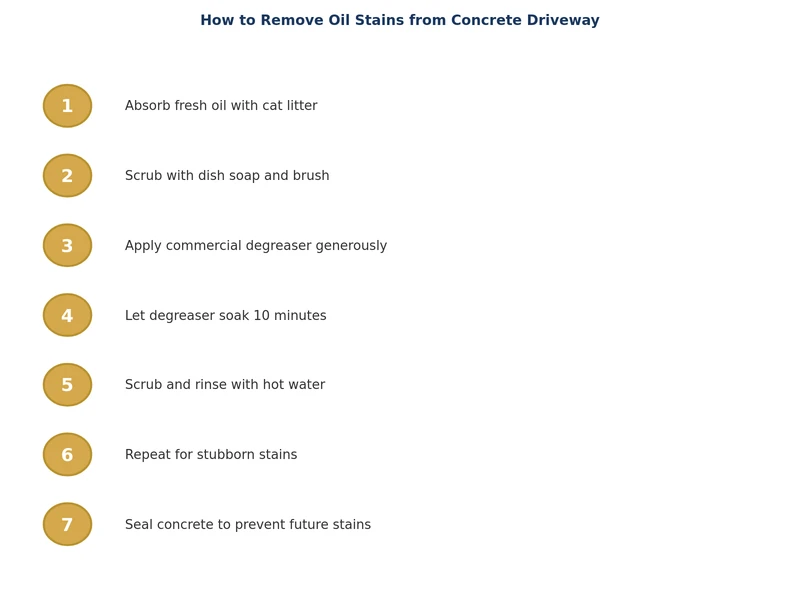
Pour a thick layer of cat litter, baking soda, or commercial oil dry over the entire spill. Do not rub — press down gently with your foot to maximize contact. Let it sit for at least 30 minutes; for larger spills, leave it for several hours. The absorbent material draws oil upward out of the pores. Sweep up the saturated material and dispose of it in a sealed bag. Never rinse the oil into a storm drain — this is an environmental violation in most municipalities.
Apply undiluted dish soap (Dawn or similar) directly onto the damp stain. Work it in with a stiff brush using circular scrubbing motions for two to three minutes. The surfactants break the oil's bond with the concrete surface. Rinse with hot water and repeat if necessary. For larger or slightly older fresh stains, a spray-on TSP substitute works faster than dish soap.
Stains older than a few days require more aggressive chemistry. The oil has polymerized slightly inside the pores, and surface scrubbing alone will not reach it. Just as stubborn interior odors require targeted treatment — see our article on how to remove mold from car interior for a similar deep-cleaning approach — old concrete stains need products that penetrate, not just clean the surface.
Products like Zep Heavy-Duty Citrus Degreaser, Oil Eater, or Simple Green Concrete Cleaner are formulated to penetrate set-in oil. Apply generously, let it dwell for 15–30 minutes (do not allow it to dry), then scrub vigorously and rinse. You may need two or three applications for stains older than a month.
Enzyme-based cleaners take a different approach: living bacteria consume the hydrocarbons in the oil. They work more slowly (often requiring an overnight dwell time kept moist), but they can remove stains that solvents cannot fully reach. They are also biodegradable and safe around plants.
A poultice combines an absorbent powder with a solvent to draw deep oil deposits back to the surface. Mix diatomaceous earth, flour, or cat litter with acetone, mineral spirits, or a commercial degreaser into a thick paste. Spread a 1/4-inch layer over the stain, cover with plastic sheeting, and tape the edges down. Leave for 24–48 hours. As the solvent evaporates through the concrete side rather than the air side, it carries the dissolved oil into the poultice. Scrape off and rinse. This method is slow but highly effective on very old or deep stains.
A pressure washer at 2,000–3,000 PSI with a 15- or 25-degree nozzle and a concrete-safe degreaser can lift stains that hand scrubbing cannot. Apply degreaser first, let it dwell, then pressure wash from the perimeter inward to avoid spreading the stain. Always wear safety glasses — concrete grit rebounds at high velocity. Pressure washing alone without degreaser rarely removes oil; the water simply pushes it around. Combined with chemistry, it is the fastest method for large surface areas.
If your driveway also shows general weathering and chemical residue from road spray, the same thorough approach applies to your vehicle's finish — our guide on how to remove oxidation from car paint explains similar principles of dissolving surface contamination before sealing.
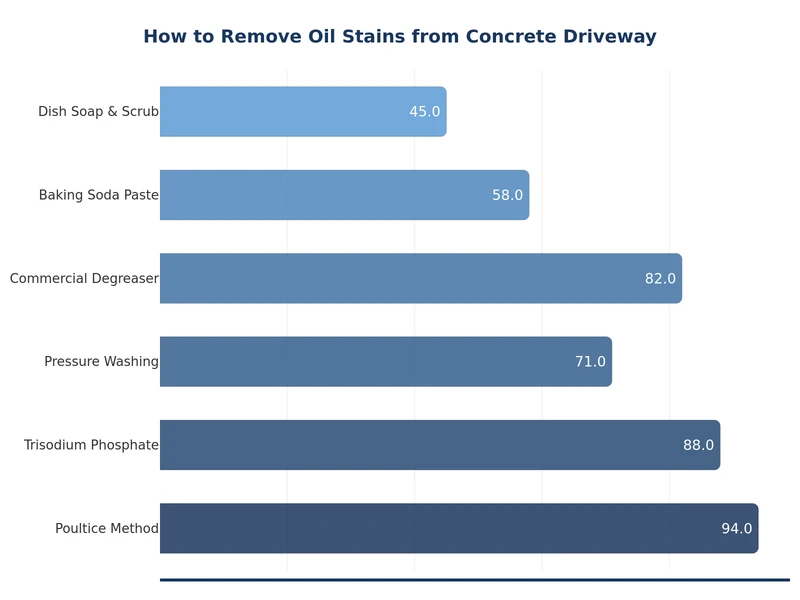
| Method | Best For | Dwell Time | Effectiveness | Cost |
|---|---|---|---|---|
| Dish soap + scrub | Fresh spills (under 24 hrs) | 5–10 min | Good | Very low |
| Commercial degreaser | Stains up to 1 month old | 15–30 min | Very good | Low–moderate |
| Enzyme cleaner | Moderate to old stains | Overnight | Very good | Moderate |
| Poultice (solvent paste) | Deep, set-in old stains | 24–48 hrs | Excellent | Low–moderate |
| Pressure washer + degreaser | Large areas, moderate stains | 15–30 min | Excellent | Moderate (rental) |
| Muriatic acid etch | Last resort, heavy staining | 5–10 min | Good (surface removal) | Low (hazardous) |
A penetrating concrete sealer closes surface pores and is the single most effective prevention step. Silane-siloxane sealers soak in and chemically bond with the concrete rather than forming a surface film, meaning they do not peel or flake. Apply every two to three years. A sealed driveway allows you to wipe up a fresh spill with a rag before it even stains.
If your vehicle has a known slow leak, place a drip pan or an absorbent parking mat under the engine. Rubber-backed mats with absorbent tops are available at auto parts stores and catch drips before they reach concrete. This is a temporary solution — address the source leak as soon as possible.
Keep a bag of cat litter or a container of baking soda in your garage specifically for spills. Covering a fresh oil drop within five minutes prevents the vast majority of staining. The same principle applies to other automotive fluids: brake fluid, power steering fluid, and coolant all stain concrete and can damage it chemically if left long-term. Keeping your car well-maintained — including regular inspections of hoses and gaskets — reduces the frequency of driveway spills significantly.
Maintaining a clean and well-protected vehicle overall also reduces how much contamination transfers to your driveway and garage. Consider reviewing our comprehensive guide on how to protect car paint to understand the broader system of vehicle protection that keeps both your car and your surfaces in better condition.
WD-40 can loosen light surface oil stains because it is a petroleum-based solvent, but it often leaves its own oily residue. For best results, follow any WD-40 application immediately with a degreaser scrub and hot water rinse. It is not a reliable standalone solution for deep or old stains.
Bleach does not break down oil — it is an oxidizer, not a degreaser. It may lighten the appearance of a stain temporarily by bleaching the discoloration, but the oil remains in the concrete pores. Use a proper degreaser or enzyme cleaner for true removal.
Fresh stains can be removed in under an hour. Stains a few days to a few weeks old typically require one to three treatment sessions spread over a day or two. Very old, deeply set stains may need repeated poultice applications over several days before they fully lift.
A pressure washer alone rarely removes oil stains — it mostly spreads them across a larger area. Pressure washing is highly effective when combined with a concrete degreaser applied first and allowed to dwell. The degreaser breaks the oil's bond; the water pressure then flushes it out.
Muriatic acid etches the concrete surface, which can remove superficial staining by literally removing the top layer of material. However, it does not dissolve oil — it just removes the stained concrete. It is caustic, requires full protective equipment, and can damage surrounding surfaces. Reserve it as a last resort after other methods have failed.
Avoid wire brushes and muriatic acid on stamped concrete, as they damage the texture and color. Use enzyme-based cleaners and a soft-bristle brush instead. Apply gently, rinse thoroughly, and reseal after cleaning since stamped concrete sealers are thinner and more easily removed during the cleaning process.
 |
 |
 |
 |

About Joshua Thomas
Joshua Thomas just simply loves cars and willing to work on them whenever there's chance... sometimes for free.
He started CarCareTotal back in 2017 from the advices of total strangers who witnessed his amazing skills in car repairs here and there.
His goal with this creation is to help car owners better learn how to maintain and repair their cars; as such, the site would cover alot of areas: troubleshooting, product recommendations, tips & tricks.
Joshua received Bachelor of Science in Mechanical Engineering at San Diego State University.


Get some FREE car parts & gear.. Or check out the latest free automotive manuals and build guides here.
Disable your ad blocker to unlock all the hidden deals. Hit the button below 🚗
| | | |
