by Diego Ramirez
Has anyone stepped into a car and instantly recognized that dense, unmistakable blend of wet fur and dander, wondering if the odor would ever fully leave? Our team has tested how to remove pet odor from car interiors across dozens of vehicle types and fabric compositions, and the findings are consistently encouraging. Even deeply embedded odors respond well to systematic enzymatic and mechanical treatment when the correct sequence is followed from start to finish. Most people reach instinctively for an air freshener, which delivers a temporary mask while odor compounds continue building in the substrate beneath the surface. The real solution targets dander proteins, uric acid, and sebaceous oils at the molecular level — breaking them down rather than covering them. For anyone managing the physical hair challenge alongside the odor, our companion resource on how to get dog hair out of the car covers the mechanical removal phase in full detail.
Contents
Before any product contacts the interior, our team always begins with thorough mechanical removal, because no enzymatic or chemical cleaner performs effectively over a surface still coated in hair, dander, and loose organic debris. The sequence matters considerably more than most people anticipate, and skipping these initial steps measurably reduces every product's effectiveness in the phases that follow.
Our team's experience across dozens of test vehicles confirms that a thorough vacuuming phase alone reduces perceived odor intensity by roughly thirty to forty percent before any chemical intervention — setting a realistic baseline for what products must accomplish in subsequent steps.
Pro tip: Enzymatic cleaners require direct, sustained contact with organic molecules to complete their biological reaction — applying them over a layer of loose hair or debris dramatically reduces penetration depth and net effectiveness.
The gap between a well-executed DIY effort and a professional ozone or hot water extraction treatment is significant, and understanding where each approach excels helps most people allocate time and budget appropriately without over-investing in cases that respond readily to consumer products.
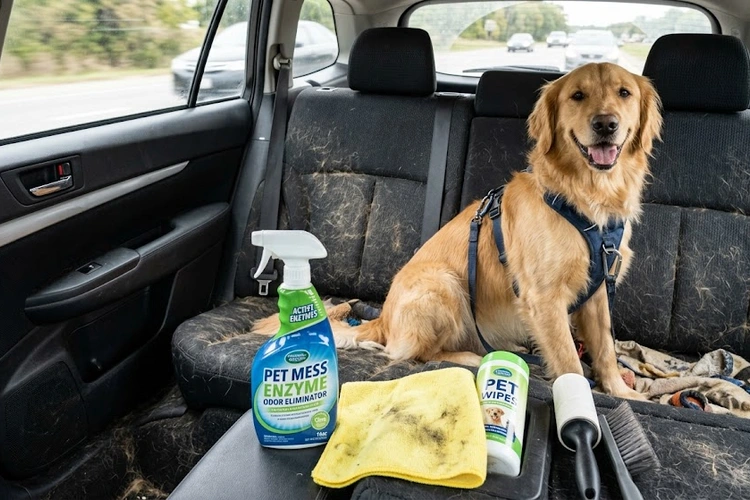
For mild to moderate odor — typical of a vehicle used by pets regularly but cleaned consistently without accidents — DIY methods achieve full elimination in the vast majority of cases. The core product toolkit our team recommends includes:
Severe odor from extended exposure, multiple pets, or accidents that saturated seat foam or carpet backing warrants professional intervention, where equipment and chemistry operate at a different scale than consumer products allow.
Our team compiled the following reference table based on testing across fabric, leather, and carpet substrates, rating each product category by the odor severity it addresses, surface compatibility, and typical cost per treatment session.
| Product Type | Best For | Compatible Surfaces | Odor Severity | Avg. Cost |
|---|---|---|---|---|
| Enzymatic spray | Urine, dander, saliva | Fabric, carpet | Mild to severe | $12–$25 |
| Baking soda | General dampness, mild odor | All fabric surfaces | Mild | $1–$3 |
| Vinegar solution | Hard surfaces, rubber trim | Hard surfaces only | Mild to moderate | $0.50–$2 |
| Activated charcoal | Residual airborne compounds | All (passive use) | Mild | $8–$18 |
| Ozone treatment | Severe, multi-pet, HVAC odor | All surfaces + ducts | Severe | $75–$200 |
| Hot water extraction | Deep carpet and upholstery | Fabric, carpet | Moderate to severe | $100–$300 |
One important distinction our team consistently emphasizes: leather interiors require enzymatic products formulated specifically for porous leather surfaces, because standard fabric enzymatic sprays strip conditioning agents and cause surface cracking with repeated application. According to research on pet dander, these microscopic protein particles remain biologically active allergens and persistent odor sources long after direct pet contact ends — reinforcing the case for enzymatic breakdown over masking chemistry at every severity level.
Our team has encountered these errors consistently across vehicles brought in after failed DIY attempts, and each one either prolongs the original problem or introduces a secondary complication that makes all subsequent treatment harder to complete effectively.
Warning: Bleach-based cleaners should never be used on car upholstery — they destroy fabric fibers, cause irreversible discoloration, and react with ammonia compounds in pet urine to produce toxic fumes in an enclosed cabin space.
Our team treats the maintenance phase as equally important as the initial elimination — most people successfully remove the odor only to see it return within weeks when no preventive habits interrupt the reaccumulation cycle. A structured routine keeps the interior consistently fresh and also protects other interior components from accelerated wear; accumulated dander follows the same neglect pattern as the debris that damages car speaker grilles and driver cones over time, compounding the cost of inattention across multiple interior systems simultaneously.
Our team recommends running the HVAC on full recirculation for eight to ten minutes with windows slightly open after every significant pet transport session, then switching to fresh air mode to flush the ducting actively. Spraying enzymatic cabin odor spray directly into the fresh air intake — located at the base of the windshield on most vehicles — allows the blower motor to distribute the product through all ducting and across the evaporator core surface, reaching the system component that most DIY routines miss entirely.
Understanding the full cost spectrum allows most people to make a well-informed decision between self-treatment and professional service, particularly when the vehicle holds significant resale value or the odor severity has crossed the DIY threshold.
Our team's consistent position: most vehicles with one or two pets respond completely to a $25–$50 DIY effort when the protocol is followed correctly and patiently, making professional escalation a targeted response to specific severity thresholds rather than a default starting point for the majority of cases.
Recognizing the threshold between manageable DIY work and situations requiring professional intervention saves considerable time and prevents the frustration of repeated partially-effective attempts on a problem rooted deeper in the vehicle's structure than surface treatment can reach.
Anyone noticing cabin smells that fall outside the typical pet odor profile — particularly sulfurous or sharp chemical notes — should investigate a mechanical source rather than attributing it to pet contamination. Our detailed breakdown on why a car smells like rotten eggs covers catalytic and exhaust-related causes that share no connection to pet odor chemistry but are sometimes misidentified in multi-pet households where unusual smells become normalized over time.
A mild to moderate case responds within a single treatment session of two to four hours, including enzymatic dwell time and adequate drying. Severe odor with foam saturation requires professional treatment and typically needs a twenty-four to forty-eight hour airing period following ozone treatment before the cabin is fully comfortable for regular occupancy again.
Baking soda functions effectively as a passive absorbent for mild, moisture-borne odors when given sufficient dwell time — eight to twelve hours at minimum. Our team uses it as a follow-up step after enzymatic application rather than as a standalone solution for anything beyond light surface odor in a well-maintained interior.
Uric acid in pet urine can permanently yellow fabric and degrade foam structural integrity when left untreated over extended periods. Dander and sebaceous oils do not cause the same structural damage but can become deeply bonded to fiber over months, making complete removal progressively more difficult without professional hot water extraction and foam-level access.
Our team recommends vacuuming every two weeks for vehicles transporting pets regularly, with a full enzymatic treatment applied monthly as a preventive measure before odor becomes perceptible at the surface level. The cabin air filter warrants replacement every 12,000–15,000 miles — or at least annually — when pets travel in the vehicle on a consistent basis throughout the year.
Enzymatic cleaners formulated specifically for pet odors — containing protease, lipase, and amylase enzyme blends — consistently outperform all other consumer product categories across our testing on fabric and carpet substrates. Rocco & Roxie Professional Strength and Nature's Miracle Auto are the two products our team returns to most frequently for fabric and carpet applications in standard passenger vehicles.
Ozone treatment eliminates existing odor compounds thoroughly and permanently, but it does not prevent reaccumulation from ongoing pet use in the same vehicle. Without subsequent preventive maintenance, odor returns at the same rate it originally built up, making ozone a powerful resetting treatment rather than a standalone long-term solution when pets continue to travel regularly in the vehicle.
Fabric seats absorb and retain pet odor compounds significantly more deeply than leather, because the porous fiber structure allows dander, oils, and moisture to penetrate into the foam layer beneath the visible surface. Leather surfaces accumulate odor primarily at the surface level and respond much more quickly to enzymatic treatment, without the deep saturation concerns that fabric interiors consistently present in high-pet-use vehicles.
 |
 |
 |
 |

About Diego Ramirez
Diego Ramirez is a maintenance and care specialist who has been wrenching on cars since he was sixteen. He focuses on fluid changes, preventive care routines, paint protection, and the small habits that turn a five-year-old car into a fifteen-year-old car.
Get some FREE car parts & gear.. Or check out the latest free automotive manuals and build guides here.
Disable your ad blocker to unlock all the hidden deals. Hit the button below 🚗
| | | |
