by Joshua Thomas
Learning how to rotate tires at home is one of the best ways to extend tire life, improve fuel economy, and save money on shop visits. With a floor jack, jack stands, and a torque wrench, most drivers can complete the job in under an hour. Before you start, check out our guide on how to use a car jack safely — proper lifting technique is essential for this job.
Tires wear unevenly depending on their position. Front tires on a front-wheel-drive vehicle wear faster because they handle steering and power simultaneously. Rotating them on a regular schedule balances that wear across all four tires, saving you hundreds of dollars by delaying full replacements. It also helps maintain consistent traction and handling.
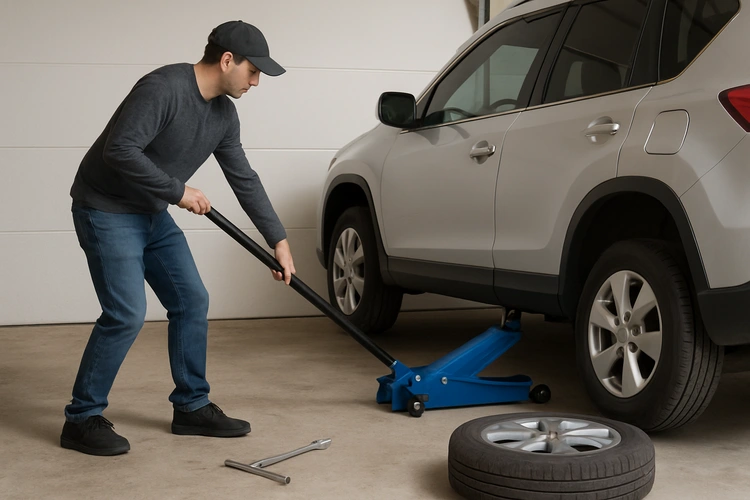
Contents
Tires do not wear at the same rate in all positions. On a front-wheel-drive car, the front tires wear significantly faster than the rears — sometimes two to three times faster. On rear-wheel-drive vehicles, the opposite is true. Even all-wheel-drive cars develop uneven wear due to the geometry of turns and braking forces.
Regular rotation distributes wear evenly, which means all four tires reach the end of their usable life at roughly the same time. That lets you replace all four together, which is far better for handling and safety than mixing old and new. It also keeps your tread depth consistent — learn how to check wear using our guide on how to check tire tread depth and when to replace.
According to the National Highway Traffic Safety Administration (NHTSA), proper tire maintenance including rotation is a key factor in preventing blowouts and maintaining safe vehicle control.
Never work under a vehicle supported only by a floor jack. Always use jack stands rated to your car's gross vehicle weight. Work on flat, solid concrete — not gravel or asphalt that softens in heat. Engage the parking brake and chock the wheels that remain on the ground before you lift any corner of the vehicle.
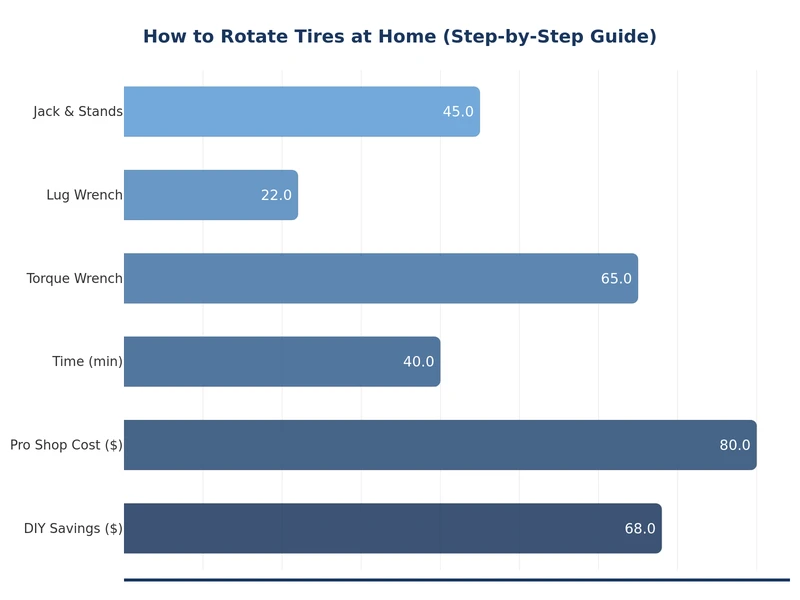
The correct rotation pattern depends on your drivetrain and whether your tires are directional or non-directional. Using the wrong pattern can actually accelerate uneven wear rather than fix it. Check your owner's manual first — it will specify the recommended pattern for your vehicle.
| Drivetrain / Tire Type | Pattern Name | Front-Left Goes To | Front-Right Goes To | Rear-Left Goes To | Rear-Right Goes To |
|---|---|---|---|---|---|
| Front-Wheel Drive (non-directional) | Forward Cross | Rear-Left | Rear-Right | Front-Right | Front-Left |
| Rear-Wheel Drive (non-directional) | Rearward Cross | Rear-Right | Rear-Left | Front-Left | Front-Right |
| All-Wheel Drive (non-directional) | X-Pattern | Rear-Right | Rear-Left | Front-Right | Front-Left |
| Directional (any drivetrain) | Front-to-Rear | Rear-Left | Rear-Right | Front-Left | Front-Right |
Use the forward cross pattern. The front tires move straight back to the same side. The rear tires cross to the opposite front positions. This compensates for the heavy wear the front tires endure from driving and steering.
Use the rearward cross pattern. Rear tires move straight forward to the same side. Front tires cross to the opposite rear positions. This is the mirror image of the FWD pattern.
Use the X-pattern (full cross). Every tire switches to the diagonally opposite position. This is the most thorough equalization and is strongly recommended for AWD vehicles where all four tires work together constantly.
Directional tires have a tread pattern designed to rotate in one specific direction, indicated by an arrow on the sidewall. These can only be moved front-to-rear on the same side — they cannot cross over without dismounting the tire from the rim and remounting it, which requires a tire machine. If you have directional tires, keep the swap same-side only.
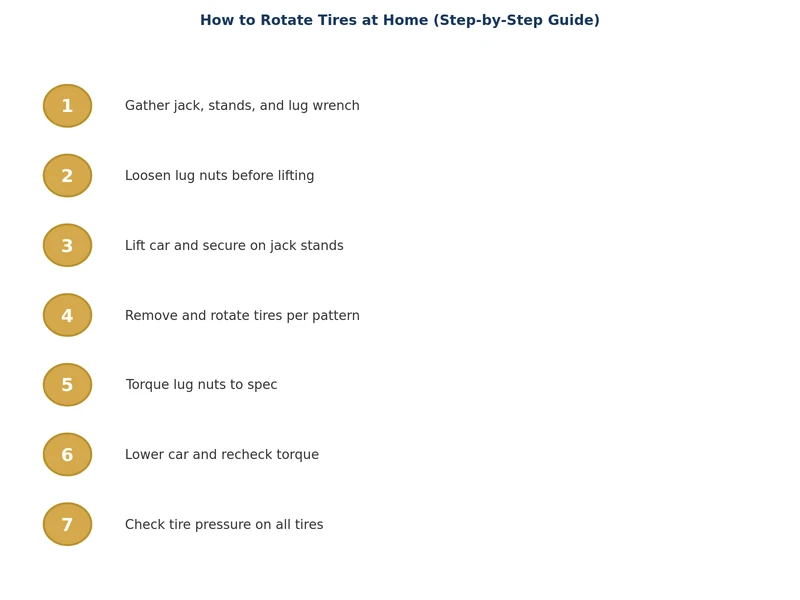
Park on flat, solid concrete. Engage the parking brake. Place wheel chocks behind the rear tires (or in front if you are lifting the rear first). Have your rotation pattern decided before you remove a single wheel — confusion mid-job leads to mistakes.
Before you lift the vehicle, break loose the lug nuts on each wheel by about a half turn. Do not fully remove them yet. Loosening them while the tire is still on the ground prevents the wheel from spinning under torque. Turn counterclockwise to loosen.
If you have two jack stands, work one axle at a time — front first or rear first. Position the floor jack under the vehicle's recommended jacking points (listed in your owner's manual). Raise the axle, then slide jack stands under the designated support points on both sides. Lower the vehicle gently onto the stands. Never rush this step. For detailed jacking technique, see our guide on how to use a car jack safely.
Remove all lug nuts and pull the wheels off. Lay them flat so they do not roll. Move each wheel to its new position according to your chosen rotation pattern. Lift each wheel onto the hub — the lug bolt holes must align perfectly. Thread the lug nuts on by hand first, alternating in a star pattern to seat the wheel evenly.
While the wheels are off, take a moment to clean your alloy wheels — brake dust buildup is easier to remove before the wheel goes back on.
Raise the vehicle off the stands, remove the stands, and lower the car to the ground. With the tires on the ground, use a torque wrench to tighten each lug nut to the manufacturer's specification — typically between 80 and 100 ft-lbs for most passenger cars, but always verify in your owner's manual. Tighten in a star pattern (not circular) to ensure even clamping force. Never skip this step — undertightened lug nuts can cause a wheel to come off while driving.
After rotation, check the tire pressure on all four tires with a gauge. Tires may lose air when removed and reinstalled. Inflate to the pressure specified on the sticker inside your driver's door jamb — not the maximum pressure printed on the tire sidewall. Correct pressure affects wear, fuel economy, and ride comfort.
The standard recommendation is every 5,000 to 7,500 miles. A convenient approach is to rotate tires with every oil change if you change oil every 5,000 miles — this ensures you never forget. AWD vehicles benefit from more frequent rotation because all four tires share the driving load.
You may need to rotate sooner if you notice uneven wear, vibration at highway speeds, or pulling to one side. These symptoms often indicate that rotation is overdue or that a wheel alignment issue is compounding the wear problem.
Rotate every 5,000 to 7,500 miles. The easiest schedule is to do it with every oil change. All-wheel-drive vehicles should rotate closer to every 5,000 miles because all four tires share power delivery and wear more evenly but still need frequent reshuffling.
You need a floor jack and at least two jack stands rated for your vehicle's weight. Never use a scissor jack alone to support the car while you work under or beside it. Jack stands are mandatory for safety — working under a car supported only by a floor jack is a serious hazard.
You need a floor jack, two to four jack stands, a torque wrench, a lug wrench or impact wrench, a tire pressure gauge, and wheel chocks. Your owner's manual is also essential for the correct jacking points, torque specification, and recommended rotation pattern.
Tires wear unevenly and wear out much faster than they should. On a front-wheel-drive car, front tires can wear out in half the miles of the rears. Skipping rotation can cost you a full set of tires much sooner than necessary and can compromise handling, especially in wet conditions.
Yes, but only front-to-rear on the same side of the vehicle. Directional tires cannot switch sides without dismounting from the rim and remounting — a job that requires a tire machine. If you stick to same-side swaps, you can do it yourself with standard equipment at home.
Not every time. Balancing is typically done when you experience vibration at highway speeds or when mounting new tires. If your tires were balanced before rotation and you do not notice vibration afterward, you can skip balancing. However, if vibration appears after a rotation, have the affected tire balanced.
 |
 |
 |
 |

About Joshua Thomas
Joshua Thomas just simply loves cars and willing to work on them whenever there's chance... sometimes for free.
He started CarCareTotal back in 2017 from the advices of total strangers who witnessed his amazing skills in car repairs here and there.
His goal with this creation is to help car owners better learn how to maintain and repair their cars; as such, the site would cover alot of areas: troubleshooting, product recommendations, tips & tricks.
Joshua received Bachelor of Science in Mechanical Engineering at San Diego State University.


Get some FREE car parts & gear.. Or check out the latest free automotive manuals and build guides here.
Disable your ad blocker to unlock all the hidden deals. Hit the button below 🚗
| | | |
