by Diego Ramirez
My neighbor pulled into my driveway last fall, looking defeated. Her car had died at a gas station — battery fully gone. She'd been ignoring slow cranking for three weeks. Three weeks. The whole situation was avoidable. Knowing how to test a car battery at home is one of the simplest, most practical skills a driver can have, and it costs almost nothing to do it right.
A weak battery almost always gives you warning signs before it quits. Sluggish cranking, dim lights, and a car that stalls in cold weather are all signals worth taking seriously. This guide walks you through the exact steps, explains what your readings mean, and tells you what to do once you have your answer — including when a new battery is unavoidable.
Contents
You don't need to be a mechanic. You need about ten minutes, one basic tool, and a car that's been sitting idle for at least an hour. Testing right after driving is one of the most common mistakes people make. A freshly driven battery carries a "surface charge" — a temporarily inflated reading that fades in an hour and doesn't reflect true battery health. Wait it out. Your reading will be accurate.
Choose one of two tools: a digital multimeter or a battery load tester. A multimeter measures resting voltage. A load tester simulates the electrical demand of actually starting the engine. Both are cheap and available at any auto parts store. Grab a pair of rubber gloves and safety glasses before you start. Car batteries contain sulfuric acid and can vent hydrogen gas. The precaution takes ten seconds. It's always worth it.
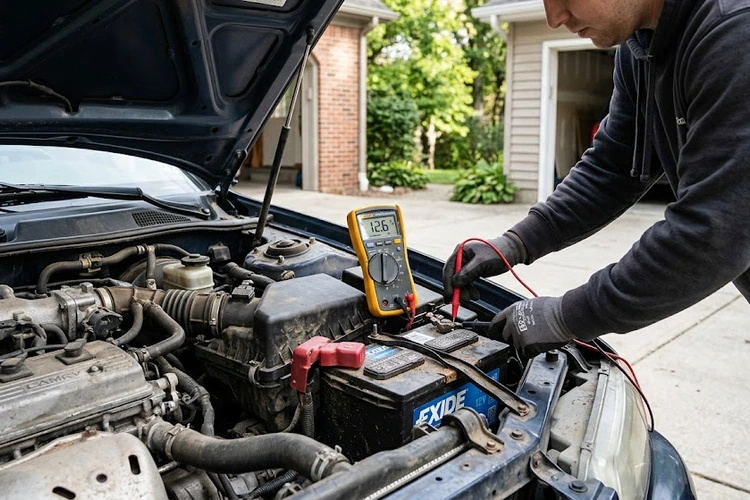
Set your multimeter to DC voltage — look for a "V" with a straight line above it, usually labeled in the 20V range. Touch the red probe to the positive (+) terminal and the black probe to the negative (–) terminal. Hold them steady and read the display. Here's how to interpret what you see:
Pro tip: Surface charge can make a failing battery read 12.7V or higher right after a drive. Always wait at least one hour after shutting the engine off before connecting your probes — or your test means nothing.
A load tester does what a multimeter simply cannot. It pulls real current from the battery and watches how the voltage holds up under that demand. Connect the red clamp to the positive terminal and the black clamp to the negative. Press the test button. The tester draws current for about 10–15 seconds and displays a pass or fail result. If the voltage drops below 9.6V during the load, that battery is failing and should be replaced. Some advanced testers also report cold cranking amps (CCA) — the battery's actual starting power in cold conditions — which is far more useful than voltage alone.
According to the automotive battery overview on Wikipedia, extreme heat is actually more damaging to battery longevity than cold — heat accelerates internal corrosion. Regular testing is the only way to catch that gradual decline before it strands you.
Both tools work. They answer different questions. A multimeter checks resting voltage in thirty seconds. A load tester checks real performance under stress. Together, they paint the full picture. Separately, each one has a clear use case depending on what symptom you're chasing.
If your car starts normally and you want a routine health check, a multimeter gives you everything you need. It's also the right tool after recharging a battery — use it to confirm the charge held overnight. For most drivers in most situations, a multimeter is the only tool they'll ever need to own.
Here's the scenario that exposes a multimeter's blind spot: your car cranks slowly, but the multimeter reads a solid 12.6V. Looks healthy on paper. Under starting load, though, the voltage collapses because the battery has weakened cells that can't deliver enough current to spin the starter. A load tester catches exactly this. If your car cranks sluggishly — especially on cold mornings — reach for the load tester. And if you also notice your car hesitates when the AC is turned on, that's another sign the electrical system is under strain and deserves a closer look.
| Feature | Digital Multimeter | Battery Load Tester |
|---|---|---|
| What it measures | Resting voltage | Voltage under load + CCA |
| Typical cost | $15–$30 | $30–$80 |
| Difficulty level | Very easy | Easy |
| Catches weak-cell batteries | No | Yes |
| Best for | Routine checks, post-charge confirmation | Slow cranking, cold-weather diagnosis |
| Works on AGM batteries | Yes | Yes (requires AGM-compatible tester) |
A reliable digital multimeter runs $15–$25. A battery load tester costs $30–$60. Buy both and you're under $85 — for tools that last the rest of your driving life. That single purchase pays for itself the first time it saves you a diagnostic fee at the shop. Add a basic trickle charger for $25–$40 and you have a complete home battery kit for around $110. That's the entire toolkit.
The math only gets more favorable over time. A replacement car battery costs $100–$250 depending on your vehicle. Knowing whether to charge or replace — rather than just guessing — easily saves you one unnecessary battery purchase over your driving years.
AutoZone, O'Reilly Auto Parts, and most national auto parts chains test your battery for free. Walk in, ask, done. They'll connect a tester in five minutes and print out a detailed result. Dealerships sometimes charge $25–$50 for a full electrical system test that also checks the alternator and starter — worth it if you suspect a deeper issue.
Before you spend money replacing parts, make sure you're targeting the right one. If you're seeing charging problems or electrical gremlins, read through our guide on the signs of a bad alternator first. Replacing a perfectly healthy battery when the alternator is the real culprit is an expensive and frustrating mistake.
This is the most dangerous assumption a driver can make. A battery can start your car a hundred times in a row and fail completely on attempt 101. Capacity drops gradually and quietly. The battery may be running at 60% health and still turning over the engine on mild mornings — right up until a cold snap or a long parking session drains what's left. Don't wait for a no-start to find out. Test it now.
New batteries can have manufacturing defects. They can also arrive partially discharged after sitting on a store shelf or in a warehouse for months. Test every battery the day you install it. If a fresh-out-of-the-box battery reads below 12.4V, charge it fully before you start relying on it. Starting out with a partially depleted new battery shortens its service life from day one — you're losing months of lifespan before you've even driven a mile.
Dim lights are a symptom. They don't tell you the cause. Yes, a weak battery causes dim lights. But so does a failing alternator. The alternator charges the battery while the engine runs. When it starts to fail, the battery drains even while you're driving — not just when the car sits. If you notice interior lights not working at normal brightness or taillights that seem dim, don't assume the battery is dead before you've also checked the charging system. Swapping a healthy battery when the alternator is dying just means you'll be back at the parts store within weeks.
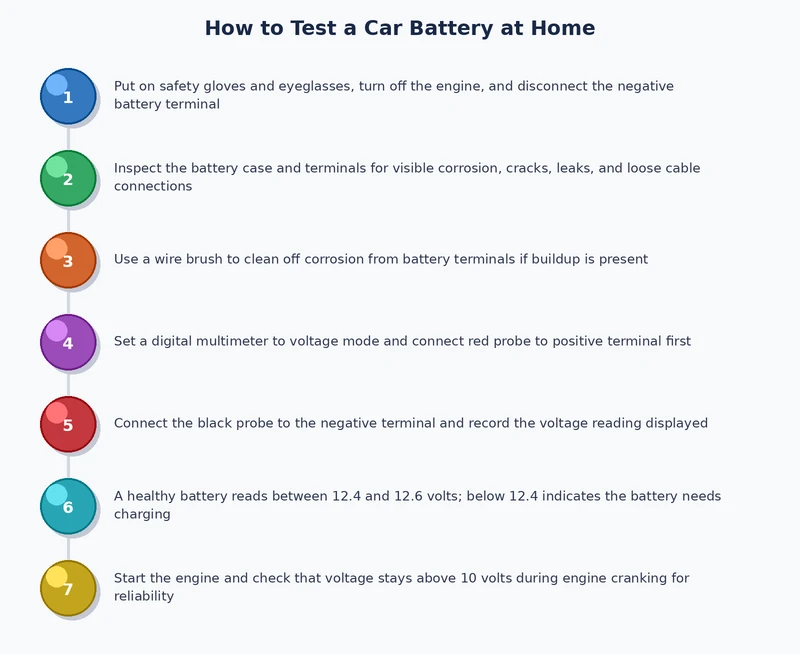
Before you replace it, charge it. A battery sitting at 12.0V–12.3V may recover completely with a proper recharge. Connect a trickle charger and let it run overnight — 12 to 24 hours at 2 amps is ideal. A slow charge is gentler on the cells than a fast charge and does far less long-term damage. After charging, retest with your multimeter. If it holds 12.6V or higher and passes a load test, that battery still has life left in it.
While you're troubleshooting, look for parasitic drain — a hidden current draw that pulls the battery down while the car sits. A dome light that stays on after you close the door is a classic example. It's easy to miss, and it can kill a perfectly healthy battery in just a couple of nights. Check for lights, electronics, or accessories that stay active with the key out.
Replace it. There is no fix for a battery with dead cells. A charger can't restore internal cell damage — it just temporarily masks the problem. Charging a failing battery only delays the inevitable, and it tends to fail faster each time. Once a battery fails a load test or won't hold a charge after a full overnight charge cycle, its useful life is over.
When shopping for a replacement, match the group size printed on your old battery's label — it's usually stamped right on the case. Check your owner's manual for the minimum cold cranking amp (CCA) rating your vehicle requires. If you live somewhere that gets genuinely cold winters, buy a battery at the high end of the CCA range for your group size. More starting headroom is always better. Most batteries come with a 3-year free replacement warranty, so keep your receipt somewhere you'll actually find it.
Recycle the old battery at any auto parts store — they accept them at no charge. Lead-acid batteries are classified as hazardous waste and should never go in household trash. Once the new battery is installed, test it immediately to confirm it shipped at full charge and is ready for service.
The actual test takes about two minutes with a multimeter. The critical step is patience — let the car sit for at least one hour after the engine was last running before you connect the probes. Testing too soon gives you a surface charge reading that makes even a weak battery look healthy. Factor in the wait time and you're looking at a total process of roughly an hour and fifteen minutes from parking to result.
Not accurately. You can pick up on warning signs like sluggish cranking or dim interior lights, but those don't give you numbers. A digital multimeter costs $15–$25 and tells you exactly where the battery stands. It also works for dozens of other electrical checks on your vehicle. It's one of the best $20 tools any driver can own.
Test it twice a year: once before summer heat arrives and once before temperatures drop in the fall. Both extremes stress the battery hard — heat accelerates internal corrosion and cold demands peak starting power. If your battery is three or more years old, bump that up to every three months. Most batteries last four to six years, but performance can drop significantly in the final year without any obvious warning signs.
Most vehicles struggle to start reliably with a resting voltage below 12.0V. At 11.8V or lower, many cars won't crank at all. Below 10.5V, the battery is effectively dead. If your multimeter reads anything under 12.0V, charge the battery immediately and retest before driving. Don't assume a jump start means the battery is back — it often just means you transferred someone else's charge long enough to get the engine running.
 |
 |
 |
 |

About Diego Ramirez
Diego Ramirez is a maintenance and care specialist who has been wrenching on cars since he was sixteen. He focuses on fluid changes, preventive care routines, paint protection, and the small habits that turn a five-year-old car into a fifteen-year-old car.
Get some FREE car parts & gear.. Or check out the latest free automotive manuals and build guides here.
Disable your ad blocker to unlock all the hidden deals. Hit the button below 🚗
| | | |
