by Sarah Whitfield
Intake manifold gasket leak symptoms are almost always present for weeks before a driver connects them to the gasket — and by then, the damage compounds. The good news: the pattern is consistent, and a correct diagnosis doesn't require tearing the engine apart to confirm.
The intake manifold sits atop the engine and distributes the air-fuel mixture to each cylinder. Its gasket seals the mating surface between the manifold and the cylinder head, keeping coolant passages, vacuum circuits, and combustion chambers isolated from each other. When that seal fails — through heat fatigue, coolant corrosion, or age — the result is a confusing mix of symptoms that mimics half a dozen other problems. Overheating, rough idle, coolant loss with no visible puddle, white exhaust smoke, and oil contamination all appear on the symptom list depending on which part of the gasket lets go. Repair costs range from $250 to $1,200 at a shop depending on engine design, with V6 and V8 applications sitting at the high end due to labor complexity. Understanding the full picture of intake manifold gasket leak symptoms is the fastest route to the right fix.

Contents
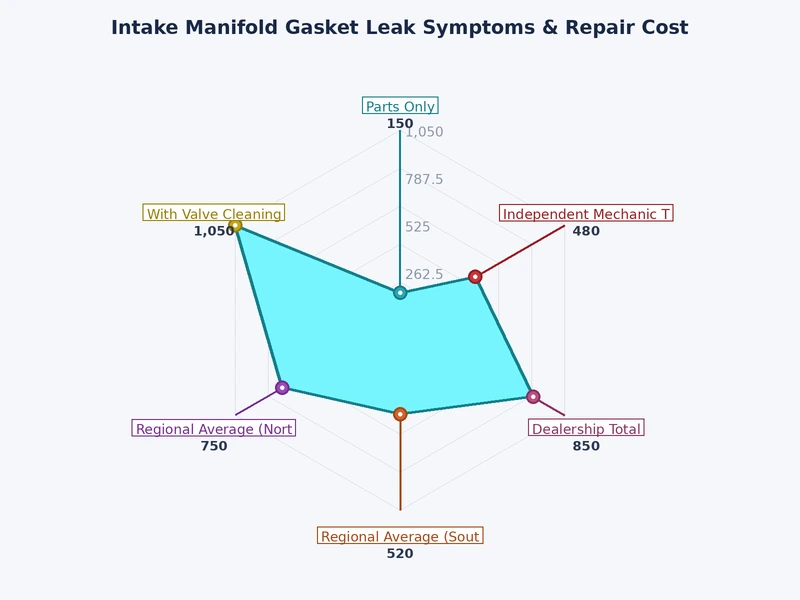
The symptom profile depends entirely on where the gasket fails and what's leaking through it. A vacuum leak at the manifold base presents completely differently from an internal coolant leak into the cylinder. Getting that distinction right changes the entire diagnostic path.
Coolant disappearing from the reservoir without any puddle under the car is one of the clearest intake manifold gasket leak symptoms. The coolant leaks internally — either into the intake port where it burns, or into the oil passages. There's no external evidence, which leads many drivers to keep topping up the reservoir while the underlying problem compounds. If the coolant reservoir is bubbling or the level keeps dropping with no visible hose, radiator, or water pump leak, the intake manifold gasket belongs at the top of the suspect list.
The overheating that follows unchecked coolant loss accelerates head warping. Any cooling system loss that can't be traced to an obvious external source warrants immediate investigation at the manifold seam — not another reservoir refill.
A vacuum leak at the manifold gasket lets unmetered air into the intake, leaning out the air-fuel mixture. The ECU compensates within its correction range, but a significant leak overwhelms the long-term fuel trim's ability to recover. The result: a rough, unstable idle that partially smooths out above 1,500 RPM — the classic behavior of a vacuum leak.
That lean condition misfires. A scan tool showing a P0300 random misfire code alongside a rough idle, after the throttle body and fuel system check out clean, is a strong signal pointing at the manifold gasket. When the leak is localized to one port, the misfire can appear cylinder-specific, which sends diagnosis chasing spark plugs and injectors instead of the actual source.
On engines where the intake manifold gasket also seals an oil passage, a failure allows coolant and oil to mix. The result is the characteristic milky, mayonnaise-like sludge visible on the oil cap and dipstick. Coolant in the oil degrades lubrication aggressively — bearing wear accelerates fast once this contamination begins.
This failure mode is engine-specific. Older GM 3.1L and 3.4L V6 platforms are the textbook example: the composite plastic-and-rubber gaskets on those engines routinely allowed coolant infiltration into the oil circuit at higher mileages. If the vehicle is one of these known-problematic applications, oil contamination should be checked at the first sign of any symptom.
Coolant leaking internally into a cylinder burns with a distinctive sweet smell and produces white or blue-white exhaust smoke — persistent, not the thin vapor that clears in the first minute of a cold start. Sustained white smoke after full warmup, combined with that antifreeze smell, means coolant is reaching the combustion chamber. The source is either the intake manifold gasket or, in more serious cases, the head gasket. Distinguishing between the two requires a combustion leak test.
If the exhaust smells sweet and the coolant level drops with no visible external leak, treat it as coolant combustion until proven otherwise — every mile driven delays a diagnosis that only gets more expensive.
Every cold start and warmup cycle expands and contracts the intake manifold and cylinder head at different rates — aluminum manifold, cast iron head, or vice versa. Over tens of thousands of cycles, the gasket material fatigues, the bolt clamping load reduces as metal deforms microscopically under the fastener, and leak paths open up. This is normal wear, not a malfunction. Most intake manifold gasket failures on high-mileage vehicles are simply the gasket reaching the end of its service life.
Neglected coolant accelerates failure significantly. Corrosion inhibitors in engine coolant deplete over time. Once they're gone, acidic coolant attacks aluminum manifolds, etches the mating surfaces, and degrades the gasket material itself. The resulting pitting creates leak paths that persist even after a new gasket is installed — which is why surface preparation isn't optional on any intake manifold gasket replacement.
The relationship between extended coolant change intervals and premature gasket failure is direct and well-documented. Drivers who push coolant beyond its service interval consistently see early gasket failures on aluminum-head engines.
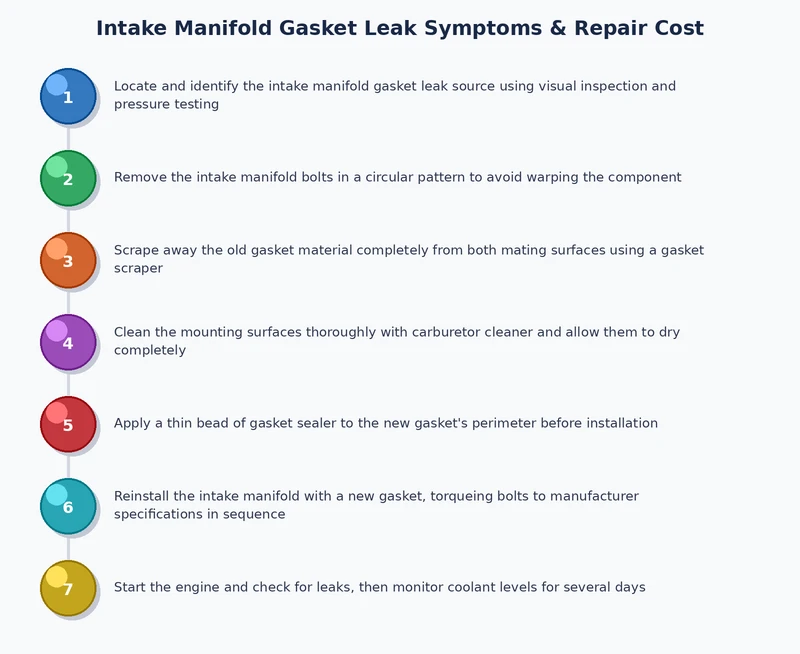
Confirming the intake manifold gasket before disassembly prevents unnecessary parts replacement and establishes the correct scope of the repair.
A cooling system pressure tester is the single most valuable tool for this diagnosis. With the system cold, remove the cap, attach the tester, and pump to the cap's rated pressure — typically 13–16 psi. A system that holds pressure for 15 minutes has no external coolant leak. A system that loses pressure with no visible drip is losing coolant internally. That result, combined with no head gasket combustion leak test positive, points firmly at the intake manifold gasket.
Full diagnostic toolkit:
For vacuum leaks, carb cleaner or propane sprayed carefully around the manifold base while the engine idles is a reliable low-tech approach — RPM rises momentarily when the flammable gas is drawn into the leak. It's effective but requires care near hot components. A smoke machine is the professional standard: pressurize the intake with smoke and the leak point becomes visible without any ignition risk. On engines with complex manifold geometry and multiple port runners, the smoke machine eliminates guesswork entirely.
Intake manifold gasket failure shares symptoms with several other common problems. The distinguishing details matter — misidentifying a head gasket failure as an intake manifold issue leads to an insufficient repair that fails immediately.
| Problem | Coolant Loss | White Smoke | Rough Idle | Oil Contamination | Block Test Result |
|---|---|---|---|---|---|
| Intake Manifold Gasket | Yes (internal or external) | Sometimes | Yes (vacuum leak) | Engine-dependent | Negative |
| Head Gasket | Yes (often severe) | Yes (heavy) | Yes | Yes (common) | Positive |
| Thermostat Housing | Yes | No | No | No | Negative; visible drip |
| Throttle Body Gasket | No | No | Yes | No | Negative |
| Valve Cover Gasket | No | Sometimes (oil burn) | No | External oil only | Negative |
The combustion leak tester is the definitive tool for separating intake manifold from head gasket failure. Blue test fluid drawn through coolant reservoir air turns yellow in the presence of combustion gases — a positive result confirms head gasket involvement. A negative result with ongoing internal coolant loss lands the diagnosis squarely on the intake manifold gasket. When a severe vacuum leak is involved, the air imbalance can also register as a compression concern; for more context, the overlap with low compression engine symptoms is worth understanding before committing to a diagnosis.
Intake manifold gasket sets range from $20 to $80 for most passenger vehicles. OEM gaskets are available at $60 to $150, but for engines with a documented history of OEM gasket failure — GM 3.1L, 3.4L, early 3.8L — an upgraded aftermarket set from Fel-Pro or Victor Reinz is the correct choice. Replacing a failed gasket with the same specification and material that failed makes no engineering sense.
At minimum, budget for a complete coolant flush, new thermostat, and upper hoses while the manifold is off. Accessing those components a second time for a thermostat that fails six months later wastes a completed repair.
Labor is where the cost variance is dramatic. A 4-cylinder engine with a simple single-plane intake might take 2–3 hours at a shop. A V6 or V8 with a two-piece manifold, dual coolant passage banks, and an intake-mounted EGR or throttle body can run 6–8 hours at shop rates of $100–$150/hr.
| Engine Type | Parts Cost | Labor (hrs) | Shop Total (est.) | DIY Total (est.) |
|---|---|---|---|---|
| 4-Cylinder (single plane) | $20–$50 | 2–3 hrs | $250–$500 | $30–$70 |
| V6 (single-piece manifold) | $40–$80 | 4–5 hrs | $450–$800 | $60–$100 |
| V6 (lower + upper manifold) | $50–$100 | 5–7 hrs | $550–$1,050 | $70–$130 |
| V8 (pushrod, two-piece) | $60–$120 | 6–8 hrs | $660–$1,200 | $80–$150 |
The DIY savings are substantial — typically 80–90% of total cost on labor-heavy jobs. The tradeoff is time and access to a torque wrench, gasket scraper, and the patience to follow a proper torque sequence. V6 and V8 applications with complex manifold geometry are full weekend jobs. Shortcuts here result in comeback repairs.
A short list of errors causes the majority of intake manifold gasket re-failures. Each one is predictable and preventable.
Done correctly once, an intake manifold gasket replacement lasts the life of the engine. These are the practices that separate a lasting repair from a six-month return visit.
When persistent overheating or cooling irregularities remain after a completed intake manifold gasket repair, the differential diagnosis expands. Heater core failure symptoms share several of the same coolant-loss and overheating patterns and are worth working through systematically if the manifold repair didn't resolve the full symptom set.
It depends on the leak type. An external coolant leak or vacuum leak caught early is a straightforward repair. An internal coolant leak that goes undiagnosed leads to overheating, oil contamination, and potential head warping — turning a $500 repair into a $2,000+ engine job. Early diagnosis and repair is critical.
Short distances only, and only if the coolant level is stable and the engine isn't overheating. Any sign of coolant loss, overheating, or oil contamination means the vehicle should not be driven until repaired. Continued operation with an internal coolant leak damages bearings and cylinder head surfaces rapidly.
An external coolant leak produces a sweet antifreeze smell from the engine bay, especially after shutdown when coolant drips onto hot surfaces. An internal coolant leak that burns in the combustion chamber produces the same sweet smell from the exhaust. Oil leaking past the gasket has a distinct burning oil odor under the hood.
Yes. A vacuum leak at the manifold gasket leans out the air-fuel mixture, which causes misfires. The P0300 random misfire code is a common result. If misfires persist after addressing ignition and fuel components, a manifold vacuum leak is the next logical suspect.
A 4-cylinder engine typically takes 2–4 hours for an experienced DIYer. A V6 or V8 with a two-piece manifold can take 6–10 hours. Shop time varies by application but follows the same pattern — 4-cylinder jobs are often same-day, complex V8 applications may require a full shop day.
A combustion leak tester (block tester) is the definitive tool. It detects exhaust combustion gases in the coolant — a positive result means the head gasket is involved. A negative result with continued internal coolant loss points to the intake manifold gasket. White exhaust smoke and milky oil are common to both; the block test separates them reliably.
An intake manifold gasket leak rarely announces itself clearly — but every symptom it produces, from coolant loss to misfires to white smoke, is the engine asking for a diagnosis, not another reservoir refill.
 |
 |
 |
 |

About Sarah Whitfield
Sarah Whitfield is a diagnostics and troubleshooting specialist who spent ten years as an ASE-certified technician before joining the editorial team. She specializes in OBD-II analysis, electrical gremlins, and the kind of intermittent problems that make most owners give up.
Get some FREE car parts & gear.. Or check out the latest free automotive manuals and build guides here.
Disable your ad blocker to unlock all the hidden deals. Hit the button below 🚗
| | | |
