by Joshua Thomas
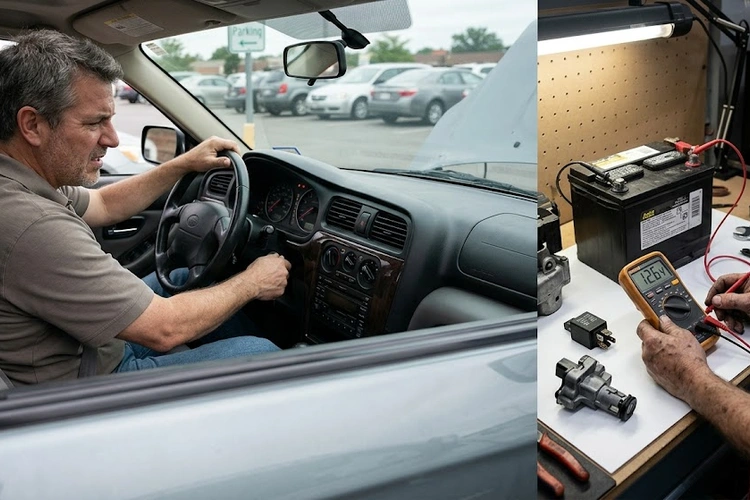
If your car won't start intermittently, the most likely causes are a weak battery, a failing crankshaft position sensor, or a faulty ignition switch. Because the fault disappears between episodes, an intermittent no-start is one of the most difficult problems to diagnose in automotive repair.
Unlike a permanent no-start, an intermittent failure leaves no obvious evidence. Your vehicle may restart minutes later, erasing the fault trail entirely. This guide covers the seven most common causes, practical diagnostic techniques for every skill level, and a side-by-side comparison to help you prioritize. For a related problem with overlapping causes, see the car won't start after sitting guide. You will also find additional diagnostic resources throughout the CarCareTotal automotive repair library.
The seven causes covered here are: a weak or failing battery, a worn starter motor, a faulty crankshaft position sensor, a failing camshaft position sensor, a failing fuel pump, a worn ignition switch, and a malfunctioning vehicle security or immobilizer system.
Contents
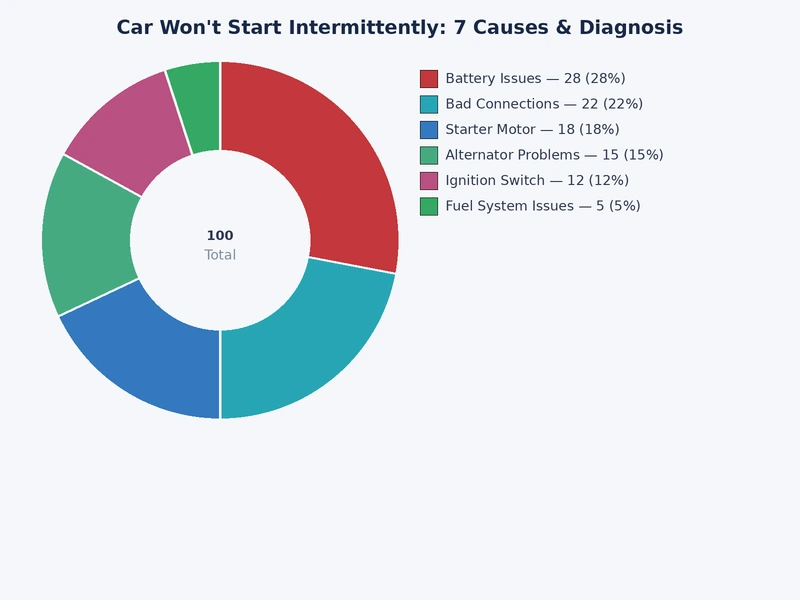
Intermittent failures occur when a component functions within normal parameters most of the time but fails under specific conditions — temperature extremes, vibration, heat soak, or electrical load spikes. Each of the seven causes below produces a recognizable pattern that helps narrow the diagnosis before you reach for a scan tool.
The battery is the most frequent culprit. A battery near end-of-life holds enough charge for routine starts but fails under cold temperatures or heavy electrical load. Corrosion on the terminals compounds the problem by adding resistance to the circuit. Test battery voltage at rest — 12.6 V or higher indicates full charge, while below 12.2 V suggests discharge. A load test at an auto parts store gives a more definitive result: a healthy battery should hold above 9.6 V under cranking load.
The starter motor is a second common cause. Worn brushes inside the starter create dead spots on the commutator. Depending on where the armature stops rotating, the motor may engage on one attempt and fail on the next. A single firm knock on the starter housing with a rubber mallet during a no-start event can confirm this — if your car then starts, the starter has an internal dead spot and requires replacement.
Pro Tip: Always perform a battery load test before replacing the starter. A weak battery draws excessive current from the starter motor and can accelerate brush wear, causing both components to appear faulty when only one is the root cause.
The crankshaft position sensor (CKP) tells the ECU when to fire the injectors and ignition system. A failing CKP sensor — particularly one with heat-damaged wiring insulation — may function correctly when cold and drop its signal when it reaches operating temperature. This pattern is documented across a wide range of makes and models.
The camshaft position sensor (CMP) produces nearly identical symptoms. Both sensors are inexpensive to replace, but confirm the fault with a scan tool before purchasing parts. A live data log showing no CKP or CMP signal during a no-start event is a definitive result.
The ignition switch is an underappreciated cause of intermittent no-starts. Worn contacts inside the switch interrupt power to the ECU or starter relay circuit when the switch is hot or vibrated. A reliable indicator: your dashboard warning lights flicker or go dark at the exact moment your car fails to crank. That behavior points to the switch rather than the battery.
A malfunctioning vehicle immobilizer or security system will also prevent starting. This is especially common on high-mileage vehicles where the key transponder reader or the key fob battery delivers inconsistent results rather than failing completely.
A failing fuel pump is a classic intermittent fault. The pump motor overheats during extended use, reduces line pressure or stops entirely, then recovers after cooling. The diagnostic signature is a no-start after a hot engine has been shut off for 20 to 40 minutes.
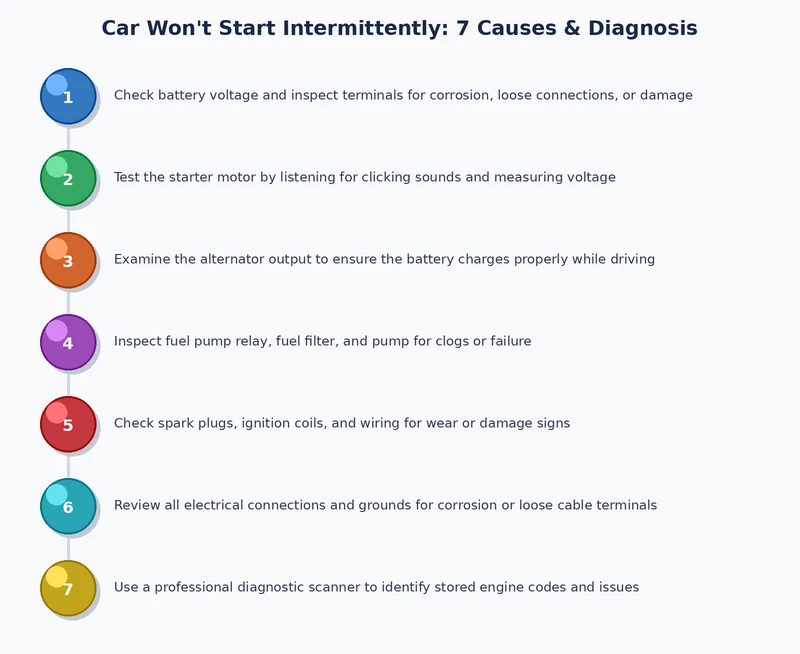
Effective diagnosis always begins at the simplest level. Skipping to expensive scanner tests before checking basic connections wastes time and can obscure an obvious cause.
The distinction between "no crank" and "cranks but won't fire" narrows the suspect list immediately. If your engine cranks normally but then starts and dies right away, the problem is almost certainly a fuel delivery or sensor fault rather than a battery or starter issue.
A scan tool that logs live data is your most valuable instrument for intermittent faults. During a no-start event, monitor your crankshaft sensor signal, camshaft sensor signal, and battery voltage under cranking load simultaneously. A voltage drop below 9.6 V during cranking confirms a battery or cable fault. Absent sensor signals with adequate battery voltage confirm a sensor or wiring failure.
Warning: Do not clear stored diagnostic trouble codes before logging and documenting them first. Clearing codes erases freeze frame data — the snapshot of sensor readings at the moment of failure — which may be your only reliable record of the fault conditions.
The hot-soak test is the most reliable method for isolating heat-related failures. Drive the vehicle to full operating temperature, then park it for 30 minutes without opening the hood. Attempt a restart. If the car fails to start at this point but starts normally after a full cool-down, heat soak is confirmed. Target the fuel pump, the CKP sensor, and the ignition switch as the primary suspects in that order.
Recognizing the behavioral pattern of a failure is often more informative than any single test result. Each of the seven causes tends to produce a consistent scenario across different drivers and vehicle platforms.
Cold temperatures reduce battery capacity by as much as 50 percent. A battery that passes a room-temperature bench test may fail completely on a cold morning. If your intermittent no-start occurs exclusively in cold weather and the car starts reliably during warmer months, a marginal battery is the most probable cause.
Cold, thick oil also places higher mechanical demands on the starter motor. A starter with worn brush segments may fail under this combined electrical and mechanical load. If the engine cranks slowly before failing entirely, test both the battery and starter in sequence rather than assuming one or the other is the sole cause.
Heat-soak failures follow a predictable pattern that is distinct from cold-weather events. Your vehicle starts normally in the morning. After a short trip and a 20-to-40-minute wait, it refuses to crank — or it fires briefly and immediately stalls. This pattern is most closely associated with three causes:
Heat-soak failures are consistently misdiagnosed as fuel pump problems when a CKP sensor is the actual cause. The hot-soak test combined with live scan data prevents this mistake.
The table below summarizes each cause, the most useful diagnostic test, and the approximate DIY part cost. Professional shop labor rates are not included and vary by region and vehicle platform.
| Cause | Typical Trigger | Key Diagnostic Test | Avg. DIY Part Cost |
|---|---|---|---|
| Weak or failing battery | Cold weather, age, corrosion | Load test under cranking current | $100–$200 |
| Worn starter motor | Heat, brush wear, dead spot | Tap housing during no-start event | $80–$200 |
| Crankshaft position sensor | Heat soak, wiring damage | Scan tool: absent CKP signal | $20–$60 |
| Camshaft position sensor | Heat, high mileage | Scan tool: absent CMP signal | $20–$55 |
| Failing fuel pump | Heat soak, low fuel operation | Fuel pressure gauge at rail | $50–$200 |
| Ignition switch | Heat, vibration, contact wear | Voltage test at switch output terminal | $30–$150 |
| Immobilizer / security fault | Weak transponder, sensor fault | Security indicator lamp, scan tool | $5–$50 |
Battery replacement carries the lowest total cost and the highest probability of resolving an intermittent no-start in vehicles that are more than four years old. Crankshaft and camshaft sensor replacements are inexpensive for the part, but labor time increases significantly on platforms where the CKP sensor is mounted behind the transmission bell housing — a location that can add two or more hours of shop time to an otherwise simple job.
Fuel pump replacement sits in the mid-range for parts cost but is labor-intensive on most vehicles because the fuel tank must be lowered to access the pump assembly. Budget $150 to $400 in shop labor if you choose not to perform this repair yourself.
Battery testing and replacement, terminal cleaning, neutral safety switch testing, and key fob battery replacement are all achievable with basic hand tools and no specialized equipment. Sensor replacements are mechanically straightforward on most vehicles but require a scan tool to confirm the fault before purchasing parts. Fuel pump and ignition switch replacements are within the range of a capable DIYer with a repair manual, though the consequence of an installation error — a repeat failure or a dangerous fuel leak — makes professional installation worth considering for both repairs.
Perform a load test at any auto parts store. A battery that reads 12.6 V at rest but drops below 9.6 V under a full cranking load is failing and should be replaced. Also inspect both terminals for corrosion — even minor oxidation adds enough resistance to prevent reliable cranking on a battery that is already marginal.
Yes, and it is one of the most common heat-related causes. A CKP sensor with damaged wiring insulation or a deteriorating internal element drops its signal when it reaches operating temperature. A scan tool logging live data during a failed start attempt will show the ECU receiving no crankshaft signal, which is the definitive diagnostic confirmation.
This is a classic heat-soak pattern. After your engine reaches operating temperature and you park for 20 to 40 minutes, residual heat peaks before dissipating. The three most likely causes are a fuel pump motor that overheats and loses pressure, a crankshaft position sensor with heat-damaged insulation, and an ignition switch whose contacts expand and lose continuity when hot.
The neutral safety switch prevents your engine from starting in any gear except park or neutral. When the switch wears or falls out of adjustment, it may make poor contact specifically in the park position while working correctly in neutral. If your car starts reliably in neutral but fails in park, the neutral safety switch is the likely cause and is inexpensive to replace.
Most original fuel pumps last between 100,000 and 150,000 miles under normal conditions. Consistently running the fuel tank below one-quarter full shortens service life significantly, because the fuel itself cools and lubricates the pump motor. A pump that has begun causing intermittent no-starts will usually fail completely within weeks to a few months if not replaced.
Not necessarily. Two of the most common causes — a weak battery and a failing crankshaft position sensor — are among the least costly repairs on the list. A battery replacement typically costs between $100 and $200 for most passenger vehicles. The key to controlling cost is a thorough diagnosis before purchasing any parts, which prevents replacing components that are not actually at fault.
A car that won't start intermittently rewards a methodical approach and punishes guesswork. Begin with the battery load test, work through the basic checks outlined above, and perform the hot-soak test if heat appears to be a factor. If you have access to a scan tool, log live sensor data during a no-start event before replacing any parts — that single step will save you from the most common and costly diagnostic mistakes. Take your vehicle to a trusted technician if the failure cannot be replicated during your testing, and bring your written log of when and how the fault occurs, as that documentation is the most useful tool you can hand to any professional diagnosing an intermittent condition.
 |
 |
 |
 |

About Joshua Thomas
Joshua Thomas holds a Bachelor of Science in Mechanical Engineering from San Diego State University and has spent years applying that technical foundation to hands-on automotive work — from routine maintenance to full mechanical repairs. He founded CarCareTotal in 2017 to give car owners the kind of clear, practical guidance that helps them understand what is happening under the hood and make smarter decisions about upkeep and repairs. At CarCareTotal, he oversees editorial direction and covers automotive fundamentals, maintenance guides, and troubleshooting resources for everyday drivers.
Get some FREE car parts & gear.. Or check out the latest free automotive manuals and build guides here.
Disable your ad blocker to unlock all the hidden deals. Hit the button below 🚗
| | | |
