by Sarah Whitfield
A colleague arrived at our shop one morning after a three-hour drive, describing a sharp, repeating sound that had developed midway through the trip. The vehicle tracked straight and stopped cleanly, but every expansion joint and pothole on the interstate had produced an unmistakable knock from somewhere beneath the front end. That scenario — a fully drivable car that announces every imperfection in the road — is among the most common diagnostic presentations our team encounters.
A knocking noise when going over bumps rarely resolves itself, and the range of possible causes is broad enough to frustrate even experienced technicians without a structured approach. The suspension system is an interconnected assembly of pivot points, elastomeric bushings, and load-bearing joints, each capable of producing nearly identical acoustic signatures as they degrade. Complaints that are closely related in character — including the suspension creaking noise produced by dry or cracked bushings — frequently share diagnostic territory with knock complaints, reinforcing the value of a comprehensive inspection over reactive parts replacement.
Contents
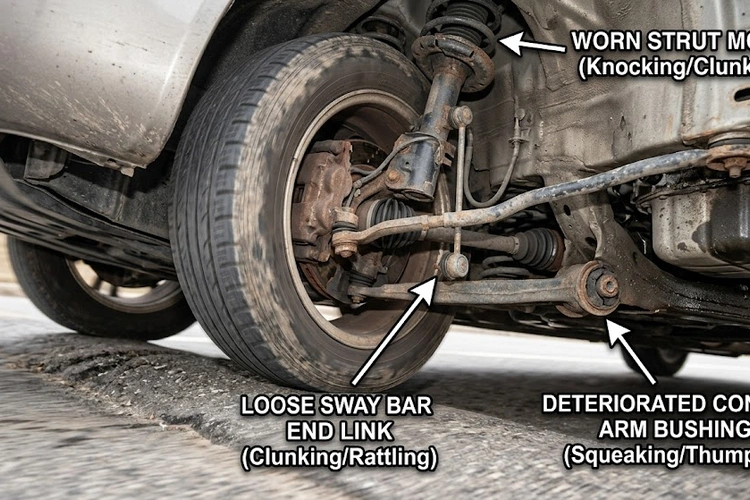
The suspension system functions as a collection of interdependent assemblies, and wear in any single component can transmit vibration through chassis metal until it registers as cabin noise. Our team organizes the seven primary causes by structural significance, beginning with the components whose failure carries the greatest safety consequence.
Ball joints connect the steering knuckle to the control arm and carry both the vertical load of the vehicle's sprung mass and the lateral forces generated during cornering. When the ball joint socket wears beyond its service tolerance, the resulting play allows the knuckle to rock under suspension compression, generating a sharp knock that coincides precisely with wheel drop events. The knock escalates in severity as wear advances and is frequently accompanied by a faint clunk during parking-lot turning maneuvers. This is among the most safety-critical failure modes in the entire suspension assembly.
The stabilizer bar couples left-side and right-side suspension travel to resist body roll. End links — the short connecting rods between the bar and each strut or lower control arm — use internal ball-and-socket joints that degrade with accumulated mileage. A worn end link develops axial play and produces a bilateral knock that reproduces on nearly every bump, regardless of vehicle speed. Bushing deterioration at the bar's chassis mount points generates a lower-frequency clunk and is often accompanied by increased body roll in corners.
A MacPherson strut body that has developed internal wear, or a strut bearing plate that has lost its preload, produces a hollow thud over sharp road inputs. The jounce bumper — the polyurethane stop that prevents full metal contact at maximum compression — also contributes when collapsed or torn; without it, the coil spring perch contacts the strut body directly under hard impacts. Cold ambient temperatures worsen strut-related noise measurably, as degraded polymer components stiffen and lose their damping compliance in ways that are not evident during warm-weather operation.
Control arm bushings occupy the inner pivot points of the arm and isolate it from chassis vibration while constraining its designed arc of travel. Cracked, oil-contaminated, or liquefied rubber in these bushings allows the arm to shift fractionally under load — producing a knock that aligns with weight transfer during braking, acceleration, and lateral inputs, in addition to pure vertical bump events. Visual inspection frequently reveals cracking, bulging, or extrusion of the rubber compound from the metal sleeve bore, often visible without removing the component from the vehicle.
Wheel bearing failure presents classically as a speed-correlated hum or growl, but a severely worn bearing also knocks under the impact loading imposed by road imperfections. The abrupt vertical force temporarily spikes contact stress at the worn race surfaces, producing an audible report. Our team recommends consulting a detailed average wheel bearing replacement cost reference when bearing failure is confirmed, as the cost envelope varies significantly by vehicle class, bearing design, and whether the hub assembly is serviceable as an integrated unit.
Outer constant-velocity joints transmit drivetrain torque through the full range of steering and suspension angles. Worn Rzeppa or tripod joint elements produce a pronounced click during tight turns, but also generate a knock under combined bump and torque loading at moderate speeds. Boot failure is the primary accelerant: once the grease charge escapes and moisture ingress begins, joint degradation proceeds at a pace that makes replacement a near-term certainty regardless of current noise level. Any split or missing CV boot found during inspection should be treated as an imminent failure indicator.
Not every knock beneath a vehicle originates in the suspension. Stamped-steel heat shields that protect underbody surfaces from exhaust heat corrode at their fastener points and begin resonating against adjacent panels when disturbed by road inputs. The resulting noise is metallic and hollow, and it sometimes replicates on specific road surface textures or speed ranges rather than general bump events. Tightening the mounting hardware — or removing a fully corroded shield that no longer serves its thermal purpose — typically resolves the noise in minutes.
A thorough undercar inspection on a lift remains the most information-dense first step. Each suspension pivot should be checked using a pry bar while a second technician observes for movement — ball joint axial play exceeding the manufacturer's specification (typically 0.030 to 0.060 inch) confirms failure. Sway bar end links can be evaluated by hand; any perceptible rattle or socket play indicates worn internals. Strut top mounts are assessed by rocking the wheel assembly through its travel while palpating the strut tower for clunking. Our team also taps exhaust shields with a rubber mallet to identify resonant loose hardware before a road test is warranted.
A controlled road test adds the dynamic dimension that static inspection cannot replicate. Slow passes over a known road irregularity isolate load-dependent noise, while steering lock-to-lock inputs at a crawl separate CV joint behavior — a symptom our team covers in depth in the guide to clicking noise when turning — from pure suspension component knock. Varying vehicle speed over the same surface helps identify components whose noise threshold correlates with impact frequency rather than load magnitude, which is a characteristic signature of strut bearing and bushing wear.
Recording undercar noise with a smartphone positioned near the suspect corner during a slow-speed drive test, then reviewing the audio at 0.5× playback speed, frequently reveals knock sequences that are impossible to parse in real time — our team treats this as a standard step in ambiguous suspension diagnoses.
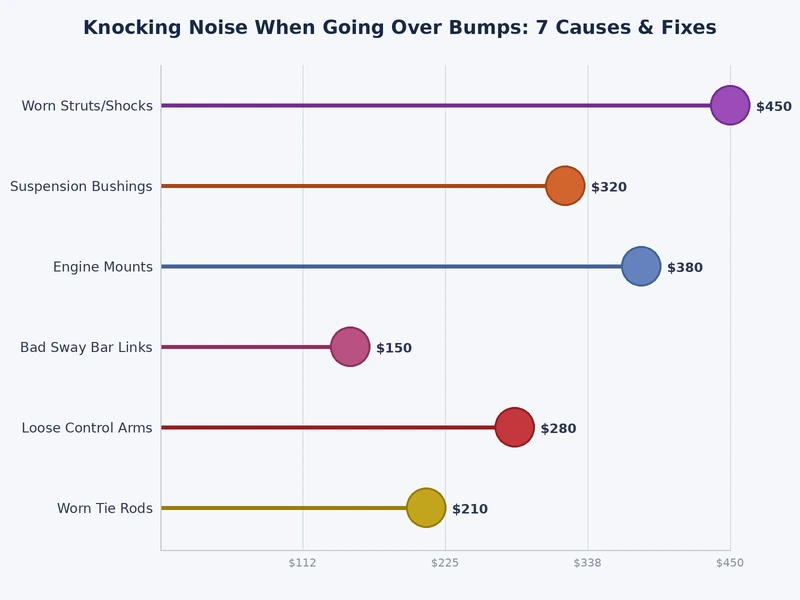
Repair costs for a suspension knock span a wide range depending on the failed component, vehicle make and model, and whether work is performed at a dealership or an independent shop. The following table summarizes typical price ranges drawn from our team's service experience across a broad sampling of domestic and import vehicles.
| Component | DIY Parts Cost | Professional Total (Parts + Labor) | Urgency Level |
|---|---|---|---|
| Sway Bar End Links (pair) | $30–$70 | $120–$220 | Moderate |
| Sway Bar Bushings (pair) | $15–$40 | $80–$160 | Low–Moderate |
| Ball Joint (per side) | $30–$120 | $200–$450 | High |
| Control Arm Bushing Set | $40–$100 | $200–$500 | Moderate–High |
| Strut Assembly (per side) | $80–$200 | $300–$600 | Moderate |
| Wheel Bearing Hub Assembly | $60–$180 | $250–$500 | High |
| Outer CV Joint / Axle Shaft | $60–$150 | $200–$450 | Moderate–High |
| Heat Shield Repair | $5–$20 | $50–$150 | Low |
Several variables elevate repair costs beyond the midpoint estimates shown above. Vehicles with independent rear suspension carry higher labor rates than solid-axle designs due to the complexity of rear knuckle and bushing access. Corroded fasteners — endemic to vehicles operated in high-salt environments — add one to two labor hours per corner as seized ball joint tapers, pinch bolts, and control arm mounting hardware must be cut, heated, or pressed free. Alignment fees of $80–$150 follow nearly every suspension repair that disturbs a pivot point, since camber and toe settings shift when control arm geometry changes. Our team consistently recommends bundling related work — replacing both front struts in a single visit, for example — to reduce per-job overhead and minimize the number of alignment events.
Sway bar end link replacement is among the most accessible suspension repairs available to home mechanics. The hardware is inexpensive, and most vehicles require only a basic wrench and socket set for removal. Heat shield tightening and exhaust clamp inspection similarly require no specialized tooling and carry no meaningful structural risk. Shock absorber replacement on vehicles with separate coil springs — where the spring does not require compression — is also within reach for methodical independent mechanics who invest in proper jack stand support. These tasks represent genuine cost-saving opportunities, provided the failed component has been correctly identified before any parts are purchased.
The most expensive DIY mistake our team observes is parts replacement based on assumption rather than diagnosis — purchasing a set of struts for a noise that turns out to originate in a $35 pair of end links.
Ball joint and control arm bushing replacement requires either a hydraulic shop press or a comprehensive ball joint service tool set with vehicle-specific adapter plates. Improvised substitutes risk damaging the steering knuckle bore or leaving the joint improperly seated — a failure mode with serious structural consequences. Strut replacement on MacPherson-style suspensions requires a coil spring compressor; this tool carries significant injury potential when misused, and rental availability from parts retailers does not include instruction in correct application technique. Wheel bearing hub assemblies on many modern vehicles also require a press, as the bearing is not serviceable separately from the knuckle on these designs.
Ball joint failure and severely worn control arm bushings are non-negotiable repair priorities. A ball joint that has lost taper retention can separate under load, dropping the suspension corner and eliminating directional control. The separation risk increases measurably at highway speed and under combined braking and cornering forces. Any vehicle exhibiting a knocking noise when going over bumps that is accompanied by steering vagueness, a variable directional pull, or a shimmy transmitted through the steering wheel must be treated as a safety concern. Conservative operation — reduced speed, avoidance of aggressive lane changes — is appropriate only as a bridge to an immediate inspection, not as a long-term strategy.
Loose heat shields and early-stage sway bar bushing wear present minimal structural risk and can tolerate a short monitoring window — typically one to two weeks — before repair, provided the noise character remains consistent. Documenting the noise frequency and any changes in vehicle behavior establishes a useful diagnostic baseline. Any escalation in knock severity, any new vibration through the floor or steering wheel, or any change in braking response should accelerate the repair timeline immediately. Monitoring is a diagnostic posture, not a substitute for addressing the underlying wear. Our team draws a firm line at any symptom that implicates a load-bearing joint — those components do not offer warning periods.
Safety depends entirely on the component responsible. Heat shield rattles carry no structural risk and pose no danger to vehicle control. Worn ball joints, by contrast, can separate under load and eliminate steering control entirely. A professional undercar inspection is the only reliable method for assessing the actual risk on any specific vehicle — guessing the source and continuing to drive is not a sound strategy.
Yes, and sway bar end links are among the most statistically frequent sources of suspension knock. The internal ball socket degrades after extended use and develops axial play, producing a sharp knock that reproduces consistently on both left and right bump events regardless of vehicle speed. Replacement is inexpensive and the repair is typically straightforward.
Ball joint service life ranges from approximately 70,000 to 150,000 miles, depending on vehicle design, road conditions, and load-carrying habits. Vehicles operated frequently on unpaved surfaces or subjected to heavy payload reach the lower bound of that range considerably faster than highway-primary vehicles driven under light load conditions.
A severely deteriorated wheel bearing produces a knock over bumps in addition to its characteristic speed-correlated hum. Impact loading from road imperfections temporarily spikes contact stress at the worn race surfaces, generating an audible report that compounds the steady-state grinding — making the diagnosis more straightforward once both symptoms are present simultaneously.
Our team begins with the sway bar end links, as they are the most statistically frequent source of suspension knock and the easiest to evaluate by hand without lifting the vehicle. If the end links are sound, the inspection proceeds to ball joints, strut top mounts, and control arm bushings in sequence, before advancing to wheel bearings and CV joints.
 |
 |
 |
 |

About Sarah Whitfield
Sarah Whitfield is a diagnostics and troubleshooting specialist who spent ten years as an ASE-certified technician before joining the editorial team. She specializes in OBD-II analysis, electrical gremlins, and the kind of intermittent problems that make most owners give up.
Get some FREE car parts & gear.. Or check out the latest free automotive manuals and build guides here.
Disable your ad blocker to unlock all the hidden deals. Hit the button below 🚗
| | | |
