by Joshua Thomas
What happens when a wheel's connection to the hub begins to fail? The answer is not hypothetical — it is a documented safety emergency that begins long before the wheel detaches. Loose lug nuts symptoms appear early and consistently, yet most drivers misattribute them to other mechanical causes. Recognizing these warning signs, understanding the underlying dangers, and knowing how to correct the problem are skills every vehicle owner should possess.
Lug nuts are the primary threaded fasteners securing the wheel to the stud array on the hub flange. Under normal operation, they maintain precise clamping force through a combination of thread engagement and bearing surface friction. Thermal cycling, road vibration, and dynamic cornering loads all work continuously to reduce that clamping force. When the initial torque application is insufficient — or when the mandatory re-torque after installation is skipped — the conditions for progressive loosening are established.
Drivers who experience a lateral pull during braking often trace the problem to brake or alignment issues, when the actual cause may be uneven wheel seating from loose fasteners. A detailed examination of this overlap appears in the guide on steering wheel pulls to one side when braking. For context on how hub and fastener systems interact during wheel bearing wear, the resource on wheel bearing replacement cost offers a useful reference point on adjacent repair scope and expense.
Contents
The diagnostic value of loose lug nuts symptoms lies in their predictability. They follow a consistent pattern across vehicle types and present across multiple sensory channels — tactile, auditory, and visual. Early presentation is subtle. Late-stage presentation is unmistakable and dangerous. Drivers who understand this progression can intervene at the lowest-cost point on the failure curve.
Rhythmic wheel vibration is the most universally reported early symptom. It transmits through the steering column, floorboard, and seat cushion, and it intensifies with vehicle speed. At low speeds — under 30 mph — the vibration may appear to subside, misleading drivers into dismissing it as a road surface artifact. At highway speeds, the same vibration becomes pronounced and directional.
Lateral wandering is a closely related indicator. When lug nuts fail to maintain adequate clamping force, the wheel develops micro-movement on the hub flange. This produces a subtle but persistent shimmy during straight-line travel. It differs from alignment-related drift in that it does not respond to steering correction — the oscillation originates at the hub, not the suspension geometry.
Speedometer irregularity under load is another correlated symptom. The wheel speed sensor, mounted adjacent to the hub, is sensitive to axial and radial wheel movement. Drivers who notice erratic speed readings alongside vibration should investigate both the fastener condition and sensor health simultaneously. The guide on speedometer bouncing or erratic behavior addresses this diagnostic intersection in detail and helps isolate the root cause when multiple systems appear affected.
Sound is a critical secondary diagnostic channel for loose lug nuts symptoms. A repetitive clicking, clunking, or rattling noise — one that varies directly with vehicle speed — is a strong indicator of loose wheel fasteners. The pattern changes under cornering loads, becoming more pronounced as the wheel shifts against the hub under lateral force vectors.
A metallic popping during tight-radius turns is particularly significant. It indicates axial wheel movement — the wheel flange shifting back and forth along the stud axis with each load transition. This motion accelerates thread damage on both the studs and the lug nuts themselves. When these sounds appear immediately following a tire rotation or seasonal wheel change, procedural error during installation is the presumptive cause until definitively ruled out by a torque verification.
Unaddressed loose lug nuts symptoms are not a maintenance inconvenience. They represent a progressive mechanical failure sequence with potentially irreversible consequences at each stage of escalation.
Complete wheel separation is the failure mode that defines the severity of this issue. The National Highway Traffic Safety Administration (NHTSA) documents wheel-off events as a significant source of highway fatalities and serious injuries each year. Once loosening begins, the process is self-accelerating: each wheel rotation applies additional cyclic stress to the remaining engaged fasteners, hastening their failure threshold.
At highway speeds, a separated wheel becomes an unguided projectile. The vehicle loses directional stability instantaneously. The detached wheel poses lethal risk to surrounding traffic. Even at urban speeds, the loss of a wheel results in hub-to-pavement contact, brake system failure, and loss of steering authority — a combination that leaves the driver with no effective countermeasures and no time to react.
Even before full separation, loose lug nuts impose severe secondary damage on adjacent components. Wheel stud threads are the first casualty. The cyclic micro-movement of the wheel against the hub creates a fretting action that strips thread crests on both the stud and the lug nut bearing surface. Once thread damage reaches a critical threshold, re-torquing is ineffective — full stud replacement becomes the only structural remedy.
The brake rotor degrades in parallel. Lateral wheel movement causes asymmetric pad-to-rotor contact during braking, generating localized heat stress and uneven wear patterns that compromise stopping performance and can induce thermal warping. In advanced cases, the hub flange itself sustains impact damage, elevating the repair scope from a fastener service to a complete hub assembly replacement — a substantially more expensive outcome.
Correcting loose lug nuts symptoms requires both the correct tools and an uncompromising procedural approach. The most common error in amateur wheel service is substituting impact tool speed for torque accuracy. These are not equivalent, and treating them as such is the source of most repeat loosening incidents.
A calibrated 1/2-inch drive torque wrench is the non-negotiable primary tool. Click-type or digital beam models are both acceptable for this application; torque sticks paired with impact guns introduce too much variability for final verification use. A breaker bar for initial snug-down and adherence to a star-pattern tightening sequence complete the procedural toolkit.
The vehicle must rest on level, stable ground with the parking brake fully engaged before wheel work begins. All lug nuts should be threaded by hand first, confirming straight engagement before any tool is applied. The star pattern — tightening opposing fasteners in sequence rather than proceeding around the wheel clockwise — is mandatory. Circular tightening produces uneven clamping force distribution and can cause hub distortion over time.
Always perform a re-torque check after driving 25 to 50 miles following any wheel installation — the initial seating compression set reduces bolt preload by up to 15 percent and must be compensated for before the vehicle returns to regular service loads.
Torque specifications vary significantly by vehicle class, stud thread size, and lug nut seat geometry. The table below provides general reference ranges applicable to most production vehicles. Factory service manuals and the vehicle owner's manual supersede all generalized guidelines — always confirm the vehicle-specific value before applying final torque.
| Vehicle Category | Thread Size | Torque Range (ft-lbs) | Notes |
|---|---|---|---|
| Compact Cars | M12 × 1.5 | 80 – 100 | Most prevalent OEM specification |
| Mid-Size Sedans | M12 × 1.5 / M14 × 1.5 | 85 – 110 | Varies considerably by manufacturer |
| Full-Size Trucks | M14 × 1.5 or 9/16”–18 | 120 – 165 | Higher clamping load requirement |
| Unibody SUVs | M12 × 1.5 | 95 – 115 | Often identical to passenger car spec |
| Body-on-Frame SUVs | M14 × 1.5 | 115 – 150 | Approaches full truck specification |
| Performance / Sports Cars | M12 × 1.25 (fine pitch) | 85 – 100 | Lower value due to fine thread geometry |
The financial consequence of loose lug nuts scales directly with the delay between symptom onset and corrective action. Addressed at the first sign, the cost is negligible. Deferred past the point of stud or hub damage, the expense multiplies across multiple component categories simultaneously.
A 1/2-inch drive click-type torque wrench of serviceable quality costs between $30 and $120 — a one-time investment applicable across the lifetime of the vehicle. Individual lug nuts range from $1 to $10 for OEM-specification replacements; aftermarket variants with extended thread engagement or hardened bearing surfaces cost more but offer improved durability under thermal cycling.
Replacement wheel studs cost $5 to $20 per unit. Installation can be accomplished with a controlled pull-through technique using an oversized socket stack and the lug nut itself, eliminating the need for a hydraulic press in most cases. For scenarios involving no stud thread damage, total DIY remediation cost remains well below $50 — making this one of the most cost-efficient corrective actions in routine vehicle maintenance.
Many tire shops offer complimentary torque verification on vehicles previously serviced in their facility. When stud replacement is necessary, professional labor runs $80 to $200 per corner depending on vehicle make, access difficulty, and regional shop rates. Full hub assembly replacement — the outcome of sustained loose lug nut operation combined with hub flange impact damage — ranges from $150 to $400 per corner in combined parts and labor, before factoring in any concurrent rotor or bearing work that an inspection may reveal.
The cumulative cost trajectory of ignoring loose lug nuts symptoms is therefore not linear — it is exponential. Each additional mile driven with compromised fasteners expands the damage footprint and the eventual repair invoice in ways that often surprise vehicle owners who assumed the vibration was minor.
Loose lug nuts are rarely spontaneous. In the overwhelming majority of cases, they trace to a discrete procedural error at the moment of installation or during subsequent service intervals. Understanding these failure points is the most effective form of prevention available.
Exclusive reliance on impact guns without final torque verification is the most prevalent installation error across both professional and consumer contexts. Pneumatic and electric impact tools apply torque inconsistently — output varies with tool wear, air supply pressure, and battery charge state. The result is a wheel carrying a mix of under-torqued and over-torqued fasteners. Under-torqued nuts loosen from vibration. Over-torqued nuts stretch the stud shank beyond its elastic limit, permanently reducing clamping capacity and paradoxically making future loosening more likely.
Cross-threading is the second critical error. When a lug nut is introduced to the stud at an angle, partial thread engagement occurs. The nut may seat and appear tight under wrench load, yet strip under the dynamic forces of normal driving. Finger-threading each fastener straight — confirming free rotation for at least two full turns before any tool engagement — is the only reliable prevention for this failure mode.
The re-torque interval is the most consistently skipped step in wheel service. After initial installation, the mating surfaces between the wheel, hub face, and lug nut bearing seat undergo a compression set — a microscopic flattening of surface irregularities under the applied clamping load. This process reduces the effective bolt preload by 10 to 15 percent within the first 25 to 50 miles of operation, creating the exact conditions that produce the loose lug nuts symptoms described throughout this guide.
Professional shops that perform high-volume tire changes schedule free return visits specifically for re-torque verification. Drivers who bypass this step — particularly after seasonal tire swaps — are disproportionately represented in loose lug nut incident reports. The corrective action demands minimal time: drive the specified break-in distance, return with a calibrated torque wrench, and verify that every fastener still reads within the manufacturer-specified range.
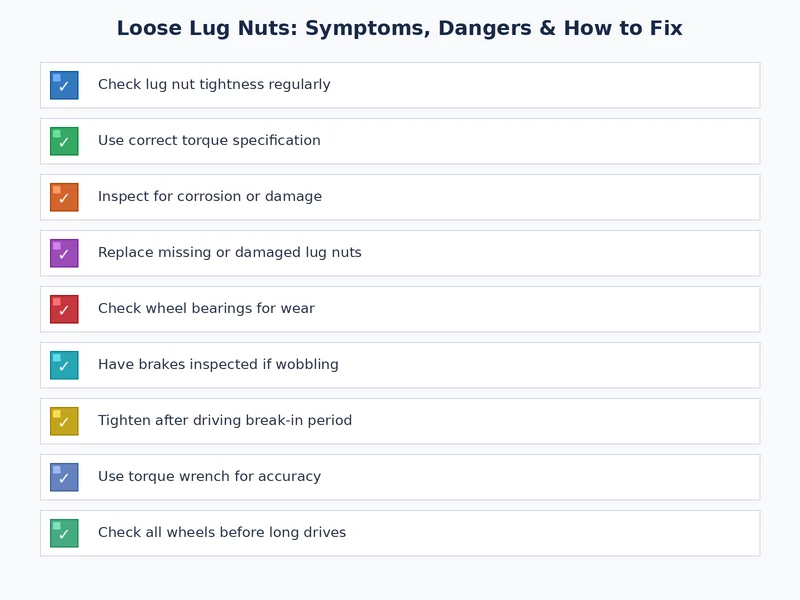
The most consistent loose lug nuts symptoms are rhythmic vibration felt through the steering wheel or floorboard, a repetitive clicking or clunking sound that changes with vehicle speed, and a subtle lateral shimmy during straight-line travel. These symptoms intensify at highway speeds and may diminish at low speeds, which leads many drivers to underestimate the severity of the underlying condition.
Driving on loose lug nuts is not safe for any meaningful distance. Even minor looseness accelerates thread damage on the wheel studs and imposes abnormal loads on the brake rotor and hub assembly. Complete wheel separation can occur with minimal warning once loosening progresses past a critical threshold. The vehicle should be inspected and corrected before continued operation.
Loose lug nuts do not directly cause a conventional tire blowout. However, the wheel oscillation they produce can cause the tire bead to unseat from the rim under sustained dynamic load at highway speeds, resulting in rapid air loss. The outcome is functionally similar to a blowout in terms of vehicle control loss and driver response time.
Correct lug nut torque varies by vehicle class and stud thread size. Most passenger cars require 80 to 110 ft-lbs; full-size trucks typically require 120 to 165 ft-lbs. The vehicle owner's manual or factory service manual provides the definitive specification. A calibrated torque wrench must be used for final application — impact guns alone cannot reliably deliver accurate torque.
Yes. Sustained operation with loose lug nuts damages the wheel's lug holes through fretting wear and repeated impact loading. Elongated or deformed lug holes prevent proper seating against the hub face even after stud replacement, which can necessitate full wheel replacement. This outcome is common when loose lug nuts symptoms are ignored for extended mileage.
A loose lug nut is never a minor inconvenience — it is the first link in a failure chain that ends with no wheel, no control, and no warning.
 |
 |
 |
 |

About Joshua Thomas
Joshua Thomas just simply loves cars and willing to work on them whenever there's chance... sometimes for free.
He started CarCareTotal back in 2017 from the advices of total strangers who witnessed his amazing skills in car repairs here and there.
His goal with this creation is to help car owners better learn how to maintain and repair their cars; as such, the site would cover alot of areas: troubleshooting, product recommendations, tips & tricks.
Joshua received Bachelor of Science in Mechanical Engineering at San Diego State University.
Get some FREE car parts & gear.. Or check out the latest free automotive manuals and build guides here.
Disable your ad blocker to unlock all the hidden deals. Hit the button below 🚗
| | | |
