by Sarah Whitfield
Have the brakes ever felt softer than usual mid-stop, with the pedal sinking lower than it should? That sensation is one of the clearest low brake fluid symptoms — and it's one our team treats as urgent every time. The hydraulic brake system depends on incompressible fluid to transfer pedal force into stopping power at each wheel. When that fluid drops below the minimum threshold, the entire hydraulic chain weakens. The result ranges from subtle pedal changes to complete brake failure under load.
Low brake fluid is rarely a random occurrence. It almost always signals one of two things: a slow leak somewhere in the system, or worn brake pads that have pushed fluid out of the caliper circuit and away from the reservoir. Either root cause demands a real diagnosis — not just a quick top-off. This guide walks through every symptom, the tools required for a proper inspection, and the exact steps our mechanics follow when this issue is confirmed.
Contents
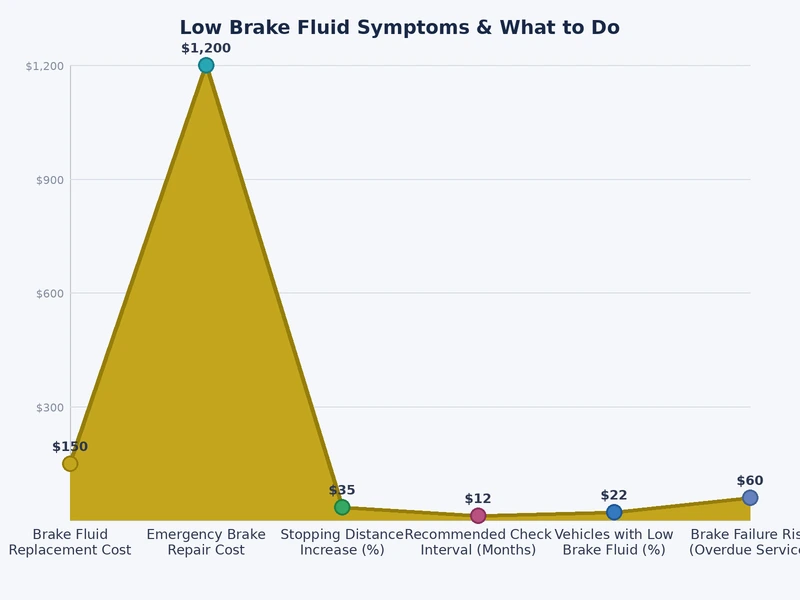
Low brake fluid symptoms don't always arrive as a dramatic event. Some develop gradually over weeks. Others appear suddenly during a hard stop. Our team consistently finds that drivers who recognize the early signs avoid the more dangerous stages entirely.
A properly functioning brake pedal should feel firm and linear — resistance builds progressively as the pedal travels down. When fluid is low, air can enter the brake lines. Air is compressible; brake fluid is not. That compressibility is what creates the mushy, spongy feel most drivers describe. More pedal travel is needed to generate the same stopping force, and the response feels unpredictable.
If the pedal sinks all the way to the floor under normal pressure, that escalates beyond a simple low-fluid situation. Our team covers the full diagnostic breakdown for that emergency in the brake pedal goes to floor guide.
Most modern vehicles use a float sensor inside the brake fluid reservoir. When fluid drops below the minimum mark, the sensor triggers the dashboard brake warning light. On most vehicles, it's a red exclamation mark inside a circle, sometimes with the word "BRAKE" underneath. Our team never treats this light as a sensor glitch unless the fluid level is confirmed full and the system has been pressure-tested. It's a direct hydraulic alert — treat it as one.
Reduced hydraulic pressure means the calipers can't clamp the rotors with full force. The vehicle slows, but not at the rate the driver expects. This gap between expectation and reality is what makes low brake fluid genuinely dangerous at highway speeds. Our team measures stopping performance on inspection days and consistently documents increased distances when fluid is below the minimum mark — even before the pedal feel changes noticeably.
A functioning ABS system shouldn't activate during ordinary stops on dry pavement. When brake fluid is critically low, hydraulic pressure drops unevenly across the circuit. The ABS module may interpret that imbalance as wheel lockup and intervene unnecessarily. For a complete walkthrough of what ABS system failure looks and feels like, our guide on ABS not working symptoms covers every diagnostic angle.
Brake fluid is clear to pale yellow when fresh. It darkens toward amber or brown as it ages and absorbs moisture. A small puddle near a wheel, under the master cylinder, or along a brake line is a direct leak indicator. Unlike engine oil, brake fluid has a glycol-like, slightly oily feel and almost no petroleum odor. Our team always marks the spot with chalk and rechecks after 24 hours to confirm an active leak versus old residue.
Our mechanics keep a compact kit on hand for brake fluid inspection. Most items cost under $20 and belong in any serious home garage.
Brake fluid is corrosive to automotive paint. Our team lays a rag under the reservoir cap before opening and keeps a water source nearby during any fill operation.
Most people check the reservoir level and call it done. That's a partial inspection at best — and it misses the most important variable entirely.
Brake fluid is hygroscopic — it absorbs atmospheric moisture continuously. A full reservoir of old, moisture-saturated fluid performs worse under hard braking than a slightly low reservoir of fresh fluid. According to the NHTSA, brake fluid with elevated moisture content has a significantly reduced wet boiling point, which increases the risk of vapor lock and brake fade during heavy use. Our team has pulled fluid samples from vehicles with full reservoirs that tested above 3% moisture — well past the service threshold.
The standard among experienced mechanics is a two-part check: level plus condition. Brake fluid test strips measure moisture percentage in under 60 seconds. Below 2% moisture, the fluid is serviceable. Between 2–3%, it's near the end of its effective life. Above 3%, a flush is needed regardless of how full the reservoir looks.
This same principle — that fluid appearance and quantity tell different stories — applies across automotive fluids. Our analysis of engine oil color meaning demonstrates how much diagnostic information sits in a fluid sample that most people overlook.
Brake fluid maintenance is systematically skipped by most service schedules that only list oil, air filter, and tire rotation. Our team builds it into every annual inspection without exception.
Vehicles driven aggressively — track days, mountain roads, heavy towing — absorb moisture faster due to repeated high-temperature cycling. Our team shortens the flush interval to 18 months for those use cases.
The reservoir cap seal is the primary defense against moisture ingress. A cracked, warped, or degraded rubber seal lets humid air into the system every time the cap flexes during driving. Replacement caps cost $5–$15 and can extend fluid service life by months. Our team replaces the cap whenever the rubber shows visible deterioration — it's one of the cheapest preventive moves in brake maintenance.
Wiping the reservoir cap and surrounding area before opening is also non-negotiable. Brake dust and road grime carried into the reservoir during a fill will contaminate the entire circuit.
Not all brake fluid is interchangeable. Using the wrong specification damages seals, degrades rubber components, and can compromise ABS modulator function. Our team always verifies the type on the reservoir cap or in the owner's manual before adding anything.
| Fluid Type | Dry Boiling Point | Wet Boiling Point | ABS Compatible | Notes |
|---|---|---|---|---|
| DOT 3 | 401°F (205°C) | 284°F (140°C) | Yes | Absorbs moisture fastest; older vehicles |
| DOT 4 | 446°F (230°C) | 311°F (155°C) | Yes | Most common in modern vehicles; better heat resistance |
| DOT 5 | 500°F (260°C) | 356°F (180°C) | No | Silicone-based; cannot mix with DOT 3/4/5.1 |
| DOT 5.1 | 500°F (260°C) | 356°F (180°C) | Yes | Glycol-based; high-performance and ABS systems |
DOT 5 is the one that creates problems in mixed-fluid situations. It's silicone-based and chemically incompatible with all glycol-based fluids. Mixing causes sludge that clogs ABS modulators and destroys caliper seals. The fix, when this happens, is a complete system flush and seal inspection. Our team treats DOT 5 vehicles as a separate diagnostic category entirely.
When low brake fluid is confirmed, our team follows a consistent protocol built from years of seeing what shortcuts produce in follow-up failures.
Brake fluid expands under heat. Overfilling the reservoir creates excess pressure as operating temperature rises, which can cause drag on the calipers and uneven pad wear. The MAX line on the reservoir is not a suggestion. Our team fills to MAX and stops there — if the reservoir is genuinely full and pads are new, that's the diagnostic puzzle to solve, not a reason to add more fluid.
Adding brake fluid without finding the source of the loss masks the real problem — it's the automotive equivalent of resetting a check engine light without reading the code.
Our team's standard procedure when fluid is low: inspect pad thickness first. Worn pads mean caliper pistons are extended further into the bore, displacing fluid from the caliper circuit into the reservoir — or the reverse, pulling it down as fluid moves to fill the extended caliper bore. This is normal pad-related fluid movement, not a leak. Replacing the pads will bring the reservoir level back up on its own.
When pads are in acceptable condition but fluid is still low, a physical leak exists. Our team inspects in this order:
A one-sided caliper leak often produces a steering pull during braking. Our detailed analysis of steering wheel pulls when braking connects that symptom to hydraulic imbalance in the brake circuit. Drivers who notice both symptoms simultaneously almost always have a leaking caliper on the pulling side.
Fluid leaks at the master cylinder can sometimes be confused with other under-hood drips. For reference on how other fluid leaks present and escalate, our breakdown of radiator leaking symptoms is a useful comparison for understanding leak behavior in hydraulic systems generally.
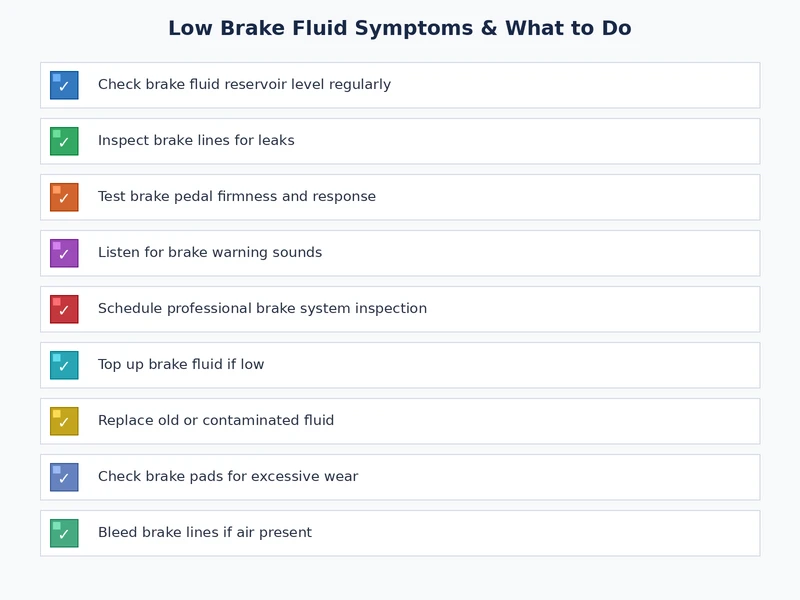
These are the high-priority, time-sensitive actions our team recommends the moment low brake fluid is discovered or suspected.
If the brake warning light is illuminated and the pedal feels soft, limiting vehicle movement is the first priority. Driving on severely low fluid risks complete hydraulic failure at speed. Our team treats this as a non-negotiable stop-drive threshold.
The brake fluid reservoir is typically a translucent white plastic container mounted on top of the master cylinder, near the firewall on the driver's side. The fluid level should fall between the MIN and MAX lines visible through the reservoir wall. If it's at or below MIN, add the correct DOT fluid in small increments, checking frequently against the MAX line.
With the engine off, pump the brake pedal five to ten times. Pedal feel should firm up noticeably. If it remains spongy or sinks to the floor, air has entered the brake lines and bleeding is required. Topping off fluid alone won't restore pressure in an air-contaminated system. A proper bleed — starting from the wheel furthest from the master cylinder — is the next step.
Low fluid is a symptom of something else, not an isolated problem. Our team schedules a comprehensive brake inspection — pads, rotors, calipers, lines, master cylinder — within 24–48 hours of any confirmed low-fluid event. Treating it as a standalone fix is what leads to repeat failures.
The spongy or soft brake pedal is typically the first sign. Most drivers describe needing to press harder than usual to slow the vehicle, or noticing the pedal traveling further before resistance builds. The brake warning light often accompanies this, though it can illuminate before pedal feel changes in vehicles with sensitive reservoir sensors.
Yes. When hydraulic pressure drops significantly, the ABS module can misread wheel speed differential data and activate the ABS warning light. The brake warning light and ABS light appearing together is a reliable indicator that fluid level is critically low or that the system has lost pressure due to a leak or air intrusion.
Our team recommends checking the fluid level at every oil change — roughly every 5,000 to 7,500 miles under normal driving conditions. Moisture content should be tested annually using brake fluid test strips or a refractometer. A full flush every 2–3 years keeps the system performing at spec regardless of level.
Fresh brake fluid is clear to very light amber. As it ages and absorbs moisture, it darkens toward gold, then medium brown. Dark brown or black fluid has degraded significantly and should be flushed immediately. Color alone isn't a complete diagnostic — moisture testing is still necessary, as fluid can test poorly while still appearing light-colored.
Yes. Worn brake pads are the most common cause of a dropping reservoir level without an external leak. As pads wear thin, the caliper pistons extend further to maintain pad-to-rotor contact, drawing fluid from the reservoir into the caliper bore. No fluid escapes the system — it simply redistributes. Replacing the pads and resetting the pistons returns fluid to the reservoir.
Mixing DOT 3 and DOT 4 is generally acceptable in an emergency because both are glycol-based and chemically compatible. Performance will default to the lower specification — typically DOT 3. Our team recommends flushing and replacing with a single fluid type at the next full service interval. Mixing DOT 5 (silicone-based) with any glycol fluid is never acceptable and will damage the system.
A professional brake fluid flush at an independent shop typically runs between $80 and $150 depending on vehicle size and fluid specification. Dealerships often charge $100 to $200. The fluid itself costs $10 to $25 per liter. For anyone comfortable with basic mechanical work, a DIY flush using a hand vacuum pump and fresh fluid is a straightforward procedure.
Ignored low brake fluid leads to progressively worsening pedal feel, extended stopping distances, and eventual hydraulic failure. If the cause is a slow leak, fluid loss accelerates as the system pressure forces more fluid through the breach. Complete loss of hydraulic pressure means the brakes will not function. Our team considers this a safety-critical failure with zero acceptable delay in repair.
The brake system is the one component on a vehicle where deferred maintenance doesn't just cost money — it costs stopping distance, and sometimes far more than that.
 |
 |
 |
 |

About Sarah Whitfield
Sarah Whitfield is a diagnostics and troubleshooting specialist who spent ten years as an ASE-certified technician before joining the editorial team. She specializes in OBD-II analysis, electrical gremlins, and the kind of intermittent problems that make most owners give up.
Get some FREE car parts & gear.. Or check out the latest free automotive manuals and build guides here.
Disable your ad blocker to unlock all the hidden deals. Hit the button below 🚗
| | | |
