by Joshua Thomas
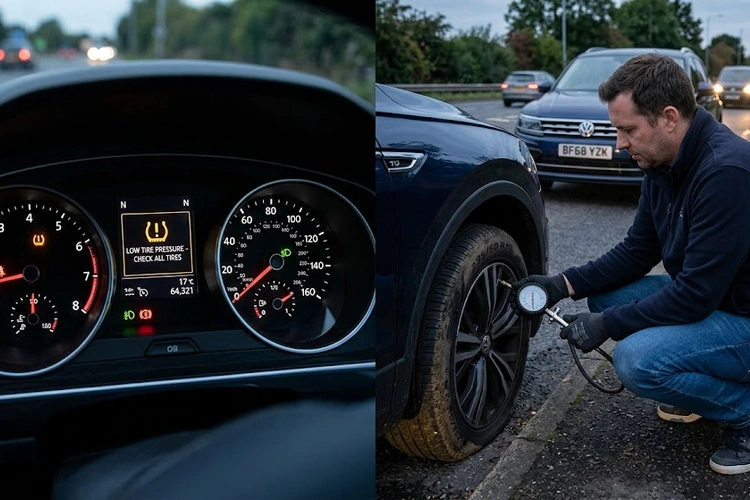
Studies show that roughly 1 in 4 vehicles on U.S. roads has at least one underinflated tire at any given moment. When the low tire pressure light on the dashboard turns on, most people either panic or keep driving without a second thought. Both reactions cause problems. Our team has diagnosed hundreds of tire pressure issues over the years, and we've found this warning is straightforward to handle once the basics are clear. Catching it early prevents blowouts, saves fuel, and extends tire life significantly. For drivers dealing with multiple dashboard warnings at once, our guide on dashboard lights flickering helps sort out what's urgent.
The TPMS (Tire Pressure Monitoring System) was federally mandated for all new U.S. passenger vehicles after a rash of deadly blowout-related crashes prompted safety regulators to act. It monitors all four tires continuously and alerts drivers when pressure drops more than 25% below the recommended level. Our team considers it one of the most genuinely useful safety features on modern vehicles — but only if drivers understand how to respond correctly.
Contents
The low tire pressure light doesn't have a single trigger. Several different situations cause it to illuminate, and knowing which situation applies changes the correct response entirely. Treating every instance the same is one of the most common mistakes our team sees.
Temperature is the most frequent culprit. Tire pressure drops roughly 1 PSI for every 10°F decrease in temperature. A tire inflated to 35 PSI on a warm afternoon can register 29–30 PSI on a cold morning. That's enough to trigger the TPMS. Our team sees this constantly — drivers rush to a shop only to find their tires are physically fine. Adding 4–6 PSI to each tire resolves it immediately, and the light clears within a few miles of driving.
Our tip: Always check tire pressure in the morning before driving. Tires heat up quickly during use and give falsely high readings after even a short trip — cold readings are the accurate ones.
A nail or piece of road debris can lodge in a tire and cause a slow, steady pressure drop over days or even weeks. The TPMS light comes on once pressure falls 25% below spec. Most drivers don't feel a slow leak at all until it's severe. Our team recommends a visual inspection of all four tires any time the light appears — walking around the car takes 60 seconds and often reveals an obvious culprit.
Sometimes the sensor itself is the problem, not the tire. Dead or malfunctioning TPMS sensors send erroneous signals to the dash. This is especially common after tire rotations, battery replacements, or wheel swaps. When tires look and measure fine but the light stays on, a tire pressure sensor fault is the likely cause. Our team uses an OBD-II (on-board diagnostics) scanner to confirm sensor health before assuming an inflation issue exists.
Understanding what actually causes pressure to drop — not just what triggers the light — helps prevent repeat occurrences. The table below covers every major cause our team encounters regularly.
| Cause | Speed of Pressure Loss | Repairable? | Typical Cost |
|---|---|---|---|
| Temperature drop | Immediate (overnight) | N/A — add air | Free |
| Natural air seepage through rubber | 1–3 PSI per month | N/A — top off monthly | Free |
| Tread puncture (nail/screw) | Hours to days | Yes — plug and patch | $15–$30 |
| Sidewall puncture | Minutes to hours | No — tire replacement required | $80–$250+ |
| Faulty valve stem | Days to weeks | Yes — replace stem | $5–$15 |
| Damaged wheel bead seal | Hours | Sometimes — depends on damage | $50–$150 |
| TPMS sensor failure | Sensor only — no real pressure loss | Yes — replace sensor | $50–$100 per sensor |
All tires lose air over time. Rubber is slightly permeable, and air molecules pass slowly through the tire wall regardless of conditions. Most tires lose 1–3 PSI per month under normal use. This is why monthly pressure checks matter even when no warning light appears. Nitrogen inflation slows this process, though our team finds the benefit modest for most everyday drivers — it's nice to have, not essential.
Road debris punctures are the second most common cause our team diagnoses. A screw in the tread area is often repairable with a professional plug-and-patch. A puncture in the sidewall almost always means tire replacement — no exceptions. Our team always inspects the full circumference of the tire, not just the tread surface, before recommending a repair. Underinflated tires from slow punctures also affect braking — car shudders when braking is a common secondary symptom worth knowing about.
The valve stem is the small metal or rubber port used to add air to a tire. These degrade over time, especially on higher-mileage vehicles. A cracked or corroded stem leaks continuously and gradually. Valve stems are inexpensive — typically under $5 to replace at a shop — but many drivers overlook them completely when tracking down a persistent pressure problem.
Our team hears the same misconceptions over and over. Getting these wrong causes real damage — to tires, fuel economy, and safety.
Myth 1: "The tire looks fine, so the pressure is fine."
A tire can appear fully inflated and still be 10–15 PSI below spec. Modern radial tires (the standard construction type used today) don't visibly bulge until pressure is dangerously low. Visual inspection alone is not a reliable diagnostic tool. A gauge is the only way to know.
Myth 2: "Just add air until the light goes off."
Over-inflation is a genuine problem. Tires inflated beyond the maximum rating wear faster in the center tread, reduce the contact patch (the area touching the road), and increase blowout risk on hot pavement. Our team always checks the spec before adding air — not after.
Myth 3: "The TPMS shows the exact current pressure."
Many TPMS systems only warn when pressure drops 25% below spec — they don't display live readings. Older indirect TPMS systems don't measure pressure at all; they estimate it using wheel speed differences. A physical gauge remains necessary for accurate readings on most vehicles.
Myth 4: "Wait until tires warm up for an accurate reading."
The opposite is correct. The standard practice — and the one NHTSA's tire safety guidance follows — is to check pressure when tires are cold (before driving, or after sitting for 3+ hours). Hot tire readings run 4–6 PSI higher than resting pressure.
Warning: Driving at highway speeds with a tire 20+ PSI below spec significantly increases blowout risk. Our team treats the low tire pressure light as urgent — not something to address "later."
Dashboard warning lights often appear in clusters. For drivers seeing multiple warnings at once, our article on brake warning light causes covers several diagnostic principles that apply broadly across warning systems.
The correct tire pressure for any vehicle is printed on the driver's door jamb sticker — not on the tire sidewall. The number on the tire sidewall is the maximum allowable pressure, not the recommended operating pressure. These two numbers are often 10–20 PSI apart. Confusing them is one of the most common over-inflation mistakes our team sees. Most passenger vehicles run between 30–35 PSI, though crossovers and trucks often spec higher.
Our team's recommended process keeps it simple and repeatable:
Our team recommends a digital tire gauge over the classic pencil-style gauges. Digital versions read to within 0.5 PSI and cost under $15. It's one of the most useful low-cost tools any driver can keep in a glove box.
How someone handles the low tire pressure light depends heavily on experience level. Our team has noticed a consistent gap between drivers seeing this light for the first time and those who've dealt with it before.
First-time drivers typically make one of two mistakes:
Experienced drivers typically:
Our team's advice for less experienced drivers: treat the first occurrence as a learning moment. Check all four tires with a gauge, find the door jamb spec, and compare. The whole process takes under five minutes and builds a skill that saves money long-term.
TPMS problems also connect to other vehicle warning systems. Low tire pressure affects wheel speed sensor readings, which the ABS and traction control systems rely on. A persistent pressure issue can trigger the traction control light as a secondary warning — something worth knowing when multiple lights appear simultaneously.
The TPMS has clear strengths and real limitations. Our team thinks drivers deserve an honest assessment of both rather than a simplified "it's great, trust it" take.
What TPMS does well:
Where TPMS falls short:
Pro insight: Our team recommends monthly manual pressure checks regardless of TPMS status — the system misses 5–10 PSI deficits that still measurably hurt fuel economy and accelerate tire wear.
Ignoring low pressure long-term creates downstream problems. Consistently underinflated tires create uneven road contact, which accelerates wear on brake components and can lead to brake pedal pulsation over time — a separate issue that compounds the original problem.
Our team has found that drivers who never face serious tire emergencies share one consistent trait: they are deliberate about maintenance. Tire pressure isn't a one-time fix. It's an ongoing habit that takes minutes per month and pays off significantly over the life of a vehicle.
Monthly checks: Setting a recurring reminder for the first morning of every month takes 30 seconds to set up. Checking all four tires — plus the spare, if applicable — before the first drive takes under five minutes. Logging the readings in a phone's notes app reveals gradual pressure trends. A tire that loses 3 PSI per month has a slow leak. Catching that early avoids a roadside flat.
Seasonal adjustments: In regions with cold winters, adding 2–4 PSI per tire when temperatures drop is standard maintenance. In very hot climates, parked vehicles in direct sun can see pressure spike temporarily — checking that tires aren't over-inflated after extended parking in summer heat is worthwhile.
Pressure checks at tire rotations: Rotating tires every 5,000–7,500 miles evens out wear patterns. Our team treats every rotation as an automatic pressure checkpoint. Most shops include it, but confirming is always smart. A rotation is also the moment to have TPMS sensors inspected if the vehicle has high mileage.
Resetting the light after inflation: After inflating all four tires to the correct spec, the TPMS light typically clears within a few miles of normal driving. If it doesn't clear:
Our team also recommends checking tire age during any pressure investigation. Most manufacturers recommend replacing tires after a set number of years regardless of tread depth. Old rubber becomes brittle and prone to sudden pressure loss. The DOT date code molded into the sidewall shows the manufacturing date — a tire shop can decode it in seconds.
Staying on top of tire health also prevents cascading issues elsewhere. In extreme cases, driving for extended distances on a severely underinflated tire generates excessive heat from friction — and that heat buildup can sometimes contribute to a rise in overall vehicle temperature. Our guide on temperature gauge rising covers heat-related warnings in full detail. Separately, any time warning lights appear after a service visit, checking for related causes — like those covered in our speedometer not working article — helps rule out sensor cross-contamination from recent work.
Driving a short distance at low speeds to reach a gas station or tire shop is generally acceptable. Driving long distances or at highway speeds with the light on is a different story — blowout risk increases significantly if a tire is 20+ PSI below spec. Our team's position is clear: check and fill as soon as it's safely possible, not at the next convenient stop two days later.
Tire pressure drops roughly 1 PSI for every 10°F decrease in temperature. A tire at 35 PSI in warm weather can fall to 29–30 PSI on a cold morning — enough to trigger the TPMS warning. Adding air to reach the door jamb specification resolves it immediately. Our team sees this pattern every fall and winter without exception.
The simplest reset is inflating all four tires to the correct PSI listed on the driver's door jamb sticker, then driving at normal speeds for a few minutes. The TPMS light clears automatically on most vehicles within 5–10 miles. If it stays on, using the TPMS reset button in the vehicle's settings menu or running an OBD-II scan to check sensor status is the next logical step.
 |
 |
 |
 |

About Joshua Thomas
Joshua Thomas just simply loves cars and willing to work on them whenever there's chance... sometimes for free.
He started CarCareTotal back in 2017 from the advices of total strangers who witnessed his amazing skills in car repairs here and there.
His goal with this creation is to help car owners better learn how to maintain and repair their cars; as such, the site would cover alot of areas: troubleshooting, product recommendations, tips & tricks.
Joshua received Bachelor of Science in Mechanical Engineering at San Diego State University.
Get some FREE car parts & gear.. Or check out the latest free automotive manuals and build guides here.
Disable your ad blocker to unlock all the hidden deals. Hit the button below 🚗
| | | |
