by Sarah Whitfield
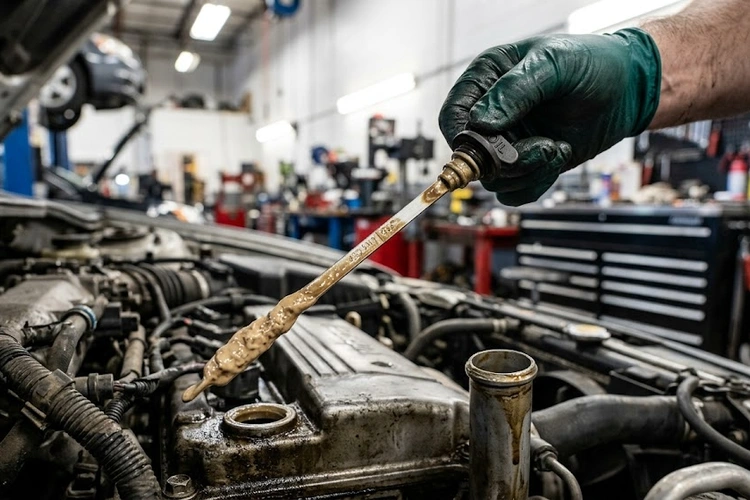
Roughly one in four engine repair bills exceeding $1,000 involves coolant mixing with oil — and milky oil on dipstick readings are nearly always the first visible warning, long before other symptoms compound. Our team has documented this pattern across hundreds of diagnostic calls, and the finding is consistent: drivers who act on that milky discoloration within days pay a fraction of what those who wait end up spending. The mixture produces a frothy, tan or grayish-brown coating on the dipstick that resembles a chocolate milkshake, and it means the oil has already lost most of its protective properties.
The cause is almost always internal — coolant or water has found a path into the oil passages, most commonly through a failed head gasket (the metal seal separating the combustion chamber from the coolant and oil galleries). Our experience puts head gasket failure as the source in roughly 60 percent of milky oil cases, though cracked engine blocks, a failed oil cooler, and even condensation in cold climates round out the rest. Anyone already seeing related symptoms should cross-reference the full list of blown head gasket symptoms — the overlap confirms diagnosis quickly and decisively.
Contents
Fresh engine oil is a clear amber color, darkening to a deep brown as it accumulates combustion byproducts over normal use. Our team always wipes the dipstick on a clean white rag before reading, because color differences that look subtle against the metal stick become obvious against white fabric. Oil that is dark brown to black is dirty but not contaminated — it is doing its job. The moment that color shifts toward tan, gray, or a creamy off-white froth, contamination is present and every mile driven from that point adds measurable wear to the engine's most vulnerable surfaces.
The table below gives our team's field-tested reference for interpreting dipstick appearance, matching it to the most likely cause, and assigning an urgency level before any money changes hands.
| Dipstick Appearance | Likely Cause | Urgency | Recommended Action |
|---|---|---|---|
| Dark brown, slightly opaque | Normal combustion byproducts | Low — routine maintenance | Change oil at normal interval |
| Light tan, slightly foamy | Minor condensation or early contamination | Medium — monitor closely | Check coolant level; pressure-test system |
| Gray or creamy froth | Active coolant leak into oil | High — stop driving | Diagnose and repair before restarting engine |
| Chocolate-milk consistency | Significant head gasket or block failure | Critical — engine at risk | Tow to shop; do not drive under any circumstances |
A faint tan tint on a cold-morning dipstick can be harmless condensation — but if it persists after the engine reaches full operating temperature, our team treats it as a confirmed contamination event and proceeds accordingly.
The head gasket sits between the engine block and the cylinder head, sealing oil passages, coolant passages, and combustion chambers in one compressed metal layer. When that gasket fails — typically from overheating, detonation (uncontrolled ignition inside the cylinder causing a sharp knock), or age-related fatigue — coolant finds a direct path into the oil galleries. Our team sees this most frequently in high-mileage four-cylinder engines and in any vehicle that has experienced even a single overheating event, because heat warps the cylinder head slightly and breaks the gasket seal in a slow, progressive way. According to the Wikipedia overview of head gasket construction, modern multi-layer steel (MLS) gaskets are more durable than older composite designs, but thermal stress from overheating degrades them regardless of material quality.
A cracked engine block — the main cast-iron or aluminum housing containing the cylinders — produces the same milky dipstick result as a blown gasket but is far more expensive to address, often making full engine replacement the more economical path. Oil cooler failures are common on diesel engines and on certain V6 and V8 gasoline platforms; the cooler develops an internal pinhole leak and coolant mixes directly into the oil circuit without any gasket involvement, which is why our team never assumes head gasket failure as the only possibility. Condensation is the benign exception: short cold-weather trips that never fully warm the oil allow water vapor to condense inside the crankcase, producing a light milky film that clears on the next sustained highway drive.
Engine oil forms a thin hydrodynamic film — a pressurized wedge of lubricant — between metal surfaces moving at thousands of revolutions per minute. Water and coolant in that film reduce its viscosity (thickness) and break down the additive package, which is the chemical blend of anti-wear, detergent, and anti-corrosion compounds that makes modern motor oil far more protective than straight base stock. Our team has pulled engines with confirmed milky oil where the bearing surfaces showed the equivalent of 10,000 miles of wear in fewer than 3,000 miles of contaminated operation, because the degradation is exponential rather than linear once the lubricant film is compromised.
Main bearings (the curved metal inserts that support the crankshaft) and rod bearings (which connect the pistons to the crankshaft) both depend on continuous pressurized oil flow for survival, and milky oil — because it is partly water — promotes rust on these bare metal surfaces in ways clean oil never would. Our team also consistently sees accelerated degradation in rubber seals and o-rings when coolant is present, which compounds the original leak by creating new leak points downstream. For related damage patterns that often appear as a secondary consequence of contamination-softened gasket material, the symptoms covered in a typical oil pan gasket leak diagnosis overlap significantly with long-running milky oil cases.
Our team's standing rule is blunt: milky oil means no more driving until the source is confirmed and repaired — even a short trip to a shop risks scoring the bearing surfaces past the threshold where machining can save them.
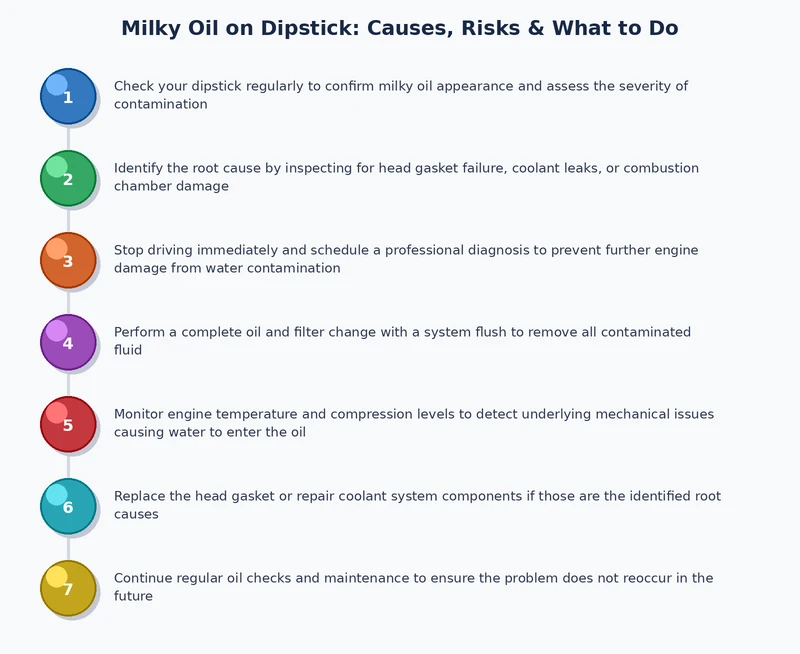
The single most costly mistake our team witnesses is performing an oil change as a first response to milky oil on dipstick findings, then driving the vehicle as though the problem is resolved. Fresh oil turns milky again within hours if the contamination source remains active, and the act of flushing the old oil produces zero diagnostic information about the leak's location or severity. The correct sequence is diagnosis first, repair second, then a fresh oil and filter fill as the final step after confirming the seal is restored — not the other way around. Changing oil before diagnosing is the mechanical equivalent of mopping the floor without fixing the leaking pipe.
Milky oil on the dipstick almost never travels alone — it accompanies coolant loss, white exhaust smoke (from coolant burning in the combustion chamber), intermittent overheating, and sometimes a sweet maple-syrup smell from the exhaust. Our team has seen shops replace head gaskets based solely on dipstick evidence, only to discover a cracked block or failed oil cooler was the true source because no one ran a full pressure test or a combustion gas test (a chemical dip-test that detects exhaust gases crossing into the coolant). Incomplete diagnosis is precisely how a $1,200 repair evolves into a $4,000 engine replacement through a series of well-intentioned but misdirected parts replacements.
Any dipstick reading showing creamy gray or chocolate-milk-colored oil warrants stopping the vehicle and arranging a tow rather than driving it even to a nearby shop. The threshold our team uses is straightforward: if the milky layer is uniform across the entire dipstick film rather than just a faint trace at the very tip, the contamination is active and the engine should not be restarted. Continuing to drive risks hydrolock (water entering the combustion chamber and causing a piston to stop abruptly against an incompressible fluid column), which converts a fixable gasket repair into a total engine failure with no cost-effective path back.
Our team recommends three confirmatory checks that cost nothing and sharpen the diagnosis before any money is committed to labor or parts.
A cooling system pressure test involves attaching a hand pump to the radiator cap neck and pressurizing the system to its rated cap pressure — typically 13 to 16 psi — then watching for a drop over 10 to 15 minutes while checking hoses, the radiator, and the overflow tank for external leaks. If the external system holds pressure but coolant level keeps dropping, the leak is internal and almost certainly crossing into the oil or combustion chamber, which narrows the working diagnosis to head gasket, cracked block, or oil cooler failure with very high confidence. Most independent mechanics charge no more than one labor hour for a thorough pressure test, and our team considers it non-negotiable before authorizing any major repair.
The combustion leak test — sometimes called a block test or exhaust gas analyzer test — uses a chemical indicator fluid that changes color from bright yellow to green or blue in the presence of combustion gases in the coolant. Our team considers this the most definitive non-invasive test for head gasket failure, because it directly detects whether combustion products are crossing into the cooling system, which is the same pathway coolant uses to contaminate the oil. A positive result here, combined with confirmed milky oil, justifies authorizing the head gasket repair without further teardown — the two tests together close the diagnostic loop completely and eliminate guesswork that costs real money on the bench.
Not always — condensation from repeated short cold-weather trips can produce a light milky film that clears after a full warm-up drive, and a failed oil cooler is a common alternative source in diesel engines and certain V6 and V8 platforms. That said, head gasket failure is the most frequent cause overall, and our team treats milky oil as a probable gasket failure until a combustion gas test or cooling system pressure test specifically rules it out.
Our team's position is no — even short trips under active coolant contamination accelerate bearing wear at a rate that can turn a $1,200 head gasket repair into a full engine rebuild requiring $4,000 or more. The only safe option is to stop at the nearest secure location and arrange a tow rather than risk scoring the bearing surfaces past the threshold where machining or repair is viable.
Head gasket replacement on a four-cylinder engine runs $1,000 to $2,000 including labor; V6 and V8 engines typically run $1,500 to $3,000 due to greater disassembly time. An oil cooler replacement generally costs $400 to $900 depending on accessibility. A cracked engine block often makes replacement the more economical path, with remanufactured engines starting around $2,500 fully installed.
 |
 |
 |
 |

About Sarah Whitfield
Sarah Whitfield is a diagnostics and troubleshooting specialist who spent ten years as an ASE-certified technician before joining the editorial team. She specializes in OBD-II analysis, electrical gremlins, and the kind of intermittent problems that make most owners give up.
Get some FREE car parts & gear.. Or check out the latest free automotive manuals and build guides here.
Disable your ad blocker to unlock all the hidden deals. Hit the button below 🚗
| | | |
