by Diego Ramirez
When it comes to nitrogen vs air in tires, the debate has been going on for years. Walk into any tire shop and you'll likely see the option to fill with nitrogen — often for a small fee. But is it actually worth it for the average driver, or is it just marketing hype? The short answer: nitrogen has real but modest benefits, and whether those benefits justify the cost depends entirely on your situation.
Regular air is about 78% nitrogen already, so you're not switching to a completely different gas. You're simply going from roughly 78% nitrogen to 95–98% nitrogen by removing the remaining oxygen, water vapor, and other trace gases. That change is what's responsible for any differences you'll notice.
Contents
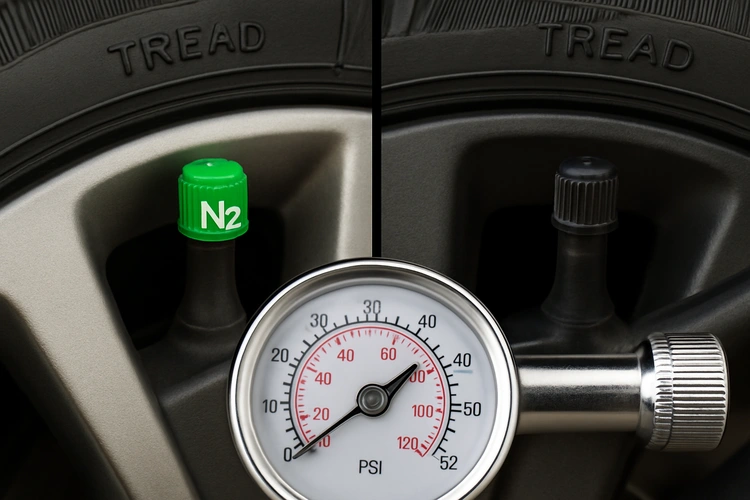
Nitrogen tire inflation means filling your tires with pure nitrogen gas rather than compressed air from a standard pump. Because regular air is mostly nitrogen anyway, the main advantage comes from removing the oxygen and moisture that make up the remaining 21–22%.
Nitrogen tires have been standard in professional motorsports, commercial aviation, and large commercial trucking for decades. According to Wikipedia's article on tires, nitrogen use in aircraft is partly due to its inert properties — oxygen at high pressure and temperature can react with rubber and wheel components in ways nitrogen won't. NASCAR and Formula 1 teams use nitrogen because consistent, predictable tire pressure is critical at race speeds where even small pressure variations affect handling significantly.
To properly fill with nitrogen, a technician should first deflate your tire completely, then purge it with nitrogen before filling. Simply topping off an air-filled tire with nitrogen won't give you the benefits — you'll just end up with slightly more nitrogen than before. A proper fill means the tire starts empty and is inflated purely with nitrogen gas to your vehicle's recommended PSI. Always verify the correct PSI using your door jamb sticker, and if you want a refresher on checking tire pressure, see our guide on how to check tire pressure.
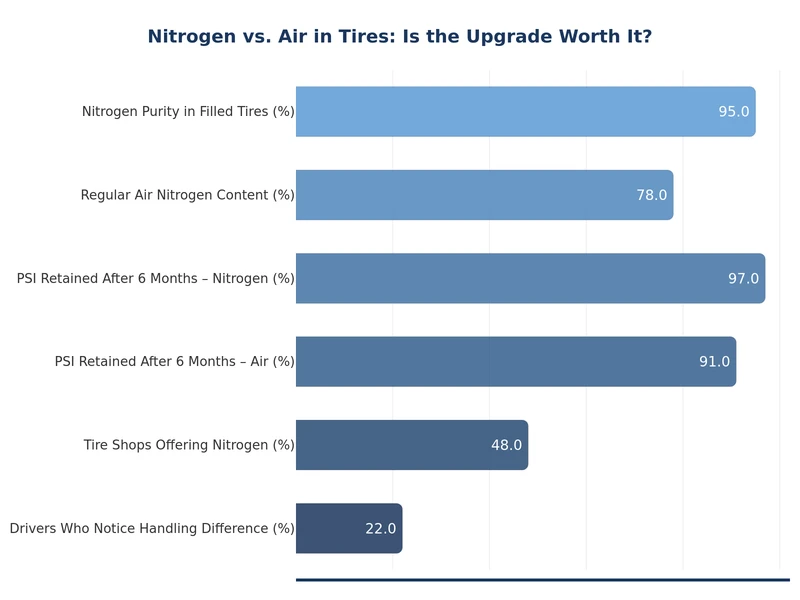
The practical differences between nitrogen and air in tires come down to three main areas: pressure retention, temperature stability, and moisture content. Understanding each one helps you decide whether nitrogen makes sense for your vehicle and driving habits.
Nitrogen molecules are slightly larger than oxygen molecules, which means they permeate through the rubber of the tire at a slower rate. Studies have shown nitrogen-filled tires lose pressure approximately 3–4 times more slowly than air-filled tires over the same period. In practical terms, a tire filled with air might lose 1–2 PSI per month under normal conditions, while a nitrogen-filled tire might lose closer to 0.5 PSI over the same period. This slower loss is real and measurable, but it doesn't eliminate the need to check pressure — it just extends the intervals slightly.
As tires heat up from driving friction and hot pavement, the air inside expands and pressure rises. Nitrogen behaves more predictably under temperature changes because it contains no moisture. Oxygen and water vapor expand and contract more aggressively with temperature swings. For regular street driving, this difference is small. For track use or heavily loaded vehicles, it's more meaningful. This is one reason nitrogen is standard for commercial truck fleets — consistent pressure under load and heat means more even tire wear and better fuel efficiency over thousands of miles.
Compressed air from a standard pump contains water vapor. Over time, this moisture can cause oxidation on metal wheels, particularly steel wheels, and can degrade the rubber of the tire from the inside. Nitrogen is dry — it introduces no moisture. On aluminum alloy wheels, this difference is minimal. On steel wheels or in humid climates, nitrogen can meaningfully reduce internal corrosion over the long term. This is also the reason aircraft tires use nitrogen: at high altitude, temperature extremes and any moisture presence can cause dangerous pressure spikes.
For most drivers, the benefits of nitrogen vs air in tires are modest rather than transformative. Here's what you can realistically expect:
Properly maintained tire pressure has a direct impact on how long your tires last, and nitrogen can help maintain that pressure more consistently. If you want to maximize tire life overall, pair nitrogen or regular air with good habits — rotation, alignment, and correct PSI. Our guide on how to extend the life of your car tires covers all the fundamentals in detail.
It's also worth noting that tire selection matters as much as what's inside them. If you're debating between tire types for seasonal driving, our comparison of all-season vs. winter tires is a good starting point before you even think about the fill gas.
Nitrogen isn't a magic solution, and there are real limitations to consider before paying for it:
| Factor | Compressed Air | Nitrogen |
|---|---|---|
| Cost to fill | Free at most gas stations | $5–$10 per tire |
| Availability | Everywhere | Tire shops, dealerships only |
| Pressure retention | Loses ~1–2 PSI/month | Loses ~0.3–0.5 PSI/month |
| Temperature stability | Moderate variation | Slightly more stable |
| Moisture content | Contains water vapor | Dry (no moisture) |
| Wheel corrosion risk | Higher (especially steel wheels) | Lower |
| Requires special equipment | No | Yes |
| Best for | Everyday commuting | Track use, fleets, commercial vehicles |
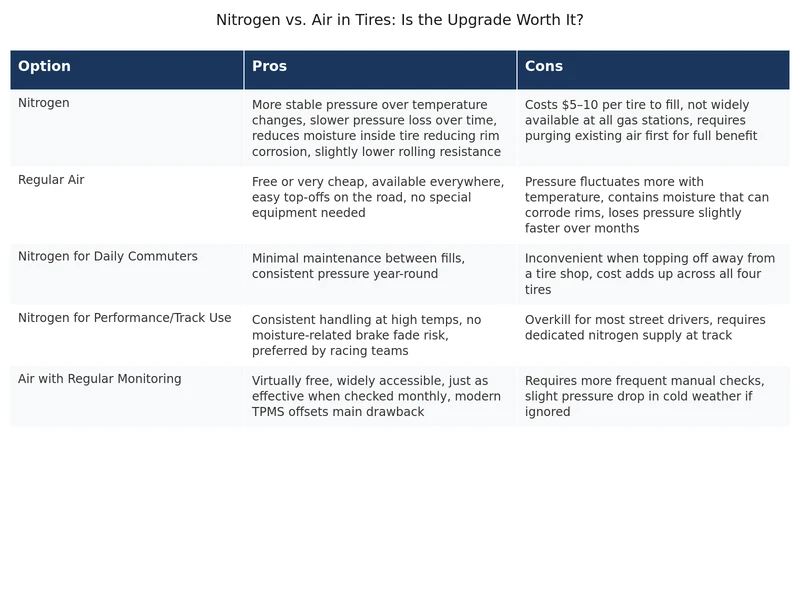
Nitrogen makes the most sense in specific situations. Here's a practical breakdown:
The bottom line on nitrogen vs air in tires: nitrogen is a genuine but incremental upgrade. It's not a gimmick, but it's also not a game-changer for most drivers. The far bigger impact on tire performance, fuel economy, and safety comes from simply maintaining proper pressure consistently — whether that's air or nitrogen inside the tire.
Nitrogen offers modest but real advantages: slower pressure loss, slightly more stable pressure under temperature changes, and no moisture inside the tire. For everyday drivers, these benefits are small enough that most people won't notice a difference. For track use, commercial fleets, or long-term storage vehicles, the improvements are more meaningful.
Yes, you can top up nitrogen-filled tires with regular air in a pinch — it won't damage anything. However, mixing dilutes the nitrogen concentration, which reduces the benefits. For best results, top up only with nitrogen when possible, or do a full deflate-and-refill to restore purity.
Nitrogen fills typically cost $5–$10 per tire at tire shops or dealerships, putting the total for all four tires at $20–$40. Some shops charge a flat set fee. Many dealerships include nitrogen fills with new vehicle purchases at no extra cost.
Nitrogen-filled tires typically lose around 0.3–0.5 PSI per month, compared to 1–2 PSI per month for air-filled tires. Even so, monthly pressure checks are still recommended since tires can lose pressure from temperature changes, slow leaks, or valve stem issues regardless of what's inside.
Nitrogen itself doesn't directly improve fuel economy — properly inflated tires do. Nitrogen's benefit is that it helps maintain proper pressure more consistently over time, which indirectly supports better fuel economy. If you're already checking and topping up your tire pressure monthly, nitrogen provides no additional fuel economy benefit.
For a typical daily driver, nitrogen is not worth the cost. The benefits are real but too small to perceive in regular driving. Your money and attention are better spent on monthly pressure checks, regular tire rotations, and proper wheel alignment — habits that have a far larger impact on tire life and fuel efficiency than switching from air to nitrogen.
 |
 |
 |
 |

About Diego Ramirez
Diego Ramirez is a maintenance and care specialist who has been wrenching on cars since he was sixteen. He focuses on fluid changes, preventive care routines, paint protection, and the small habits that turn a five-year-old car into a fifteen-year-old car.


Get some FREE car parts & gear.. Or check out the latest free automotive manuals and build guides here.
Disable your ad blocker to unlock all the hidden deals. Hit the button below 🚗
| | | |
