by Sarah Whitfield
An oil burning smell inside car cabins almost always means engine oil has found its way onto a hot surface somewhere in the engine bay, and the resulting vapor is seeping into the passenger compartment through vents or gaps in the firewall. Pinpointing the exact source is the whole game — once the leak or burn point is found, the fix usually follows quickly and clearly.
Our team has diagnosed this problem across dozens of vehicles, and the causes cluster into a handful of reliable patterns. This guide walks through every major source, explains how urgency varies depending on the symptoms, and covers which fixes most people can handle at home versus which ones belong at a shop. For a full reference hub, our overview of the oil burning smell inside car problem brings everything together in one place.
Contents
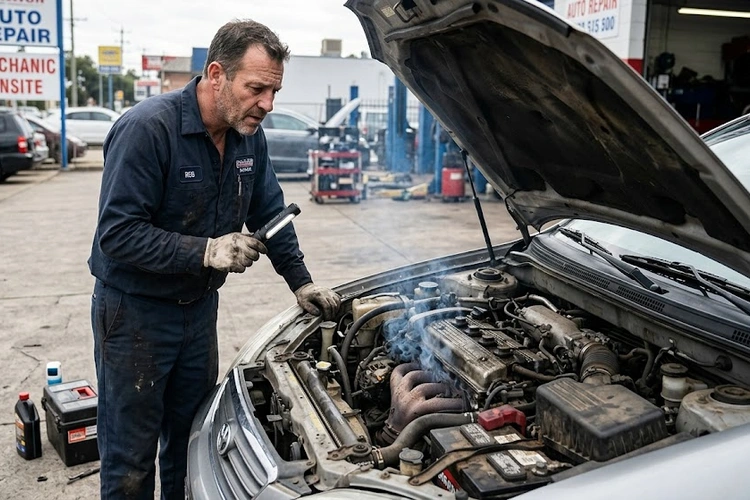
The oil burning smell inside car interiors always originates from outside the cabin — vapor from burning oil seeps through the firewall, the HVAC intake, or small gaps around wiring and hoses. Motor oil (the lubricant that keeps metal engine parts from grinding against each other) produces a sharp, acrid smell when it contacts any surface hot enough to vaporize it, and the exhaust system is the most common culprit by far.
A leaking valve cover gasket (the rubber seal between the valve cover and the cylinder head) sits directly above the exhaust manifold on most engines, and the manifold routinely reaches temperatures above 700°F during normal operation. Even a slow drip landing on that surface produces enough vapor to fill the cabin within minutes of startup. Our team also regularly sees oil landing on turbocharger housings and catalytic converters as additional ignition points. If a vehicle is already dealing with a catalytic converter rattling problem, the converter is already running hot and stressed, which makes it an especially aggressive burner when oil reaches it.
When valve seals (small rubber components that prevent oil from entering the combustion chamber) or piston rings (metal rings that seal each piston inside its cylinder bore) wear out, oil gets burned directly inside the engine alongside the normal fuel-air mixture. The exhaust in these cases takes on a bluish-gray color, and the smell tends to be persistent rather than intermittent. Our team consistently finds bad spark plug symptoms alongside this problem, because oil fouling the electrode tips causes misfires and rough running on top of the burning smell.
Too much oil in the crankcase creates pressure that pushes oil past seals and gaskets it would otherwise never reach, sending it onto hot exhaust components. According to Wikipedia's overview of motor oil, the dipstick's minimum and maximum marks represent a precise safe operating range, and overfilling by even half a quart causes foaming and leaks in many engines. Our team recommends checking the dipstick immediately after any oil change where a burning smell appears within the first day of driving.
Our first move when a burning smell appears right after an oil change is always the dipstick — overfilling is one of the most common and most overlooked causes, and it takes less than two minutes to rule out completely.
The severity of a burning oil smell ranges from a minor annoyance that resolves itself in a day or two, to an active emergency that can destroy an engine within minutes if ignored. Understanding which situation is which is genuinely critical knowledge for any driver.
Our team's standing rule is non-negotiable: any warning light alongside a burning smell means the car stops immediately, because the cost of a tow is nothing compared to the cost of a seized engine.
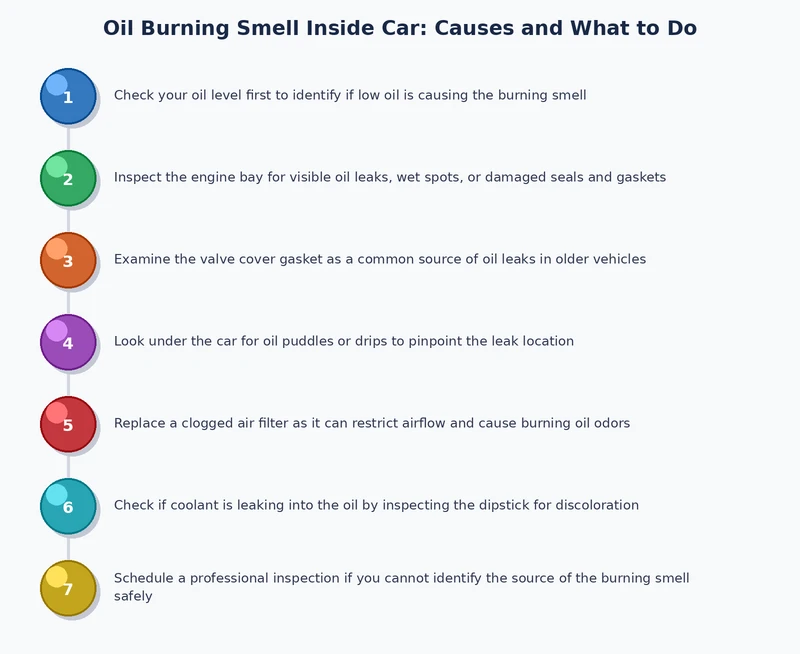
Systematic inspection beats random part replacement every single time, and most of the diagnostic legwork for a burning oil smell requires nothing more than a flashlight, a rag, and some patience. Our team follows the same walkthrough on every vehicle regardless of make or model.
Starting with a cold engine eliminates burn risk and makes fresh oil traces easier to spot against clean, cool surfaces. The inspection sequence our team recommends runs as follows:
| Symptom | Most Likely Cause | Urgency |
|---|---|---|
| Faint smell at startup, fades within minutes | Residual oil from recent service | Low — monitor for a day or two |
| Persistent smell with oily residue on engine | Valve cover gasket leak | Medium — repair within the week |
| Blue-gray exhaust smoke plus smell | Worn valve seals or piston rings | High — schedule shop visit soon |
| Smell with oil pressure warning light on | Major leak or critically low oil | Critical — stop driving immediately |
| Smell appeared right after oil change | Overfill or spilled oil on exhaust | Low — check dipstick, monitor closely |
| Smell plus noticeable fuel economy drop | Oil burning in combustion chamber | High — internal seal wear likely |
Our team holds a clear position on this: some of these repairs are genuinely accessible to anyone with basic mechanical comfort and a free afternoon, while others involve deep engine disassembly that goes far beyond what most people should attempt without professional training. Matching the task to the skill level saves money and prevents the very real risk of making things significantly worse.
When the burning smell comes with a noticeable drop in efficiency at the pump, that pairing often signals more than just an external leak — the fuel economy suddenly dropped guide covers how internal seal wear affects both symptoms together and what the repair timeline typically looks like.
After the source is fixed, the goal shifts to prevention, and the habits that matter most are neither expensive nor complicated — they just require consistency and a bit of attention during routine service visits.
Degraded oil (oil that has broken down chemically after extended heat cycling) becomes thinner and less viscous, meaning it seeps past seals and gaskets it would normally never reach under pressure. Following the manufacturer's oil change interval from the owner's manual — rather than an arbitrary fixed mileage — keeps the oil in a condition where it protects seals rather than compromises them. Every oil change is also a built-in opportunity to spot a developing leak while the volume of oil loss is still small and the repair is still inexpensive.
Rubber gaskets and seals harden and crack with age as they cycle through thousands of heat and cool cycles over the engine's life, and catching them during a routine check costs nothing compared to the repair bill they generate when they fail fully. The spots our team recommends checking at every oil change include:
It depends entirely on the cause and severity. A faint smell after a fresh oil change is harmless and burns off on its own, but a strong persistent smell combined with a warning light or visible smoke signals an active problem that can cause serious engine damage quickly. Our team recommends treating any strong or worsening burning oil smell as urgent until proven otherwise.
Sometimes, yes — spilled oil from a service visit typically burns off within a day or two of normal driving, and the smell disappears completely. However, a smell caused by a leaking gasket, worn seal, or overfill does not resolve itself and will worsen over time as the leak grows or the seal deteriorates further.
The range is wide. A valve cover gasket replacement typically runs between $100 and $350 at a shop depending on the engine layout, while a rear main seal can reach $600 to $1,200 with labor. Valve seal or piston ring repairs are the most expensive, sometimes exceeding the vehicle's value on older cars.
The HVAC system draws air through an intake near the base of the windshield, and if there is burning oil vapor present in the engine bay, the system pulls that vapor directly into the cabin. Turning the system to recirculate mode temporarily stops fresh outside air from being drawn in, which can reduce the smell while driving to a shop.
It is uncommon but not impossible. Oil dripping onto a very hot exhaust component can ignite under the right conditions, particularly if the leak is significant and the exhaust system is running at maximum temperature. Our team considers any situation where smoke accompanies the smell to be a potential fire risk and recommends stopping the vehicle immediately.
Not always — oil burning inside the combustion chamber due to worn valve seals or piston rings produces the same smell without any external leak visible under the hood or on the ground beneath the car. Blue-gray exhaust smoke at startup is the key indicator that the burn is happening internally rather than from an external drip.
Burning oil smells sharp, acrid, and slightly smoky — similar to a hot frying pan. Burning coolant (antifreeze) smells distinctly sweet, almost like maple syrup, and the smoke it produces tends to be white and thicker. The two smells are quite different once a driver has experienced both, and the distinction matters because each one points to a completely different set of problems.
Adding oil to bring the level back to the correct mark on the dipstick is absolutely the right move if the level is low, and it is safe to drive carefully to a shop afterward as long as the oil pressure warning light is not on and the engine is running smoothly. If the warning light is illuminated, adding oil without first stopping the engine risks further damage, and the car should not be moved until the situation is assessed.
An oil burning smell inside the car is one of those problems where acting promptly makes an enormous difference in the final repair cost — a ten-dollar gasket caught early versus a seized engine caught too late are outcomes separated entirely by how quickly the problem gets addressed. Our team encourages anyone dealing with this smell to run through the visual inspection walkthrough above, match the symptoms to the table, and get the car looked at before that small leak has time to become a much larger and more expensive one.
 |
 |
 |
 |

About Sarah Whitfield
Sarah Whitfield is a diagnostics and troubleshooting specialist who spent ten years as an ASE-certified technician before joining the editorial team. She specializes in OBD-II analysis, electrical gremlins, and the kind of intermittent problems that make most owners give up.
Get some FREE car parts & gear.. Or check out the latest free automotive manuals and build guides here.
Disable your ad blocker to unlock all the hidden deals. Hit the button below 🚗
| | | |
