by Joshua Thomas
An oil pressure gauge fluctuating is a sign that needs immediate attention — it's rarely a random glitch. In most cases, the cause is low oil level, a failing oil pressure sensor, or internal engine wear reducing oil flow.
Oil pressure keeps every moving part inside the engine riding on a thin film of lubrication. When that pressure drops or swings unpredictably, metal parts start making direct contact. Our team has seen engines fail completely from ignored pressure warnings. Most drivers notice the needle jumping between idle and cruising speed, or dropping suddenly at stops. These patterns each mean something specific.
Understanding the root cause matters before touching a single part. If there's also an oil leak nearby — like a valve cover leak sending oil onto spark plugs — that's worth diagnosing alongside the pressure problem.
Contents
Oil pressure fluctuations fall into two broad categories: actual pressure problems inside the engine, and sensor or gauge problems. Actual pressure issues are the serious ones. Sensor failures are more common and far cheaper to fix. Knowing which category applies changes everything about the repair.
The engine's oil pump pushes oil through narrow passages to every moving part. If that flow drops — or if the sensor measuring that pressure fails — the gauge needle will bounce around. The causes listed below cover both scenarios.
These causes mean real oil pressure changes are happening inside the engine — not just a bad reading:
Not every fluctuation signals an engine in distress. Sometimes the messenger is the problem:
| Cause | Where to Look | Urgency | Typical Fix |
|---|---|---|---|
| Low oil level | Dipstick | Immediate | Top up; locate the leak source |
| Faulty oil pressure sensor | Sensor connector & wiring | Low | Replace sensor ($15–$35 parts) |
| Worn oil pump | Mechanical gauge test | High | Oil pump replacement ($300–$800) |
| Worn engine bearings | Mechanical gauge test | Critical | Engine rebuild or replacement |
| Wrong oil viscosity | Dipstick / oil cap label | Moderate | Correct oil change |
| Clogged pickup screen | Oil pan removal | High | Clean or replace screen |
| Coolant in oil | Dipstick (milky appearance) | Critical | Head gasket diagnosis immediately |
Diagnosing this properly takes a few targeted steps. Jumping straight to parts replacement is the most expensive mistake anyone can make with an oil pressure issue — and it happens constantly.
This is the test most shops skip — and it's the most valuable one available.
A mechanical oil pressure gauge threads directly into the engine block where the stock sensor lives. It reads actual hydraulic pressure with zero electronics in the loop. If the mechanical gauge reads steady and normal while the factory gauge jumps around, the sensor is broken. If the mechanical gauge also fluctuates, there's a real pressure problem inside the engine.
Mechanical gauge testers cost $15–$30 at any auto parts store. Our team treats this test as mandatory before any engine-related work is authorized. It eliminates all the guesswork in under 20 minutes.
According to Wikipedia's overview of oil pressure, normal operating pressure in a typical gasoline engine ranges from 25 to 65 PSI (pounds per square inch) — a practical benchmark when interpreting mechanical gauge results.
"It went away on its own" is something our team hears constantly. Intermittent fluctuations are easy to dismiss because the car keeps running fine afterward. But intermittent problems become constant ones — usually at the worst possible moment.
An oil pressure gauge that drops at idle but reads normal at higher RPMs is a classic early sign of low oil or worn engine bearings. Both conditions get worse over time, not better. Driving on compromised pressure accelerates internal wear at an exponential rate.
Erratic behavior across multiple gauges is worth noting too. A bouncing speedometer appearing alongside a fluctuating oil pressure gauge can point to a failing instrument cluster — though both need independent diagnosis to rule out real mechanical issues first.
Replacing the oil pressure sensor is cheap and easy. Most people swap it out immediately and hope for the best. Our team understands the logic — but it's the wrong first move without a mechanical gauge test.
If the real problem is worn engine bearings, a new sensor changes nothing. The gauge still fluctuates. Now there's a fresh sensor AND a serious engine problem that went undiagnosed for another few weeks. The repair bill grows while the engine quietly gets worse.
Pro tip: Always perform a mechanical gauge test before replacing any oil pressure components. It takes 20 minutes and removes every shred of guesswork from the diagnosis.
Many drivers assume higher oil pressure means a healthier engine. That's not accurate. Pressure that's too high is caused by a stuck pressure relief valve — and excess pressure blows out gaskets and seals. Normal oil pressure sits between 25 and 65 PSI at operating temperature. Consistent readings above 80 PSI deserve investigation, not celebration.
Engine knock is a symptom of severe bearing damage. By the time that knocking starts, the bearing journals are already badly scored. Waiting for knock to appear as confirmation of an oil pressure problem is like waiting for smoke to confirm a fire.
Low oil pressure damages engine components silently and progressively. The gauge is the early warning system. Knock is the late alarm — and by then, the damage is done.
Warning: A sudden pressure drop at highway speed is a pull-over-immediately situation. Running even a short distance with no oil pressure can permanently seize the engine.
If the oil level is critically low, adding any available oil is better than running dry. That part is true. But topping up regularly with the wrong viscosity changes the oil blend's behavior over time. This matters most in high-mileage engines where precise oil film thickness is what separates working bearings from failing ones.
Engine oil problems often show up in unexpected connected systems. Our piece on coolant reservoir bubbling covers a related scenario where internal engine pressure problems affect the cooling system at the same time — making it worth inspecting both systems together.
A 2008 Ford F-150 with 210,000 miles came in with an oil pressure gauge that dropped near zero at every stoplight. At highway speed, it read completely normal.
Oil level was fine. Oil condition looked clean. The mechanical gauge test told the real story — actual pressure was dropping at idle. Not a sensor problem at all.
The cause: a worn oil pump combined with a partially clogged pickup screen restricting oil flow at low RPMs. The fix was an oil pump replacement, screen cleaning, and a viscosity bump from 5W-20 to 10W-40. Pressure stabilized immediately. The truck left the same day.
A 2015 Honda Civic came in with a gauge that jumped randomly — sometimes at idle, sometimes at speed, with no discernible pattern. Oil level and condition were both perfect.
The mechanical gauge read completely steady throughout the entire test. Diagnosis: a faulty oil pressure sensor sending erratic voltage to the instrument cluster.
An $18 replacement sensor fixed the problem in under 30 minutes. No engine damage, no expensive teardown. This case is exactly why the mechanical gauge test always comes first in our shop.
Electrical sensor failures follow similar logic across different systems. A failing alternator producing irregular electrical output can cause multiple gauges to behave erratically simultaneously — making it worth checking the charging system whenever several instruments act up at once.
A 2011 BMW 328i arrived with fluctuating oil pressure and rough running. The dipstick showed milky, foamy oil — coolant contamination from a failed head gasket.
Coolant in the oil thins it severely, destroying the protective film that keeps bearings and journals alive. Symptoms had been building for weeks: a rough idle, mild overheating, and a faint sweet smell from the exhaust. Classic exhaust manifold symptoms had been overlooked on earlier inspections, and the cooling system had been running under stress long enough to fatigue the head gasket.
The repair required a full head gasket replacement and a complete oil system flush. The engine survived — but it was a close call. A week more of driving would have taken out the main bearings.
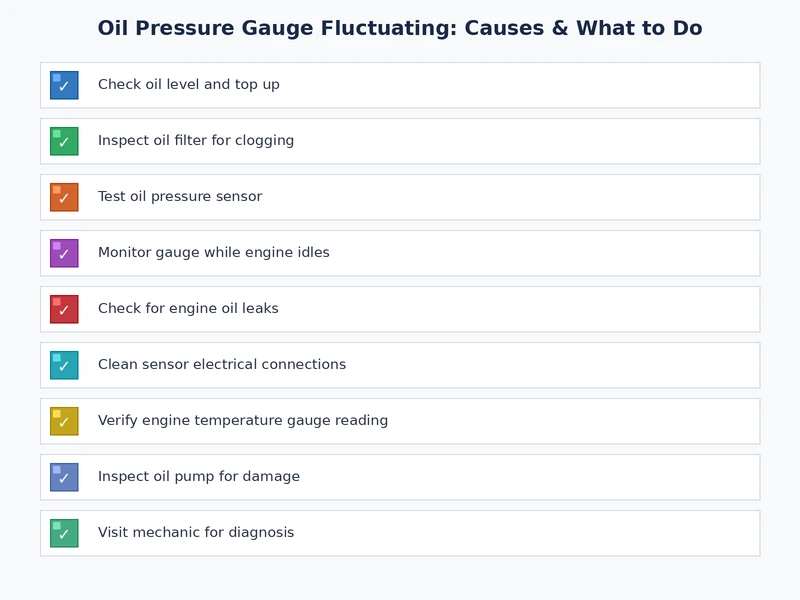
It depends on the cause. A faulty sensor alone isn't immediately dangerous, but driving with genuinely low oil pressure causes rapid engine damage. The safest move is to check the oil level immediately and avoid extended driving until a mechanical gauge test confirms whether actual pressure is affected.
A pressure drop at idle that recovers at higher RPMs typically points to low oil level, a worn oil pump, or worn engine bearings. The oil pump spins faster at higher RPMs and temporarily compensates for the weakness — masking the underlying problem until it gets serious enough to show at all speeds.
Yes. Using the wrong oil viscosity during a service can cause pressure fluctuations. Oil that's too thin flows too freely and reduces measured pressure. Oil that's too thick in cold temperatures creates artificially high readings that drop sharply as the engine reaches operating temperature.
If the cause is a bad sensor, repairs run $50–$150 including parts and labor. An oil pump replacement typically costs $300–$800 depending on the vehicle and labor rates. Worn engine bearings are the most expensive scenario — often $1,500–$4,000 or more depending on the extent of internal damage found during teardown.
Yes, and it happens faster than most people expect. Running with genuinely low oil pressure for even a short time at highway speeds scores bearing surfaces and cylinder walls. Once those metal surfaces are damaged, restoring normal oil pressure won't repair them — only a full rebuild or engine replacement addresses the damage.
Most gasoline engines run between 15 and 30 PSI at idle and 30 to 65 PSI at normal cruising speeds. Readings below 10 PSI at idle are a serious concern. Some modern engines with variable displacement oil pumps run lower by design — always cross-check the specific vehicle's service manual for accurate specifications.
A basic test involves unplugging the sensor connector and using a multimeter to check resistance across the sensor terminals. A fully open or fully shorted reading confirms a dead sensor. The definitive test remains a mechanical gauge comparison — it reads actual hydraulic pressure with no electronics in the chain, making the result impossible to misinterpret.
 |
 |
 |
 |

About Joshua Thomas
Joshua Thomas just simply loves cars and willing to work on them whenever there's chance... sometimes for free.
He started CarCareTotal back in 2017 from the advices of total strangers who witnessed his amazing skills in car repairs here and there.
His goal with this creation is to help car owners better learn how to maintain and repair their cars; as such, the site would cover alot of areas: troubleshooting, product recommendations, tips & tricks.
Joshua received Bachelor of Science in Mechanical Engineering at San Diego State University.
Get some FREE car parts & gear.. Or check out the latest free automotive manuals and build guides here.
Disable your ad blocker to unlock all the hidden deals. Hit the button below 🚗
| | | |
