by Sarah Whitfield
A quiet stretch of highway, engine running smoothly, and then a small amber glow appears on the instrument cluster without warning. Our team has witnessed this scenario hundreds of times, and the pattern is nearly identical across all cases. When the oil pressure light on the dashboard activates, that first moment of indecision can determine whether an engine survives intact or requires a complete rebuild at significant cost.
The oil pressure warning belongs in a different category from routine maintenance reminders and minor sensor notifications. According to Wikipedia's overview of oil pressure in internal combustion engines, the lubrication system must maintain consistent film pressure across all bearing surfaces to prevent metal-to-metal contact and progressive wear. Our broader coverage of common oil pressure light on causes confirms that most engine failures from oil starvation were preceded by a warning the driver dismissed or misread. This guide covers the seven most common causes, proven diagnostic steps, and when this warning demands an immediate stop.
Contents
Engine oil does far more than reduce friction between moving metal surfaces. It forms a pressurized film that separates bearing surfaces from direct contact, preventing the metal-on-metal wear that progresses catastrophically without that protective layer. Our team consistently observes that adequate oil pressure ranks as the most immediately decisive operating parameter in any internal combustion engine, more critical than coolant temperature or fuel mixture in the short term.
The oil pump, driven mechanically by the engine itself, draws oil from the sump and forces it under pressure through passages cast into the block and head. Those galleries route pressurized oil to the crankshaft main bearings, connecting rod bearings, camshaft journals, and valve train components at the top of the engine. Typical operating pressure in a modern passenger car ranges from 25 to 65 PSI at highway speed, dropping to roughly 15 to 25 PSI at a fully warmed idle. When pressure falls below the sensor's threshold — usually 5 to 7 PSI — the warning circuit closes and the light activates on the instrument panel.
The oil pressure warning system uses a sensor mounted in the engine block and connected directly to the lubrication circuit. Most traditional systems use a binary switch that closes the warning circuit when pressure drops below a fixed threshold, rather than reporting precise PSI values to the ECU. This simplicity makes the sensor reliable for detecting dangerous low-pressure conditions, but it cannot distinguish between a failed sender unit and an actual mechanical crisis without additional testing.
Our team notes that many drivers confuse the oil pressure warning with the oil life or oil change reminder, which are entirely separate systems with very different consequences. The dashboard lights meanings guide on our site covers the full range of warning indicators, and the distinction is critical. An oil change reminder can safely wait until the next scheduled service stop, while an oil pressure light on while the engine is running demands investigation immediately without exception.
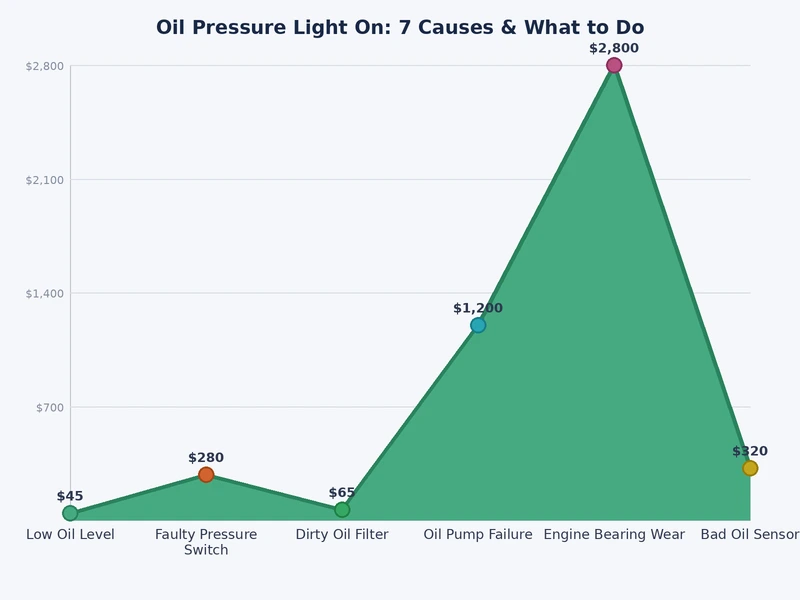
The most frequent cause our team encounters is simply insufficient oil in the crankcase. When the level drops below the minimum mark on the dipstick, the pump begins drawing air along with oil, producing a cavitation condition that interrupts the continuous pressure supply to bearing surfaces. A difference of just one quart below the full mark can reduce effective pressure at higher RPMs, particularly in engines with elevated consumption or worn seals. Checking the dipstick first eliminates this cause quickly, costs nothing, and should always precede any other diagnostic step.
The oil pump wears gradually over time, and internal clearances between its gears or rotors increase with accumulated mileage. As those clearances widen, the pump moves an increasing proportion of oil internally rather than delivering it under pressure to the engine galleries. High-mileage engines are most susceptible to pump wear, with the warning often appearing at idle or in hot conditions when oil viscosity is at its lowest point. Oil pump replacement typically requires removing the oil pan and represents a significant repair rather than a routine service item.
A defective oil pressure sensor accounts for a meaningful share of warning activations that do not reflect actual mechanical problems. The sensor itself corrodes, develops internal electrical faults, or fails mechanically, triggering the warning light even when actual system pressure remains well within specification. Mechanics typically verify actual pressure with a mechanical gauge before condemning any other component — if the gauge reads normal pressure while the warning light remains on, the sensor is the most probable cause. Replacement is inexpensive compared to any internal engine repair that might otherwise be authorized based on the warning alone.
Engine oil that has exceeded its service interval loses viscosity and develops sludge deposits that restrict the narrow passages feeding crankshaft and camshaft bearings. This starvation occurs even when the oil level reads normal on the dipstick, because volume and flow rate are not equivalent to pressure. Our team has documented significant bearing damage in engines with fewer than 60,000 miles, caused exclusively by neglected oil changes — an outcome particularly common in turbocharged applications where oil is exposed to extreme and sustained heat with every cold start.
Oil leaks fall into two categories with meaningfully different diagnostic implications. External leaks — from valve cover gaskets, the oil pan rail, the rear main seal, or the drain plug threads — reduce crankcase level over time until pressure eventually drops below the warning threshold. Internal leaks, such as worn piston rings or a deteriorating head gasket that allows oil to enter the combustion chamber, reduce level without leaving visible evidence beneath the vehicle. The car burning oil symptoms guide identifies the characteristic blue exhaust smoke and consumption patterns that distinguish internal from external leakage sources.
A severely clogged filter restricts flow through the lubrication circuit, forcing the bypass valve to open and route unfiltered oil directly to the engine. When the bypass valve itself becomes restricted or fails to open properly, overall system pressure drops across all lubrication points simultaneously. Extended service intervals on a single filter, using a filter rated for fewer miles than the actual change interval, or oil contaminated with coolant or fuel all contribute to premature restriction. Clogged internal passages from sludge accumulation present a more serious problem because cleaning them often requires engine disassembly, converting a maintenance failure into a major repair bill.
Worn crankshaft and connecting rod bearings represent the most serious cause on this list. Increased bearing clearance allows pressurized oil to escape too rapidly before reaching other lubrication points, dropping system pressure throughout the entire network simultaneously. This condition is most common in very high-mileage engines or those that have experienced a prior episode of oil starvation. When bearing wear is the root cause, the oil pressure warning is frequently accompanied by the deep knocking or rumbling noise detailed in our engine knocking noise causes guide — a combination that mechanics treat as a strong indicator of imminent internal failure requiring prompt action.
Shop warning: When the oil pressure light on appears alongside any metallic knocking from the engine, our team recommends shutting down immediately — running a bearing-starved engine for even a few additional minutes converts a repairable situation into a complete engine replacement.
Our team's position is unambiguous: when the oil pressure warning activates at normal operating temperature, pulling over safely and shutting down the engine is the correct response. Continuing at highway speed with insufficient lubrication pressure can destroy an engine within minutes, turning a manageable problem into a complete engine replacement at several thousand dollars. The oil pressure warning is not a reminder to schedule service — it is a real-time alert that critical engine components may be operating without adequate protection at that exact moment.
An oil pressure warning combined with engine knocking, sudden power loss, or visible smoke from the engine bay constitutes a mechanical emergency requiring immediate shutdown. Our team also notes that engines showing these combined symptoms should not be restarted until a professional inspection confirms the cause. Even brief additional running can convert a repairable problem into an irreparable one when bearing starvation is involved, and the financial consequences of that distinction are substantial.
Not every oil pressure warning activation represents an immediate catastrophe, and recognizing lower-risk scenarios prevents unnecessary panic alongside unnecessary engine damage. A warning that illuminates briefly at idle and extinguishes as RPMs rise often indicates borderline low oil level rather than a critical mechanical failure. This situation still warrants checking the dipstick at the next safe stopping point rather than continuing to drive without investigation, because the margin between borderline and critically low narrows quickly with additional mileage.
A warning that activates only during hard cornering or aggressive braking frequently relates to oil sloshing away from the pump pickup in a low crankcase, again pointing to oil level as the primary variable. A brand-new warning in a vehicle with a recent, verified oil change and no prior symptoms deserves sensor verification before assuming internal mechanical failure. Our team consistently recommends carrying a spare quart of the correct specification engine oil as standard practice, ensuring that any borderline level condition can be addressed immediately without requiring a tow to the nearest shop.
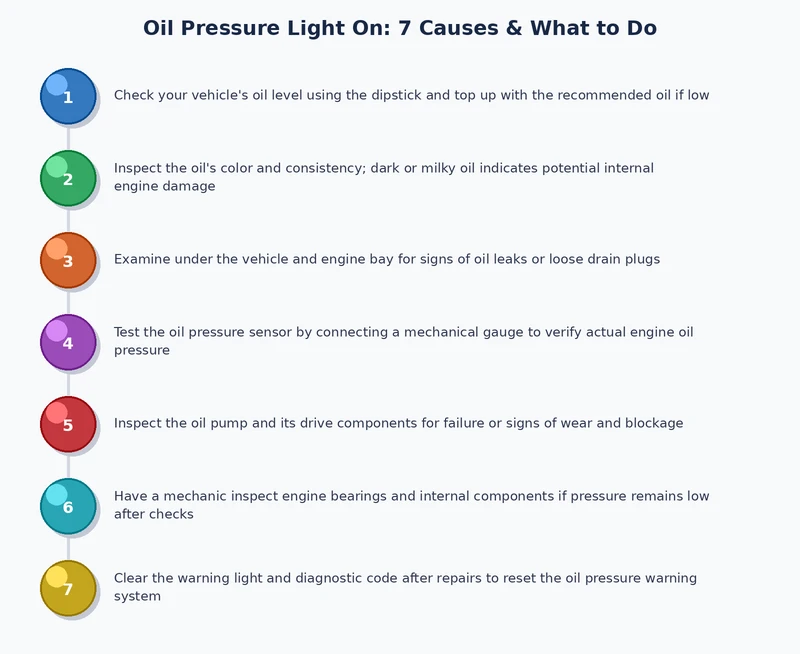
The diagnostic sequence our team follows starts at the most accessible and least costly possible cause. The first step is checking the oil level on the dipstick with the engine off and the vehicle parked on level ground. If the level reads low, adding oil to bring it to the full mark and then restarting the engine eliminates the low-level cause within seconds. If the warning extinguishes after adding oil and the level was significantly depleted, identifying the source of that oil loss becomes the next immediate priority.
That investigation follows the framework in the car burning oil symptoms overview, which distinguishes external leakage from internal consumption through exhaust characteristics and consumption rate. If the oil level reads normal, the next check is oil condition itself. Fresh oil on the dipstick should appear amber and translucent; black, gritty, or milky oil indicates contamination or extreme degradation that can reduce pressure even at a correct volume. Oil that appears frothy or unusually light in color suggests coolant intrusion — a head gasket concern that carries its own urgency beyond the pressure warning alone.
Any situation where the oil level reads normal, the condition appears acceptable, and the warning persists after restart requires a mechanical oil pressure gauge test performed by a qualified technician. This test bypasses the sensor entirely and reads actual system pressure directly from the lubrication circuit. If actual pressure reads within specification while the warning light remains on, the sender unit is replaced as the definitive cause. If actual pressure reads below specification, the diagnostic path moves to the oil pump, then the internal passages, and ultimately the engine bearings in sequence.
Our team has found that many drivers who experience the oil pressure warning without obvious causes benefit from a full lubrication system inspection during that same visit. That inspection frequently reveals developing pump wear well before it reaches a critical failure point, catching the problem at a repair cost of hundreds of dollars rather than the thousands required once the pump fails completely and bearing damage accumulates.
One of the most common cases our team has reviewed involves a driver who noticed the oil pressure warning illuminate during a long highway drive. That driver dismissed it as a likely sensor glitch and continued for another 45 minutes before the engine seized completely. Post-inspection revealed the crankshaft bearings had spun — a failure mode in which bearing shells rotate within their bore and block oil passages entirely, preventing any further lubrication regardless of oil level or pump condition. The vehicle had consumed approximately two quarts since the last service, dropping below the pump pickup threshold at highway RPMs, and the final repair estimate reached $6,200 for a remanufactured engine installation. A single dipstick check and one quart of oil at any rest stop along the route would have prevented the failure entirely.
Cases like this are not rare in our documentation, and they share a consistent pattern: the warning appeared, was dismissed, and the engine damage was irreversible within a relatively short additional driving period. The same failure pattern often precedes the engine knocking and loss of power that drivers report noticing only moments before the engine stops responding, suggesting the bearing damage had been progressing for some time before those secondary symptoms became perceptible.
On the opposite end of the severity spectrum, our team documented a late-model sedan whose oil pressure warning activated without any accompanying noise, smoke, or power loss. A mechanical gauge test revealed actual oil pressure of 42 PSI — well within normal operating range — while the warning circuit remained closed and the dashboard light stayed on. The cause was a failed oil pressure sender unit costing $28 to replace, and the repair resolved the warning permanently without any additional engine work. This case illustrates why the mechanical gauge test is the critical branch point in any oil pressure diagnostic, definitively separating a $28 electrical fault from a multi-thousand-dollar internal repair before any significant labor is committed. Our team treats this test as non-negotiable before authorizing any internal engine work based on a warning light alone.
Several dashboard warning lights generate confusion because their icons and coloring appear similar under the stress of an unexpected activation. Our team assembled the following comparison to clarify how the oil pressure warning differs from related alerts most commonly misidentified in real cases.
| Warning Light | What It Monitors | Typical Cause | Stop Immediately? | Typical Repair Range |
|---|---|---|---|---|
| Oil Pressure | Lubrication system pressure | Low oil, pump failure, sensor | Yes — in most cases | $28–$6,000+ |
| Oil Change Reminder | Calculated oil life percentage | Service interval exceeded | No — schedule soon | $35–$120 |
| Battery Light | Charging system voltage | Alternator, drive belt, battery | Drive to nearest shop | $100–$650 |
| Engine Temperature Warning | Coolant temperature | Low coolant, thermostat, water pump | Yes — overheating risk | $150–$1,800 |
| StabiliTrak / Stability Control | Traction and stability systems | Wheel speed sensor, steering angle sensor | No — system deactivated | $80–$900 |
The comparison highlights a critical point. The oil pressure warning is the only common dashboard alert capable of producing irreversible engine damage within minutes of activation while the vehicle remains in motion. All other warnings in this comparison allow additional driving time to reach a service facility safely, provided the driver monitors accompanying symptoms and does not delay excessively. That distinction in urgency is what makes the oil pressure warning unique among the cluster of alerts most drivers encounter during a vehicle's lifetime.
Our team's experience across thousands of documented cases points consistently to a small set of maintenance practices that prevent oil pressure problems from developing in the first place. Adhering to the manufacturer's recommended oil change interval, using the specified viscosity grade for the application, is the single most impactful preventive measure available to any vehicle owner. Modern full-synthetic oil resists viscosity loss and sludge accumulation far better than conventional alternatives, protecting the passages that feed critical bearings throughout the engine's operating life.
Checking the oil level monthly, regardless of the service interval, catches consumption trends before they reach dangerous thresholds. Our team recommends documenting each reading so that a pattern — such as losing a quart every 1,500 miles — prompts professional investigation before levels drop to a critical point. Addressing any identified leak promptly, whether from a valve cover gasket or a more serious internal source, prevents the gradual depletion that catches most drivers completely off guard. The same disciplined maintenance approach that prevents oil pressure failures also catches early symptoms covered in our guides to hesitation during acceleration and cooling system failures — both of which share a common thread of deferred fluid and filter maintenance that compounds over time.
 |
 |
 |
 |

About Sarah Whitfield
Sarah Whitfield is a diagnostics and troubleshooting specialist who spent ten years as an ASE-certified technician before joining the editorial team. She specializes in OBD-II analysis, electrical gremlins, and the kind of intermittent problems that make most owners give up.
Get some FREE car parts & gear.. Or check out the latest free automotive manuals and build guides here.
Disable your ad blocker to unlock all the hidden deals. Hit the button below 🚗
| | | |
