by Joshua Thomas
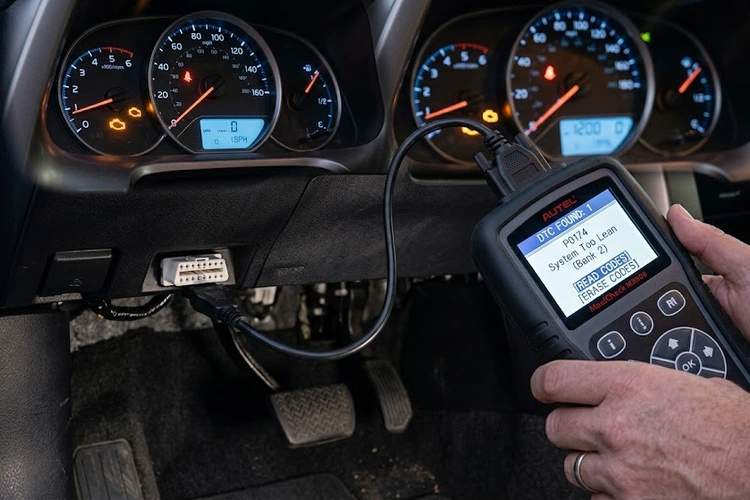
A customer brought in a late-model Ford F-150 last spring, convinced the engine was finished. The truck stumbled at idle, hesitated under load, and the check engine light had been glowing for weeks. We plugged in the scan tool and found it quickly — P0174. Understanding the p0174 code causes is exactly what prevented an expensive and unnecessary engine teardown that day.
The P0174 code signals that Bank 2 of the engine — the cylinder bank on the opposite side from cylinder number one — is running too lean. "Lean" means too much air and not enough fuel in the combustion chamber. This is one of the most common codes we encounter on the check engine light diagnostic list, and the good news is that most underlying causes are straightforward to fix once properly identified.
Contents
The engine control module (ECM — the car's main computer) monitors the air-fuel ratio continuously using oxygen sensors mounted in the exhaust. The target mixture is 14.7 parts air to 1 part fuel, a ratio known as stoichiometric. When the ECM detects that Bank 2 is persistently running lean and has exhausted its fuel trim correction range — meaning it has added as much extra fuel as the system allows and the mixture is still off — it stores the P0174 fault code.
Bank 2 is the cylinder bank on the opposite side from cylinder number one. On a V6 or V8 engine, this matters because oxygen sensors, fuel injectors, and vacuum ports are split across two separate banks. Four-cylinder engines have only one bank, so P0174 is exclusive to V6, V8, and larger multi-bank configurations.
P0174 frequently appears alongside P0171 (System Too Lean, Bank 1). When both codes show up together, the problem almost certainly involves a shared component — a failing fuel pump, a clogged fuel filter, or a large vacuum leak affecting the entire intake system upstream of both banks. According to the U.S. Environmental Protection Agency, a lean-running engine produces elevated nitrogen oxide (NOx) emissions, which can trigger a failed emissions inspection.
Running lean raises combustion temperatures significantly above the normal range. Those elevated temperatures stress pistons, exhaust valves, and the catalytic converter. Over time, pre-detonation — more commonly called engine knock — becomes a serious risk, and knock is mechanically destructive. It pounds on piston rings, rod bearings, and cylinder walls with every combustion cycle. Our team has seen P0174 codes that owners delayed fixing for months, ultimately resulting in repair bills many times higher than the original root cause would have cost to fix.
The signs of a lean condition are hard to ignore once they begin escalating. Rough idle, reduced fuel economy, hesitation under acceleration, and a noticeable loss of power are the primary complaints. Some vehicles stall at low speeds or struggle to start when cold. The longer a lean condition runs uncorrected, the greater the risk of catalytic converter damage — converter replacement is not an inexpensive repair on most vehicles, running several hundred dollars at minimum.
Start with a reliable OBD-II scan tool. Confirm the P0174 code, check for companion codes like P0171, P0172, or any MAF-specific fault codes, and review the freeze frame data — the snapshot of engine conditions captured at the moment the code was stored. The freeze frame tells our team whether the lean condition appears at idle, under load, or all the time. That distinction alone narrows the diagnosis considerably before touching a single component.
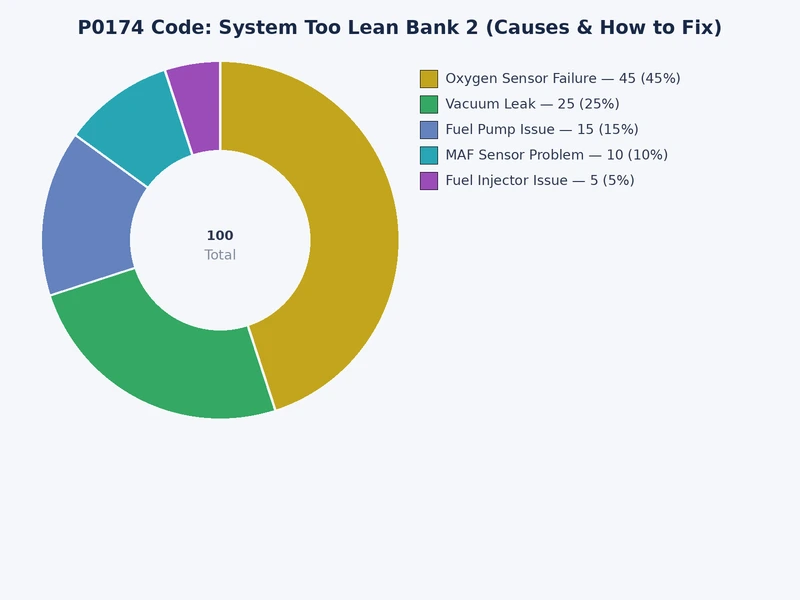
Vacuum leaks are the single most common cause of P0174 in our experience. A thorough inspection covers all vacuum hoses, the intake boot between the air filter housing and throttle body, intake manifold gaskets, and the PCV (positive crankcase ventilation) system hose. A cracked or loose intake boot is a classic offender — it allows unmetered air into the intake past the MAF sensor, and the ECM has no way to compensate for air it cannot measure.
A smoke machine is the fastest and most reliable way to find vacuum leaks — our team pumps smoke into the intake with the engine off and watches for wisps escaping from cracks or loose connections. Spraying carburetor cleaner around intake joints carries a real fire risk and is not a method our team uses.
A dirty or failing MAF (mass airflow) sensor is a close second behind vacuum leaks as a P0174 trigger. It transmits incorrect airflow data to the ECM, which then miscalculates how much fuel to inject. Spraying dedicated MAF cleaner on the sensor wire is the low-cost first move. If cleaning does not resolve the issue, checking fuel pressure is the logical next step. A weak fuel pump or clogged fuel filter reduces fuel delivery to both banks, producing exactly the lean condition that P0174 describes.
Ford F-150, Explorer, and Expedition models with 4.6L and 5.4L V8 engines are especially prone to P0174. Cracked intake manifold gaskets, failed DPFE sensors, and deteriorating intake air hoses are recurring issues on these platforms. The plastic intake manifolds on certain Ford V8s can develop hairline cracks that are nearly invisible to the naked eye but allow enough air infiltration to drive Bank 2 consistently lean.
The 1GR-FE V8 found in 4Runner, Tacoma, and Sequoia models commonly develops P0174 from a dirty MAF sensor or a cracked air intake hose between the airbox and throttle body. These are typically straightforward repairs — a clean MAF sensor and a fresh hose seal the issue in most cases.
GM's 3.8L V6 and 5.3L V8 engines see P0174 primarily from intake manifold gasket failures and aged vacuum line deterioration. The 3.8L V6 is particularly notorious for intake manifold gasket leaks that worsen gradually, producing a lean condition that creeps up over thousands of miles before setting a fault code.
| Cause | Bank Affected | Common Symptom | Repair Difficulty | Estimated Cost |
|---|---|---|---|---|
| Vacuum leak (hose or gasket) | Bank 2 or both | Rough idle, high idle RPM | Easy–Medium | $20–$150 |
| Dirty or failing MAF sensor | Both banks | Poor fuel economy, hesitation | Easy | $10–$200 |
| Low fuel pressure (pump or filter) | Both banks | Stumble under load, stalling | Medium | $50–$700 |
| Clogged fuel injector (Bank 2) | Bank 2 | Misfire, hesitation | Medium–Hard | $100–$400 |
| Failed PCV valve or hose | Both banks | Rough idle, increased oil use | Easy | $15–$50 |
| Intake manifold gasket leak | Bank 2 or both | Coolant loss, rough idle | Hard | $400–$900 |
A contaminated MAF sensor is responsible for a large portion of P0174 codes our team diagnoses. A can of dedicated MAF sensor cleaner costs around $10 and the job takes about 15 minutes. Remove the sensor, spray lightly and directly on the sensing wire, let it dry completely before reinstalling, and clear the codes. Our team has resolved P0174 with this step alone more times than we can count — it is always the first thing to try before spending money on other parts.
A severely clogged air filter can distort MAF sensor readings and trigger a lean code on some systems. It takes about two minutes to check. If the filter looks gray, packed with debris, or well past its service interval, swapping it out is worth doing regardless of whether it turns out to be the root cause of P0174.
A stuck-open PCV valve or cracked PCV hose introduces unmetered air directly into the intake manifold. These are inexpensive parts and fast to replace. Ignoring a failed PCV system also leads to spark plug fouling over time — oil mist drawn through a broken PCV hose coats the plugs and compounds the running problems significantly.
Routine filter maintenance is the simplest prevention available. A clean air filter keeps the MAF sensor reading accurately. A fresh fuel filter maintains the pressure that proper fueling depends on. On older vehicles with inline fuel filters, most manufacturers recommend replacement every 30,000 miles — many owners skip this step entirely and are surprised when lean codes and fuel delivery problems eventually appear. Staying ahead of this service interval is far cheaper than diagnosing the downstream problems it causes.
Rubber ages, cracks, and shrinks — especially under the heat cycling of an engine bay. Our team inspects intake boot connections and vacuum lines every time the hood is open for a routine oil change. Catching a hairline crack before it opens into a gap prevents P0174 from ever triggering. These inspections take under two minutes and cost nothing. It is one of the most effective preventive habits available to anyone who does their own maintenance.
Cleaning the MAF sensor, replacing the air filter, swapping the PCV valve and hose, and replacing cracked vacuum lines or intake boot hoses are all accessible repairs for anyone comfortable with basic hand tools. No special equipment is needed. Parts are inexpensive. Our team's general rule: if the fix costs under $50 in parts and takes under an hour, trying it at home first is the smart move.
If the quick fixes do not clear P0174, the diagnosis gets more demanding. Fuel injector flow testing, fuel pump pressure testing under load, and professional smoke machine leak testing require proper equipment and real diagnostic experience. Misdiagnosing at this stage — replacing the wrong parts — costs far more than a professional diagnostic fee.
When P0174 appears alongside codes like P0128 (coolant temperature below thermostat threshold) or misfires pointing toward bad piston rings, the combination needs a trained eye. Similarly, when a car won't accelerate from a stop alongside a lean code, the condition has likely progressed far enough to affect multiple systems — a comprehensive shop diagnosis is the appropriate next step.
Basic P0174 repairs — MAF cleaning, air filter, PCV valve, vacuum hose — run $20 to $150 in parts. Fuel pump replacement typically costs $300 to $700 depending on vehicle and whether the work is done at home or a shop. Intake manifold gasket repair on a V8 can reach $400 to $900. Getting the diagnosis correct the first time is the single most effective way to keep costs on the lower end of those ranges.
Yes. A lean-running engine produces elevated nitrogen oxide (NOx) emissions. In states with active emissions testing programs, P0174 can trigger a failure both from the stored fault code and from elevated tailpipe readings. Resolving the root cause is necessary before a vehicle will pass inspection.
Short distances are generally manageable, but extended driving with a lean condition accelerates wear on pistons, valves, and the catalytic converter. Our team recommends diagnosing and resolving P0174 promptly rather than treating it as a low-priority issue.
A faulty O2 sensor influences the ECM's fuel trim calculations, but oxygen sensors do not cause a genuinely lean condition on their own. A bad O2 sensor typically stores its own specific codes alongside or instead of P0174. The lean condition itself almost always has a physical root cause — vacuum leak, fuel delivery issue, or MAF sensor failure.
Not always. Vacuum leaks are the most common cause, but a weak fuel pump, dirty MAF sensor, clogged fuel injector, or failing fuel pressure regulator can all produce P0174 without any vacuum leak present. Freeze frame data and a methodical diagnostic process are the only reliable way to confirm which cause applies.
The cost depends entirely on the root cause. MAF sensor cleaning costs around $10 in supplies. Vacuum hose repairs typically run $20 to $50. Fuel pump replacement averages $300 to $700 including labor. Getting the diagnosis right the first time is the most important cost-saving step in the entire process.
P0174 is almost never the catastrophic problem it feels like at first — find the air leak or the weak fuel delivery, fix it properly, and the engine runs exactly as it should.
 |
 |
 |
 |

About Joshua Thomas
Joshua Thomas just simply loves cars and willing to work on them whenever there's chance... sometimes for free.
He started CarCareTotal back in 2017 from the advices of total strangers who witnessed his amazing skills in car repairs here and there.
His goal with this creation is to help car owners better learn how to maintain and repair their cars; as such, the site would cover alot of areas: troubleshooting, product recommendations, tips & tricks.
Joshua received Bachelor of Science in Mechanical Engineering at San Diego State University.
Get some FREE car parts & gear.. Or check out the latest free automotive manuals and build guides here.
Disable your ad blocker to unlock all the hidden deals. Hit the button below 🚗
| | | |
