by Joshua Thomas
Misfires account for nearly one in three engine-related service visits at independent shops — and the P0300 code random misfire sits at the center of that statistic. Unlike P0301 through P0308, which finger a single cylinder, P0300 fires when the ECM detects misfires cycling across multiple cylinders with no consistent pattern. That randomness is exactly what separates this code from a straightforward ignition swap and turns diagnosis into a methodical process.
The P0300 is classified under SAE OBD-II standards as "Random/Multiple Cylinder Misfire Detected." The ECM monitors crankshaft rotational acceleration between each power stroke. Any measurable deceleration beyond a calibrated threshold increments the misfire counter. When no single cylinder dominates the pattern, the ECM logs P0300 — sometimes alongside individual P030X codes that reveal which cylinders are contributing the most.
Our team covers the full range of engine misfire symptoms in a dedicated guide. This article focuses tightly on the P0300 diagnostic path: what causes it, how to diagnose it accurately, what tools the job actually requires, and what realistic repair costs look like.
Contents
P0300 is a generic OBD-II powertrain code. "Generic" means the diagnostic logic applies to every fuel-injected vehicle sold since 1996, regardless of make or model. It does not mean the fault is simple — it means the detection method is standardized while the root cause remains wide open.
The crankshaft position sensor (CKP) is the ECM's primary misfire detection tool. Between each power stroke, the crankshaft should accelerate within a predictable velocity window. An incomplete or absent combustion event produces a measurable deceleration. The ECM counts misfire events over two windows: a 200-revolution window for catalyst damage detection and a 1,000-revolution window for emissions monitoring.
When misfire counts exceed calibrated thresholds across multiple cylinders, P0300 is stored. If the misfire rate is severe enough to damage the catalytic converter, the check engine light flashes rather than illuminating steadily. That flashing CEL changes the urgency of the situation significantly.
P0301 through P0308 indicate a dominant misfiring cylinder. P0300 indicates either a genuinely distributed pattern or a root cause affecting the entire engine uniformly — such as low fuel pressure, a vacuum leak, or a timing deviation. In our experience, P0300 frequently appears alongside one or more cylinder-specific codes simultaneously. That combination is actually more informative than either code alone; the dominant cylinder code narrows the diagnosis while P0300 suggests a systemic contributor exists.
Symptoms that accompany P0300 include rough idle, hesitation under acceleration, reduced fuel economy, and an intermittent stumble that worsens under load or during cold starts. Some engines exhibit a vibration that varies with RPM — a feel that distinguishes misfire from other driveability complaints.
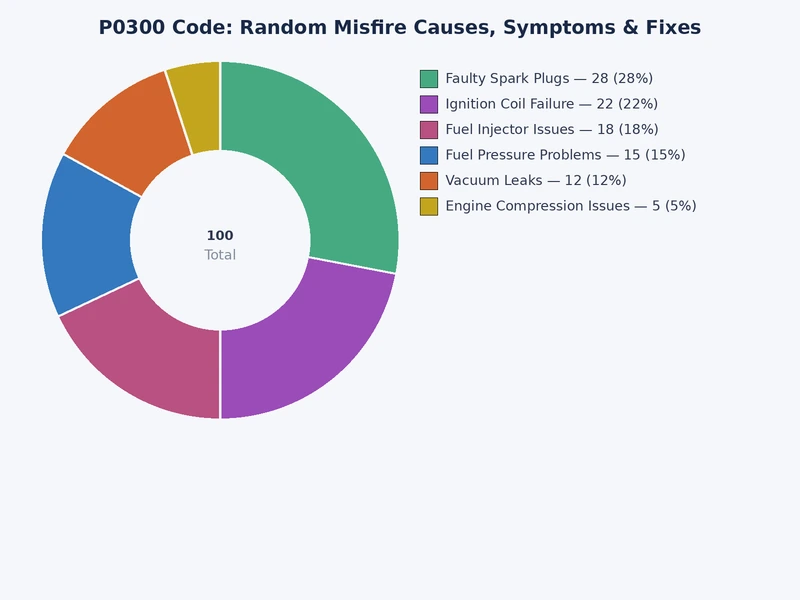
The P0300 code random misfire can originate from any point in the ignition, fuel, or compression systems. Our diagnostic workflow always starts with the most statistically common and most accessible causes before moving deeper into the engine.
Worn spark plugs are the single most common P0300 cause in high-mileage engines. Platinum and iridium plugs last longer than copper, but electrode gap erosion still produces intermittent misfires before total failure. The behavior is often heat-sensitive — plugs that fire normally during a cold start misfire once the engine reaches operating temperature and the gap expands further.
Ignition coil failures on coil-on-plug (COP) systems produce exactly the kind of multi-cylinder random pattern that P0300 describes. A coil that passes a basic resistance test can still fail under thermal stress or high voltage demand. Plug wire carbon tracking on older distributorless systems is a similar failure mode — easiest to spot in a dark engine bay where corona discharge becomes visible at night.
A weakening fuel pump that cannot sustain adequate rail pressure under load creates lean misfires simultaneously across all cylinders. The ECM sees no dominant cylinder and logs P0300. This failure mode worsens with a hot engine and high fuel demand — highway acceleration or climbing grades are typical trigger conditions.
Clogged fuel injectors create lean combustion events in individual cylinders. When multiple injectors are restricted, the pattern spreads and mimics a random misfire. A dirty throttle body compounds lean misfire conditions by disrupting metered airflow at idle and low load — a common tag-team cause of P0300 on higher-mileage naturally-aspirated engines.
Low compression prevents complete combustion regardless of spark quality or fuel delivery. Worn piston rings, a failing head gasket, bent valves, or a burnt valve seat all produce the same downstream effect: incomplete combustion and a misfire event. Head gasket failures that allow coolant infiltration into one or more cylinders produce aggressive misfires and often generate P0300 alongside white exhaust smoke and rising coolant reservoir pressure.
Timing chain stretch on high-mileage engines retards valve timing relative to the crank, reducing effective compression and disrupting fuel delivery synchronization. Our team has traced multiple P0300 diagnoses directly to timing system wear — the full symptom profile for that failure mode is covered in our timing chain noise guide. EGR valve sticking open and cracked intake manifold gaskets round out the mechanical causes by introducing unmetered air that leans out affected cylinders.
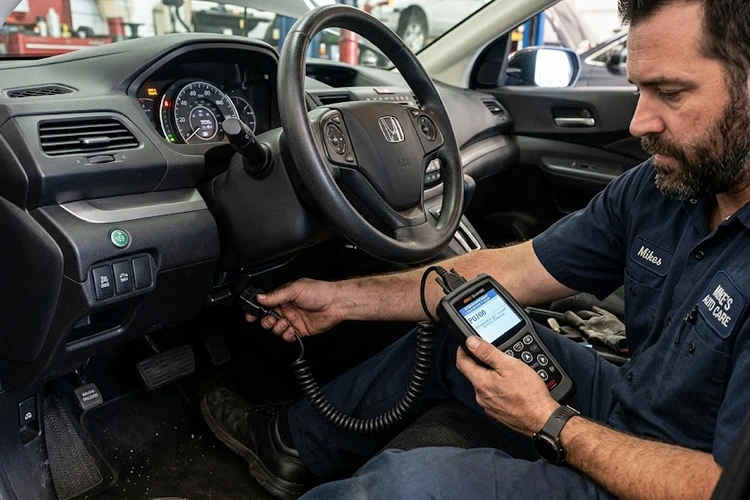
A basic code reader retrieves the P0300 fault number and nothing else useful. Accurate P0300 diagnosis requires an enhanced scanner capable of:
Our team uses mid-range professional units (Autel MaxiSys, Launch X431) for P0300 work. Individual cylinder misfire counters alone often narrow a "random" misfire down to two or three cylinders within a single test drive — before a single component is touched.
A standard compression tester ($30–$60) belongs in every diagnostic setup. Any cylinder reading more than 15% below the average across all cylinders warrants further investigation. A leak-down tester pressurizes each cylinder at TDC and identifies the leak path by listening — rings, valves, or head gasket — without pulling the head.
A fuel pressure gauge with a Schrader valve adapter confirms whether rail pressure holds steady under load versus dropping off. A vacuum gauge provides a rapid engine health snapshot in under two minutes, revealing valve timing issues, intake leaks, and compression problems through characteristic needle behavior.
Our team checks individual cylinder misfire counters on a live scan before pulling a single plug. In roughly 40% of P0300 cases, the so-called random misfire has one or two dominant cylinders hiding behind the noise — and that changes the entire repair strategy.
Data first, disassembly second. The freeze frame captured at the P0300 event contains RPM, engine load, coolant temperature, throttle position, and fuel trim values at the moment of fault. These parameters define the diagnostic direction before anything physical is inspected:
After freeze frame review, a basic visual inspection covers the obvious: cracked vacuum lines, corroded coil connectors, broken plug wires, and coolant seepage around the head gasket. Spark plug color on removal — ash-white for lean, sooty black for rich, oily for compression bypass — provides a fast combustion quality snapshot per cylinder.
A cylinder contribution test cuts fuel delivery to each cylinder in sequence while monitoring RPM drop. A cylinder producing no RPM drop when cut is already not contributing power — the misfire cylinder reveals itself without any guesswork.
For COP ignition systems, swapping suspect coils to adjacent cylinders and re-scanning is the fastest confirmation method. If a P030X code migrates with the coil, the coil is the fault. This costs nothing and eliminates oscilloscope analysis for the majority of cases. Injector swapping follows identical logic — move the injector to a known-good cylinder and watch whether the misfire counter follows it.
If misfire counters show no dominant cylinder and all ignition and fuel components pass testing, compression testing is the logical next step. Engines that run cold consistently can mask lean misfire patterns through abnormal fuel trim compensation; our guide on engine running cold covers the coolant temperature feedback loop that creates those diagnostic false floors.
Spark plug replacement is straightforward on most inline-4 and V6 engines with unobstructed plug access. Ignition coil replacement on COP systems typically requires only a 10mm socket and a connector release clip. These two repairs cover the majority of P0300 cases and both sit well within DIY capability.
The following repairs are routinely completed without professional equipment:
Direct-injection fuel injectors sit under high pressure inside the cylinder head. Replacement requires proper fuel system depressurization, injector bore sealing, and torque sequencing that exceeds casual DIY. Timing chain service, head gasket replacement, and EGR system work require a lift, specific tooling, and manufacturer-level procedures.
Diagnosis itself is where the DIY boundary gets tested most. Interpreting live cylinder misfire data, running contribution tests, and correlating fuel trim patterns requires scanner software that costs considerably more than most home mechanics invest. Our team has encountered multiple cases where all eight coils and plugs were replaced as a parts-swap attempt when the actual fault was low fuel pump pressure. A professional diagnostic fee is almost always cheaper than that approach.
A flashing check engine light means the misfire rate has crossed the threshold for catalytic converter damage. Raw, unburned fuel entering the exhaust overheats the converter substrate and destroys it from the inside. Catalytic converter replacement runs $800–$2,500 depending on vehicle and configuration — substantially more than the ignition or fuel repair underneath it. A flashing CEL is an immediate stop condition.
Continued operation with a severe P0300 misfire also risks oil contamination from fuel wash-down on cylinder walls, bearing wear from uneven combustion pulses, and potential hydrolock if coolant is the underlying cause.
A steady (non-flashing) P0300 with no noticeable driveability degradation permits limited operation to reach a shop. "Limited" means short, low-load trips — not extended highway driving. If the engine stumbles, hesitates, or produces vibration felt through the seat or steering wheel, parking it is the only correct decision.
Our team's position on this is unambiguous: a flashing CEL means stop now, every time, without exception. The math never works in favor of continuing to drive.
The final repair cost for a P0300 depends entirely on the root cause. Ignition service is inexpensive. Head gasket work is not. The table below covers the most common P0300 repair scenarios with realistic cost ranges for parts and labor at independent shops.
| Repair | Parts Cost | Labor (hrs) | Estimated Total |
|---|---|---|---|
| Spark plugs — 4-cylinder | $20–$60 | 0.5–1 | $80–$175 |
| Spark plugs — V6 / V8 | $40–$120 | 1–3 | $140–$420 |
| Ignition coil (COP, each) | $30–$80 | 0.5 | $90–$200 |
| Fuel injector cleaning (full set) | $50–$100 | — | $50–$100 |
| Fuel injector replacement (set) | $150–$500 | 2–5 | $350–$1,100 |
| Fuel pump replacement | $200–$600 | 2–4 | $400–$1,100 |
| Timing chain kit | $200–$800 | 6–15 | $1,000–$2,800 |
| Head gasket replacement | $400–$1,500 | 8–20 | $1,500–$3,800 |
Most independent shops charge $100–$150 for a diagnostic scan and inspection. Some apply that toward the repair cost; others treat it as a separate line item. Our team recommends confirming the policy before authorizing any work — it matters at the higher-cost end of the repair spectrum.
At the complex end — head gaskets, timing chains, injector sets — dealership labor rates run 30–50% above independent shop rates. Parts quality matters significantly at this level. OEM or OEM-equivalent components reduce the probability of repeat failures. Installing economy-tier ignition components on a vehicle that demands premium-spec coils is a reliable path back to P0300 within 12,000 miles.
P0300 is an OBD-II diagnostic trouble code defined as "Random/Multiple Cylinder Misfire Detected." The ECM uses crankshaft velocity data to detect incomplete combustion events. When misfires occur across multiple cylinders without a dominant pattern, P0300 is stored instead of — or alongside — a cylinder-specific code like P0301 or P0302.
A steady check engine light with mild symptoms permits limited, short-distance driving to reach a shop. A flashing check engine light indicates a misfire rate severe enough to damage the catalytic converter — that demands an immediate stop. Continued driving with a severe P0300 risks converter destruction, oil contamination, and accelerated engine wear.
Worn spark plugs and failing ignition coils account for the majority of P0300 cases across all engine types. Ignition system degradation is both the most statistically frequent cause and the most accessible starting point for diagnosis. Fuel delivery and compression faults are less common but more expensive to repair when they are the root cause.
Not always, but spark plugs are the correct first diagnostic step on any high-mileage engine. If plugs and coils are within service life and in good condition, the diagnosis moves to fuel delivery — fuel pressure, injector flow, and throttle body condition — followed by compression testing if fuel system components check out.
A failing mass airflow sensor can contribute to P0300 by providing inaccurate airflow data to the ECM, which disrupts fuel trim calculations and creates lean conditions across all cylinders. MAF sensor faults typically show as fuel trim deviations in live data. Cleaning the MAF element with electronics-safe spray resolves contamination-related issues before replacement is considered.
P0300 returning after a plug service usually means the root cause was not the plugs — or that a secondary fault was missed. Ignition coils that were borderline at plug replacement time often fail shortly after. Low fuel pressure, a vacuum leak, or the early stages of a compression fault can also survive a plug service and continue producing misfires.
Repair cost depends entirely on the root cause. A spark plug service runs $80–$420 depending on engine configuration. Ignition coil replacement adds $90–$200 per coil. Fuel pump replacement runs $400–$1,100. Head gasket and timing chain repairs reach $1,000–$3,800. A proper diagnosis before parts replacement is the most cost-effective approach in every scenario.
Severely low oil can indirectly contribute to misfires by affecting hydraulic valve lifters on engines that use them, causing valve timing disruption and inconsistent compression. Variable valve timing systems that rely on oil pressure for cam phaser operation are particularly susceptible. Low oil is not a direct misfire cause, but it is a legitimate contributing factor worth checking early in any P0300 diagnosis.
The P0300 code random misfire is not a mystery — it is a process: follow the data, test systematically, and the root cause always surfaces before the parts bill gets out of hand.
 |
 |
 |
 |

About Joshua Thomas
Joshua Thomas just simply loves cars and willing to work on them whenever there's chance... sometimes for free.
He started CarCareTotal back in 2017 from the advices of total strangers who witnessed his amazing skills in car repairs here and there.
His goal with this creation is to help car owners better learn how to maintain and repair their cars; as such, the site would cover alot of areas: troubleshooting, product recommendations, tips & tricks.
Joshua received Bachelor of Science in Mechanical Engineering at San Diego State University.
Get some FREE car parts & gear.. Or check out the latest free automotive manuals and build guides here.
Disable your ad blocker to unlock all the hidden deals. Hit the button below 🚗
| | | |
