by Sarah Whitfield
Last winter, our team encountered a vehicle that had been left on a steep residential driveway for three weeks during a particularly brutal cold snap — and when the owner finally returned, the parking brake cable had seized completely solid, refusing to release regardless of how aggressively the lever was cycled. The cable had corroded into a near-rigid structure, binding the rear drums hard against the shoes and leaving the car entirely immovable. Situations like that one illustrate precisely why recognizing and addressing a parking brake cable seized condition quickly matters so much to any technician or serious DIY mechanic. This guide pulls together everything our team has documented across dozens of real-world cable seizure cases, from early stiffness through complete lockup.
A seized parking brake cable is one of the most deceptively simple failures in a vehicle's braking system — the component costs very little, yet neglect transforms it into a problem that can immobilize a vehicle entirely or, in the opposite failure mode, allow it to roll freely when it should hold firm. Our team treats this component with the same urgency applied to any safety-critical brake part, because the consequences of getting it wrong in either direction are significant. For broader context on related brake issues, our comprehensive resource on parking brake not holding covers the full spectrum of parking brake failures alongside cable seizure specifically.
Contents
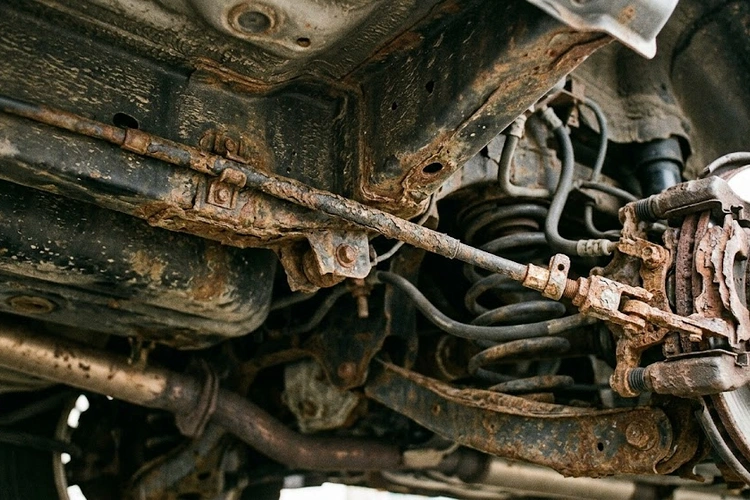
The parking brake cable is a braided steel wire running inside a polymer-lined conduit, transmitting mechanical force from the cabin lever or foot pedal down to the rear brake assembly. The environment this cable occupies, however, is one of the harshest zones on the entire vehicle — directly exposed to road spray, exhaust heat, and standing water in the undercarriage.
Moisture infiltration is the primary driver behind virtually every parking brake cable seized failure our team has investigated. Water enters through cracked conduit end caps, damaged housing sections, or degraded seals at the brake assembly junction, then becomes trapped inside the conduit with no effective path to escape. The confined moisture accelerates oxidation of both the braided wire and the conduit's interior walls, producing iron oxide deposits that progressively reduce the clearance between the wire and its housing. In climates where road salt is applied seasonally, this process accelerates by a factor of three to five compared to dry-climate vehicles, which explains why seizure problems are disproportionately concentrated in northern and coastal regions.
Leaving a parking brake engaged for extended periods without use is a well-documented pathway to full seizure, particularly in humid or cold environments. Our team consistently advises against leaving the parking brake set on stored vehicles for longer than two weeks in damp conditions, because moisture accumulates precisely at the contact zones where tension holds wire and conduit in sustained contact. On drum brake systems especially, the brake shoes can bond directly to the drum surface after prolonged contact — a problem our team examined in depth in our guide on drum brake noise causes and symptoms — which compounds cable seizure by adding mechanical resistance beyond the cable itself and requiring substantially more lever force to release.
Repeated thermal expansion and contraction from normal vehicle operation degrades the polymer inner liner of the cable conduit over time, creating irregular friction surfaces that grip rather than guide the wire during actuation. The outer sheath develops micro-cracks from UV exposure and heat cycling, admitting moisture at the transition points between protected and exposed cable sections — exactly where seizure typically initiates first.
Catching a partially seized cable early prevents the complete lockup that costs far more to resolve than a straightforward lubrication and inspection service. The symptoms progress through recognizable stages, and most hands-on owners notice the warning signs well before full seizure occurs.
| Seizure Stage | Key Symptoms | Recommended Action | Urgency |
|---|---|---|---|
| Early — Stiffness | Increased lever effort, gritty feel on manual cable flex | Lubricate cable, inspect conduit seals | Low — address at next service |
| Moderate — Partial Bind | Brake warning light, rear wheel heat, vehicle pulls to one side | Penetrating oil treatment, full lubrication, adjustment check | Medium — address within one week |
| Severe — Full Lockup | Cable will not release, vehicle immobile or dragging heavily | Professional evaluation, likely cable replacement | High — do not drive |
| Complete Failure — Cable Break | No parking brake engagement, lever pulls freely with zero resistance | Immediate cable replacement, full system inspection | Critical — safety risk |
Warning: A rear wheel that runs noticeably hotter than its counterpart after a routine drive is one of the clearest early indicators our team recognizes for a partially seized cable — and it is the symptom most consistently dismissed until the cable locks up completely.
The release procedure for a parking brake cable seized through corrosion follows a clear sequence, moving from the least invasive method toward progressively more direct mechanical intervention. Rushing to manual force before giving penetrating oil adequate dwell time is the single most common error our team observes in field repairs.
Pro tip: Applying penetrating oil the evening before the repair and allowing overnight dwell before the first lever-cycle attempt dramatically improves success rates on cables seized for several months — our team considers overnight dwell time standard practice on any seizure older than four weeks.
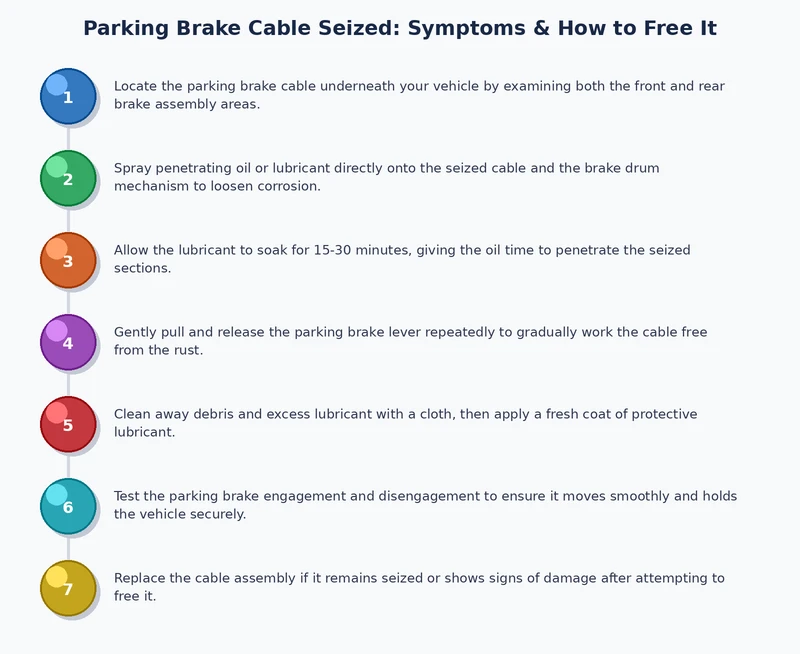
The choice of lubricant and the quality of the post-release adjustment determine whether a freed cable remains serviceable for years or re-seizes within weeks. Our team has evaluated dozens of lubricant options across varying climates and vehicle types.
Lubricants our team recommends for parking brake cables:
Products our team avoids on parking brake cables:
A parking brake cable freed after corrosion seizure often stretches unevenly during the release process, requiring re-adjustment to restore correct operating tension. The procedure our team follows:
The single most common error our team observes in field repairs is saturating a seized cable with original-formula WD-40 and expecting a lasting outcome. This product is a water displacer rather than a true penetrating lubricant, and its active ingredients evaporate within days of application, leaving the cable in the same corroded condition it was found in. A closely related error is using oxy-acetylene heat on cable assemblies — the temperatures generated by that equipment easily exceed the annealing threshold of the cable wire, reducing tensile strength by 20 to 40 percent and creating a component that appears functional but fails unpredictably under braking load.
After freeing a parking brake cable seized through corrosion, many DIY technicians over-tighten the adjuster to compensate for perceived slack or restore a more confident lever feel. Over-adjustment places the cable under chronic resting tension, accelerating wear at both conduit end caps and the lever pivot, and in many documented cases stretches a marginally serviceable cable to the point where replacement becomes unavoidable within weeks of a repair that should have lasted years. The four-to-six-click hold specification is the only correct benchmark, regardless of how the lever feels subjectively.
Caution: Any visible kinking in the cable wire after a manual release procedure is an immediate indicator that full replacement is required — a kinked wire has suffered structural damage and cannot provide reliable braking force even if it appears to operate normally after lubrication.
Corrosion in parking brake cables often signals broader brake system neglect, and our team's coverage of brake rotor surface rust illustrates how oxidation affects interconnected brake components simultaneously — making a comprehensive brake inspection the appropriate response whenever cable seizure is discovered.
A parking brake cable that releases cleanly after a single penetrating oil application is not necessarily free of its underlying corrosion problem. Our team has documented numerous cases where cables initially freed through surface oil treatment re-seized within two to three weeks, because the oxidized material inside the conduit was never fully cleared — the oil simply created a transient path of low resistance through the corrosion layer. Unless the internal conduit surface is fully lubricated along its complete length using a cable injection tool, re-seizure under normal operating conditions is the predictable outcome in the majority of moderate-to-severe cases.
Penetrating oil is a first-response tool for early-stage seizure, not a comprehensive repair for a severely corroded cable assembly. According to Wikipedia's overview of parking brake system design, the cable-conduit assembly depends on specific radial clearances between the wire and housing to permit low-friction sliding motion — once corrosion materially reduces those clearances, no penetrating agent restores the original internal geometry. Full cable replacement is the correct and permanent repair in those cases, and deferring it through repeated oil treatments introduces progressive risk into a safety-critical system without addressing the mechanical root cause.
Our team recommends a twice-annual inspection of the parking brake cable assembly — in spring and fall — to identify early corrosion before it advances toward seizure. Each inspection should address the following:
There is no universal replacement interval for parking brake cables — service life varies substantially based on climate, usage patterns, and cable construction quality. Our team's field-derived benchmarks:
For owners building a comprehensive understanding of brake system health, our detailed guide on brake master cylinder symptoms and replacement cost provides context on how the broader hydraulic system ages in parallel with mechanical components like parking brake cables, and what warning signs indicate multiple repairs may be needed at once.
The timeline depends heavily on seizure severity — early-stage cases typically respond to penetrating oil within one to two hours of treatment, while moderate-to-severe cases require overnight dwell time followed by multiple application cycles spanning six to twelve hours total. Complete mechanical releases including cable injection lubrication and tension adjustment generally require two to four hours of hands-on work for a qualified technician. Our team budgets a full afternoon for any case where the cable has been seized for longer than one month.
A fully seized parking brake cable absolutely immobilizes a vehicle by holding the rear drums or disc pads in sustained contact with the braking surface. This is the failure mode our team most commonly encounters after extended cold-weather storage, where sub-freezing temperatures accelerate both cable corrosion and shoe-to-drum bonding simultaneously. In these cases, even high-torque attempts to drive forward or reverse fail to overcome the combined resistance of the seized cable and bonded rear brakes.
Driving with a partially seized cable introduces two distinct and serious risks: continuous drag from a partially engaged brake shoe generates enough heat to accelerate rotor or drum wear, degrade brake fluid through elevated system temperatures, and potentially ignite accumulated road debris near the wheel assembly. Additionally, a partially seized cable provides asymmetric and unpredictable braking force in emergency stops, compromising directional control at a critical moment. Our team advises resolving even moderate cable seizure before regular driving resumes rather than deferring until full lockup forces a more invasive repair.
For most passenger cars, a single cable costs between $20 and $60 in parts, with labor bringing the total repair to $80 to $200 at an independent shop. Trucks and SUVs with longer cable runs or integrated drum brake systems at the rear typically run $250 to $400 for a complete replacement including adjustment. Proactive replacement before seizure is invariably less expensive than emergency repair after complete lockup, which often requires additional work on drums, shoes, and hardware damaged by the seizure event itself.
A parking brake cable seized through corrosion is a fully preventable failure in the vast majority of cases, requiring nothing more than twice-annual inspection and a few minutes of targeted lubrication to keep the system operating reliably for the life of the vehicle. Our team encourages anyone who notices increased lever effort, rear wheel heat, or an intermittent brake warning light to address the cable immediately rather than deferring until full lockup forces a more invasive and expensive repair — start with a thorough undercarriage inspection, pick up a quality penetrating oil and cable injection tool, and work through the step-by-step process outlined above before the problem progresses to the point where replacement becomes the only option.
 |
 |
 |
 |

About Sarah Whitfield
Sarah Whitfield is a diagnostics and troubleshooting specialist who spent ten years as an ASE-certified technician before joining the editorial team. She specializes in OBD-II analysis, electrical gremlins, and the kind of intermittent problems that make most owners give up.
Get some FREE car parts & gear.. Or check out the latest free automotive manuals and build guides here.
Disable your ad blocker to unlock all the hidden deals. Hit the button below 🚗
| | | |
