by Sarah Whitfield
You park on a hill, set the brake, and walk to your front door — only to hear tires scraping against the curb behind you. You turn around and watch your car slowly drifting down the driveway while the transmission is in Park and the brake lever is fully up. That scenario is how most drivers first discover they have a serious parking brake not holding problem, and it almost always comes at the worst possible moment.
The parking brake, also called the emergency brake or handbrake, is a secondary braking system that holds your vehicle stationary when the engine is off and the transmission is in Park or Neutral. According to the National Highway Traffic Safety Administration (NHTSA), runaway vehicle incidents caused by parking brake failures injure hundreds of people across the United States every year. If your brake feels soft, travels too far before engaging, or fails to hold the car on any meaningful incline, you are dealing with a safety problem that demands immediate attention. You can find a broader overview of these issues in our dedicated guide to parking brake problems and solutions.
This guide walks you through exactly how the system works, what most commonly causes it to fail, how to diagnose which problem you have, and which repairs you can handle yourself versus which ones require a professional shop with the right equipment.
Contents
Before you can fix a parking brake that refuses to hold, you need a clear picture of what the system is doing when it functions correctly. The parking brake operates completely independently from your primary hydraulic braking system — the network of brake fluid, master cylinder, and calipers that engages when you press the pedal. That independence is by design: if your hydraulic system fails while you are driving, the parking brake provides a manual backup that can slow or stop the vehicle without relying on fluid pressure at all.
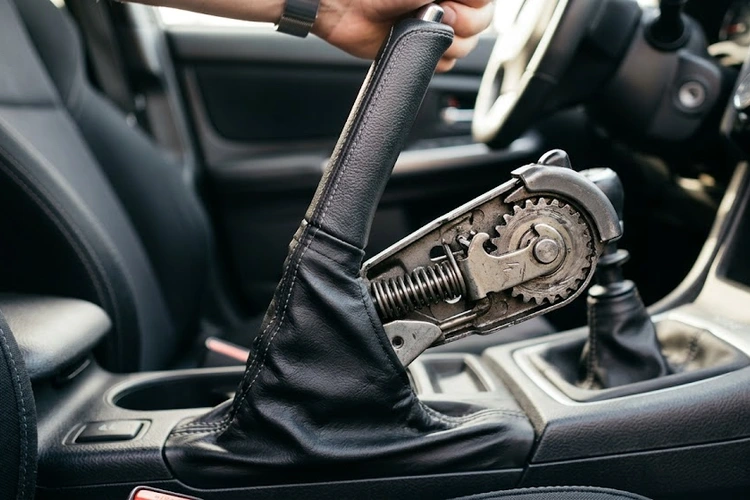
Most older vehicles and the majority of trucks and SUVs on the road today use a purely mechanical cable system. When you pull the lever or press the foot pedal, a steel cable runs through a protective conduit and physically pulls the rear brake components into contact with the friction surface, holding the wheel still. The mechanical simplicity of this design is also its vulnerability — steel cables stretch under load over time, corrode in wet or salty climates, and eventually fail to transmit enough tension to engage the brakes effectively.
Newer vehicles increasingly use an electronic parking brake, commonly abbreviated EPB. When you press the EPB button, a small electric motor mounted directly on the rear caliper clamps the brake pads against the rotor with precise, self-adjusting force. Electronic systems eliminate cable stretch as a failure mode, but they introduce their own problems, including motor failures, control module faults, and the need for specialized scan tools to diagnose and reset the system after any repair work.
Your vehicle's rear brake type changes how the parking brake actually engages the friction material. In a drum brake system — common on economy cars and older vehicles — the parking brake forces curved brake shoes outward against the inside of a spinning drum, generating the friction that holds the wheel stationary. In a disc brake system, most manufacturers use a secondary set of small shoes housed inside the rear rotor hub, a setup called drum-in-hat. These hidden shoes handle parking brake duty exclusively and are separate from the main disc brake pads you replace during routine service. Drum-in-hat systems are especially prone to the shoes glazing over (becoming hard and smooth from heat) or seizing solid from corrosion, which is why parking brake not holding complaints are so frequently reported on vehicles equipped with this configuration.
Pro tip: If your vehicle sits unused for more than two weeks, cycle the parking brake before any extended parking — surface rust forms on drum interiors and rotor hat surfaces within days, and a full engagement-and-release cycle scrubs it away before it reduces holding power.
Parking brake failure rarely happens in a single dramatic moment. The system usually degrades gradually, with early symptoms mild enough that most drivers ignore them until a more serious incident forces the issue into focus. Recognizing the early warning signs lets you address the problem before a repair job turns into a towing bill or an accident report.
The clearest sign is also the most dangerous: your vehicle moves on an incline even though the brake is fully engaged. A flat parking lot will not reveal a marginal system, so you need to test on a real slope — a 10 to 15 percent grade is sufficient. If the car holds on flat ground but drifts on a hill, the system is generating some clamping force but not enough to handle real-world conditions, which means it is deteriorating and will only get worse. This specific failure — holding on flat surfaces but failing on inclines — is the scenario most closely linked to runaway vehicle accidents, and it deserves same-week attention rather than a "I'll get to it eventually" response.
On a cable-actuated parking brake, a healthy system engages firmly within five to seven clicks of the ratchet lever. If you are pulling the lever all the way to its mechanical stop and the car still drifts, the cable has almost certainly stretched beyond the adjustment range, or the brake shoes are worn so thin that they can no longer reach the friction surface effectively. A lever that offers almost no resistance and rises freely without clicking points to a different problem entirely — a snapped inner cable strand or a seized component that is physically preventing the cable from transmitting force to the rear wheels. If you are also noticing unusual sounds from the rear of the vehicle, unusual noises similar to a knocking noise when going over bumps can indicate worn rear brake hardware that is contributing to the parking brake failure at the same time.
The vast majority of parking brake failures fall into three categories: cable problems, worn friction material, and seized components. Identifying which category applies to your vehicle before you begin any repair work is essential — chasing the wrong cause wastes money and time, and it can leave you with a brake that performs exactly as poorly as before.
Steel parking brake cables are subject to both metal fatigue and corrosion, particularly on vehicles driven in regions that use road salt during winter. A stretched cable means the lever or pedal has to travel further than its designed range before generating enough tension to pull the brake shoes or pads into contact with the friction surface — which is why the lever clicks up unusually high before anything grips. A fully broken cable means zero tension reaches the rear brakes regardless of how hard you pull, making the parking brake completely non-functional. Cable replacement is mechanically straightforward on most vehicles, but it does require getting underneath the car and working near the rear axle components, which means proper jack stands and a working knowledge of your vehicle's underside layout.
Every friction surface wears down with use, and parking brake shoes in a drum-in-hat system are particularly easy to overlook during routine service because they are hidden inside the rear rotor hat and are not part of the primary braking circuit. A technician can replace your rear disc brake pads without ever inspecting the parking brake shoes, which means they can wear to the metal without triggering any obvious warning during a standard brake job. Once the shoe material wears thin enough, the cable can pull the shoes all the way to full mechanical travel without generating meaningful friction against the drum surface. Replacing drum-in-hat parking brake shoes typically costs between $100 and $250 at an independent shop, and the repair becomes much cheaper in labor terms when it is done alongside a rear brake service — always ask your technician to specifically inspect and adjust the parking brake components while the rotor is already off.
In humid climates, or on vehicles left sitting for extended periods without being driven, the rear caliper pistons or wheel cylinders can seize in place and prevent the parking brake mechanism from moving through its full range. A seized component creates two opposite failure modes: either the brake will not hold because the mechanism cannot engage, or it will not release because the seized part holds the friction material against the rotor permanently even after you release the lever. If you notice a grinding noise when turning combined with parking brake problems, a seized rear caliper is a strong candidate. You should also inspect for brake fluid leaks around the rear caliper or wheel cylinder — a leaking seal allows moisture to enter the piston bore, which accelerates the corrosion that causes seizing in the first place.
| Cause | Primary Symptom | DIY Difficulty | Typical Shop Cost |
|---|---|---|---|
| Out-of-adjustment cable | Lever clicks high; brake holds weakly | Easy | $50–$100 |
| Stretched cable | Lever at maximum travel; minimal hold | Moderate | $80–$200 |
| Broken cable | No resistance at lever; brake completely dead | Moderate | $100–$250 |
| Worn brake shoes | Cable is taut but brake still slips on inclines | Moderate–Hard | $100–$250 |
| Seized caliper or cylinder | Brake drags, car pulls to one side, grinding noise | Hard | $150–$400 |
| EPB motor or module failure | Warning light on; brake fails to engage or release | Very Hard | $300–$700 |
Some parking brake repairs are genuinely within reach for a careful home mechanic with basic tools and an afternoon to spend. Others require a vehicle lift, specialized tools, or scan equipment that is simply not practical to own. Knowing the difference prevents you from turning a manageable repair into a larger problem through an incomplete or incorrect fix.
A cable that is simply out of adjustment — by far the most common and least expensive cause of a parking brake not holding — can often be corrected in 20 minutes with nothing more than a wrench. Most vehicles route the adjustment nut to an accessible location under the center console trim or at the rear cable equalizer bar beneath the vehicle. Tightening the nut five to ten increments restores proper cable tension and brings the engagement point back to the correct lever position. Before attempting any work under the vehicle, place it on a flat surface, chock the front wheels securely, and use rated jack stands to support the frame — never work under a vehicle supported only by a floor jack. Developing these habits, like the systematic approach you would take when maintaining your car through seasonal extremes, protects both you and the vehicle. You should also make a habit of deep cleaning your wheels and wheel wells regularly, because removing road grime and salt buildup from around the drum and caliper area lets you spot corrosion and cable damage before it progresses into a full failure.
Warning: A dragging parking brake — one that fails to fully release after you lower the lever — generates enough heat to warp rear rotors within a single driving session, so a brake that holds too hard is just as urgent a problem as one that won't hold at all.
Replacing worn parking brake shoes in a drum-in-hat system requires removing the rear rotor, cleaning the drum surface, fitting the new shoes to the correct arc, setting the shoe-to-drum clearance, and reassembling in the correct order — one miscalibrated measurement leaves the parking brake in worse condition than before the repair. Seized caliper repairs add brake line bleeding and, on EPB-equipped vehicles, a control module reset using a manufacturer-specific scan tool that instructs the electric motor to relearn its home position after the new caliper is installed. If you skip that reset step on an EPB system, the motor will apply incorrect force on the next engagement and can damage the new caliper immediately. For context, the same principle applies to any warning-light-driven repair: the light signals a system state, not just a part failure, and diagnosing the Service 4WD light demonstrates exactly how electronics-dependent modern drivetrains require specialized tools to clear and verify a complete repair. If you also notice a suspension creaking noise alongside the parking brake problem, have the shop inspect the rear suspension mounts and trailing arm bushings while the rear end is already disassembled — these components share labor time and deteriorate together on high-mileage vehicles.
A surprising amount of misinformation about the parking brake circulates among everyday drivers, and some of it actively discourages proper use and maintenance of a safety system that protects your vehicle every single time you park on any incline. These myths are worth addressing directly and bluntly.
The label "emergency brake" has convinced a large portion of drivers that engaging the parking brake during ordinary parking is unnecessary, excessive, or somehow bad for the vehicle. Every one of those conclusions is wrong. Using the parking brake every single time you park — not just on steep hills and not just in emergencies — keeps the cable lubricated through its full range of motion, prevents the brake shoes from glazing over in the disengaged position, and confirms the system is functional before you actually need it urgently. Drivers who engage the parking brake only on extreme inclines are statistically the ones who discover their brake has silently failed, because infrequent use allows cables to freeze in their conduits and shoes to bond to drum surfaces from rust and disuse. Using the parking brake routinely is not overcautious — it is the correct operating procedure according to every major automotive manufacturer's owner's manual.
A widespread belief among automatic transmission drivers holds that leaving the car in the Park position is sufficient to prevent rolling, making the parking brake redundant on anything other than a very steep grade. The transmission's Park mechanism works through a small hardened pin called a parking pawl (a metal tab that locks into a notched ring on the transmission output shaft), and that pawl was not engineered to serve as the primary restraint for a several-thousand-pound vehicle on any significant slope. Placing the full weight of the vehicle on the parking pawl over extended parking periods stresses a component far beyond its design intent, and documented pawl failures — though rare — do occur, releasing the vehicle unexpectedly. The correct procedure is to apply the parking brake first, then shift to Park so the pawl bears no load, and then release your foot from the brake pedal. This sequence protects the transmission, keeps the parking brake mechanism exercised, and gives you two independent systems holding the vehicle instead of one.
Pro tip: When your shop replaces the rear brake pads or rotors, ask them to lubricate the parking brake cable guides and equalizer bar and check cable tension while everything is already disassembled — this adds almost no labor time and prevents the cable from seizing or stretching prematurely.
A broken cable gives you zero resistance at the lever — the handle rises freely with no clicking and no tension. A stretched cable still clicks through its ratchet teeth and creates some lever resistance, but the car rolls on any significant slope because the cable cannot transmit enough force to fully engage the brakes. Testing on a 10 to 15 percent grade will confirm a stretched cable; a completely free lever with no resistance almost always means a broken strand or a fully snapped cable.
You can drive the vehicle, but you should not park it on any incline — even a shallow one — until the brake is repaired. Park only on flat surfaces, leave the vehicle in Park or in gear, and chock the wheels with blocks if you must park on a slope. Treat this as a near-term repair, not something to defer for weeks, because a parking brake not holding creates real runaway vehicle risk.
On a cable-actuated system, most manufacturers recommend checking cable adjustment every 20,000 to 30,000 miles or whenever your rear brakes are serviced. If you drive in a wet or salty climate, inspect the cable conduit and adjustment hardware annually for corrosion, because corroded cables stretch faster and seize at a much higher rate than cables on vehicles in dry climates.
Cold temperatures cause the moisture inside cable conduits to freeze, which prevents the cable from sliding freely back to the released position. If the rear brake shoes or pads were left in contact with the friction surface during freezing temperatures, the shoes can bond lightly to the drum or rotor from condensation and freeze. Parking in a garage, releasing the brake before long cold-soak periods, and using a cable conduit lubricant rated for low temperatures are the most effective preventive measures.
On vehicles in dry climates with regular use, a cable can last the entire life of the vehicle — 150,000 miles or more. In regions with heavy road salt use and high moisture, cables commonly need replacement between 80,000 and 120,000 miles. Infrequent use actually shortens cable life, because a cable that sits in the same position for months corrodes and stiffens inside its conduit rather than staying lubricated through regular motion.
Yes, and this is one of the clearest signs of a seized rear caliper or a dragging parking brake cable. If the brake mechanism on one rear wheel is partially engaged — either because the cable is stuck in tension or because the caliper piston will not retract — that wheel generates drag while the opposite side rolls freely, pulling the vehicle toward the dragging side. You will typically also notice the affected rear wheel getting unusually hot after driving, and you may hear a grinding or rubbing sound consistent with a grinding noise when turning.
On cable systems, this usually means the switch that detects lever position is faulty or misadjusted, not that the brake is still engaged. On EPB systems, a persistent warning light typically signals that the electric motor or its control module has logged a fault code and requires a scan tool to read and clear. In either case, if the light stays on during driving, have the system diagnosed promptly — on some vehicles, a parking brake warning light illuminated while driving can also indicate low brake fluid, which points to a separate but equally urgent problem with the primary hydraulic system.
In normal circumstances, leaving the parking brake engaged overnight is perfectly safe and is in fact the recommended practice. The one exception is extremely cold and wet weather: if the rear brake components are wet and temperatures will drop below freezing overnight, the shoes or pads can bond to the friction surface and make the vehicle difficult to move in the morning. In those specific conditions, park on a flat surface, leave the vehicle in Park or in gear, and skip the parking brake for that overnight period only.
 |
 |
 |
 |

About Sarah Whitfield
Sarah Whitfield is a diagnostics and troubleshooting specialist who spent ten years as an ASE-certified technician before joining the editorial team. She specializes in OBD-II analysis, electrical gremlins, and the kind of intermittent problems that make most owners give up.
Get some FREE car parts & gear.. Or check out the latest free automotive manuals and build guides here.
Disable your ad blocker to unlock all the hidden deals. Hit the button below 🚗
| | | |
