by Sarah Whitfield
A power seat not working almost always comes down to one of four things: a blown fuse, a faulty seat switch, damaged wiring, or a failed motor. Most of these are cheap and straightforward to fix — if you know where to look.
Power seats are one of those features you ignore completely until the day they stop responding. Suddenly your seat is frozen two inches from the steering wheel, or you can't recline for a long drive. It's frustrating, but it's rarely a reason to panic. Before you book a dealer appointment, take a few minutes to understand how the system works. A basic diagnosis can save you hundreds of dollars in unnecessary labor.
Power seat issues share the same logic as other electrical gremlins in your car — like when your power window stops working. The fix is usually simpler than it looks.
Contents
A power seat not working can show up in several ways. Sometimes the seat is completely dead — no response at all when you press the switch. Other times it moves in one direction but refuses to go the other way. You might hear a clicking or grinding noise when you push the switch, which usually means a motor is struggling under load or a mechanical drive component has worn out.
Pay close attention if one adjustment works but others don't. For example, the seat slides forward and back just fine, but the recline motor does nothing. Each adjustment is controlled by its own motor, so a partial failure like this often points to a specific motor or that motor's circuit rather than a system-wide issue.
Tip: If your vehicle has separate switches for each seat movement, try every function one at a time. Knowing exactly which movement is dead tells you which motor or circuit to focus on — and can cut your diagnosis time in half.
If you notice multiple electrical accessories acting up at the same time as your seat, check your fuse box first. Electrical problems that hit several components at once often share a root cause — the same way high beams that suddenly stop working can point to a relay or fuse that feeds more than one circuit.
Not every power seat problem demands same-day attention. If your seat is stuck in a position you can safely drive from and it holds that position without drifting, you're okay to keep driving while you schedule a diagnosis. Power seats are a convenience feature, not a safety system — within reason.
That said, don't ignore a seat that grinds, smells like burning plastic, or intermittently lurches on its own. A seat that unexpectedly slides forward while you're driving is genuinely dangerous. Those symptoms mean something is actively failing, and you should get it looked at within a few days.
| Cause | Typical Symptom | DIY Friendly? | Approximate Part Cost |
|---|---|---|---|
| Blown fuse | Seat completely unresponsive | Yes | Under $2 |
| Faulty seat switch | Some directions work, others don't | Yes | $20–$80 |
| Loose or corroded connector | Intermittent operation | Yes | $0–$15 |
| Failed seat motor | Buzzing sound, no movement | Moderate | $40–$150 |
| Stripped drive nut or gear | Motor runs but seat won't move | Moderate | $20–$60 |
| Track obstruction or debris | Slow movement or sudden stops | Yes | $0 |
Start here every single time. Open your owner's manual and find the fuse box diagrams — most cars have one inside the cabin (usually under the dash or in a side panel) and one in the engine bay. The power seat fuse is typically labeled "PWR SEAT" or "SEAT." Pull it out and look at the metal strip inside. If it's broken or blackened, you've found your problem.
Replace it with a fuse of the exact same amperage rating — that number is printed right on the fuse body. Fuses cost less than two dollars at any auto parts store and take about thirty seconds to swap.
Warning: If the new fuse blows immediately after you replace it, stop. A fuse that keeps blowing points to a short circuit somewhere in the wiring, and continuing to replace fuses won't fix it — it will make the underlying problem worse.
If the fuse is fine, move on to the switch. You can test it with a basic multimeter (a handheld device that measures electrical voltage). Check whether voltage is reaching the switch when you press it. If voltage arrives but doesn't leave, the switch itself is dead.
On most vehicles, the switch panel is held in by clips and pops out with a plastic trim tool. Replacement switches are available at your dealer or online for most makes and models — usually between $20 and $80. The swap itself takes about twenty minutes.
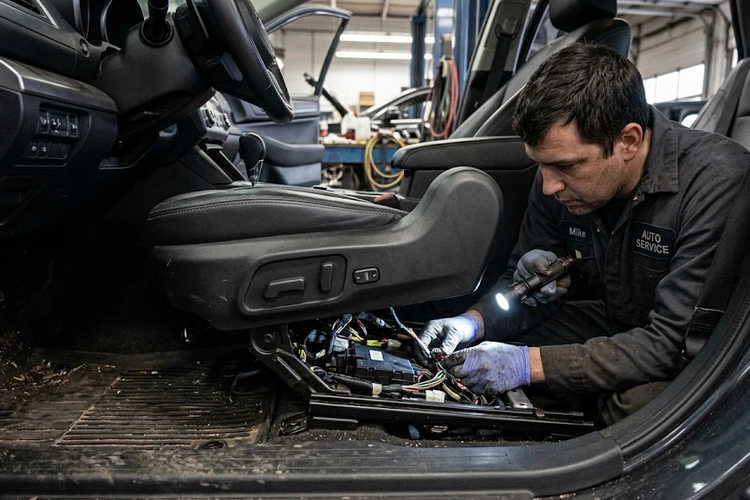
Wiring issues are especially common in high-mileage vehicles. The wiring harness (the bundle of wires that connects everything under and around the seat) flexes every time you adjust your position, and over years that repeated motion causes connectors to loosen and insulation to crack.
Slide your seat all the way forward, then all the way back, and visually inspect the harness. Look for wires that are pinched, melted, chewed by rodents, or simply hanging loose. Then try wiggling the main connector while pressing the seat switch. If the seat briefly responds, you have a loose or corroded connection — clean the terminal pins with electrical contact cleaner and reseat the connector firmly.
If all the electrical components check out, the fault is mechanical. A motor that hums but produces no movement usually has a stripped drive nut — the plastic or metal nut that the motor turns to move the seat along its rails. A motor that does absolutely nothing, even after confirming it receives voltage, needs replacement.
Before concluding it's the motor, look along the seat tracks for debris. Coins, charging cables, and food items regularly jam the rails and put enough resistance on the motor that it triggers a thermal shutdown. Clearing the obstruction and letting the motor cool for a few minutes is sometimes all it takes.
This is the most common assumption, and it's usually wrong. Seat motors are built to last the life of the vehicle under normal use. Fuses blow far more often. Switches wear out before motors do. Connectors corrode long before the motor gives up. Don't let a shop jump straight to motor replacement without showing you that the simpler causes have been ruled out first.
The reputation for expensive power seat repairs comes from people who skip the diagnosis and hand the car straight to a dealer. A blown fuse costs under two dollars. A new switch runs $20 to $80. Even a full motor replacement, which is the most involved repair in this chain, typically runs under $200 at an independent shop — parts and labor included.
The same logic applies to most car electrical problems. Just like windshield washers that stop spraying, the fix is usually cheaper than you fear — but only once you actually know what's broken. A proper diagnosis pays for itself.
You don't. Every component in a power seat system — the motor, switch, harness, drive nut, and track assembly — is available as a standalone part. A full seat replacement is almost never the right answer for a power seat malfunction. Any shop that recommends it without first identifying the specific failed component deserves a second opinion.
Pro tip: On vehicles where both front seats share a similar wiring layout, test the switch from the opposite seat in the same circuit. If it works on one side and not the other, you've instantly confirmed the issue is isolated to one seat's switch or motor — not a shared fuse or relay.
The seat track is the most neglected maintenance item in the entire cabin. Debris builds up over time, increasing the load on the motor every time you adjust your position. Once or twice a year, slide the seat fully forward, clear the rear section of the tracks with a stiff brush or vacuum, then slide the seat back and repeat. A thin coat of silicone spray on the rail surfaces keeps movement smooth. Skip the WD-40 — it attracts dust and accelerates buildup.
If you want to do a full interior refresh while you're at it, our guide to repairing torn car seat upholstery walks you through restoring the fabric and foam yourself for very little money.
When a seat stops mid-travel, release the switch immediately. Holding the switch down against a jammed or overloaded motor is the fastest way to burn it out permanently. Let go, find the obstruction, remove it, and give the motor a minute to cool before trying again.
Erratic behavior — a seat that occasionally hesitates or responds sluggishly — is your early warning. Check the connector and clean the contacts at the first sign of inconsistency. A loose connection that causes intermittent problems today will become a full failure tomorrow. For a broader look at how power accessories relate to your vehicle's electrical system, Wikipedia's overview of power seats explains the basic components well.
A blown fuse is the most common cause. It costs almost nothing to check and replace, so always start there before testing anything else. Faulty seat switches are the second most frequent culprit.
Check your owner's manual for the fuse box diagram — most vehicles have the power seat fuse in the interior fuse panel, usually under the dashboard or in a side panel near the driver's door. It's typically labeled "PWR SEAT" or "SEAT."
Yes, as long as the seat is locked in a safe driving position and doesn't move on its own. If the seat is stuck in an unsafe position or shifts unexpectedly while driving, stop using the vehicle until it's repaired.
It depends on the cause. A fuse replacement costs under $2. A new switch runs $20 to $80. A motor replacement at an independent shop typically costs $100 to $250 including labor. Dealer prices are higher.
A bad seat motor usually buzzes or hums when you press the switch but doesn't move the seat. If the motor is completely silent and you've already confirmed voltage is reaching it, the motor has failed and needs replacement.
Yes. A battery with low voltage can cause power accessories — including seats — to respond sluggishly or fail intermittently. If you're experiencing issues with multiple electrical components at once, test your battery before diagnosing individual components.
Power seat motors are designed to last the life of the vehicle under normal use — often 150,000 miles or more. Premature failure is usually caused by debris jamming the tracks, forcing the motor to work against excessive resistance over time.
In most cases, yes. The repair cost is low relative to the value it restores, and the underlying components are simple and available as individual parts. Unless the vehicle has other major mechanical issues, fixing the seat is almost always worthwhile.
A power seat not working is almost never the catastrophic repair it feels like in the moment. Start with the fuse, work your way through the switch and wiring, and you'll resolve most failures without spending more than a few dollars. Grab a multimeter, pull your owner's manual, and spend twenty minutes diagnosing before you book anything at a shop — that one step is the difference between a $2 fix and a $200 estimate.
 |
 |
 |
 |

About Sarah Whitfield
Sarah Whitfield is a diagnostics and troubleshooting specialist who spent ten years as an ASE-certified technician before joining the editorial team. She specializes in OBD-II analysis, electrical gremlins, and the kind of intermittent problems that make most owners give up.
Get some FREE car parts & gear.. Or check out the latest free automotive manuals and build guides here.
Disable your ad blocker to unlock all the hidden deals. Hit the button below 🚗
| | | |
