by Joshua Thomas
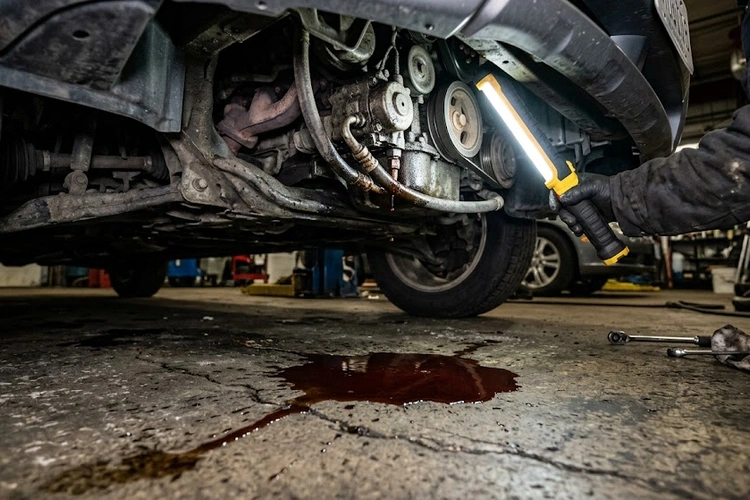
A power steering fluid leak is one of the most identifiable hydraulic failures in a passenger vehicle — and one that demands prompt attention before the power steering pump suffers permanent damage. The fluid typically appears amber, reddish, or dark brown depending on its age and oxidation level, pooling beneath the front axle near the steering rack or pump housing. Our team has traced dozens of these failures across a wide range of platforms, and the pattern is consistent: early intervention costs a fraction of what delayed repair demands. Drivers who notice abnormal steering noise alongside the leak may find our article on why a steering wheel makes noise when turning relevant to their diagnosis, as the two conditions frequently share a root cause in hydraulic circuit degradation.
Contents
The hydraulic system in a conventional rack-and-pinion or recirculating-ball steering assembly operates under pressures ranging from 800 to 1,500 PSI during full-lock maneuvers. Any component in that pressurized circuit can degrade and produce a power steering fluid leak. The most frequent failure points include the high-pressure hose between the pump outlet and the rack inlet, the low-pressure return hose, the rack inner and end seals, the pump shaft seal, the O-rings on banjo bolt fittings and pressure line connections, and the reservoir housing when the plastic becomes embrittled from sustained thermal cycling.
High-pressure hose failures are particularly prevalent because the rubber compound deteriorates under the combined stresses of heat cycling, ozone exposure, and mechanical vibration transmitted through the engine compartment. A degraded high-pressure hose often cracks longitudinally or fails at the crimp fitting interface, producing a fine mist or spray pattern rather than a discrete drip. Rack inner seal failures behave differently — they generate a slow seep that migrates through the rack bellows and accumulates on the outer boot surface, often remaining invisible until the boot is manually compressed and inspected. Pump shaft seal failures present as fluid tracing along the pulley face and dripping from the front of the pump casting.
UV dye testing remains the most precise diagnostic method for tracing ambiguous power steering fluid leaks — a small quantity added to the reservoir before a lock-to-lock test cycle makes even hairline seeps immediately visible under ultraviolet light.
The symptom progression of a power steering fluid leak follows a predictable trajectory. The earliest functional indicator is increased steering effort, particularly at low speeds or during confined-space maneuvering. As the fluid level continues to drop and air enters the suction circuit, the pump cavitates and produces a characteristic whining or groaning noise that intensifies during lock-to-lock steering input. A vehicle that has also begun pulling to one side while driving warrants immediate fluid level verification, as asymmetric assist loss from a partially collapsed hose or rack seal failure can produce measurable lateral drift under otherwise neutral straight-line conditions.
Physical evidence reinforces functional symptoms. Power steering fluid carries a faintly sweet odor when fresh and transitions to a burnt or acrid smell as it oxidizes with age and heat exposure. A simple overnight parking test — placing clean white cardboard beneath the front axle — confirms the presence and approximate volume of an active leak before any disassembly is attempted. The fluid's characteristic fluorescence under UV light makes dye-assisted testing the definitive localization method for multi-point or intermittent leaks that evade visual inspection.
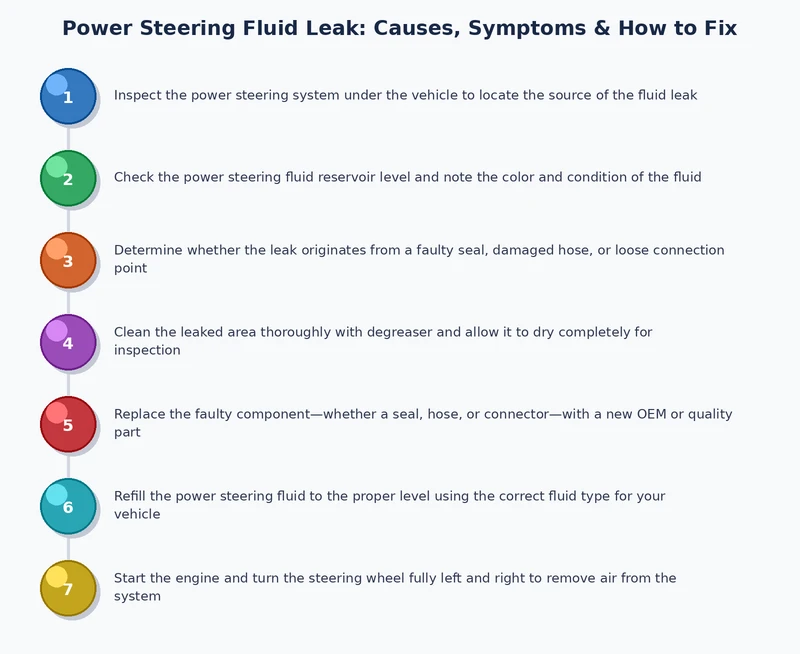
Accurate leak localization is a prerequisite for any effective repair. Our team's standard protocol involves cleaning the entire engine bay and undercarriage with a citrus-based degreaser, refilling the reservoir to the correct level, and running the engine at idle for ten to fifteen minutes while cycling the steering lock to lock at regular intervals. UV dye compatible with the vehicle's specified fluid type is introduced through the reservoir before the test cycle, enabling precise source identification even when multiple potential leak points exist in proximity to one another. This approach eliminates the guesswork that leads to unnecessary parts replacement and return visits.
Fluid specification is a detail our team treats as non-negotiable. Power steering systems across manufacturers require distinctly different hydraulic fluids — ATF Dexron III or VI, ATF+4, Pentosin CHF 11S, Honda PSF, or various proprietary OEM formulations. Mixing incompatible fluids degrades seal elastomers, alters the viscosity index, and can accelerate the very leak under investigation. The reservoir cap markings and the vehicle's factory service documentation are the only authoritative references for fluid selection — generalizations about "universal" power steering fluid carry meaningful risk.
Hose replacement requires releasing residual hydraulic pressure before disconnecting any fittings. The replacement hose must precisely match the original in routing, length, inner diameter, and fitting type. Close approximations introduce stress concentrations at misaligned bend points that accelerate fatigue failure. Banjo bolt and compression fitting torque values must be observed without improvisation — overtightening crushes the sealing surface and creates an immediate new leak point at the very fitting just serviced.
Steering rack seal replacement is a substantially more involved procedure. It typically requires full rack removal from the vehicle, disassembly, seal pressing with appropriate tooling, and meticulous reassembly using fresh fluid and new bellows clamps. Home users with intermediate mechanical competency and access to the factory service manual can complete this repair successfully. Pump shaft seal replacement follows a similar complexity profile and benefits from a dedicated pulley puller to prevent damage to the pump casting during pulley extraction. In both cases, our team recommends replacing all seals and O-rings in the affected circuit simultaneously — adjacent seals of similar age and mileage invariably reach failure within the same service window.
OEM seal kits consistently outperform aftermarket alternatives in our team's experience — the elastomer compounds are formulated to match the original hydraulic fluid specification and the operating temperature envelope of the specific platform.
Repair costs for a power steering fluid leak vary substantially based on the specific failed component, the vehicle's make and model complexity, regional labor rates, and whether the work is completed at home or delegated to a professional facility. The following table reflects typical cost ranges observed across common domestic and import platforms, including both DIY parts costs and full shop invoices.
| Failed Component | DIY Parts Cost | Shop Labor | Total (Professional) |
|---|---|---|---|
| High-pressure hose | $20–$80 | $60–$150 | $80–$230 |
| Return hose | $15–$50 | $40–$100 | $55–$150 |
| O-ring or fitting seal kit | $10–$45 | $60–$150 | $70–$195 |
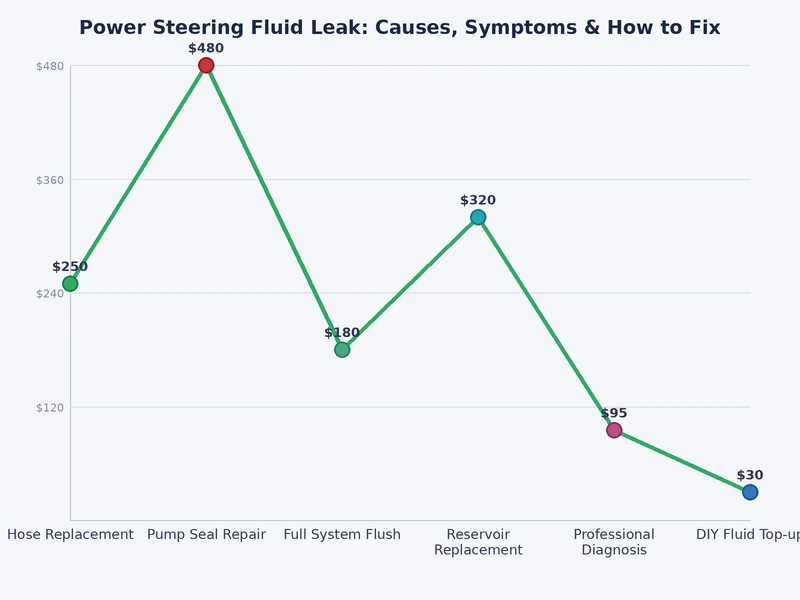
| Steering rack (seal reseal) | $30–$80 | $200–$400 | $230–$480 |
| Steering rack (remanufactured replacement) | $150–$450 | $200–$400 | $350–$850 |
| Power steering pump | $80–$260 | $100–$250 | $180–$510 |
| Reservoir replacement | $20–$90 | $40–$100 | $60–$190 |
For most people, hose replacements, O-ring swaps, and reservoir replacements are accessible home repairs when the correct fluid specification and published torque values are strictly observed. The total parts investment for these repairs rarely exceeds $90, and the labor time is typically under two hours for someone with moderate experience and basic hand tools. Steering rack and pump work, however, requires a calibrated torque wrench, a hydraulic press or seal driver set for seal installation, a dedicated pulley puller for pump service, and a four-wheel alignment check after rack reassembly — a tooling and procedural combination that makes professional service the practical choice for most home workshops.
Independent repair facilities consistently charge 20 to 40 percent less than franchised dealerships for equivalent steering system labor. Obtaining estimates from two or three shops before committing is standard practice our team endorses, as rack and pump labor rates show significant variation by region and shop type.
Several recurring errors transform what might be a straightforward component repair into a full system replacement. The most pervasive is the use of stop-leak additives as a permanent corrective measure. These products temporarily swell dried elastomers, which can reduce visible leakage for a brief interval. Over longer service periods, however, they deposit particulate matter in pump passages, contaminate the hydraulic fluid with incompatible chemistry, and frequently accelerate failure in seals that were still functional at the time of application. Our team has documented cases where stop-leak additives contributed to complete pump seizure within a few thousand miles of use.
A closely related error is topping off the reservoir with an incorrect fluid type — whether out of convenience or a mistaken belief in universal compatibility. Our team has documented instances where a single incorrect fluid addition triggered progressive seal degradation across the entire hydraulic circuit within a short mileage interval. The financial cost of using the wrong fluid type consistently exceeds the cost of sourcing the correct specification by a substantial margin.
Overtightening pressure line fittings during reassembly constitutes a third category of self-inflicted failure. Every banjo bolt, compression fitting, and flare nut in a power steering circuit has a published torque specification that exists for precision metallurgical reasons. Exceeding it distorts the seating surface in ways that cannot be corrected without part replacement — creating a new leak at the exact fitting that was just serviced.
Routine fluid condition checks every 30,000 miles allow most people to identify early seal degradation — evidenced by darkened, gritty, or foamy fluid — before an active external leak develops and forces a more expensive repair.
The service life of a power steering hydraulic system correlates directly with the quality and consistency of its maintenance history. Flushing and replacing the hydraulic fluid at the manufacturer's recommended interval removes oxidized fluid, metallic wear particles shed by the pump vanes, and absorbed moisture — all of which degrade internal seal compounds and reduce the lubrication film protecting the pump's internal surfaces. Our guide on 8 great pointers for maintaining a vehicle addresses hydraulic fluid service as part of a broader preventive framework that most people can implement without professional assistance.
Annual inspection of the high-pressure and return hoses for surface cracking, abrasion from chassis contact points, or swelling near crimp fittings allows preemptive replacement before an active failure event. Verifying that factory hose routing brackets remain intact prevents the gradual abrasion-induced leaks that develop unnoticed across multiple seasons. For anyone investigating whether low transmission fluid symptoms overlap diagnostically with power steering complaints — both conditions can produce noise, sluggish response, and fluid pooling beneath the vehicle — our team recommends inspecting both systems concurrently rather than assuming a single root cause.
Avoiding sustained full-lock steering holds reduces peak pressure loading on the rack inner seals and the pump shaft seal. On vehicles where full-lock engagement is habitual — frequent tight parking maneuvers, repeated multi-point turns in confined driveways — seal fatigue accumulates measurably faster than on vehicles operated with moderate steering inputs. Disciplined driving habits combined with scheduled fluid service represent the most cost-effective long-term strategy for preventing a recurring power steering fluid leak.
A power steering fluid leak left unaddressed is not a minor inconvenience — it is the opening chapter of a repair that ends with a rack or pump replacement and an invoice that early diagnosis would have reduced to the cost of a single hose.
 |
 |
 |
 |

About Joshua Thomas
Joshua Thomas just simply loves cars and willing to work on them whenever there's chance... sometimes for free.
He started CarCareTotal back in 2017 from the advices of total strangers who witnessed his amazing skills in car repairs here and there.
His goal with this creation is to help car owners better learn how to maintain and repair their cars; as such, the site would cover alot of areas: troubleshooting, product recommendations, tips & tricks.
Joshua received Bachelor of Science in Mechanical Engineering at San Diego State University.
Get some FREE car parts & gear.. Or check out the latest free automotive manuals and build guides here.
Disable your ad blocker to unlock all the hidden deals. Hit the button below 🚗
| | | |
