by Sarah Whitfield
Steering system failures contribute to an estimated 9,000 crashes each year in the United States, according to data maintained by the National Highway Traffic Safety Administration, and a significant portion of those incidents trace back to power steering not working at a critical moment on the road. The condition can emerge without warning, transforming what appears to be a routine drive into a genuinely hazardous situation within seconds. Our team at CarCareTotal has examined the full range of contributing factors — from straightforward hydraulic fluid deficiencies to complex electronic module failures — and the evidence consistently points to six recurring causes. For a comprehensive overview of the topic, our dedicated guide on power steering not working provides extensive background and additional context. In the sections below, our team addresses each cause, the corresponding remedies, and the realistic cost ranges that most vehicle owners can anticipate when seeking professional assistance.

Contents
Understanding why power steering fails requires distinguishing between hydraulic and electric systems, as each follows distinct failure pathways. Hydraulic systems rely on pressurized fluid circulated by a belt-driven pump, while electronic systems depend on an electric motor and control unit mounted on the steering column or rack assembly. Our team has observed that most real-world cases of power steering not working fall within six well-documented categories, and accurate identification of the root cause early in the process often determines whether the repair remains affordable or escalates into a significant expense.
Hydraulic power steering systems are particularly vulnerable to fluid loss, and our experience confirms this as the most frequently encountered cause among vehicles exhibiting sudden steering difficulty. Fluid levels decline gradually through small leaks at hose connections, pump seals, or rack seals, and many vehicle owners remain unaware of the problem until steering effort increases noticeably. Contaminated fluid — darkened, foamy, or carrying a burned odor — accelerates wear across the entire hydraulic circuit just as rapidly as critically low levels do. Our team recommends treating the power steering reservoir as a standard maintenance checkpoint at every oil change interval rather than an afterthought between service visits.
The power steering pump generates the hydraulic pressure that makes low-effort steering possible, and once it begins to deteriorate, the symptoms tend to be unmistakable. A groaning or whining noise that intensifies during low-speed turns is often the first indicator, followed by inconsistent assist — sometimes adequate, sometimes entirely absent. Our team has noted that pump failures occur most frequently in higher-mileage vehicles where fluid changes were neglected for extended periods, as contaminated fluid accelerates internal wear throughout the pump assembly. Replacement costs vary considerably by vehicle make and whether the work is performed at an independent shop or a franchise dealership.
A groaning pump that misbehaves only during parking-lot maneuvers often indicates a fluid deficiency rather than outright pump failure — our team recommends checking the reservoir level and condition before condemning the pump entirely.
In hydraulic systems, the serpentine belt drives the power steering pump alongside the alternator, air conditioning compressor, and water pump simultaneously. When the belt wears, cracks, or separates entirely, the pump loses its drive source and steering assist disappears without delay. Our team has documented cases where drivers first noticed difficulty steering moments before observing other symptoms, because all belt-driven accessories fail at the same instant when the belt breaks. For a thorough overview of early warning signs, our coverage of serpentine belt symptoms details six indicators that the belt requires immediate attention before complete failure occurs.
The steering rack translates rotational input from the steering column into the lateral movement that turns the wheels, and when it sustains internal damage, steering can become unpredictable, stiff, or unresponsive across specific ranges of motion. Rack damage typically develops from sustained exposure to deteriorated fluid, physical impact from road hazards, or age-related wear on internal seals and bushings. Our team regards rack-related failures as among the costlier repairs in this category, as the component generally requires full replacement rather than targeted repair, and the labor involved is considerable given its location beneath the vehicle. Unusual sounds during steering input, similar to those explored in our article on why the steering wheel makes noise when turning, often precede rack degradation and are worth investigating promptly.
Modern vehicles increasingly use electric power steering systems that replace the hydraulic pump with an electric motor and an electronic control unit. When the module fails — whether from software faults, connector corrosion, or motor winding degradation — the result is either a complete loss of steering assist or an erratic, inconsistent response with no fluid-related indicators present. A warning light labeled EPS or EPAS on the instrument cluster typically accompanies the failure. Our team has observed that electrical problems elsewhere in the vehicle can trigger false EPS warnings, as voltage irregularities produced by a deteriorating battery or failing alternator frequently confuse the module — a dynamic explored further in our guide on car battery keeps dying.
The high-pressure and return hoses routing fluid between the pump and the rack are subject to heat cycling, vibration, and chemical degradation over the life of the vehicle. A collapsing return hose creates a restriction that closely mimics pump failure in its symptoms, while a leaking high-pressure line can drain the reservoir rapidly enough to cause steering difficulty within a single drive cycle. Our team recommends a tactile inspection of both hoses — feeling for soft spots, brittleness, or oily residue along the full length — as part of any diagnostic process where the cause of power steering not working is not immediately apparent from an initial visual survey.
Several widespread assumptions about power steering failure lead vehicle owners toward unnecessary parts replacement or, equally problematic, toward dismissing genuine warning signs. Our team has encountered these misconceptions frequently enough to address them directly and correct the record for anyone investigating a steering concern.
Many people operate under the belief that steering problems always present progressively, affording ample time for scheduled maintenance. In practice, our team has documented numerous cases where power steering failed abruptly — particularly in scenarios involving serpentine belt breakage or sudden hose rupture — leaving drivers with no meaningful advance notice whatsoever. Treating any perceptible change in steering feel as worthy of prompt investigation, rather than assuming adequate time remains, is the posture our team consistently advocates for all vehicle owners who notice something different in their steering response.
Topping off the power steering reservoir addresses only the symptom of low fluid, not the origin of the loss itself. Our team has observed that vehicle owners who add fluid repeatedly without investigating the leak source allow hydraulic components to sustain cumulative damage, ultimately increasing repair costs well beyond what early intervention would have required. The appropriate response to persistent fluid consumption is a pressure test and a thorough inspection of all hoses, seals, and the pump housing before adding any additional fluid to the system.
Our team regards repeated fluid top-offs without a corresponding leak inspection as a meaningful diagnostic error — the underlying failure continues to compound silently with every drive cycle while attention remains focused on the symptom.
Not every power steering anomaly demands an immediate roadside stop, but certain presentations are unambiguous safety concerns that require a decisive response. Understanding the distinction allows vehicle owners to make sound decisions under pressure without either overreacting to manageable symptoms or underestimating genuinely dangerous conditions.
Complete loss of power steering assist at any speed warrants pulling off the road safely and calling for roadside assistance rather than continuing to drive. While manual steering remains physically possible in most vehicles, the effort required — particularly at low speeds or during emergency maneuvers — is substantially greater than most drivers are accustomed to, and reaction times suffer accordingly. If power steering fluid is observed pooling beneath the vehicle, or if the steering anomaly coincides with a rising temperature gauge — a scenario covered in detail in our guide on temperature gauge rising — the situation represents a compounding concern that warrants immediate professional diagnosis. Our team also treats any steering failure that accompanies changes in braking performance, as explored in our article on stuck brake caliper symptoms, as an elevated safety concern requiring same-day attention.
Intermittent stiffness during cold starts, a faint whine that disappears after the engine reaches operating temperature, or a mildly spongy steering feel without complete loss of assist are situations where driving cautiously while scheduling prompt service represents a reasonable course of action. Our team emphasizes that reasonable does not mean indefinite delay — symptoms in this category tend to progress, and what begins as an occasional inconvenience frequently escalates into a safety-critical failure within weeks if left unaddressed.
Repair costs for power steering problems span a wide range depending on the root cause, vehicle make and model, and whether the work is performed at an independent shop or a franchise dealership. Our team has assembled the following cost reference based on observed service invoices and published industry data across the most common repair types.
| Repair Type | DIY Cost | Professional Cost | Difficulty Level |
|---|---|---|---|
| Power Steering Fluid Top-Off | $8–$15 | $25–$50 | Low |
| Hose Replacement (High-Pressure or Return) | $25–$80 | $150–$350 | Moderate |
| Serpentine Belt Replacement | $15–$50 | $75–$200 | Low to Moderate |
| Power Steering Pump Replacement | $80–$250 | $300–$800 | High |
| EPS Motor or Control Module Replacement | $150–$500 | $400–$1,200 | High |
| Steering Rack Replacement | $200–$600 | $650–$1,800 | Very High |
Labor rates vary significantly by geographic region, with metropolitan dealerships typically charging 40 to 60 percent more per hour than independent shops in smaller markets. Vehicle architecture also plays a meaningful role — some front-wheel-drive platforms make the steering rack relatively accessible, while others require partial subframe disassembly, adding two to four hours of labor to an otherwise identical repair. Our team recommends obtaining at least two written estimates before authorizing any repair that falls in the higher cost tiers of the table above, particularly for rack and pump replacements.
In cases where the repair estimate approaches or exceeds the vehicle's current market value, a cost-benefit analysis becomes necessary before proceeding. Our team has observed that older vehicles with multiple deferred maintenance items are most susceptible to this scenario, particularly when a steering rack replacement arrives alongside a list of additional worn components. In such situations, a pre-purchase inspection of a replacement vehicle — rather than sustained investment in diminishing returns repairs — may represent the more financially sound decision for most people in this position.
When the steering rack quote arrives alongside a list of other deferred repairs, our team recommends requesting a comprehensive vehicle inspection before committing — the full picture often changes the financial calculus significantly and can prevent over-investment in a declining asset.
Accurate diagnosis of power steering failure prevents unnecessary parts replacement and directs attention toward the root cause rather than surface symptoms. Our team follows a structured sequence that has proven effective across a wide range of vehicle types, system configurations, and mileage levels.
The diagnostic process should begin at the power steering reservoir, noting the fluid level, color, and consistency. Dark or foamy fluid indicates contamination; a low level without visible spillage suggests a slow leak somewhere along the hydraulic circuit. Tracing the hoses from the reservoir to the pump and from the pump to the rack, our team inspects for oily residue, chafing marks, or soft spots that indicate internal collapse. This initial assessment takes fewer than ten minutes and frequently confirms or eliminates the most common causes before any specialized diagnostic equipment is introduced into the process.
A power steering pressure test involves connecting a calibrated gauge to the high-pressure hose fitting and recording output at idle and under steering load. A healthy pump typically generates between 1,000 and 1,500 PSI depending on the vehicle specification; readings substantially below this threshold indicate pump wear or internal bypass failure. Our team regards the pressure test as the single most decisive step in distinguishing pump failure from rack failure, as both conditions produce similar symptoms but require entirely different repairs. Unusual accompanying noises during the test — similar in character to those described in our coverage of rattling noise when accelerating — may indicate additional drivetrain concerns worth addressing concurrently.
For vehicles equipped with electric power steering, connecting an OBD-II scanner with EPS module support retrieves fault codes that identify whether the failure originates in the motor, the torque sensor, or the control unit itself. Generic scanners may not access EPS-specific codes; a manufacturer-level or bi-directional scan tool provides substantially more complete diagnostic data in these cases. Our team cross-references EPS fault codes with battery and charging system readings, as voltage irregularities frequently generate false EPS warnings that resolve once the charging system is restored to proper output. Related electrical symptoms — including those discussed in our article on headlights flickering — can serve as useful secondary indicators of charging system health during the diagnostic process.
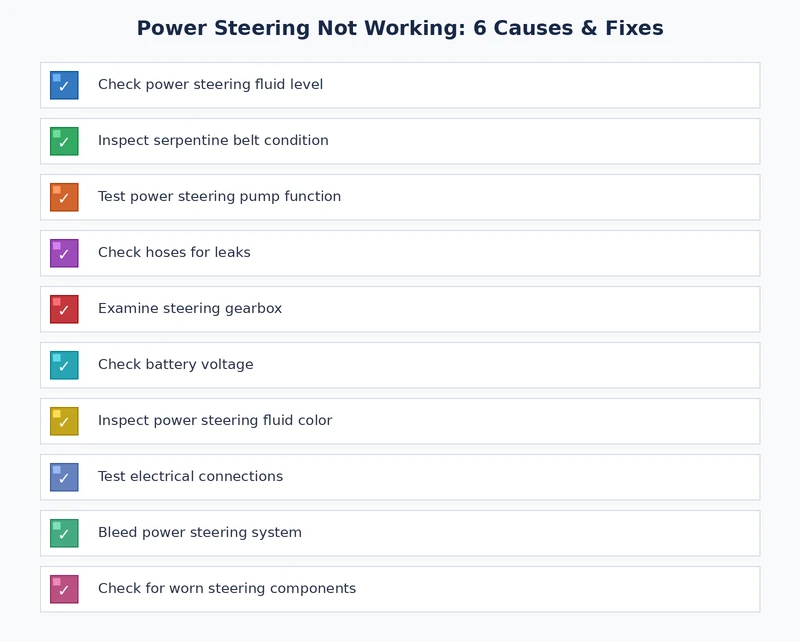
The most frequently observed signs include increased steering effort at low speeds, a groaning or whining noise during turns, a steering wheel that feels stiff or jerky under load, fluid puddles beneath the front of the vehicle, and an EPS warning light on vehicles with electric systems. Our team recommends addressing any of these indicators promptly rather than waiting for complete steering failure to occur during a drive.
Driving with a complete loss of power steering assist is not considered safe, as the physical effort required to steer — especially at low speeds — significantly exceeds what most drivers are accustomed to, reducing reaction capability during emergency situations. Short, cautious movements to reach a safe stopping location or a nearby repair facility are generally manageable, but sustained highway driving without any assist presents a meaningful and unnecessary safety risk.
Yes — when fluid levels fall far enough, the hydraulic pump runs dry, which can cause a complete loss of assist and accelerate internal pump damage within a short period of continued operation. Our team has documented cases where a sudden hose or seal failure drained the reservoir within a single drive cycle, causing what appeared to be a healthy system to fail with almost no warning. Checking the reservoir at regular intervals helps prevent this outcome.
A well-maintained power steering pump generally lasts between 80,000 and 150,000 miles, though this range varies considerably with fluid change frequency and fluid quality. Our team has observed pumps failing well below 80,000 miles in vehicles where fluid was never serviced, and pumps remaining functional beyond 150,000 miles in vehicles with consistent maintenance histories. Regular fluid inspection remains the single most effective measure for extending pump service life.
Hydraulic power steering failure typically involves fluid leaks, pump wear, belt breakage, or rack damage — all mechanical in nature and often preceded by audible warning signs or visible fluid loss. Electric power steering failure involves the motor, torque sensor, or control module, and commonly presents as a warning light with sudden or intermittent loss of assist, without any fluid-related indicators. These two failure categories require distinct diagnostic approaches, which is why our team emphasizes identifying the system type before beginning any inspection.
In vehicles with electric power steering, yes — a failing alternator or weak battery can produce voltage irregularities that confuse the EPS control module, generating warning lights and intermittent loss of assist even when the steering hardware itself is undamaged. Our team has resolved apparent EPS failures simply by addressing the charging system, without any steering-specific components requiring replacement. A charging system evaluation is therefore an important early step whenever EPS concerns arise.
Steering rack replacement at a professional shop typically ranges from $650 to $1,800, depending on the vehicle make, model, and prevailing labor rates in the local market. Some platforms require partial subframe disassembly to access the rack, substantially increasing the labor hours involved and pushing the total toward the higher end of that range. Our team recommends obtaining multiple written estimates for this repair, as pricing variation between independent shops and dealerships tends to be especially pronounced for rack work.
In most cases, yes — though the warning period can be quite brief depending on the cause. Gradual increases in steering effort, occasional groaning during turns, fluid spots beneath the vehicle, or mild vibration in the steering wheel under load are among the precursors our team most frequently documents. In serpentine belt failure scenarios, however, the transition from normal function to complete loss of assist can occur within moments, underscoring the value of inspecting belt condition as a routine part of any maintenance interval.
Power steering not working is a condition that warrants prompt attention regardless of whether the underlying cause is a simple fluid deficiency or a failed electronic control module. Our team encourages anyone who observes a change in steering feel, unusual noises during turns, or an EPS warning light to schedule a professional inspection without delay — early diagnosis consistently produces lower repair costs and eliminates the safety risks that accompany operating a vehicle with compromised steering. A qualified technician can identify the root cause within a single service visit and provide a clear assessment of the repair options available, allowing for an informed decision rather than an urgent one made under pressure.
 |
 |
 |
 |

About Sarah Whitfield
Sarah Whitfield is a diagnostics and troubleshooting specialist who spent ten years as an ASE-certified technician before joining the editorial team. She specializes in OBD-II analysis, electrical gremlins, and the kind of intermittent problems that make most owners give up.
Get some FREE car parts & gear.. Or check out the latest free automotive manuals and build guides here.
Disable your ad blocker to unlock all the hidden deals. Hit the button below 🚗
| | | |
