by Sarah Whitfield
You pull out of a parking lot, crank the wheel hard to the left, and a sharp whining fills the cabin. It happens again at the next corner — and again when you pull into your driveway. The sound is hard to ignore, and for good reason.
Power steering pump noise is one of the most common complaints in car maintenance and repair. Whether the sound is a high-pitched whine, a low moan, or a groaning noise that peaks during slow turns, it is the system's way of signaling trouble. Left unaddressed, a noisy pump can escalate into stiff steering, a complete pump failure, or damage to connected components. This guide walks you through the causes, what each noise type means, and how to fix it — from quick DIY steps to longer-term repair decisions.
If you have already noticed that your steering feels heavy alongside the noise, the two issues are almost always linked. That context matters for your diagnosis.
Contents
The power steering system uses hydraulic pressure — fluid pushed by a belt-driven pump — to reduce the effort needed to turn the wheel. When something disrupts that pressure or wears out a component, the pump starts making noise. Four causes account for the overwhelming majority of cases.
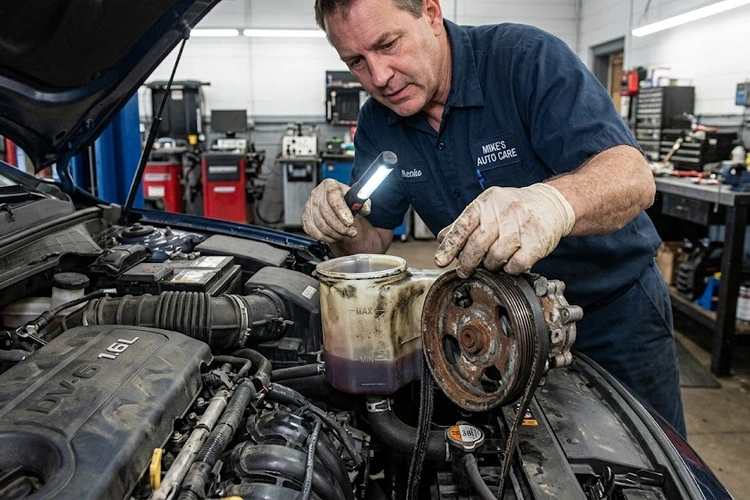
This is the single most common cause. The pump is built to move fluid continuously. When the level drops, the pump pulls in air and begins to cavitate — a process where tiny bubbles form and implode inside the pump housing. The result is a whining or moaning sound that typically peaks when you turn the wheel.
Inside the pump are small rectangular blades called vanes. They spin and push fluid under pressure. Over time, those vanes wear down, the pump loses pressure, and it works harder to compensate. The characteristic sound is a whine that increases with engine RPM — not just during turns.
Air can enter the power steering circuit through a loose hose clamp, a low fluid level, or an improperly bled system after a repair. Trapped air causes cavitation without any actual fluid loss. The sound is a gurgling or whining noise — often at its worst during full-lock turns (wheel cranked all the way to one side).
Not every steering noise originates in the pump itself. A cracked high-pressure hose, a worn steering rack, or a failing tie rod end can all produce sounds that seem to come from the pump area. Misidentifying the source leads to unnecessary pump replacements.
The type of power steering pump noise and the conditions that trigger it are diagnostic clues. Pay attention before you reach for the wrench.
Timing and conditions tell you a great deal about the source of the noise.
Several pieces of bad advice circulate in online forums and even in some shops. Here are the ones most likely to cost you money.
Myth 1: "If the car steers fine, the noise is harmless."
Not accurate. A noisy pump is a pump under mechanical stress. It may still provide assistance, but internal wear is accelerating. Ignoring the sound usually leads to a larger repair bill.
Myth 2: "Any hydraulic fluid works in a power steering system."
False. Power steering fluid is formulated for the specific seals and pressure ranges of your system. Using the wrong fluid — such as ATF (automatic transmission fluid) in a system not designed for it — can swell or shrink seals and cause leaks. Check your owner's manual for the correct specification.
Myth 3: "Additives will fix a noisy pump."
Partially misleading. Some stop-leak or conditioner products can quiet a pump short-term by swelling dried seals. They do not repair mechanical wear. Certain additives can also clog small filter screens inside the reservoir, creating new problems.
Myth 4: "Topping off the fluid once fixes the problem permanently."
Only if there was never a leak. If the level dropped because of a seeping hose or a worn pump seal, topping off buys time. Check whether the level drops again within a week or two — if it does, you have a leak to chase.
Myth 5: "Electric power steering can make this noise too."
Mostly false. Electric power steering (EPS) uses a motor instead of a hydraulic pump. It produces no whining from fluid starvation. If your vehicle has EPS and you hear a whine, the source is elsewhere — possibly a wheel bearing or the EPS motor itself.
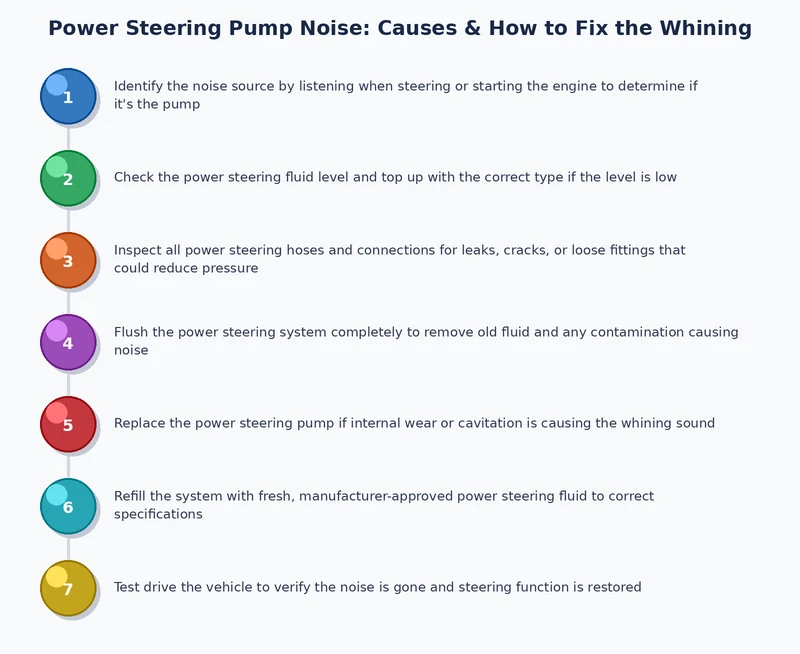
Before scheduling a shop visit, run through these two steps. They resolve a significant share of power steering pump noise cases, especially on vehicles that have not had fluid attention in years.
Pro tip: If the fluid looks dark brown or smells burnt rather than clear to light amber, a full flush will serve you better than simply topping off — degraded fluid speeds up pump wear.
This procedure works best when the noise started after a fluid change or after a hose repair. If the noise persists after two or three bleed cycles, the problem is mechanical rather than air-related.
Most power steering problems develop gradually. Consistent maintenance prevents the noise from starting in the first place.
Power steering fluid degrades over time. It absorbs moisture, oxidizes, and loses its ability to lubricate and protect seals. Most manufacturers recommend a fluid flush every 30,000 to 50,000 miles, though your owner's manual is the definitive source. High-mileage vehicles benefit from shorter intervals.
Run through this list every time you check other fluid levels under the hood:
Warning: Never run the engine with the power steering reservoir cap off — pressurized fluid can spray and cause burns. Always replace the cap before starting the vehicle.
Use this sequence to pinpoint the source of the noise before spending anything on parts or labor. Each step either confirms or rules out a potential cause.
Once you have diagnosed the cause, you face a practical decision: repair the specific component or replace the pump assembly. Cost, vehicle age, and mileage all factor into that call.
| Repair Scenario | Typical DIY Cost | Typical Shop Cost | Worth It? |
|---|---|---|---|
| Top off / flush power steering fluid | $10–$25 | $60–$120 | Always — do this first |
| Replace high-pressure hose | $25–$60 | $150–$300 | Yes, if hose is the source |
| Replace serpentine belt | $20–$50 | $100–$200 | Yes — belt is a wear item |
| Remanufactured pump (replacement) | $60–$150 (part only) | $250–$600 total | Yes, if pump is confirmed worn |
| New OEM pump | $100–$300 (part only) | $350–$750 total | For newer or higher-value vehicles |
| Steering rack replacement | $150–$400 (part only) | $500–$1,200 total | Only if rack is confirmed failing |
As a general rule: if the vehicle has fewer than 100,000 miles and is otherwise in good condition, replacing a worn pump makes sense. If the vehicle is high-mileage and the pump failure is accompanied by other steering system wear, weigh the total repair cost against the vehicle's value before committing.
For a short distance, yes — but not indefinitely. A noisy pump is still providing some assistance, but it is under stress. If the noise is accompanied by stiff steering, a burning smell, or visible fluid loss, pull over and have the vehicle towed. Driving with a fully failed pump is possible on most vehicles, but steering becomes significantly heavier and harder to control.
Most power steering pumps are designed to last 100,000 miles or more with proper maintenance. Neglecting fluid changes or running the system with low fluid significantly shortens that lifespan. Vehicles that frequently hold the wheel at full lock — common in tight parking situations — also wear pumps faster.
Stop-leak additives can temporarily quiet a pump by recondditioning dried or shrunken seals. They are not a permanent fix. Some formulations are incompatible with certain reservoir filter screens and can cause clogs. If you use one, treat it as a short-term measure while you plan a proper repair.
Cold temperatures increase the viscosity (thickness) of power steering fluid, making the pump work harder until the fluid warms up. If the noise fades after a few minutes of driving, aged or degraded fluid is the likely cause. A fluid flush typically resolves cold-weather whining that does not occur once the system reaches operating temperature.
The pump will continue to wear internally. Over time, it can lose enough pressure that steering assistance drops noticeably — you will feel it as increased steering effort. In advanced cases, the pump can seize, leaving you with manual steering only. At that point, the pump is beyond repair and must be replaced, along with a flush to remove metal particles from the system.
Pump noise tends to increase with engine RPM and is most pronounced during turns. Rack noise is typically a grinding or clunking sound felt through the steering wheel, often accompanied by play (looseness) in the wheel. A wiggle test on the tie rod ends and rack housing — with the engine off and a helper rocking the wheel — usually reveals rack or tie rod movement that confirms the rack is the source.
Power steering pump noise is rarely something to put off. Start with the simplest fix — check and top off the fluid, bleed any trapped air — and work through the diagnosis steps before committing to a costly repair. If the noise persists after those basics, have a trusted mechanic confirm whether the pump, a hose, or another component is the root cause. The sooner you address it, the more options you have and the lower the bill is likely to be.
 |
 |
 |
 |

About Sarah Whitfield
Sarah Whitfield is a diagnostics and troubleshooting specialist who spent ten years as an ASE-certified technician before joining the editorial team. She specializes in OBD-II analysis, electrical gremlins, and the kind of intermittent problems that make most owners give up.
Get some FREE car parts & gear.. Or check out the latest free automotive manuals and build guides here.
Disable your ad blocker to unlock all the hidden deals. Hit the button below 🚗
| | | |
