by Diego Ramirez
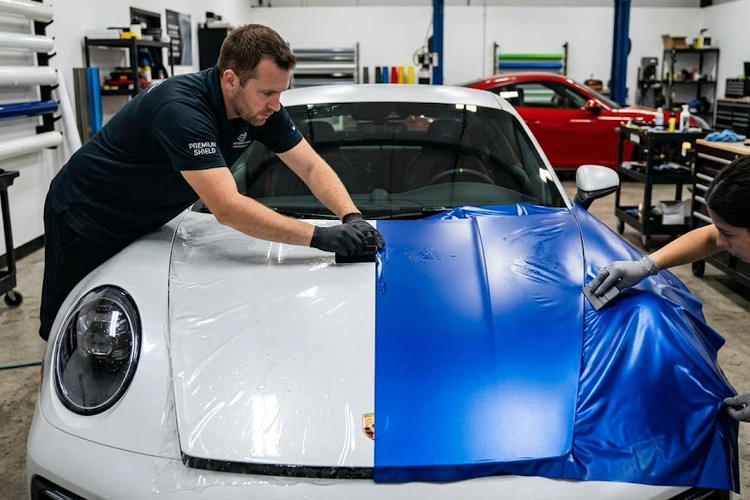
A client once brought in a freshly delivered Range Rover Sport and asked our team one question before we touched it: "PPF or wrap?" He'd spent three weeks on forums and was more confused than when he started. That conversation happens constantly in our shop. The debate over paint protection film vs vinyl wrap sits at the intersection of budget, goals, and long-term thinking — and most people get it wrong because they treat the two products as interchangeable. They are not. Understanding the difference upfront saves real money and prevents expensive regret.
Before diving into the comparison, our team also recommends reviewing the ceramic coating vs paint protection film breakdown — because in many cases, the real decision involves all three products working together.
Contents
Paint protection film — also called clear bra or PPF — is a thermoplastic urethane film originally developed for military use to protect helicopter rotor blades from debris damage. According to Wikipedia's article on paint protection film, the technology migrated to automotive applications in the 1980s and has advanced dramatically since. Modern PPF is optically clear, self-healing under heat, and rated for 10-plus years of service. It absorbs impacts, resists rock chips, and self-repairs minor swirl marks. Our team considers it the most technically sophisticated paint protection product available to consumers today.
Key properties of modern PPF:
Vinyl wrap is a cast or calendered PVC film with a pressure-sensitive adhesive. It was designed for color change and commercial fleet graphics — not impact protection. The primary function is aesthetic. A well-installed vinyl wrap transforms the vehicle's appearance while providing a thin layer of UV and minor abrasion resistance to the factory paint underneath. Our team always clarifies this point directly: vinyl wrap is not armor. It's a costume.
Key properties of vinyl wrap:
Our rule of thumb: if the goal is to change how the car looks, vinyl wrap is the answer. If the goal is to protect factory paint from physical damage, PPF is the answer. Conflating the two leads to expensive regret within the first year.
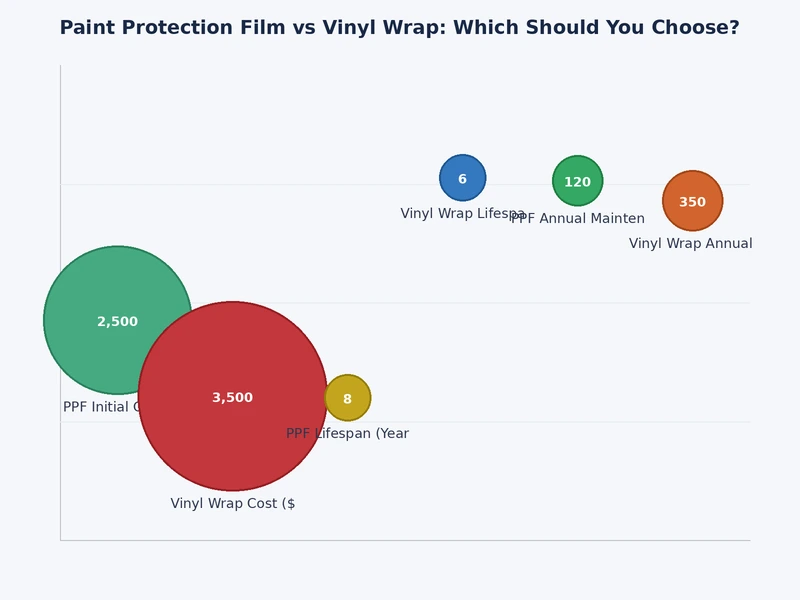
PPF earns its premium price in high-risk, high-value scenarios. Our team installs PPF as the default recommendation when:
Partial PPF coverage — hood, front bumper, mirrors, and rocker panels — is the most common entry point. Full-body PPF is reserved for vehicles where every panel matters for resale or collector value.
Vinyl wrap dominates when aesthetics are the primary driver. Most people in this category want one of the following:
Warning: vinyl wrap does not protect against rock chips. Anyone using it as a substitute for PPF on a highway-driven vehicle will see chip damage through the film — typically within the first 3,000 miles on active highways.
Pricing is where most people encounter sticker shock with PPF. Our team breaks it down transparently because the numbers drive realistic planning.
| Coverage Area | PPF Cost (Professional) | Vinyl Wrap Cost (Professional) |
|---|---|---|
| Front bumper only | $350–$600 | $150–$300 |
| Partial front (bumper + hood + mirrors) | $900–$1,600 | $400–$800 |
| Full front end (bumper + hood + fenders + mirrors) | $1,500–$2,800 | $600–$1,200 |
| Full vehicle | $4,500–$12,000+ | $1,500–$5,000 |
| DIY partial kit (front bumper area) | $100–$400 | $50–$200 |
Several factors push costs toward the high end of each range:
Our team's position is clear: full-body PPF on a vehicle under $30,000 rarely delivers positive ROI. Partial coverage on the most vulnerable forward-facing panels is where the value is strongest. For drivers evaluating premium coating options at the top of the market, our analysis of graphene coating vs ceramic coating covers the complementary layering decisions in depth.
Field results matter more than theory. Here's what our team has documented across hundreds of installations over the years.
A Tesla Model 3 owner commuting 80 miles daily came in after two years with a vinyl wrap installed by another shop. The front bumper showed over 40 visible chip strikes through the film, with one impact penetrating to bare metal. A comparable vehicle with full-front PPF that our team installed at the same time showed zero paint damage under the film at the same two-year mark. Same roads. Opposite outcomes. That comparison plays out consistently in our shop.
Vinyl wrap is a legitimate solution for lease drivers who want a custom color without triggering paint damage clauses at return. Our team has wrapped dozens of leased BMWs, Audis, and Mercedes models in matte finishes that came off cleanly at lease return, with factory paint underneath in showroom condition. For that specific use case, vinyl wrap performs exactly as intended and delivers genuine value.
Full-body PPF on exotics — Ferraris, Porsches, McLarens — is standard practice in our shop. The economics are simple: a $250,000 car driven 3,000 miles per year still accumulates debris hits, and paint correction on exotic factory colors costs $3,000–$8,000 per session. PPF pays for itself the first time it prevents a chip on a carbon fiber panel or a tri-coat finish that requires factory-level blending to repair.
Misinformation circulates constantly in automotive communities. Our team addresses the most persistent myths directly — without softening the corrections.
False. Vinyl wrap at 2–4 mil provides negligible physical impact protection. PPF at 8 mil is specifically engineered to absorb and distribute kinetic energy from road debris. These are not equivalent products serving the same purpose — they are different tools built for different jobs. Treating them as interchangeable is the single most common and costly mistake our team encounters.
This was accurate for first-generation films in the 1990s. Modern PPF from reputable brands incorporates UV inhibitors rated for 7–10 years of optical clarity. Yellowing in current-generation PPF is almost always caused by improper installation (trapped moisture, adhesive contamination) or using discount off-brand film sourced outside authorized distribution channels.
Professional PPF removed before adhesive degradation — within the warranty period — leaves zero paint damage in our experience. The real danger is DIY removal of aged film where adhesive has chemically bonded aggressively over years of heat cycling. That scenario requires heat guns, plastic tools, and patience. It does not require brute force, and brute force is what causes the damage.
This misunderstands the purpose of both products entirely. A high-quality full-body color-change wrap in a specialty finish — matte, color-shift, brushed aluminum — is not cheap and is not attempting to replicate PPF. It delivers something PPF physically cannot: a complete finish transformation. Calling it a cheap version is like calling a paintbrush a cheap version of a hammer.
Insider note: the paint protection film vs vinyl wrap debate is a false choice for roughly 30% of clients. Many premium installs combine partial PPF on vulnerable panels with a full vinyl wrap on top for color change — delivering protection and aesthetics from a single installation.
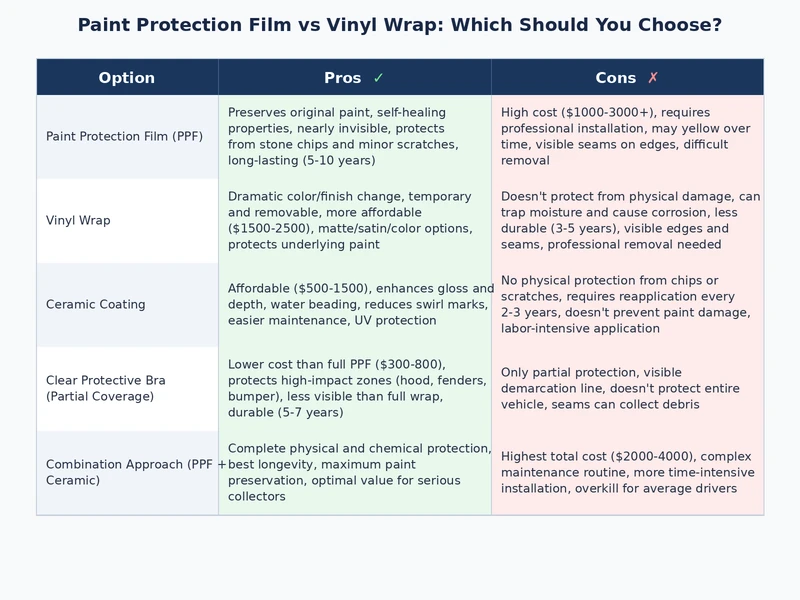
Advantages:
Disadvantages:
Advantages:
Disadvantages:
Understanding surface protection as part of a broader vehicle maintenance approach is valuable context here. Our writeup on windshield cracking causes and prevention addresses a related area where proactive protection decisions directly impact long-term vehicle condition and cost.
Our team's most recommended strategy for high-value daily-driven vehicles is a hybrid installation. The sequence matters:
This stack delivers impact protection where it matters most, a custom finish across every panel, and easy long-term maintenance. It is not inexpensive — expect $5,000–$10,000 all-in for a mid-size vehicle — but it is the most complete solution our team has found for clients who refuse to compromise on either protection or aesthetics.
Both products require proper care to reach their rated lifespan:
PPF from premium brands warrants replacement at 10 years or earlier if hazing begins or edge adhesive creep is visible. Vinyl wrap should be planned for replacement at 5 years on daily drivers, 7 years on garage-kept or weekend vehicles. Our team recommends budgeting for these replacement cycles upfront when selecting products — the total cost of ownership over a 10-year window often makes PPF the superior long-term financial decision despite its higher initial cost. Protecting a $60,000 paint job from needing a $5,000 correction every two years is straightforward math.
Yes — and our team considers this the optimal setup for high-value daily drivers. PPF goes on first over bare paint on all vulnerable forward-facing panels, then vinyl wrap is installed on top across the full vehicle for the color change. The PPF handles impact protection while the vinyl delivers the aesthetic transformation. A ceramic coating is typically added as the final layer over the wrap for hydrophobicity and UV resistance.
PPF consistently outlasts vinyl wrap. Premium brands like XPEL, SunTek, and 3M carry 7–12 year warranties with real-world performance to match. Quality vinyl wrap on a daily driver realistically reaches end-of-life at 5–7 years. Climate is a major factor — vehicles in intense UV environments or on salted winter roads see compressed lifespans from both products.
Standard PPF is optically clear and preserves the factory paint color completely — it should be invisible when properly installed on corrected paint. Some specialty PPF products offer a matte or satin topcoat to shift the gloss level, but the overwhelming majority of installations maintain the original factory appearance. Anyone seeking a true color change or finish transformation needs vinyl wrap.
Primarily cosmetic, with one real protective benefit: UV blocking. Vinyl wrap prevents UV rays from reaching factory paint, which meaningfully slows oxidation and color fading over time. However, it provides no protection against rock chips, gravel impacts, or road debris. Our team has removed vinyl wrap from vehicles with significant chip damage that occurred directly through the film — it is not an impact protection product.
Professional PPF removal runs $500–$1,500 for a full vehicle depending on film age, adhesive condition, and panel complexity. Vinyl wrap removal costs $400–$1,200 in similar conditions. Older films with degraded adhesive require substantially more heat and time, pushing costs higher. Our team always recommends professional removal — DIY attempts on aged or heat-cycled film frequently result in adhesive residue damage or paint pulling.
Technically possible but not a practice our team recommends. PPF adhesive bonds optimally to factory paint or properly prepared surfaces — not to vinyl. Wrap surfaces often carry micro-texture, seams, and edge transitions that cause PPF bubbling or premature edge lifting. The correct sequence is always PPF first on bare corrected paint, vinyl wrap second on top of the PPF if a combined installation is the goal.
Yes — this is vinyl wrap's most genuine protective function. The film layer blocks UV radiation from reaching factory paint, which significantly reduces oxidation rates and color fading, particularly on vehicles without covered parking. The tradeoff is that the vinyl itself degrades from UV exposure over time, which is why the 5–7 year replacement cycle on daily drivers is realistic rather than conservative.
PPF on a high-value vehicle consistently demonstrates a positive resale impact. Buyers of luxury and exotic cars actively seek out PPF-protected examples and will pay documented premiums for verifiable installations with transferable warranties. Vinyl wrap carries neutral to mildly negative resale impact on most vehicles — buyers sometimes question what condition lies underneath, and removal costs fall to the buyer. The exception is specialty collector or enthusiast vehicles where a documented, professionally installed wrap is valued by a specific buyer pool.
 |
 |
 |
 |

About Diego Ramirez
Diego Ramirez is a maintenance and care specialist who has been wrenching on cars since he was sixteen. He focuses on fluid changes, preventive care routines, paint protection, and the small habits that turn a five-year-old car into a fifteen-year-old car.
Get some FREE car parts & gear.. Or check out the latest free automotive manuals and build guides here.
Disable your ad blocker to unlock all the hidden deals. Hit the button below 🚗
| | | |
