A neighbor once borrowed a gas-powered pressure washer, pointed it at his sedan's driver door at close range, and watched a strip of clearcoat lift away like tape. The machine was set to a 15° nozzle, standoff distance was maybe six inches, and no one had mentioned that automotive paint has a threshold. That scenario plays out in driveways everywhere — which is precisely why the debate over pressure washer vs garden hose car washing deserves a factual, technique-centered look rather than a reflexive answer.
Both tools can deliver a clean vehicle. Both can damage one when misused. The critical variables are pressure output, nozzle selection, standoff distance, and wash sequence — all of which factor into any sound approach to how to wash a car properly. This guide examines each tool's specifications, costs, technique requirements, and real-world limitations side by side.
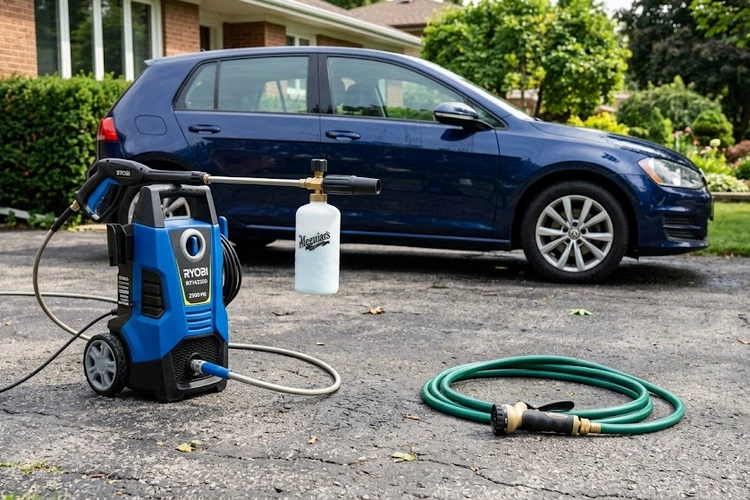
Figure 1 — A consumer-grade electric pressure washer and standard garden hose setup — the two most common tools used for home car washing.
Understanding the Hardware: Pressure Washers and Garden Hoses
The fundamental distinction between these two tools is pressure output. A standard residential garden hose delivers water at roughly 40–60 PSI at the nozzle. A consumer-grade electric pressure washer operates between 1,300–1,900 PSI. Gas-powered units push 2,000–3,200 PSI or higher. These are not marginal differences — they represent an order-of-magnitude shift in the kinetic energy delivered to a vehicle's surface at any given standoff distance.
Pressure Washer Specifications
Electric models: 1,300–1,900 PSI, 1.2–1.6 GPM — adequate for most residential wash applications
Gas models: 2,000–3,200+ PSI, 2.0–4.0 GPM — suited for heavily soiled vehicles, undercarriage work, and fleet use
Nozzle types: 0° (red), 15° (yellow), 25° (green), 40° (white), soap nozzle — automotive work calls for the 25° or 40° exclusively on painted panels
GPM rating: Governs rinse efficiency and water consumption independent of PSI — both numbers matter
Foam cannon compatibility: Most pressure washers accept a quick-connect foam lance, enabling a thick pre-soak application that dramatically reduces contact-wash time
Turbo nozzles: Rotating 0° nozzles that deliver high impact across a wider arc — useful on concrete, not recommended for vehicle paint
Garden Hose Setup
Standard diameter: 5/8 inch delivers 9–17 GPM at typical residential supply pressure
Nozzle options: Pistol-grip adjustable heads, fan spray wands, soaker attachments
Water consumption: High GPM without concentrated pressure means significantly more water per wash cycle compared to a pressure washer
Portability: No power source required — effective anywhere a spigot is reachable
Foam application: Requires a separate foam gun (not a foam cannon) that operates at garden hose pressure, producing a thinner, less clingy lather
Expandable hose options: Lightweight retractable hoses trade flow volume for convenience — trade-off worth noting for longer vehicle rinses
Matching the Right Tool to the Job
Neither tool is universally superior. Task specificity — the type of contamination, vehicle condition, and wash sequence — determines which performs better in a given scenario. Mixing them within a single wash session is a common professional practice.
When Pressure Washers Excel
Road salt removal: High PSI flushes salt deposits from wheel wells, undercarriage channels, and rocker panels — a task where a garden hose falls measurably short
Mud and caked road film: Loosens compacted debris before contact washing begins, reducing the contamination load on the wash mitt
Wheel and barrel cleaning: Blasts brake dust and iron particles from spoke faces without brush abrasion
Foam cannon pre-soak: Thick foam lances coat the entire vehicle, minimizing the grit dragged across paint during the contact wash phase
Engine bay pre-rinse: Lower-pressure settings (40° nozzle, 18-inch standoff) handle degreaser rinse on protected components
Water efficiency: Lower GPM relative to a running garden hose means less total water used per wash cycle over time
Garden Hose Strengths
Post-wax final rinse: Gentle laminar flow rinses away soap without disturbing freshly applied wax or ceramic coating residue
Spot cleaning: Quick removal of bird droppings, pollen, or tree sap without setup time or electrical access requirements
Fragile paint surfaces: Older single-stage paint, visible clearcoat peeling, or oxidized finish — lower pressure reduces the risk of accelerating existing damage
Cost of entry: Most households already own a garden hose; no capital investment required
Water sheeting effect: Removing the nozzle entirely for the final rinse creates unrestricted sheet flow across glass and panels, aiding water runoff
Pro insight: Vehicles with soft or single-stage paint — older trucks, restorations, or any car with visible clearcoat wear — benefit from a garden hose rinse over a pressure washer. Protecting that surface between washes is equally important; the paint gloss maintenance guide covers that side of the equation.
Cost and Budget Breakdown
The financial comparison shifts significantly with frequency of use, local water rates, and whether a pressure washer is already in the garage. Short-term cost favors the hose; long-term operating cost often favors the pressure washer due to reduced water consumption.
Factor
Garden Hose
Electric Pressure Washer
Gas Pressure Washer
Initial purchase cost
$15–$40 (nozzle only)
$100–$350
$300–$800+
Water use per full wash
80–140 gallons
20–40 gallons
30–60 gallons
Energy / fuel cost
None
~$0.05–$0.15 per session
~$0.50–$1.50 per session
Foam applicator cost
Foam gun: $15–$30
Foam lance: $25–$60
Foam lance: $25–$60
Annual maintenance
Minimal
Pump seals, O-rings
Oil, spark plugs, fuel storage
Expected lifespan
10–20 years (rubber hose)
3–8 years (consumer grade)
5–15 years (well maintained)
According to the EPA WaterSense program, a standard garden hose left running can consume two to three times more water per car wash than a pressure washer — a measurable utility cost over an entire washing season, particularly in drought-restricted or metered-water regions.
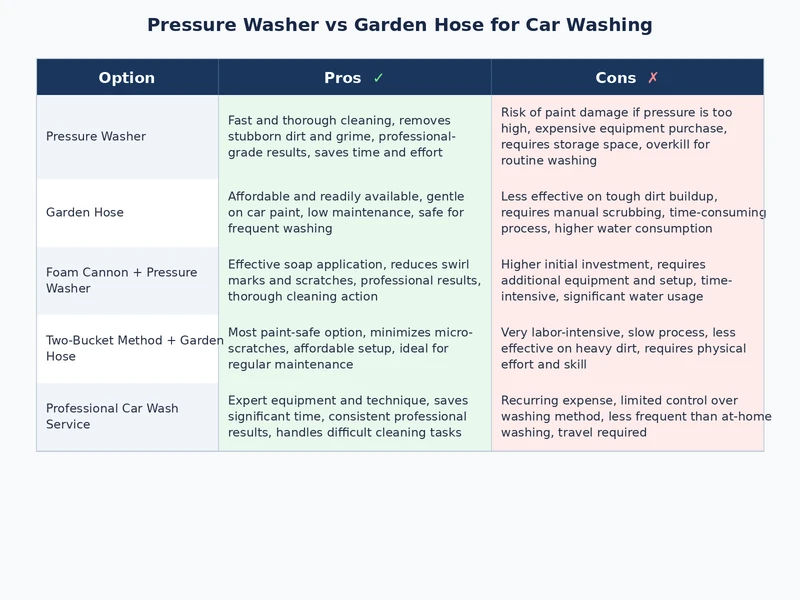
Figure 2 — Comparative overview of pressure washer and garden hose performance across cost, water consumption, and application suitability for car washing.
Technique and Safe Application for Pressure Washer vs Garden Hose Car Washing
Correct technique separates a clean vehicle from a damaged one. Both tools carry real risk when applied carelessly, and both produce excellent results when applied with attention to angle, distance, and sequence.
Pressure Washer Technique
Nozzle selection first: Use 40° (white) for all painted panels; 25° (green) for wheels, lower rockers, and wheel wells; never use 0° or 15° tips on any painted surface
Standoff distance: Maintain a minimum 12 inches from the paint surface — 18 inches is the safer default for vehicles with aged or unknown clearcoat history
Pre-rinse sequence: Work roof-to-bottom using wide sweeping horizontal passes to dislodge loose contamination before soap is applied
Foam cannon soak: Apply thick foam, allow 3–5 minutes dwell time (without letting it dry), then proceed with the two-bucket wash method using a clean microfiber wash mitt
Post-wash rinse: Switch to a wider nozzle or transition to a garden hose for the soap rinse — this avoids stripping fresh wax or sealant with residual high pressure
Avoid: Never direct the nozzle at rubber trim, antenna bases, convertible top seams, or window weatherstripping at close range
Garden Hose Technique
Fan spray setting: Use a wide-fan pistol nozzle rather than a concentrated jet on paint panels — the difference in surface impact is significant
Pre-rinse coverage: Higher GPM partially compensates for lower PSI; keeping the nozzle 4–6 inches from the surface improves contamination removal
Foam gun application: Garden hose foam guns produce a thinner lather than pressure washer foam lances; two passes over heavily soiled areas may be necessary
Rinse direction: Always start at the roof and work down; gravity pulls soap and loosened particulates away from already-rinsed panels
Final sheeting rinse: Remove the nozzle entirely for the last pass — unrestricted flow sheets water off panels and glass, reducing spot formation and complementing a solid water spot prevention strategy
Door jambs: Use controlled low-angle flow through door gaps rather than pointing the stream directly into the jamb cavity
Warning: Directing either tool's stream at a sharp 90° angle into body panel gaps, door jambs, or window seals can force water past weatherstripping and into interior cavities — creating conditions for mold growth, floor rust, and electrical system faults.
Equipment Care and Longevity
Both tools require consistent basic maintenance to perform reliably across multiple seasons. Neglected equipment degrades performance and introduces failure points at the worst possible moments.
Pressure Washer Maintenance
Pump oil inspection: Oil-lubricated pump models require periodic oil level checks and annual changes — oil-less pumps have shorter service lives and are non-serviceable
Winterization: Flush the pump with pump antifreeze before freezing temperatures; standing water in pump housings causes seal cracking and piston scoring
Inlet filter: Clean the mesh screen on the water inlet regularly — debris restriction causes pump cavitation, which degrades the pump rapidly
O-ring inspection: Check quick-connect O-rings before each use; a worn nozzle coupling O-ring causes measurable PSI loss at the tip
High-pressure hose storage: Coil loosely — tight bending fatigues the internal wire braid and causes premature hose failure under pressure
Garden Hose Maintenance
Fitting condition: Inspect brass or plastic fittings for thread wear and cracking — leaking spigot connections waste pressure and increase water bills
Nozzle cleaning: Mineral deposits clog nozzle orifices over time; soaking in white vinegar dissolves calcium and lime buildup effectively
UV degradation: Store hoses out of direct sunlight when not in use — prolonged UV exposure causes rubber compounds to crack and kink prematurely
Seasonal drainage: Fully drain and store hoses before first freeze to prevent burst damage along the body or at fittings
Common Misconceptions Cleared Up
"Pressure washers always damage automotive paint"
This claim is consistently overstated. Paint damage from pressure washers is almost always attributable to incorrect nozzle selection, excessive PSI settings, or inadequate standoff distance — not the tool category itself. Consumer-grade electric washers operating at 1,300–1,600 PSI with a 40° nozzle held at 12 or more inches are routinely used by professional mobile detailers without paint damage. The tool is not the variable; operator technique is.
"Higher pressure means a cleaner car"
Cleaning effectiveness on automotive paint depends primarily on three factors:
Chemical dwell time — how long a pre-wash or soap product sits on the surface before rinsing
Mitt agitation — quality of the contact wash pass and contamination transfer into the wash water
Rinse thoroughness — ensuring no soap residue remains to dry on the surface
Raw PSI plays a limited role once a pre-soak has loosened contamination. A full chemical pre-wash followed by a garden hose rinse frequently out-cleans a pressure-only cold rinse with no chemical assist.
"A garden hose is always the safer option"
Not consistently. A high-GPM garden hose with a tightly concentrated nozzle setting can still delaminate window tinting film, force water past door seals, or erode aged wax coatings. The delivery mechanism matters less than the angle, distance, and concentration of the flow being directed at a given surface.
Making the Final Call: When to Use Each Tool
The decision hinges on vehicle condition, the type and level of contamination present, and what equipment is realistically available. Neither tool is wrong — misapplication is wrong.
Use a Pressure Washer When:
The vehicle carries heavy road salt accumulation from winter driving or coastal environments
The undercarriage or wheel wells require a thorough blast-out before a contact wash
A foam cannon pre-soak is part of the planned wash protocol
Water conservation matters — fewer gallons per session versus a running garden hose
The vehicle has modern factory paint in good condition with no known clearcoat damage
Use a Garden Hose When:
The vehicle has single-stage paint, visible clearcoat wear, or active paint peeling
The wash is a quick spot clean rather than a full detail session
No electrical outlet is accessible near the wash location
The vehicle is a classic, restoration project, or any car where paint fragility is a known concern
A pressure washer is unavailable and purchase frequency does not justify the cost
In practice, many professional detailers combine both in a single session: a pressure washer handles the pre-rinse, wheel blast, and foam cannon application, while a garden hose manages the post-wash final rinse and sheeting step. This hybrid approach captures the efficiency advantages of each tool at the phase where it performs best.
Final Thoughts
The pressure washer vs garden hose car washing debate rarely resolves to a single correct answer — it resolves to the right tool for the specific vehicle condition and task at hand. Readers looking to build a more complete wash routine should review the full car washing guide and consider whether a mid-range electric pressure washer paired with a foam lance would close gaps in their current setup. Start there, prioritize nozzle discipline, and treat standoff distance as the single most controllable variable in keeping paint safe across every wash.
Joshua Thomas just simply loves cars and willing to work on them whenever there's chance... sometimes for free.
He started CarCareTotal back in 2017 from the advices of total strangers who witnessed his amazing skills in car repairs here and there.
His goal with this creation is to help car owners better learn how to maintain and repair their cars; as such, the site would cover alot of areas: troubleshooting, product recommendations, tips & tricks.
Joshua received Bachelor of Science in Mechanical Engineering at San Diego State University.