by Sarah Whitfield
A rattling noise when accelerating almost always points to a specific mechanical failure — and it will not fix itself. Ignore it, and a $50 heat shield clamp becomes a $1,500 catalytic converter replacement.
The rattle can originate from the exhaust, drivetrain, suspension, or engine depending on when and where you hear it. This guide covers all 8 causes with real diagnostic steps and repair costs. If you have also noticed your car sputtering when accelerating, those two symptoms together almost always point to a combustion or fueling issue, not just loose hardware. For the full library of related guides, visit our rattling noise when accelerating category page.
Contents
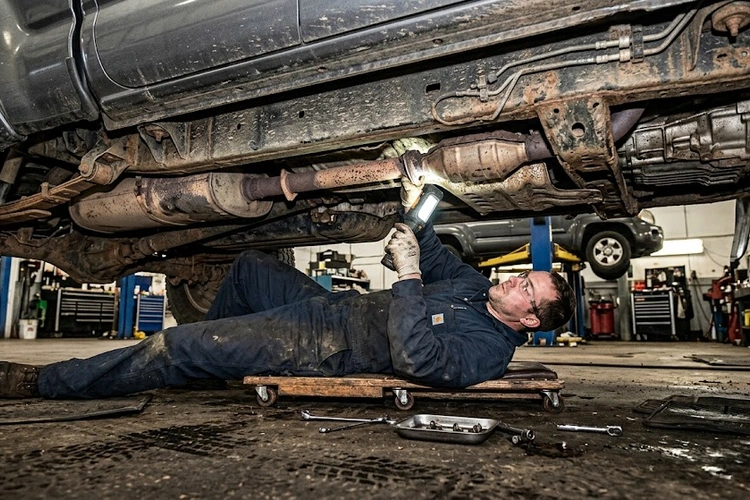
The heat shield is a thin stamped-metal plate bolted around the catalytic converter and exhaust pipe. It keeps exhaust heat away from the floorpan, fuel lines, and carpeting. It is the single most common source of a rattling noise when accelerating — especially under hard throttle or from a cold start.
Why it rattles:
Diagnosis: Crawl under the car with gloved hands and physically grab the heat shield. Shake it. If it moves freely, you found the culprit. Under acceleration, exhaust gas pulses vibrate the loose shield at a frequency that amplifies the rattle dramatically.
Fix: Re-clamp or re-bolt the shield in place. If it is cracked or too corroded to save, cut it off — heat shields are non-structural. A shop charges $50–$150 for the repair. DIY takes 15 minutes with a hose clamp and costs under $10.
When the ceramic monolith inside the converter fractures, it rattles like a can of gravel. The sound is most pronounced during acceleration and deceleration. A failing catalytic converter almost always triggers a check-engine light — P0420 or P0430 — alongside the rattle.
What fractures the monolith:
Diagnosis: Tap the converter housing with a rubber mallet while a helper listens from underneath. A hollow, rattling resonance confirms internal substrate damage. Scan the ECU for oxygen sensor codes alongside the rattle to build a complete picture.
Fix: The converter must be replaced. Cost ranges from $300–$2,500 depending on vehicle type and OEM versus aftermarket selection. Always inspect the full exhaust system at the same time — a damaged converter is frequently accompanied by other failures detailed in our guide to exhaust leak symptoms.
Per the U.S. Environmental Protection Agency, catalytic converters are federally mandated emissions control devices covered under the 8-year/80,000-mile federal emissions warranty on most vehicles — check your coverage before paying out of pocket.
Constant velocity joints transfer torque from the transmission to the drive wheels through a range of steering and suspension angles. When the CV boot tears and grease escapes, the joint wears rapidly. A worn outer CV joint produces a clicking or rattling noise under acceleration, especially during turns.
Telltale signs:
Diagnosis: Put the car in a tight circle at low speed with full steering lock. A rhythmic clicking or clunking confirms outer CV joint failure. Inner joints rattle more noticeably under straight-line hard acceleration because they operate at a steeper driveshaft angle.
Fix: Replace the full axle shaft assembly — not just the boot — once the joint itself is worn. Budget $200–$500 per axle including labor. Driving on a failed CV joint risks axle separation, which causes an immediate and complete loss of drive.
Your exhaust system hangs from rubber isolator mounts that absorb vibration and allow thermal expansion. When a hanger cracks or a clamp loosens, the pipe moves freely and contacts the chassis, floorpan, or adjacent heat shields under the pulsing load of acceleration.
Where to look first:
Diagnosis: With the engine off and exhaust cold, push and pull the pipe at multiple points along its length. Any section with more than half an inch of free lateral movement lacks proper support. A full visual check of all rubber hangers takes under 10 minutes.
Fix: Replacement rubber exhaust hangers cost $5–$20 each. A shop charges $50–$150 to rehang the exhaust, depending on the number of hangers involved. Always inspect for exhaust leaks at the same time — loose pipe sections regularly develop leaks at their joints under sustained vibration.
Engine and transmission mounts hold the powertrain rigidly in the chassis while rubber cores absorb vibration. When the rubber core fails or the mount bracket cracks, the engine shifts position under torque load. The result is a heavy thunk or rattle during hard acceleration, gear engagement, and hard braking.
Symptoms beyond the rattle:
Diagnosis: Have a helper rev the engine to 3,000 RPM while you observe from outside with the hood open. Excessive powertrain movement confirms mount failure. Confirm with a pry bar placed between the mount pad and subframe — a failed mount shows immediate deflection under light load.
Fix: Replace all mounts as a set when one fails — the others are the same age and carrying the same load. Cost runs $200–$600 per mount including labor, more on transverse-mounted FWD engines where access is restricted.
The belt tensioner maintains constant serpentine belt tension through a spring-loaded arm. The idler pulley routes the belt around the accessory drive layout. Both use sealed bearings that wear out with mileage. A failing tensioner or idler produces a high-frequency rattle or chirp that scales directly with engine RPM during acceleration.
How to identify it:
Diagnosis: Remove the serpentine belt and spin each pulley by hand. A worn bearing feels rough, notchy, or gritty. A weak tensioner spring shows obvious slack when you push the arm. Read our full guide on serpentine belt symptoms for a complete list of related failure signs before ordering parts.
Fix: Replace the tensioner and idler pulley as a matched kit — they are sold together for most applications at $50–$150. Labor adds another $50–$100. Replace the serpentine belt at the same time if it is within 20,000 miles of its service interval.
Engine knock is detonation — fuel igniting before the spark plug fires. It produces a sharp, metallic rattling under load, especially at low RPM during hard acceleration. Piston slap is distinct: a hollow, echoing knock from worn piston-to-cylinder wall clearance, loudest when cold and fading as tolerances tighten with heat.
What causes detonation knock:
Diagnosis: Switch to premium fuel for one full tank if the knock is recent. If it persists, pull fault codes. P0325 (knock sensor) or P0300-series misfires alongside the rattle narrow the diagnosis. For the full failure spectrum, see our guide to engine knocking noise causes. Always check your oil pressure warning light first — low oil pressure accelerates bearing damage in seconds.
Fix: Octane-induced knock resolves immediately with the correct fuel. Carbon-induced knock needs a walnut blast or chemical decarbonization. Rod knock or a spun bearing means an engine rebuild or replacement — costs start at $2,500 and climb fast.
Struts and shock absorbers control suspension travel and damping. When the damper seals fail and hydraulic fluid escapes, the piston slaps against internal stops under load. The result is a clunking or rattling noise over bumps that worsens under acceleration because weight transfer unloads the front suspension and causes it to cycle more aggressively.
Identifying symptoms:
Diagnosis: The bounce test is your first move. Push hard on each corner of the vehicle and release. More than one full oscillation confirms the damper is no longer controlling rebound. For a comprehensive breakdown of failure signs, see our guide to bad shock absorber symptoms.
Fix: Replace struts and shocks in axle pairs. Never replace one side without the other — uneven damping creates unpredictable handling behavior. Budget $300–$900 per axle including alignment. If you hear a rattle near the rear axle that does not respond to bounce-test diagnosis, read our guide to rear differential noise symptoms to separate drivetrain noise from suspension noise.
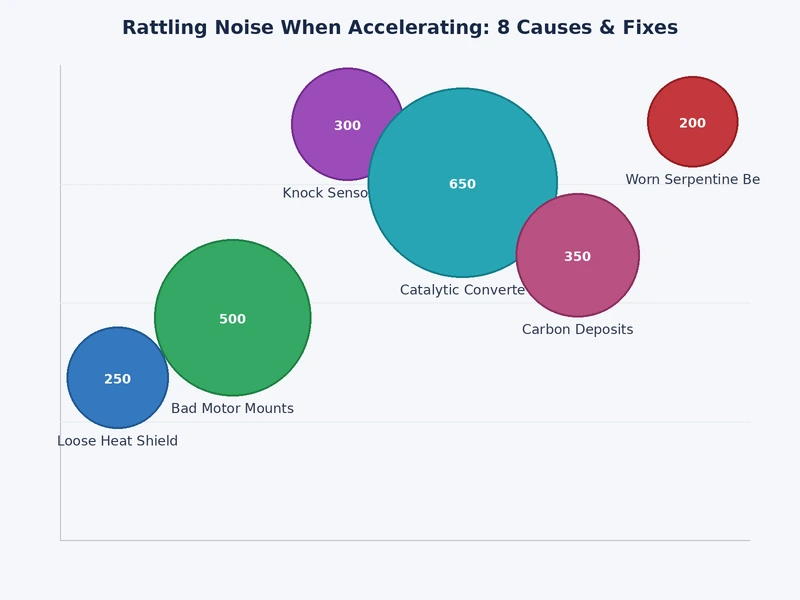
Repair costs for a rattling noise when accelerating span an enormous range. A loose heat shield costs $10 in parts and 15 minutes of your time. A rod-knock engine rebuild runs into thousands. Here is what to expect before you authorize any repair:
| Cause | DIY Parts Cost | Shop Total (Parts + Labor) | Urgency |
|---|---|---|---|
| Heat shield rattle | $5–$20 (hose clamp) | $50–$150 | Low |
| Exhaust hangers | $5–$20 each | $50–$200 | Low–Medium |
| Serpentine tensioner / idler pulley | $50–$150 | $100–$250 | Medium |
| CV axle shaft | $80–$200 | $200–$500 | High |
| Engine mounts (per mount) | $50–$150 | $200–$600 | High |
| Catalytic converter | $150–$1,500 | $300–$2,500 | High |
| Struts / shocks (per axle) | $100–$400 | $300–$900 | High |
| Engine knock / rod knock | N/A | $2,500–$8,000+ | Critical — stop driving |
Always get a second quote for catalytic converter and engine work. Converter markups vary wildly between independent shops and dealerships — sometimes by $800 or more on the same application. Use the OBD-II code as your starting point, not the shop's verbal estimate.
Pro tip: Before authorizing any catalytic converter replacement, confirm internal substrate failure with a rubber-mallet tap test. A P0420 code alone can also indicate a failing downstream O2 sensor — a $100 fix versus a $1,500 one.
Not every rattle demands an immediate roadside stop. Some rattles are harmless until your next shop appointment. Others mean you should shut the engine off right now. Knowing the difference keeps you from turning a diagnostic call into a tow and a ruined engine.
The guiding rule: any rattle originating from the engine bay combined with abnormal gauge readings demands an immediate stop. Any rattle from beneath the chassis with normal gauges and full power is safe to drive cautiously to the shop — but schedule that appointment today, not next week. If you notice related symptoms like your car hesitating when accelerating alongside the rattle, prioritize the shop visit — combined symptoms narrow the diagnosis and usually indicate something more urgent than loose hardware.
The most expensive rattles are the ones that get misdiagnosed. Replacing parts without isolating the source first is the fastest way to spend $1,500 and still have the same noise on the way home from the shop.
Warning: Never authorize strut replacement based on a rattle complaint alone — always require a documented bounce test and written inspection report before any suspension work proceeds.
A heat shield rattle left alone for several months can vibrate completely free and wrap around the driveshaft or exhaust pipe. A loose exhaust pipe can fracture at the manifold flange under sustained vibration, turning a $150 hanger repair into a $600 manifold job. Every new rattle warrants a visual inspection within the first week it appears — before the damage compounds.
Most cases of rattling noise when accelerating are fully preventable. The root causes almost always trace back to deferred maintenance, corrosion left unchecked, or ignoring early symptoms when they were cheap to fix.
The most effective long-term strategy is treating every new noise as a diagnostic event on day one. A rattle that costs $50 to fix on the day it starts costs $500 on day 90 when secondary damage sets in. Schedule an inspection the week any new noise appears under acceleration — not the month after.
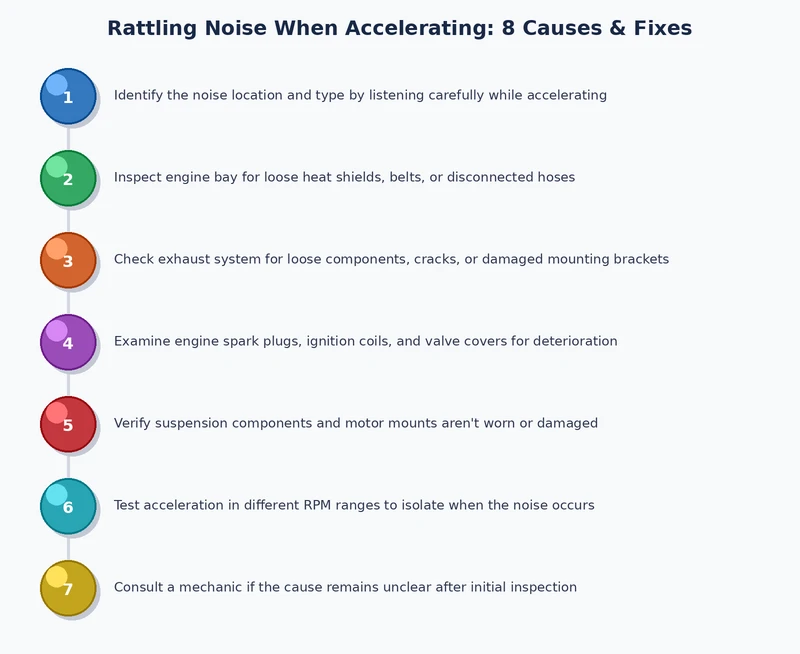
Use these distinguishing characteristics to narrow down which cause applies to your vehicle before spending time on a full inspection. Each pattern points to a specific system:
It depends entirely on the source. A heat shield rattle or loose exhaust hanger is safe to drive to a shop the same day. Engine knock, a separated CV axle, or a rattle paired with an oil pressure warning light requires you to stop the engine immediately — continuing to drive causes permanent and expensive internal damage.
Hard acceleration puts the drivetrain under peak torque load and increases exhaust gas pulse frequency simultaneously. Components that are marginally loose at idle — heat shields, exhaust hangers, engine mounts — vibrate aggressively under that combined load. The rattle disappears at light throttle because the excitation force drops below the resonant threshold of the loose component.
Costs range from $50 for a heat shield re-clamp to over $8,000 for an engine rebuild after rod knock damages the bearings. The most common causes — exhaust hangers, serpentine tensioner, CV axle — fall in the $150–$500 range. Always get a confirmed diagnosis before authorizing any repair to avoid replacing the wrong component entirely.
Yes. A fractured monolith will eventually disintegrate completely. Ceramic fragments can block exhaust flow, restrict power, and cause overheating. On some engine configurations, backpressure can push debris toward the intake. Replace a rattling converter promptly — and always fix the underlying cause (misfires, oil burning) that fractured the substrate in the first place, or the new converter will fail the same way.
Start with the free checks today — shake the heat shield, inspect the exhaust hangers, do the bounce test, and spin the accessory pulleys. Most rattling noise when accelerating cases resolve with a $50 repair once you know exactly what is loose. If the free checks come back clean, book a shop inspection this week rather than waiting for the rattle to escalate into something that costs ten times more to fix.
 |
 |
 |
 |

About Sarah Whitfield
Sarah Whitfield is a diagnostics and troubleshooting specialist who spent ten years as an ASE-certified technician before joining the editorial team. She specializes in OBD-II analysis, electrical gremlins, and the kind of intermittent problems that make most owners give up.
Get some FREE car parts & gear.. Or check out the latest free automotive manuals and build guides here.
Disable your ad blocker to unlock all the hidden deals. Hit the button below 🚗
| | | |
