by Sarah Whitfield
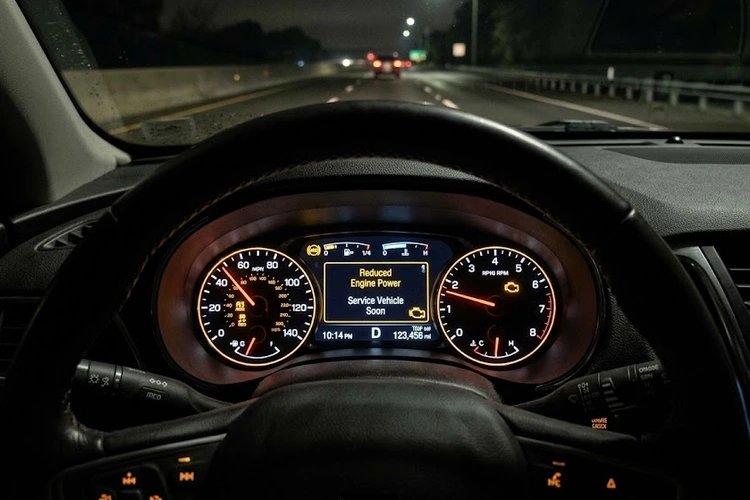
Roughly 1 in 10 modern vehicles will trigger a reduced engine power warning before reaching 100,000 miles, based on service data compiled from dealership repair networks across North America. That warning — which typically appears alongside a check engine light and an immediate loss of throttle response — activates what technicians call limp mode, a protective state built into the engine control module to prevent deeper mechanical damage. Our team has worked through a wide range of these cases, and the variety of root causes is considerably broader than most people initially expect.
The reduced engine power warning is part of a sophisticated electronic safety system that monitors sensor readings in real time and intervenes when any measurement falls outside acceptable operating limits. Knowing which causes are manageable without professional help and which ones genuinely require a shop visit is the most useful knowledge any driver can carry. Our full diagnostic resource on the reduced engine power warning covers every component connected to this system for anyone who wants a deeper look.
Contents
The engine control module monitors dozens of sensors at once — throttle position, mass airflow, oxygen levels, coolant temperature, and more — comparing every reading against stored parameters in real time. When a sensor reports a value outside the acceptable range, the ECM immediately cuts throttle authority and limits fuel delivery to prevent damage from progressing. The system's core purpose is stopping expensive mechanical failures before they cascade into complete engine destruction.
According to the National Highway Traffic Safety Administration, electronic throttle control complaints have climbed steadily as drive-by-wire systems replaced mechanical throttle cables across virtually all modern passenger vehicles. That transition made engine management considerably more capable but also more sensitive to sensor drift, corroded connectors, and brief electrical anomalies that older cable-operated systems simply absorbed without incident.
In limp mode, engine output is typically restricted to 30–45 percent of normal capacity — sufficient to reach a repair facility but not enough to sustain highway speeds or handle a towing load. The transmission sometimes locks into a fixed gear to prevent torque spikes from worsening the underlying fault, and the air conditioning compressor may be cut to reduce parasitic load on the restricted engine. Most people describe the sensation as a sudden heaviness, as though the throttle pedal has been disconnected from any real response.
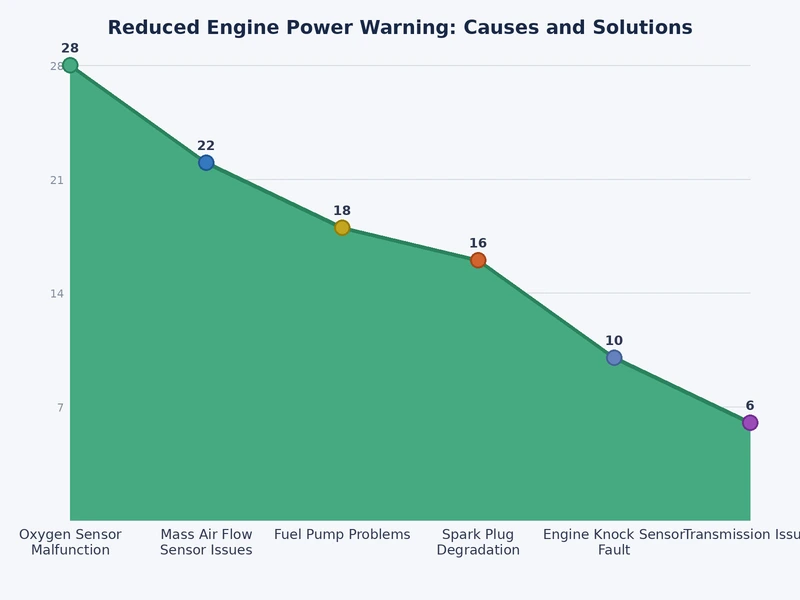
The reduced engine power warning can originate from a surprisingly wide range of components, which is why pulling OBD-II fault codes before touching anything is so important. The table below covers the causes our team encounters most frequently, organized by severity and whether the repair is realistically within reach of a careful home mechanic.
| Cause | Severity | DIY Accessible | Typical Repair Cost |
|---|---|---|---|
| Dirty throttle body | Low–Medium | Yes | $0–$40 DIY / $80–$150 shop |
| Faulty MAF sensor | Medium | Yes | $30–$120 DIY / $150–$250 shop |
| Battery or charging fault | Low–Medium | Yes | $20–$200 |
| Throttle position sensor | Medium | Moderate | $80–$200 |
| Electronic throttle actuator | Medium–High | No | $200–$600 |
| Wiring harness damage | Medium–High | No | $300–$1,000+ |
| Catalytic converter failure | High | No | $800–$2,000+ |
| Transmission fault | High | No | $500–$3,500+ |
A throttle body coated in carbon deposits is the most frequently encountered cause in our experience, and a proper cleaning with throttle body solvent resolves the warning in a notable percentage of cases in under 30 minutes with basic hand tools. A contaminated mass airflow (MAF) sensor is nearly as common — its wire element accumulates oil and fine debris over time, causing it to misreport airflow and send the ECM into protective mode. Battery terminal corrosion creates voltage irregularities that confuse the ECM into triggering the warning even when the engine itself is completely healthy, and our guide on battery terminal corrosion symptoms and cleaning covers exactly how to identify and address that condition before it causes further diagnostic complications.
Failing electronic throttle control actuators, damaged wiring harnesses, and internal transmission faults require professional diagnostic equipment to isolate accurately. Replacing a throttle actuator without first confirming the ECM's live sensor data is a common and expensive mistake — the actuator may test fine in static conditions while the true fault lives in the wiring between the throttle body and the control module.
Always record every fault code before clearing anything — those stored codes are the ECM's preserved account of what triggered limp mode, and erasing them restarts the diagnostic process from zero.
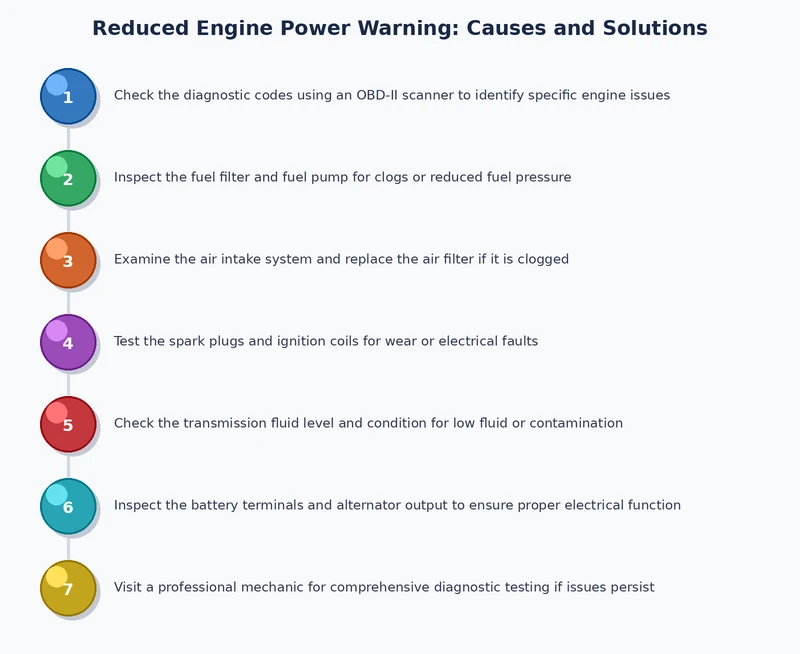
The single most important first step when the reduced engine power warning appears is connecting an OBD-II scanner and documenting every fault code present before doing anything else. Restarting the vehicle and clearing codes without recording them first destroys the diagnostic trail and significantly extends the repair timeline. Our team always captures all active and pending codes together, because the full combination often reveals the true root cause more clearly than any single code read in isolation.
Codes most commonly associated with this warning include P0120–P0124 for throttle and pedal position sensor faults, P0101–P0104 for mass airflow sensor issues, and P2135 for a voltage mismatch between the two throttle position sensor signals. A P2135 specifically indicates that both TPS signals have diverged from each other, which almost always points to a throttle body replacement or a wiring fault between the body and the ECM. Drivers who have also seen a check engine light while the car still runs fine will find that many of the same diagnostic principles and code ranges apply across both conditions.
After recording fault codes, a scan tool capable of streaming live data — specifically throttle body position percentage and MAF grams-per-second — lets a technician observe sensor behavior in real time and catch intermittent failures that static testing consistently misses. A throttle body showing smooth 0–100% travel in live data while fault codes point elsewhere typically redirects the diagnosis toward the wiring harness or the ECM software itself rather than the throttle body as a physical unit.
The reduced engine power warning surfaces most often during sustained high-load driving — extended highway operation in summer heat, towing near the vehicle's rated capacity, or repeated hard acceleration from a stop. Under those conditions, sensor readings that are tolerated during light urban driving push past the ECM's threshold and activate the protective response. Drivers who notice the warning appearing primarily during summer should prioritize the coolant temperature sensor and MAF sensor, both of which show elevated failure rates under sustained thermal stress.
Overheating is among the more serious triggers, and persistent cooling system problems like a coolant level that keeps dropping can push engine temperatures high enough that the ECM has no choice but to activate limp mode as a final safeguard before head gasket failure occurs.
Cold morning startups occasionally produce the warning temporarily when sensors haven't reached stable operating conditions after a long cold soak. When the warning clears within a few minutes of driving and doesn't return during the same trip, the cause is often a coolant temperature sensor reporting inaccurate values during warm-up — a relatively inexpensive repair that an independent shop handles without specialized equipment in most cases.
A warning that appears only during the first few minutes of a cold startup and then vanishes completely almost always points to a coolant temperature sensor or minor throttle body deposits, not a serious internal engine fault.
Preventing the reduced engine power warning is primarily a matter of keeping the components that feed the ECM clean and calibrated — the air intake system, the electrical system, and the sensors that translate physical conditions into the data the ECM uses to set operating parameters. Our team treats throttle body cleaning and MAF sensor inspection as standard preventive items rather than reactive repairs, because addressing contamination early consistently avoids the more disruptive experience of limp mode activating during actual driving.
Replacing the engine air filter on schedule is the most effective single preventive measure for the MAF sensor, since a clogged filter passes fine debris directly onto the sensor's wire element and degrades its accuracy over time. Most manufacturers recommend air filter replacement every 15,000–20,000 miles, and pairing that service with a light spray of dedicated MAF sensor cleaner adds almost no time to the interval while keeping readings accurate well beyond the threshold. A throttle body inspection and cleaning every 30,000 miles rounds out the air intake picture and addresses the leading cause of this warning before any fault codes appear.
A battery holding below 12.4 volts at rest, or an alternator outputting outside the standard 13.8–14.4 volt range, generates electrical noise that the ECM misinterprets as sensor anomalies — a common and frequently overlooked source of false limp mode events. Testing battery health and alternator output annually, particularly before temperature extremes in summer and winter, eliminates the electrical root causes of this warning systematically and prevents misdiagnosis of components that are functioning correctly.
The protective logic behind the reduced engine power system is genuinely effective at preventing the most expensive failure modes — engine seizure from oil starvation, head gasket destruction from unchecked overheating, and transmission damage from uncontrolled torque spikes. Without limp mode, a driver unaware of a failing coolant sensor could sustain thousands of dollars in internal damage within minutes of continued normal operation. The system adds a safety margin that the mechanical throttle cable designs it replaced simply could not provide, and its widespread adoption has measurably reduced catastrophic engine failure rates across the modern vehicle fleet.
The same sensitivity that makes the system effective also produces false positives that frustrate drivers and technicians alike. Minor sensor drift, a slightly loose wiring connector, or a brief voltage spike from a degrading battery can all trigger the warning and put a vehicle into restricted mode when no genuine threat to the engine exists. Our team has seen situations where several minor electrical issues compound together, creating a more alarming warning presentation than any individual fault deserves on its own.
Many drivers assume that restarting the vehicle after a reduced engine power warning is enough to resolve the underlying problem, and while the light sometimes disappears after a restart, the root cause almost never does. Carbon deposits don't clean themselves, corroded connectors don't heal, and a sensor drifting out of specification continues drifting until it fails entirely. Our team has documented cases where what began as a minor throttle body deposit warning escalated to a full throttle actuator replacement, simply because the early signal was dismissed rather than investigated promptly.
On the opposite end, a widespread belief holds that the reduced engine power warning signals imminent and catastrophic engine failure requiring major internal work. In our collective diagnostic experience, the large majority of cases resolve with a throttle body cleaning, a MAF sensor replacement, or an ECM software update — repairs that typically fall between $80 and $400 at a reputable independent shop. Understanding that distinction between a sensor fault and a genuine internal engine failure is what separates a measured, cost-effective response from an unnecessarily expensive one.
Driving short distances in limp mode to reach a repair facility is generally safe, since the ECM restricts power specifically to protect the engine from further damage. Continuing under heavy load or for extended distances with the warning active risks worsening whatever condition originally triggered the protective response.
Costs range from under $50 for a DIY throttle body cleaning to over $2,000 for a catalytic converter or transmission repair. The majority of cases — particularly those involving a dirty throttle body or failing MAF sensor — fall in the $80–$400 range at an independent shop.
Yes — a battery holding below 12.4 volts at rest or an alternator outputting outside the normal 13.8–14.4 volt range creates electrical irregularities that the ECM misreads as sensor faults, triggering the warning even when no actual engine component is failing. Testing the charging system is an essential early step in any diagnosis.
The fault codes and warning light typically remain stored in the ECM even after the root cause is fixed. Most repairs require clearing the codes with an OBD-II scanner once the fix is confirmed, though some vehicles self-clear after completing a set number of clean drive cycles without the fault reappearing.
Not at all — while a dirty or failing throttle body is the single most common cause, the warning originates just as often from a MAF sensor, throttle position sensor, battery or charging fault, wiring damage, catalytic converter, or transmission issue. Reading the OBD-II fault codes is the only reliable way to identify the actual source before spending money on parts.
The reduced engine power warning is not a catastrophe — it is the engine's most articulate request for attention, and treating it that way is the difference between a $150 repair and a $1,500 one.
 |
 |
 |
 |

About Sarah Whitfield
Sarah Whitfield is a diagnostics and troubleshooting specialist who spent ten years as an ASE-certified technician before joining the editorial team. She specializes in OBD-II analysis, electrical gremlins, and the kind of intermittent problems that make most owners give up.
Get some FREE car parts & gear.. Or check out the latest free automotive manuals and build guides here.
Disable your ad blocker to unlock all the hidden deals. Hit the button below 🚗
| | | |
