by Diego Ramirez
Our team was at the pump last spring when a fellow driver leaned over and declared — with total conviction — that premium gas would make any car run faster, smoother, and longer. It's one of the most persistent myths in automotive care, and honestly, it's costing a lot of people real money every single week. The debate over regular vs premium gas deserves a straight answer grounded in how engines actually work, not fuel industry marketing.
The short version: fuel grade matters enormously for certain engines and not at all for others, and getting it wrong in either direction has real consequences for performance and wallet alike. Our team has spent considerable time analyzing this topic because we see it come up alongside every other maintenance question — from transmission fluid intervals to how much oil a car actually needs. Engine health is a system, and fuel is part of that system.

Contents
Octane is a measurement of a fuel's resistance to pre-ignition — specifically, its ability to resist combusting before the spark plug fires in the cylinder. Regular unleaded carries a rating of 87 in most of North America, mid-grade sits around 89, and premium lands at 91 or 93 depending on the region and the station. The higher the octane number, the more compression the fuel can withstand before igniting spontaneously under pressure.
Modern engines use knock sensors to detect pre-ignition events and respond by retarding the ignition timing, which protects the engine but simultaneously reduces power output and efficiency. This compensation system is why using regular gas in a premium-required engine won't necessarily cause immediate catastrophic failure — but it does rob the engine of the performance it was engineered to deliver. The octane rating system used on North American pumps averages two separate lab measurements — the Research Octane Number and the Motor Octane Number — displayed as "(R+M)/2," which explains why European 95-octane fuel roughly equals North American 91.
The word "premium" carries a strong implied meaning in consumer culture, and that linguistic shortcut has driven decades of unnecessary fuel spending. Our team traces much of the confusion to older carbureted engines that lacked knock sensors entirely, meaning they were genuinely sensitive to octane grade in ways modern computer-managed engines simply are not. The idea carried forward even as engine technology advanced well beyond that limitation, and fuel retailers have had little incentive to correct the record.
The owner's manual is the only authoritative source for fuel grade requirements, and our team considers consulting it the single most important first step before forming any opinion on this topic. Manufacturers specify one of three designations — "regular unleaded recommended," "premium recommended," or "premium required" — and these distinctions carry meaningful technical weight that reflects how the engine was calibrated at the factory.
The difference between "required" and "recommended" is not merely semantic, and our experience shows that most people genuinely don't understand the distinction until they see the implications laid out clearly.
| Fuel Designation | Common Vehicle Types | Performance Impact of Using Regular | Est. Annual Extra Cost (Premium) |
|---|---|---|---|
| Regular Required | Economy sedans, compact SUVs, minivans | None — engine designed for 87 octane | $156–$390 wasted if using premium |
| Premium Recommended | Mid-range turbos, V6 luxury sedans | Minor power loss, small efficiency drop | Manageable savings with occasional downgrade |
| Premium Required | High-comp V8s, performance turbos, sports cars | Significant power loss, elevated heat, long-term wear | Non-negotiable for engine protection |
"Premium required" engines are calibrated at the factory with ignition timing and compression ratios that depend on high-octane fuel to function correctly at full output. Running regular in these engines consistently degrades performance, stresses the cooling system, and accumulates wear on internal components over time. "Premium recommended" engines are more forgiving by design — the knock sensor compensation handles regular fuel reasonably well, but peak numbers fall short and the difference becomes noticeable under sustained load.
When in doubt, check the fuel door sticker — most modern vehicles print the minimum octane requirement directly inside the fuel filler flap, making it a quick and reliable reference at the pump.
Turbocharged engines compress incoming air far more aggressively than naturally aspirated designs, which raises the effective cylinder pressure and makes the air-fuel mixture considerably more prone to pre-ignition. This is the environment where octane rating becomes genuinely critical, and where our team has observed the most consistent performance differences between fuel grades. Many modern sport sedans, luxury crossovers, and performance-oriented vehicles fall into this category even when their marketing materials don't emphasize it.
Our team has documented power losses in the range of 10 to 15 horsepower in turbocharged engines running regular fuel instead of the required premium — losses that are particularly noticeable during highway merges, towing, or mountain driving. For drivers who have already started investigating performance symptoms, this is one of the first variables to eliminate; our detailed breakdown of car hesitation at highway speeds covers additional contributing factors that often appear alongside fuel-grade mismatches.
For naturally aspirated four-cylinder and modest V6 engines rated for regular unleaded, premium fuel provides no measurable benefit whatsoever — not in mileage, not in power output, and not in long-term engine health. The compression ratio in these engines simply doesn't reach the threshold where higher octane resistance makes a practical difference, and the engine management system has no additional timing advance to deploy even if the fuel could theoretically support it. Spending more at the pump for these vehicles is a pure loss with no engineering justification behind it.
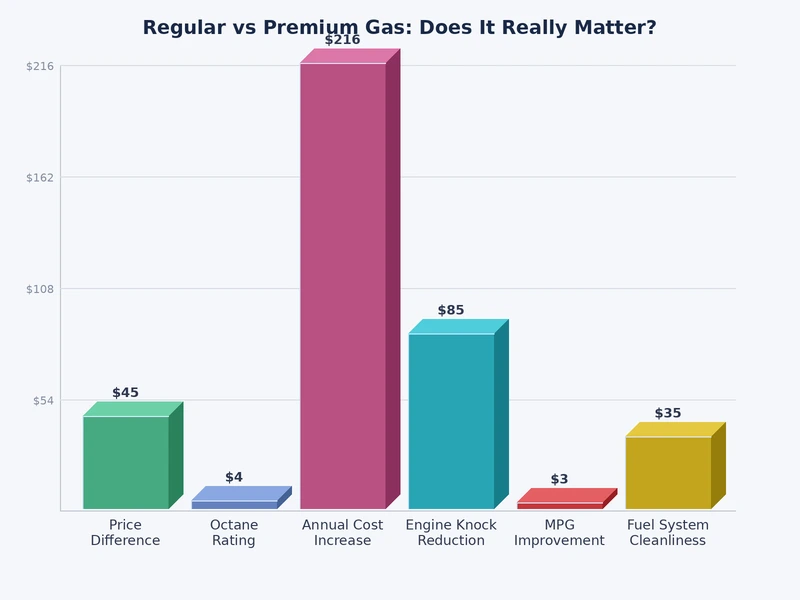
Premium gasoline typically costs between 20 and 50 cents more per gallon than regular, a gap that compounds quickly for high-mileage drivers. Our team ran the numbers for a driver filling a 15-gallon tank once weekly — that scenario produces between $156 and $390 in extra annual fuel spending with zero performance return when the car calls for regular. Redirecting that budget toward proven maintenance priorities — like keeping up with transmission fluid changes on schedule — delivers far more measurable long-term benefit for the engine as a whole.
Some drivers report marginally improved fuel economy on premium, which is technically possible in engines where the ECU can advance timing aggressively enough to gain efficiency. However, in regular-spec engines, any economy improvement — if it appears at all — is too small to offset the price differential at the pump under real-world conditions. Our team's position is consistent: matching the fuel grade to the manufacturer's specification is always the most efficient strategy, full stop.
Engine knock presents as a rapid metallic pinging or rattling sound that intensifies under acceleration, during uphill driving, or when the engine lugs at low RPM under load. Our team recommends listening carefully at moderate throttle from a rolling stop — that's when knock is most audible in affected engines — and comparing the sound to how the engine behaves at idle, where pre-ignition is far less likely to occur.
Drivers who stay attentive to overall engine condition — monitoring things like engine oil color and clarity on a regular schedule — tend to catch fuel-related problems earlier, before knock has the chance to cause measurable wear on bearings, pistons, or cylinder walls over extended time.
Switching to the appropriate fuel grade is always the first corrective step, and in most cases our team finds it resolves the symptom within a tank or two. If knock persists after upgrading fuel grade in an engine that requires premium, the cause may be carbon buildup on intake valves — a common issue in direct-injection engines where fuel never washes the back of the valves — or a malfunctioning knock sensor that isn't reporting pre-ignition events to the ECU correctly.
In persistent cases, our team recommends a professional fuel induction service, which physically cleans the intake valves and combustion chamber without requiring disassembly. This restores the compression efficiency that carbon buildup gradually degrades and often eliminates knock that premium fuel alone couldn't fully address.
 |
 |
 |
 |

About Diego Ramirez
Diego Ramirez is a maintenance and care specialist who has been wrenching on cars since he was sixteen. He focuses on fluid changes, preventive care routines, paint protection, and the small habits that turn a five-year-old car into a fifteen-year-old car.
Get some FREE car parts & gear.. Or check out the latest free automotive manuals and build guides here.
Disable your ad blocker to unlock all the hidden deals. Hit the button below 🚗
| | | |
