by Sarah Whitfield
A rough idle is caused by a disruption in your engine's air-fuel ratio, ignition timing, or cylinder sealing — that is the complete answer. Nine specific rough idle causes account for the overwhelming majority of cases technicians document on repair orders every day, and each one leaves a diagnostic fingerprint your scanner can read before you touch a wrench.
Your engine's ECU logs real-time fault data the moment a misfire or lean condition occurs. That data is your starting point, not parts swapping. If the shudder travels through your cabin, steering wheel, and seat simultaneously, the platform-specific breakdown at car shakes when idle maps each vibration pattern to a root cause before you open the hood.
Contents
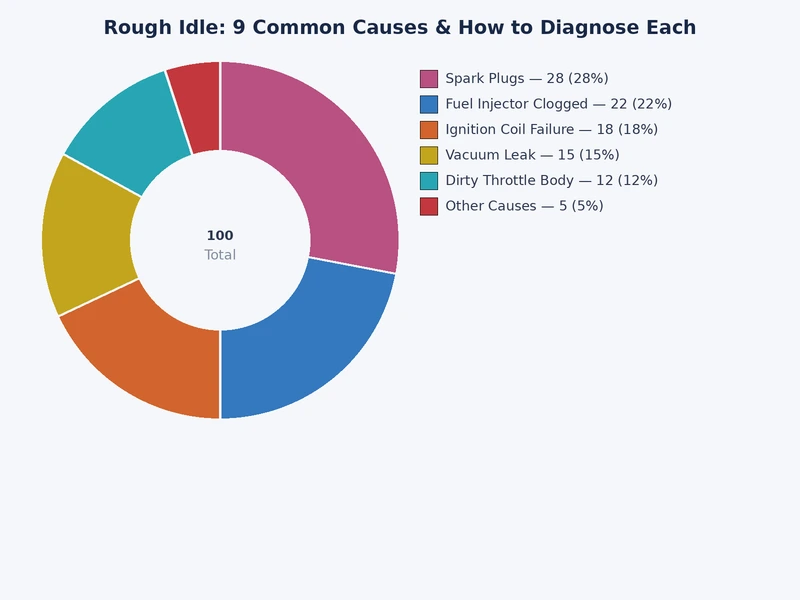
A combustion engine idles smoothly when three systems work in sync: air delivery, fuel delivery, and ignition. Uneven cylinder pressure across the firing order produces the characteristic shake, lope, or stumble you feel through the seat and floor. Every rough idle cause disrupts at least one of these three systems — usually by allowing unmetered air into the intake, restricting fuel flow to the injectors, or degrading the ignition energy reaching the spark plug.
Modern ECUs compensate aggressively for small deviations. A minor vacuum leak, for instance, triggers a lean condition that the ECU counters with additional fuel trim. When the deviation exceeds the ECU's trim authority — typically ±25% on STFT — idle quality collapses and DTCs set. The root cause was present long before the check engine light appeared, which is why fuel trim data from a scan tool tells the full story that no visual inspection can.
The table below maps each fault to its primary symptom at idle, the most common OBD-II trouble code, and the most reliable first diagnostic test before any parts are ordered.
| Cause | Primary Symptom | Typical DTC | First Test |
|---|---|---|---|
| Vacuum leak | High STFT, lean misfire | P0171, P0174 | Smoke test or propane enrichment |
| Faulty IAC valve | Hunting or fluctuating idle | P0505, P0507 | Clean IAC; measure coil resistance |
| Dirty fuel injectors | Single-cylinder misfire, rich smell | P0300–P0308 | Cylinder contribution test |
| Worn spark plugs | Misfire under load and at idle | P0300–P0308 | Pull plugs; measure electrode gap |
| Failed ignition coil | Hard misfire, single cylinder | P0351–P0358 | Swap coils; measure primary resistance |
| Dirty or failed MAF sensor | Rich/lean oscillation, both banks | P0100–P0103 | Live MAF g/s reading at idle |
| Stuck-open EGR valve | Cold misfire, lean stumble | P0400–P0408 | EGR pintle actuation test via scanner |
| Failing PCV valve | Oil consumption, rough idle | P052E | Rattle test; inspect hose condition |
| Weak fuel pressure regulator | Rich idle, hard cold start | P0087, P0088 | Fuel pressure gauge at Schrader valve |
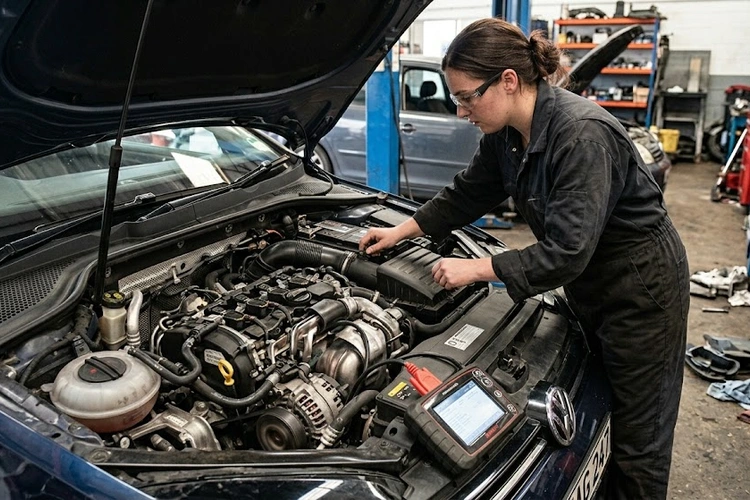
Connect a scan tool before you touch anything under the hood. Pull all stored and pending DTCs first, then switch to live data and monitor short-term fuel trim (STFT) and long-term fuel trim (LTFT) on both banks simultaneously. STFT values above +10% signal a lean condition — almost always a vacuum leak or MAF sensor underreporting airflow. Values below -10% point to a rich condition caused by excess fuel pressure, leaking injectors, or a failing O2 sensor driving the ECU blindly rich at idle.
Freeze frame data is equally critical. It captures the exact RPM, coolant temperature, engine load, and MAP sensor reading at the moment the fault triggered. Cross-reference that snapshot with live idle data and you eliminate half the suspect list before performing a single physical inspection. The freeze frame often shows whether the fault appeared at cold start, at operating temperature, or under a specific load condition — information no visual inspection can replicate.
For cylinder-specific misfires, run a contribution test directly from your scanner. The ECU sequentially disables each injector for two seconds. The cylinder that produces the smallest RPM drop when killed is the misfiring one. This test pinpoints the fault cylinder in under three minutes and is faster than any coil swap or plug pull. If the contribution test points to the ignition system, the full diagnostic sequence in 6 Symptoms of Bad Ignition Coil walks you through coil resistance measurement, spark test, and ECU misfire count correlation before you order a replacement.
After pulling OBD data, you work from simple to complex. Start at the intake. Inspect every vacuum line — the brake booster hose, the PCV hose, the MAP sensor feed line, and any small lines connecting to the intake manifold. Run your fingers along each one and feel for brittleness, collapse, or cracking. A failed hose looks intact from a foot away and leaks severely under intake vacuum.
Move to the MAF sensor next. A thin oil film on the sensing wire — deposited by a saturated air filter or an over-oiled aftermarket cotton filter — causes the MAF to underreport airflow. The ECU compensates by pulling fuel trim, which collapses idle stability. Inspect the wire under a flashlight before condemning the sensor. The cleaning procedure detailed in Mass Air Flow Sensor Symptoms and How to Clean It resolves oil-contaminated MAF faults in more than half of cases without replacing the unit.
Pull one spark plug from each bank and examine electrode wear, gap measurement, and deposit type. Carbon fouling indicates a chronic rich mixture. Oil deposits point to valve seal or ring failure. A worn electrode gap beyond 0.060 inches on a standard copper plug tells you ignition energy has been degrading for thousands of miles, well before the rough idle became noticeable at a stoplight.
A basic code reader is not sufficient for rough idle diagnosis. You need a scanner with live PID capability that displays at minimum: STFT and LTFT on both banks, MAF grams per second at idle, individual cylinder misfire counts, O2 sensor voltage waveform, and IAC steps or throttle position percentage at closed throttle. Software platforms like FORScan for Ford and Lincoln vehicles, AlfaOBD for Fiat-Chrysler platforms, and OBD Fusion for universal coverage handle most makes for under $30 in software licensing. A bidirectional scanner that can command the EGR pintle open and closed adds significant confirmation value on EGR-related faults, eliminating guesswork about whether the valve is mechanically stuck or electrically open.
A smoke machine is the definitive tool for vacuum leak detection. You pressurize the intake system with visible vapor, cap the throttle bore, and observe every hose junction, manifold gasket surface, and sensor port for wisps of escaping smoke. A shop-grade unit locates leaks in five minutes that would take an hour of propane testing to pinpoint.
Propane enrichment works as a no-equipment alternative when a smoke machine is not available. With the engine idling rough, you briefly direct unlit propane near suspect vacuum lines and intake manifold gasket surfaces. When your RPM smooths out or rises, you have found the leak point — propane entering the intake through the leak richens the local mixture and the idle momentarily stabilizes. Perform this test outdoors only. Propane accumulation in enclosed spaces creates a serious fire and explosion hazard, a risk documented extensively by the U.S. Occupational Safety and Health Administration.
Never use propane enrichment near a hot exhaust manifold or with the engine cooling fan running — a stray spark or a fan blade can ignite vapor before you locate the leak.
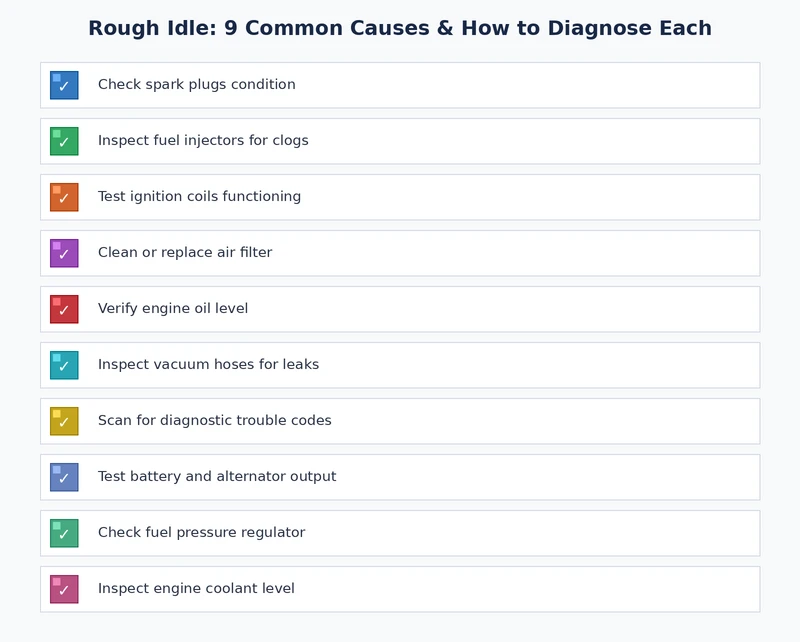
A rough idle caused by a dirty IAC valve, worn spark plugs, a marginally oil-contaminated MAF sensor, or a slightly cracked vacuum line is generally safe to drive at highway speeds. The misfire worsens at idle because the ECU's trim corrections have less authority at low airflow volumes. Under load, the idle instability often disappears entirely. Schedule the repair within one week. Extended misfiring floods your catalytic converter with unburned hydrocarbons and destroys the substrate from the inside — a repair that runs $800 to $2,500 on most platforms, making delay the most expensive decision you can make.
Stop driving immediately if your rough idle comes with a flashing check engine light. A flashing MIL indicates a misfire rate high enough to thermally damage the catalytic converter within minutes of highway driving. Pull over, shut the engine off, and arrange a tow. You must also stop if the rough idle is accompanied by white exhaust smoke at the tailpipe, coolant temperature climbing above the normal range, or visible oil consumption between short drives. These symptom combinations indicate head gasket failure or valve seal breakdown. Continued operation causes catastrophic engine damage within miles, not weeks — the repair escalates from a few hundred dollars to an engine replacement.
Premium fuel carries a higher octane rating. Octane resists detonation — the pre-ignition that occurs under compression in high-performance and high-compression engines. It does not clean fuel injectors, reseal vacuum lines, correct EGR flow rates, or adjust ignition timing errors stored in the ECU. If your vehicle specifies regular 87-octane fuel, switching to 93-octane premium produces no measurable difference in idle quality. The combustion chemistry at idle is functionally identical between grades at low compression and minimal load. The extra cost per tank buys you nothing on a misfiring standard-compression engine.
Replacing spark plugs and the air filter is the correct first step in any rough idle investigation — and that is precisely where the tune-up's diagnostic reach ends. A tune-up has zero effect on a stuck EGR valve, a leaking intake manifold gasket, a failing fuel pressure regulator, or a degraded IAC valve. Shops that recommend a tune-up for every rough idle complaint without first pulling live fuel trim data are guessing at your expense. Your repair order should document specific STFT and LTFT values, misfire counts, and the diagnostic test result that justifies each part replaced. If it does not, you are paying for a guess, not a diagnosis.
The table below reflects mid-tier OEM-equivalent parts at national retailers. Labor rates assume a $120 per hour independent shop rate. Dealer labor runs 20 to 40 percent higher on most platforms. DIY costs assume you already own a torque wrench, OBD-II scanner, and basic hand tools.
| Component | DIY Parts Cost | Shop Total (Parts + Labor) |
|---|---|---|
| Spark plugs (set of 4) | $20–$80 | $150–$320 |
| Ignition coil (single) | $30–$120 | $130–$280 |
| IAC valve | $40–$150 | $160–$390 |
| MAF sensor | $50–$200 | $180–$430 |
| PCV valve | $8–$35 | $60–$160 |
| EGR valve | $60–$250 | $200–$680 |
| Fuel pressure regulator | $30–$130 | $150–$390 |
| Fuel injector cleaning | $10–$25 (additive) | $100–$220 (ultrasonic service) |
| Vacuum line repair | $5–$25 | $80–$225 |
Spark plugs, IAC valves, PCV valves, and MAF sensors are all accessible DIY repairs on most inline-4 and V6 platforms. None require specialized equipment beyond a torque wrench, a spark plug socket set, and an OBD-II scanner. Fuel injector cleaning via fuel system additive requires zero disassembly and costs under $25 — a reasonable first step before committing to professional ultrasonic injector service.
EGR valve replacement difficulty varies enormously by engine family. On some platforms it is a top-mounted two-bolt job that takes 30 minutes. On others the valve is buried under the intake manifold and requires four to six hours of labor. The EGR passage on high-mileage engines is frequently coked with carbon deposits, adding cleaning time and cost on top of the valve itself. Get a labor quote specific to your engine code before authorizing this repair.
Fuel pressure regulator replacement on modern returnless direct-injection systems is a straightforward 45-minute DIY job. On older return-style fuel systems, you must depressurize the fuel rail at the Schrader valve before disconnecting any fuel line. Pressurized fuel spray from an improperly relieved rail is a fire hazard. If your system uses a return line, this is the one rough idle repair that warrants shop-level caution even for experienced DIYers. If you are uncertain whether your idle behavior is progressing toward a stall condition, the diagnostic steps in Car Stalls at Idle: 7 Causes and Step-by-Step Fix cover the overlap between rough idle and stall-risk territory.
Yes. Extended misfiring delivers unburned fuel to your catalytic converter, causing thermal breakdown that costs $800 to $2,500 to repair. A rough idle caused by a lean vacuum leak also runs your engine hotter than its design spec, accelerating wear on piston rings and valve seats. Any rough idle with a confirmed misfire count in your OBD data warrants a repair appointment within one week, not one month.
Not always. A misfire that occurs below the ECU's DTC storage threshold — typically fewer than a set number of events per 1,000 ignition cycles — produces a noticeable rough idle with no stored code. STFT and LTFT deviations also cause idle instability before they cross the threshold for P0171 or P0174. A scan tool displaying live fuel trim data reveals the fault even when your dashboard shows no warning lights.
Check STFT on both banks simultaneously. A vacuum leak on bank 1 only drives bank 1 STFT high while bank 2 stays near zero — the asymmetric lean pattern is the giveaway. A failed MAF sensor drives both banks lean at the same time because the ECU uses a single MAF g/s value to calculate fueling for the entire engine. That split-bank versus global lean pattern separates the two causes in under two minutes without touching a tool.
Yes, and it is a common pattern with a failing fuel pressure regulator or a marginally weak fuel pump. At idle, injector pulse width is very short. If rail pressure drops below spec, the injectors cannot deliver a consistent fuel charge per pulse, producing cylinder-to-cylinder variation and the characteristic stumble. At highway speed, higher injector duty cycle compensates for the pressure drop and the symptom disappears — which is exactly why a fuel pressure gauge test at idle is the correct first step, not a pump replacement.
It depends on what your scanner shows. A steady check engine light with no temperature deviation, no white exhaust smoke, and no flashing MIL is generally safe for a short drive to the shop. A flashing check engine light means pull over immediately — the active misfire rate is already damaging your catalytic converter with every mile you drive. When in doubt, tow it. A tow bill is always cheaper than a destroyed catalyst.
Diagnose the data first, buy the part second — your scanner already knows which of the nine causes is shaking your engine, and it will tell you for free if you connect it before you open your wallet.
 |
 |
 |
 |

About Sarah Whitfield
Sarah Whitfield is a diagnostics and troubleshooting specialist who spent ten years as an ASE-certified technician before joining the editorial team. She specializes in OBD-II analysis, electrical gremlins, and the kind of intermittent problems that make most owners give up.
Get some FREE car parts & gear.. Or check out the latest free automotive manuals and build guides here.
Disable your ad blocker to unlock all the hidden deals. Hit the button below 🚗
| | | |
