by Sarah Whitfield
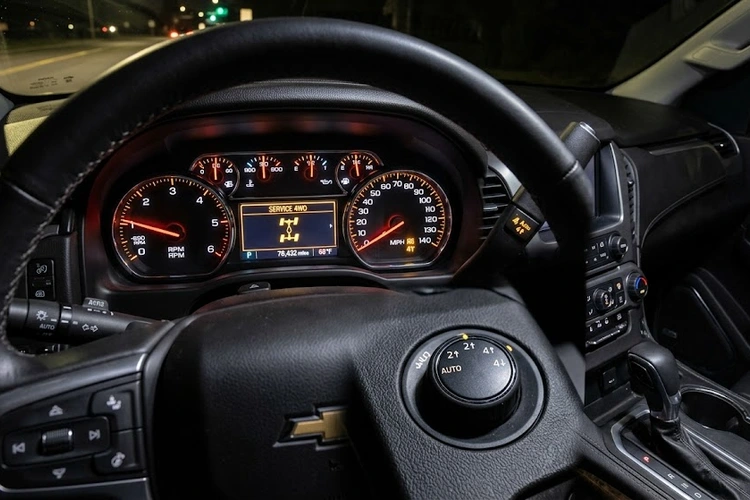
Last winter, our team was evaluating a lifted half-ton on a remote fire road when the service 4WD light illuminated without warning. No abnormal sounds, no perceptible drivetrain vibration — just a persistent amber indicator demanding attention. That experience prompted a thorough investigation into what this warning actually signals and how to address it without wasted labor.
The service 4WD light on four-wheel-drive vehicles signals an active fault within the transfer case control system, actuator circuit, or associated electronics. It is not a routine maintenance reminder. This warning demands systematic diagnosis rather than a quick dashboard reset. Understanding this indicator is foundational for anyone operating a vehicle with serious off-road capability — a context we explore further in our analysis of what Jeep Wranglers can realistically handle when towing.
When this light appears, most people instinctively cycle the 4WD selector between modes repeatedly. That approach rarely resolves the underlying fault. The sections below address the six most common root causes and a reliable diagnostic sequence for each.
Contents
Two deeply entrenched misconceptions about this warning lead most people down unproductive diagnostic paths. Addressing them first creates a more efficient repair sequence. Our team encounters both beliefs regularly in shop consultations, and both consistently delay resolution.
This belief is responsible for the most time and money lost in 4WD diagnostics. The PCM or transfer case control module (TCCM) stores a diagnostic trouble code (DTC) the moment this warning illuminates. That code persists in non-volatile memory until the fault is corrected and the memory is explicitly cleared. The service 4WD light is not a transient advisory. It is a latching fault indicator.
Unlike a loose fuel cap triggering a check engine light after a gas fill-up — a fault that can self-clear after several drive cycles — the service 4WD warning does not self-resolve. Waiting for the light to disappear on its own wastes time and risks additional mechanical stress on a system that is already operating outside its designed parameters.
Wheel speed sensors, position sensors, and encoder circuits do cause this warning. However, a failed sensor is itself a legitimate fault requiring prompt attention. The four-wheel drive system depends on continuous, accurate feedback from multiple sensors to determine safe engagement windows and confirm transfer case position. When a sensor fails, the TCCM enters a protective fault state and disables or restricts 4WD engagement. Labeling this a "glitch" misses the functional consequence entirely.
Pro Insight: Always pull DTCs with a module-capable scanner before attempting any mechanical disassembly. Working blind on a 4WD system invariably disturbs components that are functioning correctly and adds diagnostic noise.
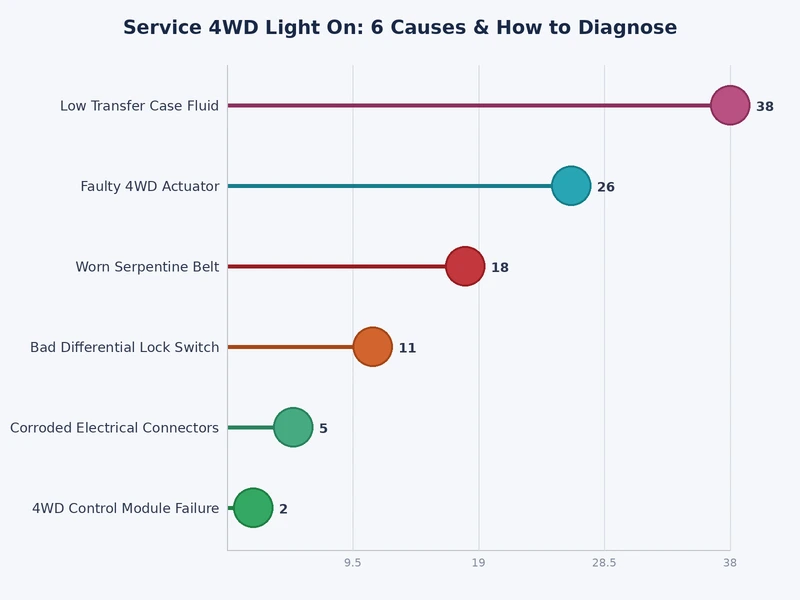
These are the six fault categories our team encounters most frequently on domestic trucks and SUVs with electronic shift or shift-on-the-fly 4WD systems. Each cause has a distinct failure signature and a corresponding diagnostic approach.
The transfer case actuator is an electrically driven motor assembly that physically shifts the transfer case between 2H, 4H, and 4L. When the actuator fails — whether from winding burnout, internal mechanical seizure, or corrosion of the motor commutator — the TCCM registers a circuit fault immediately. The service 4WD light illuminates and 4WD engagement is disabled or becomes unreliable. Actuator failure is the single most common cause on vehicles beyond 100,000 miles, and replacement is straightforward on most platforms. Bench-testing the actuator with a regulated 12V supply before condemning it rules out wiring faults upstream of the motor.
The encoder motor reports transfer case position to the TCCM in real time. If the encoder sends incorrect or absent position data, the module cannot confirm whether the case has reached the commanded mode. This unresolved state trips a fault code and activates the service 4WD light. On GM trucks, encoder faults appear most commonly as DTC C0327 or C0369. The encoder is integral to the actuator assembly on many platforms, so motor replacement resolves both faults simultaneously. On vehicles where the encoder is a discrete component, it can be tested independently with a multimeter by measuring resistance through each position.
Transfer case fluid lubricates the internal chain, planetary gear set, and — on electronically controlled units — the clutch pack that manages front axle engagement. Degraded or low fluid elevates friction, increases operating temperature, and can trigger thermal protection codes in the TCCM. Fluid contamination is often more damaging than low level alone; water intrusion from failed seals introduces oxidation and bearing wear rapidly. Most OEMs specify a dedicated transfer case fluid, and substituting ATF or conventional gear oil where it is not specified accelerates clutch pack wear and shortens service life significantly.
The 4WD control module uses wheel speed data from the ABS sensor network to determine safe engagement windows and detect speed differentials between axles. A failed front axle wheel speed sensor prevents the TCCM from confirming synchronization conditions for 4WD engagement. This fault frequently appears alongside an illuminated traction control light, since both the stability control and 4WD systems draw from the same wheel speed sensor array. Isolating the specific sensor requires live data monitoring — watching individual sensor outputs during a slow parking-lot drive identifies the dead channel immediately.
Corroded connectors, chafed wires, and degraded chassis grounds are endemic in trucks exposed to road salt, mud, or sustained off-road use. A single intermittent ground fault at the transfer case can produce a cascade of spurious DTCs across multiple modules. The harness connector at the actuator motor is a known failure point on high-mileage Ford F-Series and GM Sierra/Silverado platforms. Connector corrosion is often invisible externally — pin-probing under load is necessary to identify resistance faults that pass continuity tests at rest. Dielectric grease applied during assembly is the most effective preventive measure.
Software faults, corrupted calibration data, and module power supply interruptions can generate erroneous service 4WD warnings without any mechanical fault present. In most cases, a module reprogramming or calibration update resolves the condition. On some platforms, the TCCM requires a position relearn procedure after replacement or reprogramming — skipping this step produces immediate fault codes. PCM and TCCM faults should be the final diagnostic step after all mechanical and electrical causes are eliminated. Condemning a control module prematurely is a common and expensive diagnostic error.
Systematic diagnosis begins with electronic scanning, not disassembly. The fault code stored in the TCCM points directly to the affected circuit in most cases, eliminating speculative part replacement.
A generic OBD-II scanner reads only emissions-related codes from the PCM. It will not access 4WD-specific modules. A bi-directional scanner capable of manufacturer-specific module access — such as the Autel MaxiSYS series, Snap-on ZEUS, or equivalent — is required to retrieve TCCM or TCSM codes on most domestic trucks. The table below summarizes the most common 4WD-specific DTCs encountered in shop diagnostics.
| DTC Code | Description | Likely Component | Severity |
|---|---|---|---|
| C0327 | Encoder Circuit Performance | Encoder Motor | Moderate |
| C0369 | Transfer Case Range Sensor Circuit | Position Sensor / Encoder | Moderate |
| C0374 | Transfer Case System Error | TCCM / Actuator | High |
| C0379 | Front Shaft Speed Sensor Circuit | Front Shaft Speed Sensor | Moderate |
| C0387 | Transfer Case Actuator Circuit Low | Actuator / Wiring | High |
| C0500 | Rear Wheel Speed Sensor | ABS Wheel Speed Sensor | Moderate–High |
After retrieving and documenting all active and pending codes, the physical inspection sequence follows a logical order from least invasive to most invasive:
Preventive maintenance eliminates the two most common service 4WD fault categories before they develop. Our team's shop floor data consistently identifies fluid neglect and connector corrosion as the leading preventable root causes across all domestic 4WD platforms.
Most manufacturers specify transfer case fluid changes at 30,000 to 60,000 miles under normal operating conditions. Severe-duty use — regular towing, sustained off-road operation, or salt-belt driving — warrants intervals as short as 15,000 miles. Fluid condition is a more reliable indicator than mileage alone. Dark brown or black fluid with a burnt odor indicates the service interval is overdue regardless of the odometer reading.
Fluid specification compliance is non-negotiable on electronically controlled transfer cases. Substituting conventional ATF or gear oil where a dedicated transfer case fluid is specified accelerates clutch pack wear and introduces viscosity incompatibilities that trigger thermal protection codes. The OEM fluid specification is typically stamped on the transfer case fill plug or listed in the service manual lubricant section.
Annual inspection of the transfer case actuator connector, encoder motor wiring, and all associated ground straps prevents the majority of electrically-induced service 4WD faults. The inspection requires only a flashlight and basic hand tools. Pins showing green or white oxidation should be cleaned with contact cleaner on a fine brass brush, then packed with dielectric grease on reassembly.
On high-mileage vehicles, proactive actuator replacement during a scheduled transfer case fluid service is cost-effective. Parts cost on most domestic platforms is modest, and the labor overlap — the transfer case is already drained and accessible — eliminates duplicate teardown time. This approach avoids the inconvenience of a roadside service 4WD fault on a trail or in remote conditions.
Not every service 4WD warning demands immediate roadside action. Severity assessment depends on associated symptoms, current driving conditions, and the specific DTC stored. The following framework reflects our team's approach to triaging this warning in the field.
If the service 4WD light is illuminated but the vehicle operates normally in 2WD — no abnormal sounds, no drivability issues, and no secondary warning lights — continued operation to a diagnostic facility is generally acceptable. Most people in this scenario can drive several hundred miles without additional mechanical damage, provided the vehicle remains in 2WD mode and is not subjected to off-road terrain, heavy towing loads, or adverse surface conditions that would demand 4WD engagement.
Similar conditional logic applies when evaluating multiple concurrent warnings, a topic addressed in our overview of dashboard lights flickering and what they indicate. A single isolated code with no drivability impact is a different risk profile than multiple concurrent faults.
Several symptom combinations indicate the vehicle should be parked and diagnosed before further operation:
Operating a vehicle under these conditions risks catastrophic transfer case failure, driveshaft damage, or loss of directional control — outcomes that convert a moderate repair into a major one.
Yes. A low-voltage event — whether from a failing battery, a bad alternator, or a brief power interruption — can corrupt TCCM memory or cause the module to log a spurious fault. Our team recommends clearing all codes and performing a complete battery and charging system evaluation before replacing any 4WD-specific components following a battery replacement or jump-start event.
In most cases, the TCCM disables 4WD engagement when the service 4WD light is active as a protective measure. Attempting to force engagement through repeated selector cycling risks damaging an actuator that is already in a fault state. The system should be diagnosed and the fault cleared before 4WD engagement is attempted under load.
Repair cost depends heavily on the root cause. A wheel speed sensor replacement typically falls in the $80–$200 range for parts and labor on most platforms. A transfer case actuator replacement ranges from $150–$450 depending on the vehicle. Full TCCM replacement or reprogramming can reach $400–$900 at a dealership. Our team strongly recommends obtaining a specific DTC before authorizing any repair, as speculative part replacement is the leading driver of unnecessary repair costs on 4WD systems.
 |
 |
 |
 |

About Sarah Whitfield
Sarah Whitfield is a diagnostics and troubleshooting specialist who spent ten years as an ASE-certified technician before joining the editorial team. She specializes in OBD-II analysis, electrical gremlins, and the kind of intermittent problems that make most owners give up.
Get some FREE car parts & gear.. Or check out the latest free automotive manuals and build guides here.
Disable your ad blocker to unlock all the hidden deals. Hit the button below 🚗
| | | |
