by Sarah Whitfield
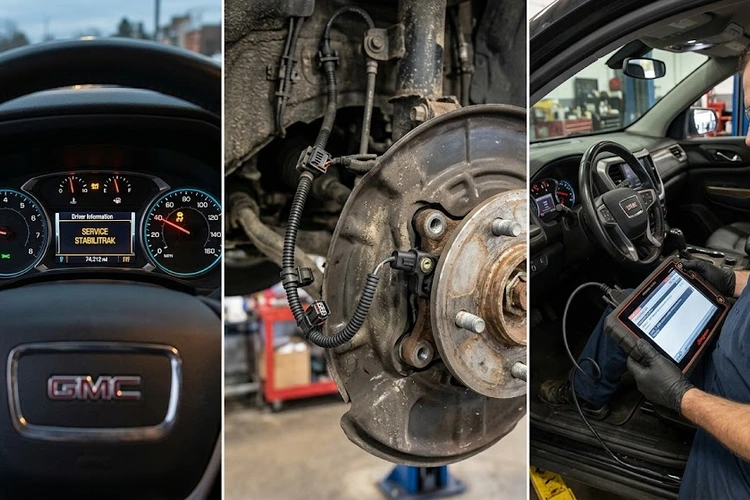
The service stabilitrak light means the car's electronic stability control system has detected a fault and gone offline. In many cases it's a sensor issue — not a catastrophic failure, but not something to ignore either.
StabiliTrak is General Motors' brand name for electronic stability control (ESC), a safety system built into most GM vehicles. It monitors wheel speed, steering angle, and brake pressure to keep the car stable during sharp turns or slippery conditions. When a sensor sends bad data — or stops sending data entirely — the service stabilitrak light appears. The car may still drive normally, but the safety net is down. For a broader look at related warnings, the Check VSC System guide covers stability and traction control faults across multiple makes.
Knowing what triggers this light — and how to address it — can save real money and prevent a small fault from becoming a bigger repair.
Contents
The service stabilitrak light doesn't appear randomly. The ECM (Engine Control Module, the car's main computer) stores a fault code every time the light turns on. That code is the starting point for any diagnosis. Without reading it first, any repair is just a guess.
The most common cause of the service stabilitrak light is a faulty wheel speed sensor. These sensors sit near each brake rotor and send constant speed data to the ECM. When one fails — from corrosion, road debris, or a broken wire — the system can't accurately track wheel movement. So it shuts down entirely rather than operate on bad data.
Wheel speed sensors also feed directly into the ABS (Anti-lock Braking System). That's why drivers often see the ABS light come on alongside the StabiliTrak warning. Anyone hearing a grinding noise when braking at the same time should have both the sensors and wheel bearings inspected together — they share the same physical area, and wear in one often signals wear in the other.
The steering angle sensor sits inside the steering column and tells the ECM where the front wheels are pointing. If it loses calibration — usually after a wheel alignment or suspension repair — the ECM thinks the car is turning when it's actually going straight. That mismatch is enough to trigger the warning.
This is a surprisingly common cause after routine shop visits. Some mechanics don't reset the steering angle sensor after an alignment. The light shows up days later, and it looks like a new problem when it's actually a leftover from maintenance that was almost finished correctly.
A weak or failing battery is high on the list of overlooked causes. Low voltage disrupts sensor communication across the entire vehicle. If the battery light is on at the same time, starting there first can save a lot of unnecessary parts replacement.
A faulty throttle position sensor is another possibility. StabiliTrak uses throttle data to calculate engine output during stability corrections. When that sensor drifts, the ECM can't do its math correctly. Throttle position sensor symptoms frequently appear alongside the StabiliTrak warning on GM vehicles. Low brake fluid, a failing ABS control module, and loose ground connections are also worth investigating if the more obvious causes check out clean.
Skipping the diagnostic step and replacing parts by feel is expensive. A few inexpensive tools narrow down the problem fast — before any money gets spent on repairs.
An OBD-II scanner reads fault codes stored in the ECM. It's the single most useful tool for diagnosing the service stabilitrak light. Basic code readers under $30 can pull generic engine codes, but StabiliTrak faults are often manufacturer-specific chassis codes (C-codes and U-codes). A mid-range scanner in the $80–$150 range will catch what cheap tools miss. Most auto parts stores — AutoZone, O'Reilly, NAPA — will scan for free, which makes them a smart first stop.
| OBD-II Code | What It Means | Likely Cause | DIY Difficulty |
|---|---|---|---|
| C0035 | Left front wheel speed sensor circuit | Bad sensor or damaged wiring | Easy–Medium |
| C0040 | Right front wheel speed sensor circuit | Bad sensor or damaged wiring | Easy–Medium |
| C0045 | Left rear wheel speed sensor circuit | Same as above | Easy–Medium |
| C0050 | Right rear wheel speed sensor circuit | Same as above | Easy–Medium |
| C0561 | Stability system disabled, codes stored | Root cause varies — check all stored codes | Varies |
| C0455 | Steering angle sensor range/performance | Calibration needed or sensor failure | Medium |
| U0073 | Control module communication bus fault | Wiring issue or low battery voltage | Medium–Hard |
A physical inspection can catch obvious problems before or after scanning. Check the wiring harness near each wheel — it sits close to the road and can fray, crack, or get snagged during brake work. Inspect the sensor connector at each wheel for corrosion or looseness. A disconnected connector is sometimes the entire cause, and cleaning and reseating it is free.
Also look at the reluctor ring (the toothed metal ring near each brake rotor that the speed sensor reads). Packed-in debris or a cracked tooth can cause erratic sensor readings. Significant vibration at highway speeds is another clue — it can point to a wheel bearing problem that affects speed sensor accuracy at the same time.
Resetting the light without fixing the underlying fault is only a temporary measure. But when a genuine glitch is the cause, a proper reset is all that's needed.
Turn the ignition off and wait at least 15 seconds. Restart the car and drive for a few miles. If the cause was a momentary voltage fluctuation or a brief sensor hiccup, the ECM may not see the fault on the next drive cycle and the light won't return.
For a deeper electrical reset, disconnect the negative battery terminal for 30 seconds, then reconnect it. This clears the ECM's stored memory. Keep in mind that it also resets other systems — radio presets, power window positions, and idle parameters. The engine may idle rough for a few minutes while the ECM relearns its base settings. That's completely normal and resolves on its own.
An OBD-II scanner can erase fault codes directly. The process takes seconds — but the rule is always to fix the root cause first. Clear the code without replacing a faulty wheel speed sensor, and the light will return within one or two drive cycles. The ECM runs continuous self-tests. Clearing codes without repairs just erases the breadcrumb trail and makes the next diagnosis harder.
Some GM vehicles also require a specific steering angle sensor reset procedure after any front suspension or alignment work. The typical method is to start the engine and turn the steering wheel from full left lock to full right lock, then back to center. The exact steps vary by model year, so checking a factory service manual or a model-specific owner forum is worth a few minutes before assuming the procedure is universal.
Several common StabiliTrak fixes are well within reach for drivers with basic tools. Others genuinely need professional equipment to do correctly. Knowing the difference saves both time and frustration.
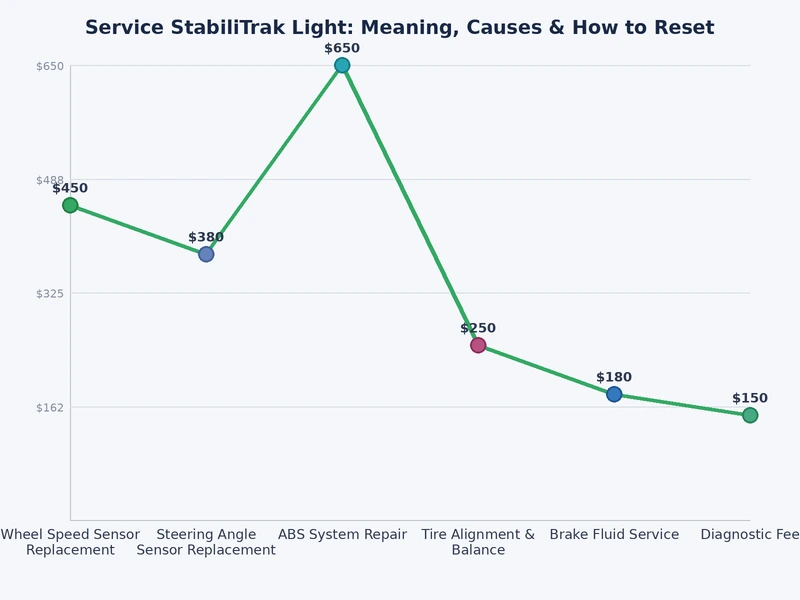
Replacing a wheel speed sensor is one of the more accessible repairs on a modern car. It typically involves one mounting bolt and one electrical connector. Parts usually cost $20–$60. The main challenge is corrosion — sensors near the brake rotor can rust in place over time, especially in areas with heavy road salt. Penetrating oil left to soak overnight usually solves it. Cleaning corroded connectors costs a few dollars in electrical contact cleaner. Resetting the steering angle sensor after alignment is a free, tool-free procedure once the correct steps are known for the specific vehicle.
ABS module replacement requires specialized brake bleeding equipment and sometimes module programming. A failing ECM needs dealer-level reprogramming tools that aren't practical for home use. When multiple fault codes appear together — particularly U-codes indicating communication failures — the issue may be a wiring harness problem requiring professional tracing and testing equipment.
Independent shop labor typically runs $100–$150 per hour. Dealer rates often land at $150–$200. Diagnostic fees of $100–$150 are standard, though many shops credit that cost toward the repair bill. Drivers who also notice unusual transmission behavior should know that transmission slipping symptoms can sometimes surface alongside stability control faults when a vehicle has broader electrical or communication issues — addressing both at the same time can reduce overall diagnostic costs.
Some dashboard warnings are genuinely low-priority. The service stabilitrak light deserves more attention than most. Here's the honest picture on both sides.
StabiliTrak is a real safety feature. On wet roads, icy pavement, or during emergency maneuvers, it can prevent a skid from becoming a crash. Driving without it on clear, dry roads at moderate speeds carries manageable risk. In poor conditions, it's a meaningful loss of protection that most drivers don't notice until they actually need it.
Acting early also prevents fault escalation. A single bad wheel speed sensor is a $40–$60 fix. Left unaddressed, the ECM may log additional codes, the ABS system may begin compensating incorrectly, and what started as one fault can grow into multiple overlapping problems. Small faults caught early are almost always cheaper than deferred ones.
When the service stabilitrak light is on, both StabiliTrak and traction control are typically disabled simultaneously — two safety systems offline at once. The car handles normally in most everyday driving, but the electronic protection that catches mistakes is gone.
There's also the vehicle inspection issue. In states that require emissions or safety inspections, active fault codes often cause a failed test. Clearing codes without fixing the cause and driving straight to inspection will still fail — modern inspection systems verify that the ECM's readiness monitors have completed their self-test cycles since the last code clear. That process takes several drive cycles and can't be rushed.
Short trips on dry, clear roads are generally manageable. But both StabiliTrak and traction control are offline when the light is on, which reduces protection on wet, snowy, or winding roads. Getting the fault diagnosed sooner rather than later is the safer choice.
Sometimes. If the cause was a temporary sensor glitch or a brief voltage drop, the light may clear after restarting the car. But if an underlying fault code is stored, the light will return within one or two drive cycles and won't stay off until the root cause is repaired.
It depends on the cause. A wheel speed sensor replacement typically runs $60–$150 in parts and labor at an independent shop. A steering angle sensor reset can cost nothing when done at home. An ABS module replacement can reach $400–$800 or more depending on the vehicle and labor rates in the area.
Yes. A weak battery causes low voltage across the entire electrical system, which can disrupt sensor communication and trigger multiple warning lights at once — including the service stabilitrak light. Checking battery health is always a smart early step before spending money on sensors or modules.
Traction control limits wheel spin during acceleration. StabiliTrak goes further — it also corrects sideways slides and oversteer by selectively applying individual wheel brakes and reducing engine power. They share sensors and hardware, so a fault in one typically disables both systems at the same time.
Yes, in states that check OBD-II readiness monitors. Active fault codes will flag the vehicle as not ready. Clearing codes without repairing the underlying fault and then immediately driving to inspection will usually still fail — the ECM's self-test monitors need several complete drive cycles to confirm the system is functioning correctly before they register as ready.
The service stabilitrak light is worth taking seriously, but it's rarely a reason to panic. A free OBD-II scan at any auto parts store is the right first move — it turns a vague warning into a specific code, and a specific code turns guesswork into a clear repair plan. Start with the scan, confirm the cause, and tackle the fix from there rather than replacing parts blindly.
 |
 |
 |
 |

About Sarah Whitfield
Sarah Whitfield is a diagnostics and troubleshooting specialist who spent ten years as an ASE-certified technician before joining the editorial team. She specializes in OBD-II analysis, electrical gremlins, and the kind of intermittent problems that make most owners give up.
Get some FREE car parts & gear.. Or check out the latest free automotive manuals and build guides here.
Disable your ad blocker to unlock all the hidden deals. Hit the button below 🚗
| | | |
