by Sarah Whitfield
Nearly 1 in 5 instrument cluster complaints filed with the National Highway Traffic Safety Administration involve a speedometer bouncing erratic or giving unreliable readings. That statistic matters because an unstable speedometer is not just a nuisance — it can trigger speeding violations, mask dangerous mechanical failures, and, in worst-case scenarios, contribute to transmission damage that costs thousands to repair.
Your speedometer is a data display. It translates electrical signals from sensors near your drivetrain into the number on your dial. When that display starts jumping, stuttering, or dropping to zero, something in that signal chain has broken down. The failure could be a $25 sensor or a $900 instrument cluster. Knowing which one requires a methodical diagnosis — not guesswork.
This guide covers every major cause of erratic speedometer behavior, how to distinguish minor from serious faults, what repairs cost, and the diagnostic mistakes that turn a cheap fix into an expensive one.
Contents
The speedometer in your vehicle does not measure speed directly. It reads pulses from a vehicle speed sensor (VSS) — a magnetic or Hall-effect sensor that counts rotations of your transmission output shaft or wheel hub. The faster the shaft spins, the more pulses per second the sensor sends to the engine control unit. The ECU converts that pulse rate into a speed value and transmits it to your instrument cluster.
Understanding this chain is essential. A fault anywhere along it produces the same visible symptom: a needle that jumps, drops, or refuses to track accurately. Pinning down which component is responsible is what separates a $30 repair from a $600 one.
Vehicles built before the early 1990s used a mechanical speedometer cable. It rotated inside a flexible sheath running from the transmission to the dashboard. No sensors, no ECU involvement — just a spinning cable driving a needle mechanism directly.
Post-1995 vehicles use fully electronic systems. The VSS sends digital pulses, the ECU handles interpretation, and the cluster displays the result. Modern vehicles also integrate ABS wheel speed sensors into the speed calculation, adding another potential failure point — but also giving you more diagnostic data via OBD-II codes.
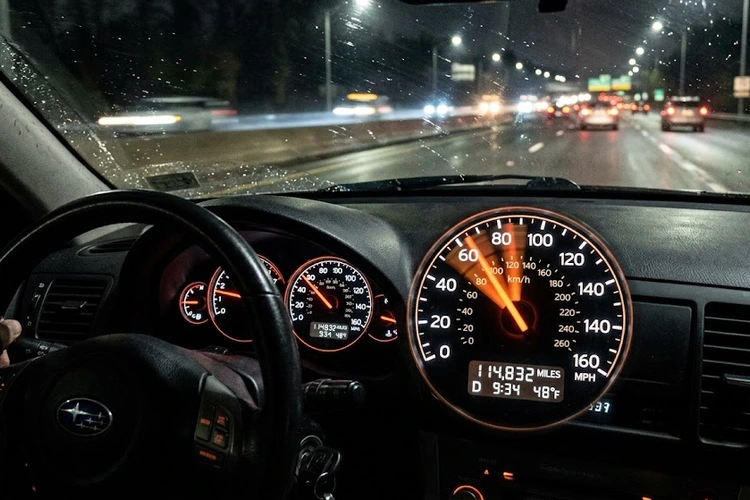
A failing VSS is responsible for the majority of erratic speedometer complaints. As this sensor degrades — through wear, heat cycling, or debris contamination — it sends inconsistent pulse signals to the ECU. Your speedometer needle responds to every bad reading. The result is a needle that surges forward, drops to zero, or oscillates without any change in actual vehicle speed.
A faulty VSS almost always triggers a check engine light and stores a diagnostic trouble code. The most common codes are P0500 (vehicle speed sensor malfunction), P0501 (VSS range/performance), and P0503 (VSS intermittent). Scan for these before touching any hardware.
The harness between the VSS and the ECU runs through a hostile environment. It is exposed to heat, road vibration, and moisture — all of which accelerate insulation breakdown. Frayed wires, corroded connector pins, or a plug that has vibrated loose will interrupt the signal intermittently. Your speedometer may function normally for miles and then start bouncing without warning.
Inspect the harness visually before replacing any component. Look for chafed insulation where wires contact metal edges, green corrosion inside connectors, and plugs that do not click firmly into place.
The cluster itself is not immune to failure. On analog gauge clusters, small stepper motors drive the needles. When a stepper motor wears out, the needle moves erratically — overshooting, stuttering, or failing to track the incoming signal. This is a cluster-side failure, entirely separate from the sensor or wiring.
If your tachometer, fuel gauge, or temperature gauge are also misbehaving, the cluster is the likely culprit. The same electrical degradation that causes interior car lights to stop working — a failing body control module or corroded ground — can also corrupt cluster behavior across all gauges simultaneously.
On mechanical speedometer systems, a kinked or cracked cable produces a distinctive rhythmic bounce. The cable rotates inside its sheath; a kink or tight bend causes the rotation to stutter at regular intervals. The needle twitches in direct proportion to vehicle speed — faster driving, faster twitching.
This pattern is easy to distinguish from electronic faults. If the bounce is rhythmic and predictable, inspect the cable for kinks, cracks, or lubrication failure. Replacement cables cost $15–$50 and the job is within reach of most DIYers.
Modern speedometers draw speed data from ABS wheel speed sensors as a primary or backup source. A failing ABS module, corrupted ECU software, or a bad wheel speed sensor can send faulty data to the cluster. This type of fault almost always appears alongside ABS or traction control warning lights. If your VSC system warning light is illuminated at the same time as your speedometer is bouncing, the ABS module or a wheel speed sensor is a strong suspect.
Pro tip: If your speedometer bounces only above 40 mph, focus on the rear wheel speed sensors first — they are more exposed to road debris and moisture at highway speeds.
VSS replacement is one of the more accessible DIY repairs on a modern vehicle. The sensor is typically mounted on the transmission housing and accessible from underneath with basic hand tools. Expect 1–2 hours of work. A quality OEM-equivalent sensor from Delphi, Bosch, or Standard Motor Products costs $20–$60.
Wiring repairs are also within reach if the damage is visible and localized. Solder the affected section, use adhesive heat-shrink tubing to seal it, and apply dielectric grease to all reconnected terminals. This approach costs under $20 in materials and fixes the majority of intermittent harness faults.
Skip the DIY route if the problem involves ECU reprogramming, ABS module replacement, or faults that span multiple systems. These repairs require professional-grade scan tools that read live sensor data — not just stored codes. If you cannot read OBD-II codes, you are diagnosing blind. That is when a shop earns its labor rate.
A speedometer bouncing erratic does not automatically ground your vehicle. In the following situations, driving a short distance to a shop is reasonable:
Pull over and arrange a tow or diagnosis if any of the following apply:
Driving with a confirmed instrument failure may also carry legal consequences. The National Highway Traffic Safety Administration classifies instrument cluster malfunctions as safety-related defects when they impair driver awareness. Some insurers use this classification to reduce or deny claims in at-fault accidents where the driver knew about the fault.
| Repair Type | DIY Parts Cost | Shop Total (Parts + Labor) | Difficulty |
|---|---|---|---|
| Vehicle speed sensor replacement | $20–$60 | $80–$220 | Easy |
| Wiring harness repair | $10–$40 | $100–$350 | Moderate |
| Speedometer cable replacement | $15–$50 | $60–$160 | Easy |
| Instrument cluster replacement | $60–$400 | $200–$650 | Moderate |
| ABS wheel speed sensor replacement | $30–$80 | $120–$300 | Easy–Moderate |
| ABS module replacement | $80–$280 | $300–$900 | Professional only |
| ECU reprogramming or replacement | N/A | $150–$1,400 | Professional only |
Independent shops charge 30–50% less than dealerships for most of these repairs. Use OEM or Tier 1 aftermarket parts (Delphi, Bosch, Standard Motor Products) — particularly for speed sensors, where cheap off-brand units have looser tolerances that create new problems on older ECUs.
Pull your own OBD-II codes before going to a shop. A $20 Bluetooth scanner and a free app gives you the same fault code a shop reads in the first five minutes of their diagnostic — which they typically bill at $100–$150. Arriving with codes in hand lets you have a specific conversation about the repair, not a general one about "the speedometer acting weird."
Order your own parts online once you have confirmed the fault. Verify compatibility using your VIN, not just your year/make/model — transmission variants and build dates matter for speed sensor fitment.
Most VSS failures trigger a check engine light before the speedometer begins bouncing noticeably. Dismissing that early warning allows the fault to propagate — eventually degrading transmission shift quality or disabling traction control. Early intervention on sensor faults is almost always cheaper than late intervention. The same principle applies to any stored code: a P0300 random misfire code that is ignored for weeks becomes a catalytic converter replacement months later.
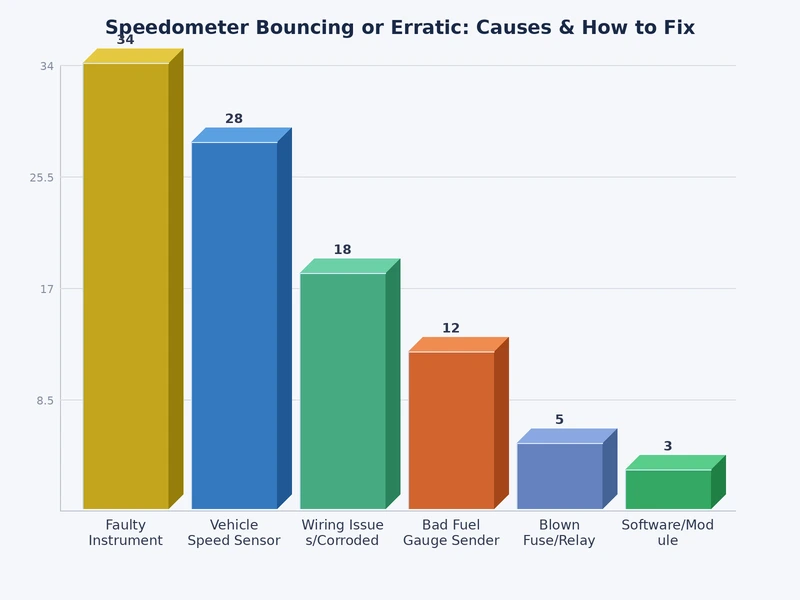
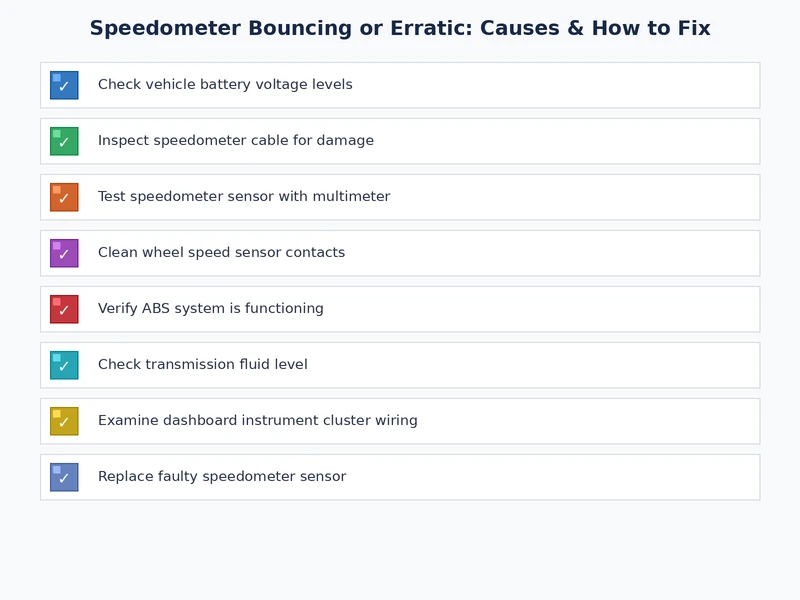
A bouncing speedometer has at least six distinct causes. Replacing the VSS without confirming it is the actual fault wastes money and leaves the real problem unresolved. Pull fault codes. Inspect the wiring harness visually. Test sensor output voltage with a multimeter. Only replace components you have reason to believe are faulty.
Guessing at parts is also how drivers compound problems. A misdiagnosed speedometer fault has caused drivers to miss the early signs of a slipping transmission or a failing ABS system — issues that compound rapidly when ignored.
Bad chassis grounds are responsible for a disproportionate share of intermittent electrical faults. A loose or corroded ground strap near the instrument cluster, ECU, or transmission creates signal noise that mimics a failing sensor perfectly. Clean and re-torque all ground connections in the affected circuit before condemning any component. This is the same oversight that produces alternator whining noise — electrical interference from degraded grounds spreads across multiple systems simultaneously.
Inexpensive aftermarket speed sensors often have looser internal tolerances than OEM parts. On a vehicle with high mileage and an aging ECU, those tolerances matter. The ECU expects a clean, consistent pulse signal within a specific voltage and frequency range. An off-spec sensor produces marginal readings that a new ECU would accept but an older one rejects — sending your speedometer right back into erratic territory within weeks of the repair. Spend the extra $15–$20 for a known brand. The labor to replace it twice costs far more than the part savings.
A faulty vehicle speed sensor (VSS) is the most common cause. As the sensor degrades, it sends inconsistent pulse signals to the ECU, which the speedometer needle reflects in real time. Check for OBD-II codes P0500, P0501, or P0503 first — these point directly to the VSS circuit.
For short distances with no other warning lights active, driving to a nearby shop is acceptable. Stop driving immediately if the needle drops to zero at speed, if ABS or traction control lights appear, or if the vehicle behaves differently during acceleration or braking. Those combinations indicate a more serious underlying fault.
Use an OBD-II scanner to check for stored fault codes first. If codes point to the VSS circuit, test the sensor output with a digital multimeter set to AC voltage. With the vehicle raised safely and the drivetrain rotating slowly, you should see a steady, consistent AC voltage signal. An erratic or absent signal confirms the sensor is faulty.
Yes. The ECU uses VSS data to determine shift points in automatic transmissions. A faulty or dead speed sensor can cause late shifting, harsh gear changes, or the transmission staying in a single gear. If your speedometer is bouncing and your transmission is shifting abnormally, address the speed sensor immediately.
Costs range from $20–$60 for a DIY vehicle speed sensor replacement up to $900 or more for ABS module or ECU repairs at a dealership. The majority of speedometer faults fall in the $80–$250 range at an independent shop when the cause is a sensor or wiring issue. Get a confirmed diagnosis before committing to any major repair.
In most cases, replacing the faulty component restores accurate readings without recalibration. However, if you have changed tire sizes, differential gearing, or replaced the instrument cluster with a unit from a different vehicle, recalibration via a dealer or specialized shop may be necessary to restore accurate speed readings.
Fix the sensor, not the symptom — a speedometer that lies is always telling the truth about something worse underneath.
 |
 |
 |
 |

About Sarah Whitfield
Sarah Whitfield is a diagnostics and troubleshooting specialist who spent ten years as an ASE-certified technician before joining the editorial team. She specializes in OBD-II analysis, electrical gremlins, and the kind of intermittent problems that make most owners give up.
Get some FREE car parts & gear.. Or check out the latest free automotive manuals and build guides here.
Disable your ad blocker to unlock all the hidden deals. Hit the button below 🚗
| | | |
