by Joshua Thomas
Approximately 35 percent of all no-start complaints trace back to a fault in the starting circuit — and the starter relay is one of the most overlooked culprits. Recognizing bad starter relay symptoms early prevents unnecessary tows, wasted diagnostic fees, and the frustration of replacing the wrong part. The starter relay is a small electromagnetic switch that sits between your battery and your starter motor. When it fails, your engine simply will not start. The fix is inexpensive. The diagnosis, if you go in blind, is not.
Understanding how the starting system operates gives you the edge you need to pinpoint this problem fast. A failed relay can behave exactly like a dead battery, a seized starter motor, or a faulty ignition switch. Each mimics the other closely. Knowing the six key symptoms changes everything.
Contents
The three most common no-start culprits — a dead battery, a bad starter relay, and a failed starter motor — share many surface-level symptoms. This overlap is exactly why so many drivers replace the wrong part first. The table below separates each fault by its most telling diagnostic clues. Study it before you spend a dollar on parts.
| Symptom | Dead Battery | Bad Starter Relay | Bad Starter Motor |
|---|---|---|---|
| Single loud click, no crank | Possible | Yes — very common | Possible |
| Rapid repeated clicking | Yes — classic sign | Rare | No |
| Intermittent starting | Rare | Yes — hallmark sign | Sometimes |
| Starter stays on after engine fires | No | Yes — relay sticking | No |
| Headlights dim noticeably on crank | Yes | No | Yes |
| Relay housing gets very hot | No | Yes | No |
| Jump-start resolves the issue | Yes | No | No |
The jump-start test is your single most reliable first step. If a jump-start solves your no-start problem, the battery is your culprit. If the vehicle still refuses to start after a jump, move your attention to the relay or the starter motor. Do not skip this step.
A starter relay is an electromechanical switch. When you turn your ignition key or press the start button, a small control signal energizes a coil inside the relay. That coil creates a magnetic field, which pulls a contact plate closed. This connection routes high current from your battery directly to your starter motor. The starter then spins the engine over.
Without the relay, your ignition switch would carry the full 200-plus amperes that the starter motor draws. That load would destroy the switch within weeks. The relay handles that current so the ignition switch does not have to. According to Wikipedia's overview of electromagnetic relays, this separation of control circuit and load circuit is the foundational principle behind every automotive relay design.
Heat is the primary enemy of the starter relay. The relay sits inside the underhood fuse box, where temperatures can exceed 200 degrees Fahrenheit on a hot day. Over time, that heat degrades the internal contacts and weakens the coil winding. Corrosion is the second major cause. Moisture enters the fuse box and oxidizes the relay terminals, increasing resistance and producing erratic behavior. Mechanical wear from vibration gradually pits the contact plate. Electrical spikes from a failing battery or alternator can also burn out the relay coil instantly.
If your starter relay fails repeatedly after replacement, test your battery and alternator first — a weak battery creates voltage spikes that destroy new relays prematurely.
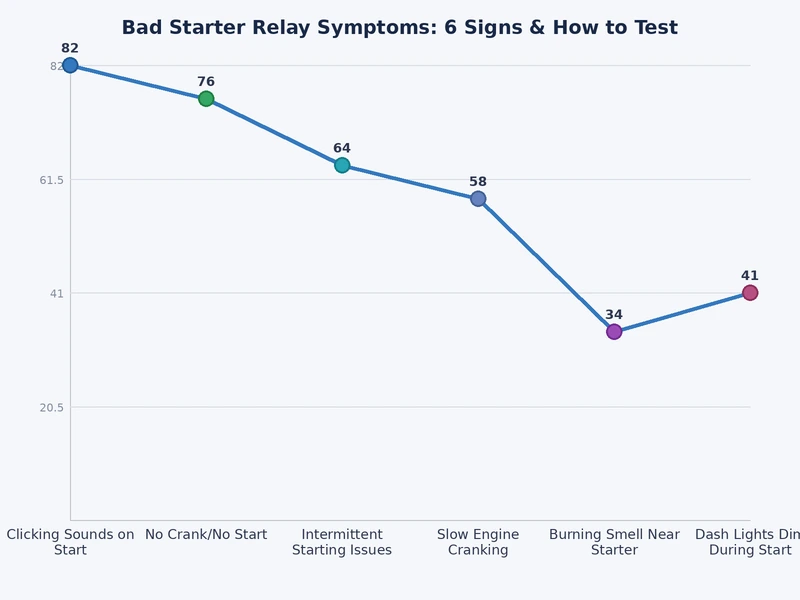
These six symptoms point directly at the relay with high diagnostic confidence. Do not dismiss any of them as minor inconveniences. Each one will worsen over time if you ignore it.
The most obvious symptom is a total no-start. You turn the key and nothing happens. No click, no crank, no engine sound. Your dashboard lights illuminate normally. Your battery reads full voltage. But the engine does not respond at all. This occurs when the relay contacts have burned open and can no longer complete the circuit to the starter motor. The battery is healthy. The starter motor may be healthy. The relay is not. Replace it before you touch anything else.
A single, loud click from under the hood — followed immediately by silence — is a textbook bad starter relay symptom. This happens because the relay partially engages but the damaged or corroded contact plate cannot sustain the connection. Contrast this with rapid, machine-gun clicking, which almost always points to a weak battery instead. One distinct click equals a relay or starter motor problem. Multiple rapid clicks equal a battery problem. This distinction matters. Do not confuse them.
Your car starts without issue on Monday. On Tuesday, it refuses to start for fifteen minutes, then fires up without explanation. This pattern is the hallmark of a relay with dirty or pitted internal contacts. Changes in temperature, vibration, or humidity cause the contacts to open and close unpredictably. The problem will not resolve on its own. It will deteriorate until the relay fails completely. If you are also experiencing other erratic electrical behavior, reviewing what to check when a car will not start after a battery change can help you rule out related causes in your electrical system before you focus on the relay.
This symptom is alarming and potentially destructive. Under normal operation, the relay cuts power to the starter the instant the engine starts. If the relay contacts weld themselves shut — which happens when excessive current arcs across the contact plate — the starter motor remains energized. You will hear a grinding sound as the starter gear drags against the already-spinning flywheel (the large toothed ring gear attached to the engine). Cut the ignition immediately if this happens. Continued engagement will destroy the starter drive gear, the flywheel teeth, and in severe cases, the ring gear itself.
After a failed start attempt, pull the relay from the fuse box and compare its temperature to an identical relay in the same box. Most fuse boxes contain several relays of the same part number. If your starter relay is significantly hotter than the comparison relay, the internal resistance has risen due to worn contacts or a partial coil short. Excessive heat is both a symptom of failure and an accelerant of further damage. A hot relay is a failing relay. Replace it without delay.
A shorted starter relay draws excessive current and can blow the fuse protecting the starting circuit. If your starter fuse blows more than once, the relay is a primary suspect. A fuse that keeps blowing is a diagnostic signal, never a problem in itself. If you have already dealt with a car fuse that keeps blowing, you understand how this logic applies — the fuse is protecting you from something drawing too much current. Find that source before you install another fuse.
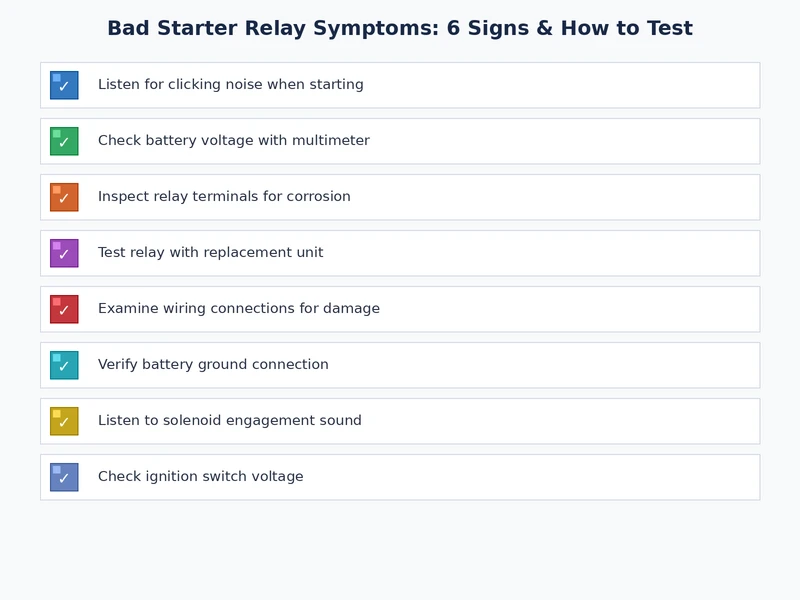
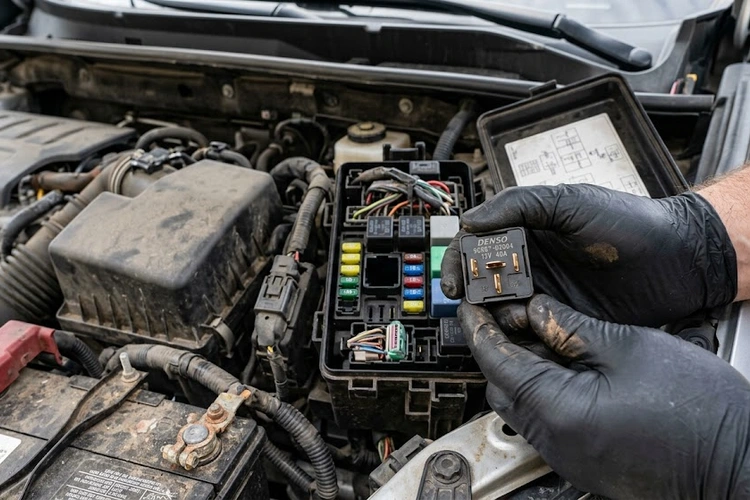
The swap test is the fastest and cheapest diagnostic method available. Open your underhood fuse box and locate the starter relay. Your owner's manual identifies the exact position — it is also labeled on the underside of the fuse box cover. Find an identical relay elsewhere in the same fuse box. Fuel pump, horn, and condenser fan relays are often the same part number. Swap your starter relay with that matching relay. Attempt to start the vehicle.
If the engine starts, your original relay was defective. Purchase a direct replacement — part numbers matter, so match it exactly. If the engine still refuses to start after the swap, the fault lies elsewhere. Move on to inspect the starter motor, ignition switch, neutral safety switch, or battery cable connections.
Remove the relay and identify the coil pins using the pinout diagram printed on the relay body or found in your vehicle's service manual. Set your multimeter (a handheld meter that measures voltage, resistance, and current) to the resistance — or ohms — setting. Touch the probes to the two coil terminals. A healthy relay coil reads between 50 and 120 ohms, depending on the relay specification. A reading of zero indicates a shorted coil. An infinite or open reading indicates a broken coil wire. Either result means replacement is necessary.
To test the contact circuit, energize the coil terminals using a 12-volt source and two jumper wires. Then switch your multimeter to continuity mode and probe across the two contact terminals. You should hear an audible click from the relay the moment you apply power, and the meter should indicate continuity. If you get no click and no continuity, the relay's contact assembly has failed entirely.
Several persistent myths around starter relay diagnosis lead drivers to spend money in the wrong place.
The most expensive myth is that replacing the starter motor is the logical first step in a no-start diagnosis. A starter motor costs between $150 and $400 installed. A starter relay costs under $20 and takes five minutes to swap. Always eliminate the relay as the cause before you approve a starter replacement. If your shop recommends a new starter without first ruling out the relay, ask why the relay was not tested. That is a fair and reasonable question.
The clearest indicators are a single loud click on startup with no engine crank, intermittent starting that comes and goes without explanation, and a relay housing that is noticeably hot after a failed start attempt. Perform the swap test first — replace the suspect relay with an identical one from your fuse box and attempt to start the vehicle. If the problem disappears, your original relay was the fault.
Yes. A relay with welded contacts keeps the starter motor energized even after you release the key or shut off the ignition. The starter motor draws hundreds of amperes, which depletes even a fully charged battery within minutes. If you discover a dead battery with no obvious cause, check whether the starter motor housing is abnormally hot — that is a clear sign the relay stuck in the closed position.
Most starter relays last between 100,000 and 150,000 miles under normal operating conditions. Heat, voltage spikes from a deteriorating alternator, and frequent short-trip driving all shorten relay lifespan. Vehicles operated in extreme heat or high-humidity climates tend to experience relay failures on the earlier end of that range.
No. They are two separate components with different functions. The starter relay is a small plug-in relay inside the fuse box that sends a low-current signal to the solenoid. The starter solenoid is mounted directly on the starter motor and physically engages the starter drive gear with the flywheel. Both can produce similar no-start symptoms, but they require different tests and different replacement procedures.
A starter relay typically costs between $10 and $30 for the part alone. If you replace it yourself, that is your total investment. A repair shop adds $50 to $100 in labor in most cases, though the entire job rarely takes more than 30 minutes for an experienced technician. It is one of the least expensive repairs in the entire starting system and should always be ruled out before authorizing more costly diagnostics.
Generally, no. The starter relay operates outside the engine management system, and the powertrain control module (PCM) does not monitor it directly under normal circumstances. You will not receive a diagnostic trouble code from a failed relay. Diagnosis relies entirely on symptom observation and hands-on testing — specifically the swap test and the multimeter coil resistance check.
 |
 |
 |
 |

About Joshua Thomas
Joshua Thomas just simply loves cars and willing to work on them whenever there's chance... sometimes for free.
He started CarCareTotal back in 2017 from the advices of total strangers who witnessed his amazing skills in car repairs here and there.
His goal with this creation is to help car owners better learn how to maintain and repair their cars; as such, the site would cover alot of areas: troubleshooting, product recommendations, tips & tricks.
Joshua received Bachelor of Science in Mechanical Engineering at San Diego State University.
Get some FREE car parts & gear.. Or check out the latest free automotive manuals and build guides here.
Disable your ad blocker to unlock all the hidden deals. Hit the button below 🚗
| | | |
