by Sarah Whitfield
Have you ever gripped the steering wheel and heard an unsettling click, squeak, or grinding sound that was not there last month — and wondered whether driving another mile was safe? If your steering column is making noise, that sound is almost never random. Every distinct tone corresponds to a specific worn or misaligned component, and understanding those patterns is the fastest path to a reliable fix. This guide examines every major cause, explains how to isolate the source, and outlines the most effective repair strategies available to you.
Noise from this area of the vehicle is particularly important to address early. The steering column transmits every input from your hands directly to the front wheels, and any mechanical play introduced by worn components translates into reduced precision when it matters most. If you have noticed the sound worsening during sharp turns or low-speed maneuvers, our overview of why your steering wheel makes noise when turning provides useful additional context for the full system.
Contents
The steering column is not a single part. It is an assembly of shafts, bearings, couplings, and electronic components that spans from the steering wheel down through the firewall to the steering rack or gearbox. Because each component carries a different load and operates under different conditions, they wear at different rates — and each produces a recognizable type of noise at a predictable stage of deterioration.
In the early stages, noise is almost always intermittent. You may hear a faint click when rotating the wheel past center, or a quiet squeak when turning at parking-lot speeds. These sounds typically point to one of three sources:
At this stage, targeted lubrication or straightforward tightening usually resolves the problem entirely. Many drivers, however, dismiss these sounds as normal vehicle behavior and wait. That delay reliably increases repair cost and complexity.
If your vehicle is also producing vibration through the wheel at rest, the underlying cause may involve components shared between the steering and suspension systems. Our guide to steering wheel vibration at idle examines that overlap in detail.
As wear progresses, the noise becomes more consistent and more forceful. Grinding during rotation typically indicates a failing universal joint on the intermediate shaft. A deep clunk — particularly noticeable over speed bumps or during sharp turns at low speed — usually points to a worn lower steering shaft coupling or excessive play in the steering rack input. At this stage, the noise is no longer merely cosmetic. It reflects mechanical slack that can eventually reduce steering responsiveness.
Accurate diagnosis prevents unnecessary parts expenditure. A structured approach lets you isolate the noise source in one or two short inspection sessions rather than replacing components at random.
Systematic reproduction is the most effective diagnostic method. With the engine running and the vehicle stationary, perform each of the following in sequence:
Document whether the noise changes with vehicle speed, steering load, or road surface texture. A sound that disappears at highway speeds but returns in parking lots is consistent with a worn U-joint. A noise that appears exclusively over rough pavement may indicate a loose column bracket or a deteriorating strut mount — a component covered thoroughly in our article on bad strut mount symptoms.
Sound character is as informative as sound location. Use the following reference to narrow your diagnosis before touching any components:
Recording the sound on a phone and reviewing it with a mechanic before your appointment can prevent misdiagnosis and reduce diagnostic labor time.
Once you have characterized the noise, the following inspection sequence moves from the most accessible components to the most labor-intensive. Work through it in order to avoid unnecessary disassembly.
Begin at the steering wheel with the vehicle off and the column unlocked. Grasp the wheel firmly at 3 and 9 o'clock and attempt to rock it axially — toward and away from the dashboard. Movement greater than 1 to 2 millimeters suggests a worn upper bearing or a loose column mounting bracket. Check that the tilt lever or telescope lock is fully engaged. Also verify that the column mounting bolts, accessible from beneath the dashboard, are torqued securely.
If the clock spring is suspect, check for corroborating symptoms: a non-functional horn, inoperative cruise control buttons, or an airbag warning light. Any of these alongside column noise strongly implicates the clock spring. If your instrument cluster is also behaving erratically, review our article on all dashboard gauges not working to rule out a broader electrical issue originating in the column.
From the engine bay, locate the intermediate shaft where it passes through the firewall. With the ignition off and the wheel unlocked, attempt to rotate the shaft by hand in both directions. Rotational play exceeding approximately three degrees indicates worn U-joint needle bearings. Next, inspect the rubber isolator coupling — sometimes called a rag joint — at the steering gear input shaft. Cracking, compression set, or visible rubber displacement are clear indicators that replacement is necessary.
Always check every clamp bolt along the intermediate shaft before ordering U-joint parts — a single under-torqued fastener can produce a clunk identical to joint wear, and tightening it takes under five minutes.
According to the National Highway Traffic Safety Administration (NHTSA), steering component failures rank among the most frequently reported safety-related defects in consumer vehicles. Prompt attention to column noise keeps your vehicle well outside that category.
| Noise Type | Most Likely Cause | Urgency Level | Typical Repair |
|---|---|---|---|
| Intermittent click | Clock spring or loose hardware | Moderate | Clock spring replacement or bolt tightening |
| Squeak on rotation | Dry plastic bushings or upper bearing | Low | Lubrication with white lithium grease |
| Grinding through full lock | Worn U-joint needle bearings | High | Intermediate shaft or U-joint replacement |
| Clunk over bumps | Loose coupling or worn spline | High | Coupling replacement or clamp retorque |
| Knock during turns | Failed rubber isolator or rack play | Critical | Rag joint replacement or rack service |
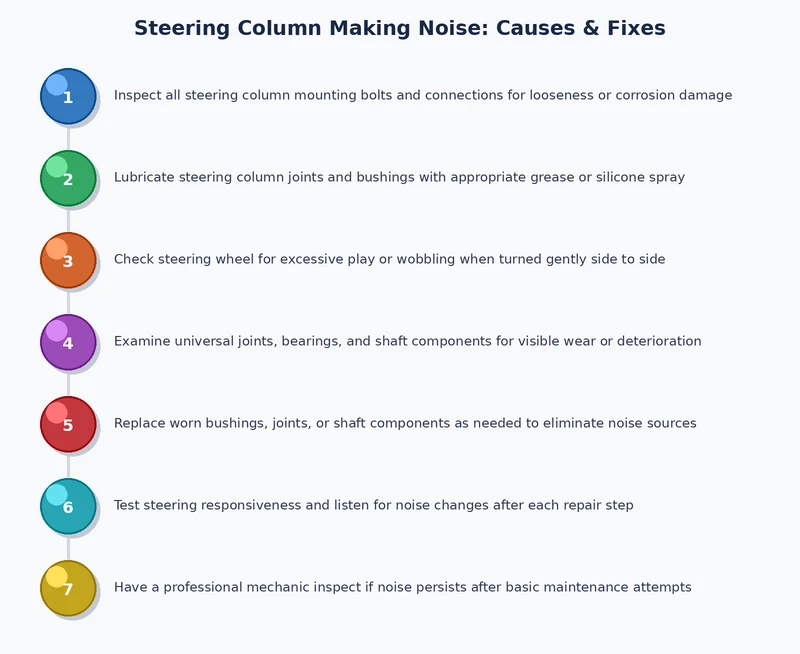
Not every steering column repair belongs on a home garage lift. Some jobs are straightforward; others require specialized tools, precise torque values, or airbag safety precautions that make professional service the more prudent choice. Matching the repair to your actual capabilities — not just your confidence — is the right approach.
Several common causes of steering column making noise respond well to informed DIY attention:
Certain repairs carry a higher risk of incorrect reassembly or safety exposure:
The distinction between DIY and professional repair is not about pride. It is about accurately matching the complexity of the work to the tools and training available to you.
The most cost-effective repair is the one that never becomes necessary. A modest maintenance routine significantly extends the service life of every steering column component and keeps subtle wear from developing into expensive failures.
Plastic bushings in the tilt and telescope mechanisms dry out over time, especially in climates with large temperature swings between seasons. Apply a thin, even coat of white lithium grease to the following contact points every 30,000 miles or at the first sign of squeaking:
Avoid petroleum-based greases, which can swell or degrade the nylon and polyethylene bushings used in most modern column assemblies. If your vehicle's fluid maintenance is generally overdue, note that neglected brake fluid — as discussed in our article on dark brake fluid — is often an indicator that other service items, including column lubrication, have been similarly deferred.
Incorporate the following into every major service interval. Catching marginal components early — before they fail audibly — prevents the more extensive disassembly that full failure requires.
Understanding what not to do is as valuable as knowing the correct repair steps. Several common errors — made by both home mechanics and inattentive professionals — consistently accelerate wear or result in the wrong component being replaced.
The most frequent mistake is treating intermittent noise as harmless background sound. A faint click during parking-lot maneuvers today can become a pronounced clunk within a few thousand miles, and a clunk can progress to shaft play that measurably reduces directional control. Early intervention — even when it involves nothing more than a lubrication service — is consistently less expensive than repairs made after the component fails completely.
Vehicles that simultaneously make a popping noise when braking deserve particular scrutiny. Multiple concurrent noises across the front end often indicate systemic wear that includes the steering column, and addressing each issue in isolation misses the broader pattern.
Similarly, if the vehicle also shakes at low speed, the front suspension and steering components may be sharing load in ways that accelerate wear across all of them simultaneously. Treating these symptoms as a connected system rather than isolated events leads to more complete and durable repairs.
A common error among home mechanics is reaching for whatever lubricant is closest at hand. Each of the following causes distinct problems when applied to steering column components:
White lithium grease or a product specifically designated for steering components in your vehicle's service manual is the correct choice. When in doubt, the specification is always in the factory documentation — not on the product label of whichever can is already in the garage.
A steering column making noise is not a quirk to adapt to — it is a system communicating exactly what it needs, and the only mistake is choosing not to listen.
 |
 |
 |
 |

About Sarah Whitfield
Sarah Whitfield is a diagnostics and troubleshooting specialist who spent ten years as an ASE-certified technician before joining the editorial team. She specializes in OBD-II analysis, electrical gremlins, and the kind of intermittent problems that make most owners give up.
Get some FREE car parts & gear.. Or check out the latest free automotive manuals and build guides here.
Disable your ad blocker to unlock all the hidden deals. Hit the button below 🚗
| | | |
