by Sarah Whitfield
You pull up to a red light on the way home from work, and the moment the engine settles into its idle rhythm, a faint but persistent buzz travels up through the steering column and spreads across your palms. You dismiss it the first time, chalk it up to rough pavement, and drive on. But it happens again at the next light — and the one after that. When your steering wheel vibrates at idle, your vehicle is flagging a mechanical condition that rarely resolves on its own and typically worsens without intervention.
This vibration is fundamentally different from the shimmy you feel at highway speed on a poorly balanced tire. High-speed vibrations disappear once you slow to a stop. An idle-specific vibration traces back to the engine, its mounting system, or the fuel and ignition components that regulate combustion quality. Understanding that distinction is the foundation of an accurate diagnosis — and if you have noticed related shaking behavior during slow city driving, the full overview at car shakes when idle addresses the broader spectrum of low-RPM movement.

Contents
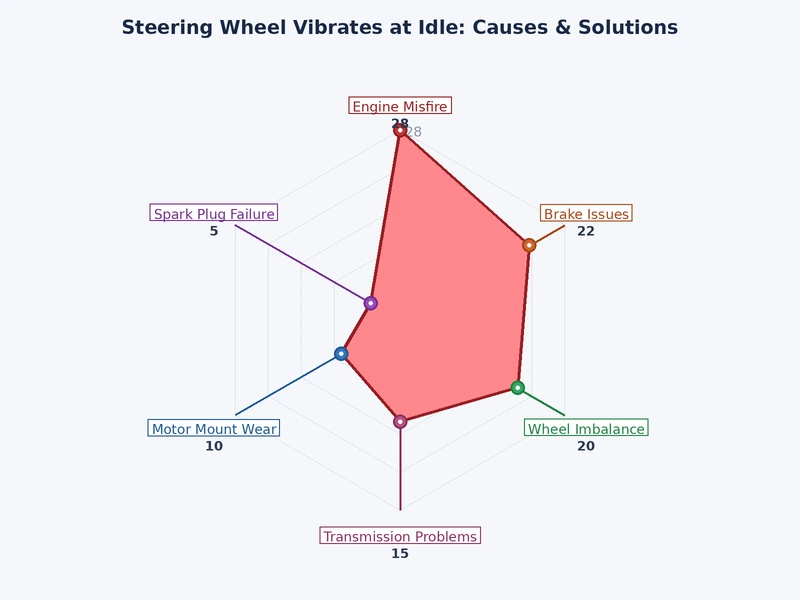
Every internal combustion engine generates vibration as a natural consequence of its operation. Each power stroke drives a piston downward with significant force, and in a four-cylinder engine idling between 600 and 900 RPM, those pulses arrive at a frequency your hands can detect without difficulty. Engine mounts are engineered specifically to absorb these pulses before they propagate through the chassis. When those mounts degrade — through age, oil contamination, or simple fatigue — the pulses transfer directly into the subframe, travel up through the steering rack, and reach the column you grip on every drive.
At higher RPM, the rapid succession of combustion events blends into a continuous rotational force, which is why engines feel smoother on the highway than they do sitting still. At idle, the firing intervals are far enough apart that each combustion pulse registers as a discrete mechanical event. Any component that is slightly worn, loose, or out of specification has more time to react to each pulse before the next one arrives, which is why conditions that cause steering wheel vibrates at idle are so much more apparent than anything felt at cruising speed.
The most common engine-side causes are misfiring cylinders, fouled spark plugs, clogged fuel injectors, and vacuum leaks. A single misfiring cylinder converts a balanced system into an uneven one, sending asymmetric pulses through every connected component. Clogged injectors restrict fuel delivery to individual cylinders, creating lean-burn conditions that produce rough, uneven combustion. A vacuum leak on the intake manifold introduces unmetered air into the combustion chamber and causes erratic RPM swings that feed directly into vibration. The P0171 lean-condition code detailed at P0171 Code: Causes, Symptoms, and How to Fix is one of the most reliable electronic indicators of this category of problem.
Worn or collapsed engine mounts are the single most direct mechanical cause of idle-only steering vibration, because their entire purpose is to isolate the engine from the chassis. Once they lose compliance, every combustion pulse transfers into the body unfiltered. Transmission mounts serve the same isolation function for the gearbox and produce a nearly identical symptom when they fail. In front-wheel-drive vehicles, worn CV axle joints add another potential source — particularly when the drivetrain is under light torque load in Drive.
| Cause | Vibration Character | Associated Symptoms | Repair Urgency |
|---|---|---|---|
| Worn engine mounts | Low-frequency thud and steady shake | Visible engine movement on acceleration | Within 2–3 months |
| Misfiring cylinder | Irregular, jerky vibration | Check engine light, poor fuel economy | Immediately |
| Dirty fuel injectors | Mild, steady vibration | Hesitation on acceleration, rough idle | Within 4–6 weeks |
| Vacuum leak | Hunting, erratic idle | High or fluctuating RPM at rest | Immediately |
| Worn spark plugs | Strong, rhythmic vibration | Hard starts, reduced throttle response | Within 2 weeks |
| Failing IAC valve | Surging idle with vibration | Stalling at stops, erratic idle speed | Within 4 weeks |
The timing of the vibration relative to engine temperature is one of the most diagnostic observations you can make without any tools at all. A vibration that appears only in the first few minutes of operation — before the coolant gauge stabilizes — and then disappears once the engine reaches normal operating temperature often points to a sensor calibration issue or a thermostat problem that clears once the engine management system transitions to closed-loop fueling. A vibration that persists or worsens as the engine warms up is a far more reliable indicator of worn mounts or a fueling problem that degrades under thermal stress, and in either case, the condition deserves systematic investigation rather than continued monitoring.
Placing an automatic transmission in Drive while stationary loads the torque converter, and that load amplifies any existing vibration from weak engine mounts or worn drivetrain components. If your steering wheel vibrates at idle only when the selector is in Drive — and the sensation eases when you shift to Park or Neutral — worn transmission or engine mounts are the most probable cause. A vibration that is equally strong in every gear selector position is more likely to originate from a purely engine-side problem, such as spark plugs or injectors. If you have also experienced the engine cutting out at intersections, the in-depth analysis at car stalls at a traffic light addresses the idle control components that connect both symptoms directly.
Your first diagnostic step requires no tools beyond your eyes. Open the hood, have a second person place the car in Drive with the parking brake firmly set, and observe the engine under light load. A failed engine mount reveals itself through visible, excessive movement — the engine should rock only slightly and return immediately to center. Next, trace all vacuum lines along the intake manifold for cracks, disconnections, or burn marks from proximity to exhaust components. Deteriorated vacuum hoses are among the least expensive parts on the vehicle, and a complete visual trace of the intake plumbing takes under five minutes.
If you can rock the engine more than an inch by hand with the car in Park, the mounts have already failed — do not treat this as a borderline case, because the unconstrained movement will accelerate wear on your CV axle boots and exhaust flex joints.
An OBD-II scanner gives you access to misfire event counts, short-term and long-term fuel trim values, and live idle speed data that would otherwise remain invisible. Positive fuel trim values above ten percent on either bank confirm a lean condition consistent with a vacuum leak or restricted injectors. Stored misfire codes referencing a single cylinder repeatedly isolate the fault to a specific plug, igniter, or injector. Live idle speed data that fluctuates beyond the normal fifty to one-hundred RPM range points toward a failing idle air control valve or a throttle body that requires cleaning and recalibration.
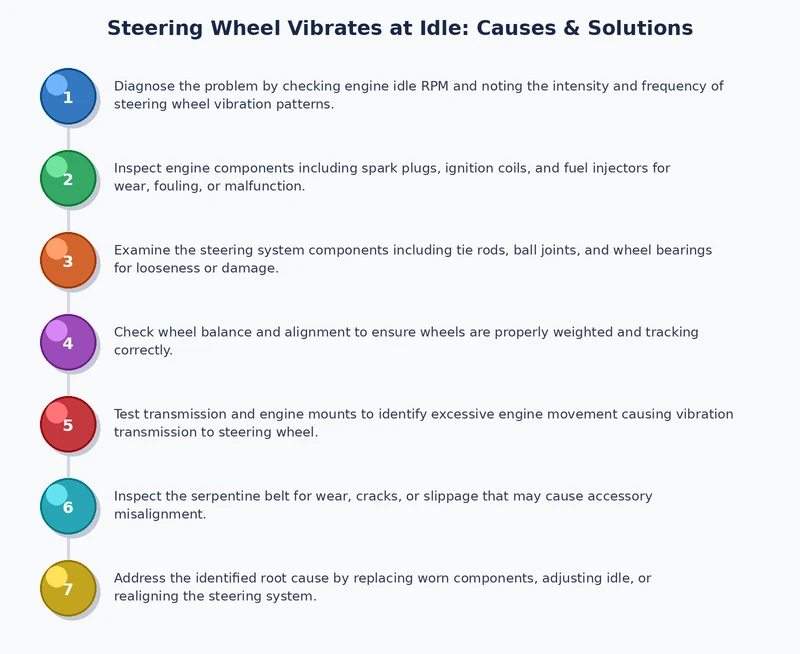
A misfiring cylinder and an active vacuum leak both warrant immediate attention, because both conditions degrade catalytic converter efficiency and can cause secondary damage within weeks of onset. Engine mount replacement follows on a moderate timeline — a collapsed mount affecting drivability should be addressed within two to three months at most, as the unconstrained engine movement places progressive stress on CV axle boots, exhaust flex joints, and transmission linkage. Spark plug and injector service occupies the scheduled maintenance tier, best handled before the hundred-thousand-mile interval or at the first appearance of symptoms, whichever arrives first.
The most effective long-term strategy keeps the fuel and ignition systems operating within specification throughout the engine's service life. Running the fuel system through a professional cleaning service every thirty thousand miles removes injector deposits before they accumulate to symptom-producing levels. Replacing spark plugs on the manufacturer's recommended interval — rather than waiting for a rough idle to appear — ensures that combustion remains balanced across all cylinders. Engine mounts benefit from a physical inspection at every major service interval, typically between sixty thousand and one hundred thousand miles. Identifying a mount that has begun to crack costs you nothing; letting one fail completely costs you the downstream repairs that uncontrolled engine movement causes.
At higher RPM, rapid combustion events smooth into continuous rotation, masking individual pulses. At idle, each pulse is discrete and detectable. Components like worn mounts or misfiring cylinders that absorb or create those pulses show their condition most clearly when the engine is running slowly.
It depends on the cause. A misfiring cylinder or vacuum leak is damaging the catalytic converter and should be repaired immediately. Worn engine mounts are less urgent but still cause secondary drivetrain wear. Get the vehicle diagnosed promptly and avoid extended driving until the root cause is confirmed.
Yes. Insufficient oil pressure starves hydraulic components and increases friction between moving parts, which raises vibration levels throughout the engine. If your oil level is low, top it off and inspect for leaks before assuming a deeper mechanical cause is responsible for the idle vibration.
Engine mount replacement typically ranges from $230 to $550 per mount, depending on the vehicle and labor rates in your area. Front-wheel-drive vehicles with transversely mounted engines often require two or three mounts for a complete repair, so budget for the full set when one has failed.
Yes. Carbon buildup on the throttle body plate restricts airflow and disrupts the precise air-fuel ratio the engine management system expects at idle. The result is an uneven, hunting idle that produces vibration throughout the cabin, including in the steering wheel. Throttle body cleaning typically resolves this condition.
A failing alternator can cause the engine to work harder to compensate for electrical load imbalances, which slightly disrupts idle quality. However, alternator-induced vibration is typically mild compared to causes like misfires or failed mounts. An electrical system test will confirm whether the alternator is contributing to the symptom.
Air conditioning engages the compressor clutch, which places an additional mechanical load on the engine and drops idle RPM slightly. If the engine is already marginal — due to worn mounts or a rough idle condition — the added AC load amplifies the vibration noticeably. This is a reliable indicator that the underlying cause needs attention.
Yes. A worn transmission mount allows the gearbox to move under the torque load applied when the selector is in Drive, and that movement transfers through the chassis to the steering column. Torque converter issues in automatic transmissions can also create an uneven load at idle that manifests as vibration in the steering wheel specifically when in gear.
Your steering wheel does not lie — when it vibrates at idle, it is telling you exactly where to look, and the sooner you listen, the less it costs to fix.
 |
 |
 |
 |

About Sarah Whitfield
Sarah Whitfield is a diagnostics and troubleshooting specialist who spent ten years as an ASE-certified technician before joining the editorial team. She specializes in OBD-II analysis, electrical gremlins, and the kind of intermittent problems that make most owners give up.
Get some FREE car parts & gear.. Or check out the latest free automotive manuals and build guides here.
Disable your ad blocker to unlock all the hidden deals. Hit the button below 🚗
| | | |
