by Sarah Whitfield
Over 32 million flat tire incidents occur on U.S. roads every year, and a single stripped lug nut can turn a 15-minute roadside swap into a multi-hour tow job. Stripped lug nut removal ranks among the most frustrating wheel service tasks in any shop or driveway — but it's entirely solvable if you match the right extraction method to the specific failure mode. Whether you're dealing with a rounded hex face, a seized fastener, or a fully corroded nut, there is a systematic path forward.
The root causes are almost always the same: overtorqued fasteners applied with an uncalibrated air gun, cross-threaded installation during a rushed tire rotation, or galvanic corrosion between the nut and hub after years of neglect. If you've been experiencing car shaking at low speed or steering wheel vibration at idle, a damaged lug nut may already be contributing. More importantly, knowing the symptoms of loose lug nuts early is the most reliable way to avoid reaching the point where extraction becomes necessary at all.
Contents
Tool selection determines whether stripped lug nut removal takes five minutes or five hours. The majority of failed home attempts result from using a worn standard socket that slips on a rounded hex and makes the damage worse. Start with purpose-built equipment before you touch the fastener.
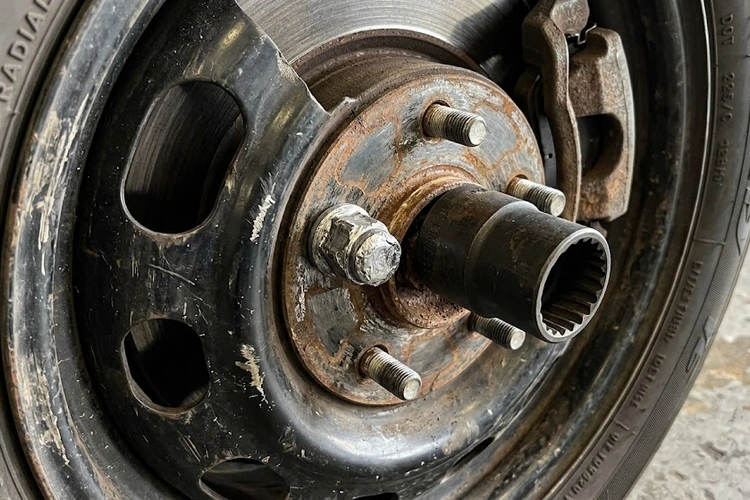
Extractor sockets — also called bolt extractors or reverse-thread bite sockets — are the correct first tool for any rounded lug nut. Their serrated interior walls grip harder as rotational force is applied, biting into the damaged hex rather than slipping past it. Key options by severity:
Impact driver torque rating matters. A 1/2-inch drive unit rated at 500 ft-lb minimum is the standard recommendation for lug nut extraction. A 3/8-inch drive with 200 ft-lb is typically insufficient to break a seized fastener free on anything larger than a compact car.
Corrosion bonding between nut and stud is frequently more of the problem than the rounded hex itself. Work these steps in sequence:
Pro tip: Apply penetrating oil from the back of the stud if access allows — capillary action pulls it into the thread engagement zone faster than topside application alone.
Not every stripped lug nut scenario belongs in a home garage. The boundary between a challenging DIY job and one requiring specialized shop equipment is defined by a few specific conditions — ignore them and you risk turning a $40 fix into a $400 hub replacement.
Handle stripped lug nut removal at home when all of these conditions are true:
The extractor socket plus impact wrench combination resolves approximately 75% of stripped lug nut cases encountered in real service environments, according to NHTSA wheel separation investigation data. The remaining 25% require either drilling or stud replacement — jobs still within DIY range, but requiring a steady hand and a drill press or quality corded hand drill.
If you notice other wheel-area symptoms alongside the stripped nut — such as a popping noise when braking or signs of bad strut mounts — address all of them in the same service session. Pulling the wheel is the opportunity for a full hub and suspension inspection.
Take it to a shop when any of these conditions apply:
Stripped lug nut removal looks different depending on the failure mechanism. Two scenarios account for the overwhelming majority of cases you'll encounter in practice.
Cross-threading occurs when the nut is started at an angle — most often during rushed tire shop rotations where the technician fires the impact gun before confirming thread engagement. Signs of cross-threading are distinct:
A cross-threaded nut cannot be extracted cleanly with a standard reverse extractor — the stud itself is compromised. Your sequence:
Rust-belt vehicles — any car operated where road salt runs from October through March — commonly develop full galvanic bonding between steel lug nuts and aluminum alloy wheels. The iron oxide expands in the seat taper, locking the nut permanently without any mechanical error ever occurring.
Your removal sequence for severe corrosion:
Wheel nuts corroded to alloy wheels are among the most common reasons a slow tire pressure loss goes undetected — the technician cannot pull the wheel for inspection without a fight.
Stripped lug nut removal is a consequence, not a random event. Every stripped fastener has an upstream preventable cause — usually bad torque practice, wrong tools, or skipped maintenance.
Overtorquing is the single largest driver of stripped lug nuts in shop data. Standard torque ranges run 80–120 ft-lb for most passenger vehicles, but the correct spec is vehicle-specific — consult the owner's manual or a verified spec chart, not "feels tight."
| Vehicle Class | Typical Torque Range | Common Stud Size | Most Common Mistake |
|---|---|---|---|
| Compact / Sedan | 80–100 ft-lb | M12×1.5 | Air gun at full torque with no limiter |
| Mid-size SUV / Crossover | 100–120 ft-lb | M14×1.5 | Re-torquing when hub is still hot |
| Full-size Truck | 140–165 ft-lb | M14×1.5 or 9/16" | Impact wrench set to maximum output |
| Performance / European | 89–110 ft-lb | M12×1.25 or M14×1.25 | Using wrong pitch thread socket |
| Light Commercial Van | 130–150 ft-lb | M14×2.0 | Not retorquing after initial 50 miles |
Technique matters as much as the number. Always hand-start all lug nuts in a star pattern before applying any power tool. Confirm thread engagement for at least three full rotations before using an impact wrench. Set your torque stick to the vehicle spec — not the tool's maximum — and finish with a calibrated click-type torque wrench.
Preventive maintenance on stud threads and wheel seat tapers adds years of trouble-free service and makes future stripped lug nut removal scenarios far less likely:
Stripped lug nut removal cost varies significantly based on severity and who does the work. Know the numbers before you decide.
Building a complete stripped fastener removal kit requires a one-time investment. Here is what you need and what it costs:
Total DIY kit investment runs $225–500. Amortized across three service events, the per-incident cost is $75–165 — competitive with or below single-event shop pricing for anything beyond a simple rounded nut.
Shop pricing scales directly with severity and region:
Dealer rates run 20–40% above independent shop rates for identical work. An independent shop with a lift and oxy-acetylene capability consistently outperforms a dealer on heavily corroded fastener jobs and charges less per hour. For this specific job, the independent shop is the better call in every corrosion scenario.
No. A stripped lug nut that cannot be torqued to spec means the wheel is inadequately clamped to the hub. Even one missing or improperly seated fastener shifts load to the remaining studs and risks wheel separation at highway speeds. Do not drive on it.
A reverse-thread extractor socket paired with a 1/2-inch drive impact wrench is the fastest and most reliable DIY method. Soak the fastener in penetrating oil for at least 30 minutes first. This combination removes rounded hex lug nuts in under five minutes in most cases.
A nut splitter, used correctly, does not contact the stud. The chisel splits the nut body longitudinally and the two halves fall away, leaving stud threads intact for a new nut. Incorrect placement — setting the chisel too close to the stud base — can nick threads, but careful setup avoids this entirely.
A freely spinning lug nut means the stud threads are stripped, not just the hex face. Grip the nut body with locking pliers to prevent rotation while applying reverse torque with an extractor socket simultaneously. If the stud rotates with the nut, it must be cut flush and replaced from the back of the hub.
No. Anti-seize on lug nut threads reduces the friction coefficient, which causes effective overtorque at any given torque wrench setting and increases strip risk. Apply anti-seize to the wheel center bore only — never to the stud threads or lug nut tapered seat surfaces.
A single stud replacement at an independent shop runs $80–180 all-in, covering one to two hours of labor and the stud itself ($8–20). Dealer rates for the same job run $100–250. DIY stud replacement costs $10–25 in parts if you have the correct punch, hammer, and jack stand setup.
Yes — overtightening is the primary cause. Torque above the vehicle's specification stretches the stud beyond its yield strength and deforms the nut threads. The next removal attempt rounds the hex or snaps the stud. Impact guns applied without a calibrated torque stick are responsible for the majority of shop-induced stripped fasteners.
Replace lug nuts every 50,000–75,000 miles on vehicles operated in salt-belt climates. In dry-climate regions, inspect at every tire rotation for thread wear or hex deformation. A full set of five OEM-spec lug nuts costs $15–60 — a negligible investment compared to the stripped lug nut removal costs they prevent.
A stripped lug nut is never bad luck — it is the invoice for every overtorqued fastener, skipped thread inspection, and wrong socket you let slide.
 |
 |
 |
 |

About Sarah Whitfield
Sarah Whitfield spent ten years as an ASE-certified automotive technician before transitioning to full-time automotive writing, giving her a diagnostic skillset that goes well beyond what most reviewers bring to the subject. She specializes in OBD-II code analysis, electrical system troubleshooting, and the intermittent failure modes that frustrate owners and confound general mechanics. At CarCareTotal, she covers car troubleshooting guides, diagnostic tools, and repair resources for drivers dealing with warning lights, strange symptoms, and hard-to-diagnose problems.
Get some FREE car parts & gear.. Or check out the latest free automotive manuals and build guides here.
Disable your ad blocker to unlock all the hidden deals. Hit the button below 🚗
| | | |
