by Sarah Whitfield
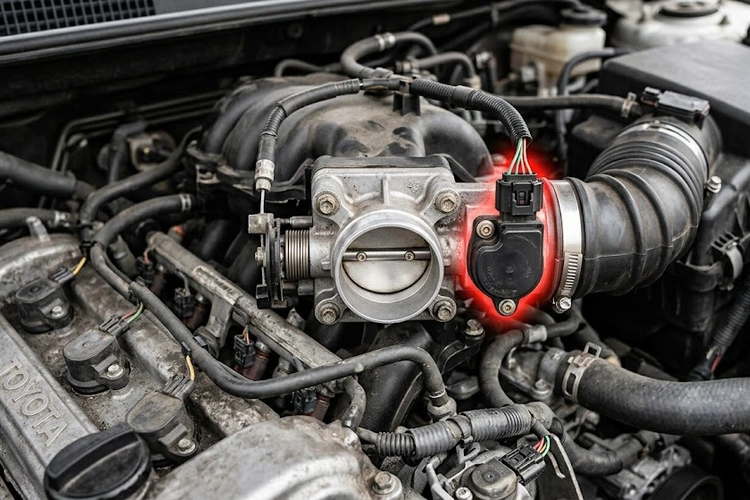
Roughly one in three check engine light diagnoses traces back to a faulty engine management sensor, and the throttle position sensor ranks among the most commonly misidentified culprits on that list. If your car has been hesitating, surging, or stalling in ways you can't quite explain, knowing the throttle position sensor symptoms puts you a step ahead of a misdiagnosis and an unnecessary repair bill. The TPS is a small component mounted directly on the throttle body, but its influence over how your engine behaves is substantial. When it starts to fail, your engine control unit loses accurate real-time data about throttle angle, and the consequences ripple across idle quality, fuel delivery, and overall drivability. Some of those symptoms look identical to what a failing idle air control valve produces, which is exactly why identifying the specific sensor matters before you start replacing parts.
This guide walks you through how the TPS works, what failure feels like behind the wheel, how to test it with basic tools, and what you can realistically expect to pay when replacement is unavoidable. You'll have a clear picture of the problem and a confident plan for fixing it by the time you finish reading.
Contents
The throttle position sensor sits on the throttle body shaft, directly measuring the rotational angle of the throttle plate as it opens and closes. That measurement translates to a voltage signal your ECU reads constantly while the engine is running, using it to calculate precisely how much fuel to inject and when to fire each ignition event. The system is elegant in its simplicity, and it's also why a small amount of wear in the sensor creates such widespread drivability problems.
Most throttle position sensors are either traditional potentiometers or contactless Hall effect units, depending on the vehicle's age and design. The potentiometer type uses a physical wiper that slides across a resistive track, generating a voltage between roughly 0.5 volts at idle and 4.5 volts at wide-open throttle. Hall effect sensors work without physical contact, which makes them more durable over time, but they cost more to source when they eventually need replacement. In both cases, the ECU expects a smooth, continuous voltage sweep as you open and close the throttle — any sudden jumps or dead spots in that sweep get flagged immediately as a fault.
The symptoms a failing TPS produces aren't subtle once they develop past the early stages. You'll feel most of them immediately behind the wheel, and they tend to get progressively worse as the sensor's resistive track continues to degrade.
When the TPS sends incorrect data at low throttle angles, your ECU miscalculates the air-fuel ratio during idle, and the engine responds with a rough, hunting idle that occasionally drops so low it stalls completely. You'll notice this most often when you come to a stop at a light or sit in traffic with your foot off the gas pedal. The ECU has correction strategies to compensate for minor sensor drift, but a worn-out TPS overwhelms those corrections and the idle becomes genuinely unstable. Stalling at stops is one of the clearest signs that the sensor is failing rather than just running dirty.
This symptom is the most disruptive for day-to-day driving. As you press the accelerator, the TPS should deliver a linear, uninterrupted voltage increase to the ECU. When the sensor has worn spots or erratic resistance in its track, that signal stutters, and your engine responds with a jerky surge or a flat spot where power drops away unexpectedly. The experience ranges from a minor annoyance at low speeds to genuinely dangerous hesitation during highway merging. It also closely mirrors what you feel with a failing mass air flow sensor, so testing both sensors at the same time is smart if you're seeing this symptom without a clear code pointing to one component.
A failing TPS can cause your ECU to enrich the fuel mixture beyond what the engine actually needs, because the sensor is feeding it a false signal that suggests more throttle demand than you're actually applying. Over the course of a full tank, that extra fuel represents money you shouldn't be spending. In more severe cases, unburned fuel makes it past the combustion chamber, and you'll see dark or black exhaust smoke at the tailpipe as a result. Your fuel trim readings will often show long-term rich correction if you watch live data on a scanner while this is happening.
Your OBD-II system stores specific codes when the TPS signal falls outside expected parameters. The most common are P0120 (TPS circuit malfunction), P0121 (range or performance fault), P0122 (low voltage), and P0123 (high voltage). These codes are specific enough that a scanner reading combined with a live data check of the TPS percentage gives you a diagnosis you can act on with confidence, rather than guessing based on symptoms alone.
You don't need to pay a shop diagnostic fee to confirm a failing TPS. Two tools cover the job completely, and you likely already own one of them.
Set your digital multimeter to DC voltage, turn the ignition on without starting the engine, and backprobe the signal wire at the TPS connector while slowly rotating the throttle plate by hand from closed to fully open. A healthy sensor sweeps continuously from around 0.5 volts at idle to 4.5 volts at wide-open throttle, with no jumps, flat spots, or sudden voltage drops anywhere in that range. Any interruption in the smooth sweep confirms a worn resistive track and tells you the sensor needs replacement, not cleaning. The test takes about three minutes and costs nothing beyond the multimeter you should already have in your toolbox.
Plug an OBD-II scanner into the diagnostic port under your dash and read any stored fault codes first. If you see P0120 through P0123, you have a strong starting point. Better scanners let you view live data, so you can watch the TPS percentage readout in real time while someone slowly works the throttle pedal. This live data view is more conclusive than stored codes alone, because it catches intermittent dropouts that only appear during sensor movement. The same live data approach works when you're investigating camshaft position sensor failure symptoms, so a mid-range scanner pays for itself across multiple diagnosis jobs.
Don't waste time cleaning a TPS that has a confirmed dead zone in its voltage sweep — contact cleaner fixes contamination, not mechanical wear on the resistive track itself.
Some drivers spray electrical contact cleaner into the TPS connector and around the throttle body, and they see temporary improvement. That improvement is real — contamination on the wiper contact can cause intermittent dropouts — but it's a short-term fix when the track itself is physically worn through. If your symptoms return within days of cleaning, or if your multimeter test reveals a dead zone anywhere in the voltage sweep, you're past the cleaning phase. Replace the sensor.
Replacement becomes clearly necessary when you have confirmed P012x codes from a live data test, confirmed dead spots on the multimeter, or persistent stalling and surging that cleaning didn't resolve. Waiting too long creates an additional problem: many vehicles enter a limp-home or fail-safe mode when the ECU loses confidence in the TPS signal, cutting maximum RPM and power output to protect the drivetrain. That limp-home mode makes the car barely usable on public roads until you address the fault.
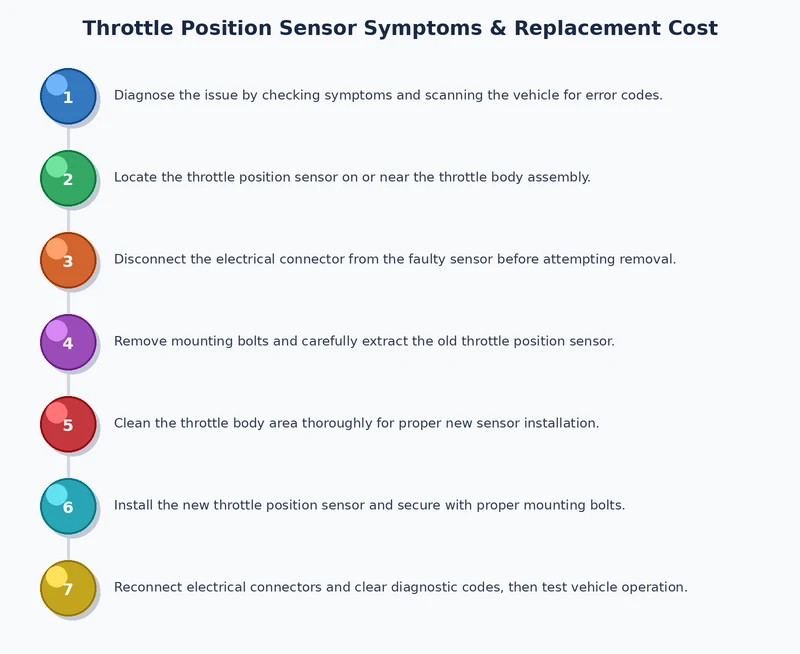
TPS replacement is one of the more approachable sensor jobs on most vehicles. You don't need a lift or specialized equipment, and on the majority of engines the throttle body is easily accessible from the top of the engine bay.
Most modern vehicles complete the idle relearn automatically after a few normal drive cycles, so you don't need to follow a complicated procedure. Check the TPS live data one more time after the relearn to confirm the voltage sweep is clean from idle to full throttle before calling the job done.
The total cost of TPS replacement varies based on whether you do the job yourself or take it to a shop, and whether you choose OEM or aftermarket parts. The good news is that this is one of the least expensive sensor repairs you'll encounter on a modern vehicle.
OEM sensors from the dealer carry a reliability premium and exact fitment, but reputable aftermarket brands — Standard Motor Products, Bosch, and Delphi are all solid choices — perform just as well in real-world use and cost significantly less. Avoid the bargain-bin no-name sensors on marketplace sites; the resistive track quality varies wildly, and a sensor that fails in six months ends up costing more than buying a known brand once. Spend the extra $15 and buy from a name you recognize.
| Cost Component | DIY | Shop |
|---|---|---|
| Aftermarket TPS (Standard/Bosch/Delphi) | $25–$80 | $25–$80 |
| OEM TPS (dealer part) | $70–$200 | $70–$200 |
| Labor (typically under 1 hour) | $0 | $75–$150 |
| Diagnostic scan and code clear | $0 (own tool) | $50–$100 |
| Total — Aftermarket DIY | $25–$80 | — |
| Total — Aftermarket at Shop | — | $150–$330 |
| Total — OEM at Shop | — | $195–$450 |
If you've been quoted significantly more than the ranges in the table above, get a second opinion before authorizing the work. Labor time for a TPS swap is rarely more than forty-five minutes on accessible engines, and shops quoting two hours or more are padding the estimate. The part itself is inexpensive enough that paying for OEM from the dealer makes sense if you plan to keep the vehicle for many more years, but an aftermarket unit from a reputable supplier is a completely rational choice for most drivers.
A failing throttle position sensor is one of the most diagnosable problems your car can develop, because the tools you need cost under $50 and the test procedure takes less time than a shop visit to get a quote. If your vehicle is showing any of the throttle position sensor symptoms described above, grab a multimeter or plug in your OBD-II scanner today rather than waiting for the problem to worsen into limp-home mode. Pick a reputable aftermarket part, clear your codes after installation, and confirm the voltage sweep is clean — that's all it takes to put this one behind you.
 |
 |
 |
 |

About Sarah Whitfield
Sarah Whitfield is a diagnostics and troubleshooting specialist who spent ten years as an ASE-certified technician before joining the editorial team. She specializes in OBD-II analysis, electrical gremlins, and the kind of intermittent problems that make most owners give up.
Get some FREE car parts & gear.. Or check out the latest free automotive manuals and build guides here.
Disable your ad blocker to unlock all the hidden deals. Hit the button below 🚗
| | | |
