by Joshua Thomas
If you've ever wondered about the difference in the timing belt vs timing chain debate, you're not alone. Both components keep your engine running in sync by linking the crankshaft to the camshaft — ensuring valves open and close at precisely the right moment. Yet they differ in material, durability, maintenance requirements, and replacement cost. Knowing which one your engine uses — and what it demands — can spare you from a very expensive repair or a roadside breakdown.
Engine timing is just one piece of a larger maintenance puzzle. Our Car Maintenance Schedule: Complete Checklist by Mileage lays out every service interval your vehicle needs, so nothing slips through the cracks.
Contents
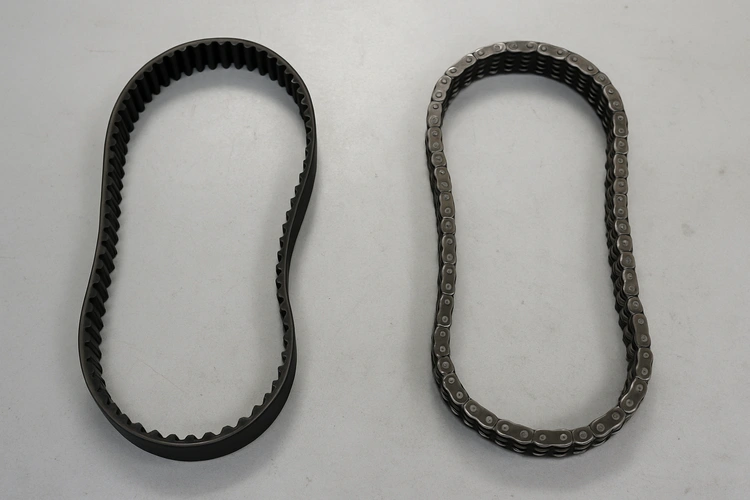
A timing belt is a toothed rubber belt that runs between the crankshaft and camshaft sprockets. Automakers began adopting it in the 1960s and 1970s because rubber runs quietly, weighs less than metal, and requires no lubrication. For decades it was the dominant choice in smaller passenger car engines.
The belt wraps around a series of pulleys and tensioners driven by the crankshaft. As the crank rotates, the belt turns the camshaft in exact synchronization. In interference engines — the majority of modern designs — a snapped timing belt allows pistons and valves to collide, causing immediate, catastrophic engine damage. In non-interference engines the engine simply stops, but no internal damage occurs. Knowing which type you have matters enormously.
Older belts used neoprene rubber reinforced with fiberglass cords. Most modern belts use EPDM (ethylene propylene diene monomer) rubber, which resists heat-related cracking far longer. Even so, rubber degrades over time regardless of mileage, which is why manufacturers specify both a mileage and a time interval for replacement.
A timing chain is a metal roller chain — conceptually similar to a bicycle chain — that connects the same crankshaft and camshaft sprockets. Chains predate belts by decades and have experienced a major resurgence in modern engines as manufacturers prioritize longevity and reduced scheduled maintenance.
The chain meshes directly with metal sprockets. A hydraulic tensioner, pressurized by engine oil, keeps it taut throughout its service life. Plastic guide rails dampen vibration and reduce chain slap. Because it runs in an oil-bathed environment and is made of steel, a timing chain handles heat, load, and wear far better than rubber over the long term.
Many current production engines use timing chains, including most BMW, Ford EcoBoost, GM, Toyota V6, and Honda four-cylinder engines. If your vehicle was made after roughly 2010 and carries a European or truck-derived engine, there is a good chance it has a chain. Your owner's manual will confirm it — or look for a scheduled belt replacement interval; if none exists, you almost certainly have a chain.
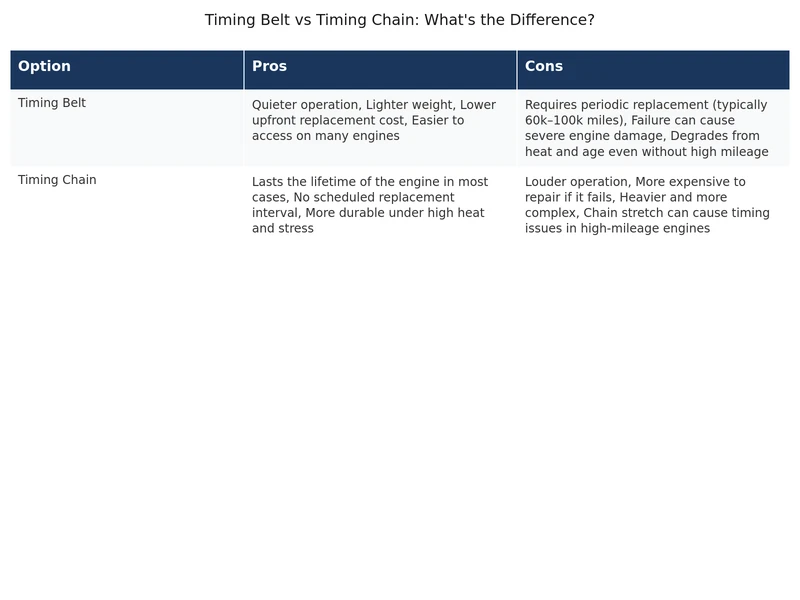
The table below summarizes the key differences at a glance.
| Feature | Timing Belt | Timing Chain |
|---|---|---|
| Material | Reinforced rubber (EPDM) | Steel roller chain |
| Typical Lifespan | 60,000–100,000 miles | 150,000+ miles (often lifetime) |
| Lubrication Required | No (runs dry) | Yes (bathed in engine oil) |
| Noise Level | Quiet | Slightly louder (especially cold start) |
| Scheduled Replacement | Yes — mandatory interval | No scheduled interval (replace when worn) |
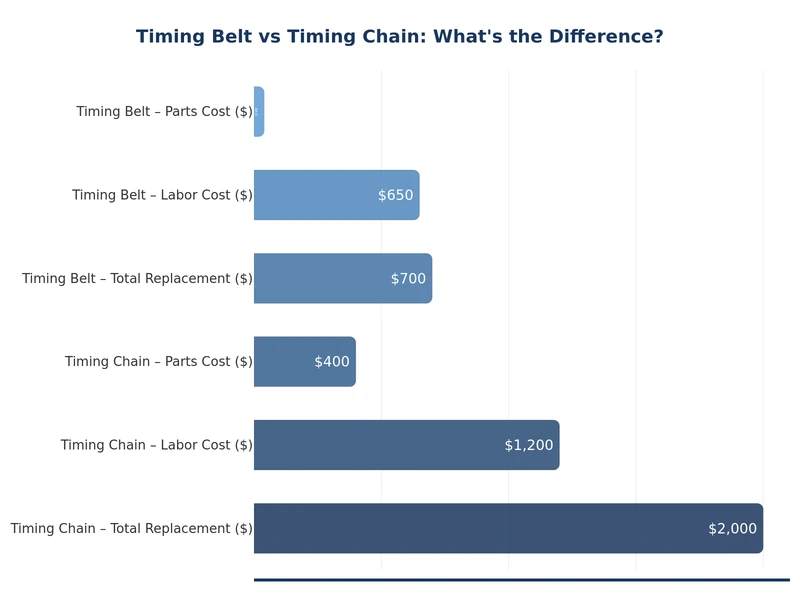
| Replacement Cost (parts + labor) | $400–$1,000+ | $800–$1,800+ (more labor intensive) |
| Failure Mode | Snaps suddenly (interference engines = major damage) | Stretches gradually, gives warning symptoms |
| Weight | Light | Heavier |
| Common In | Older and some import engines | Most modern domestic and European engines |
Most manufacturers recommend replacing the timing belt every 60,000 to 100,000 miles, or every five to seven years — whichever comes first. The time-based interval matters because rubber degrades even when the car sits in storage.
Since the water pump often rides on the same belt circuit, most mechanics replace it at the same time to avoid paying double labor later. Tensioners and idler pulleys are also commonly swapped as a kit. Total cost for a timing belt service runs $400–$1,000 depending on engine complexity. While the engine is partially open for belt work, it's a natural opportunity to schedule a cooling system flush — you'll save on labor since the coolant system is already partially accessed.
Never skip or delay this service. On an interference engine, waiting until the belt breaks is not an option — a snapped belt means bent valves or a destroyed engine head at minimum.
Timing chains have no fixed replacement mileage in most owner's manuals. With consistent oil changes using the manufacturer-specified viscosity, a timing chain can last the life of the vehicle — often well past 200,000 miles. However, oil neglect is the chain's primary enemy. Dirty or low oil starves the hydraulic tensioner, accelerates chain stretch, and wears out guide rails. When a chain does need replacement, the labor cost is often higher than a belt job because the chain sits deeper in the engine assembly.
Misfires caused by a slipped timing belt often generate the same diagnostic codes as a failing ignition system. Before replacing spark plugs in response to misfire codes, verify your timing belt is within its service interval.
Any rattling on startup should be investigated promptly. A chain that has stretched enough to rattle is already close to skipping a tooth on the sprocket — at that point, engine damage becomes a real risk.
There is no universally superior choice — both systems work reliably when properly maintained. The timing belt wins on weight, noise, and upfront replacement cost when service is done proactively. The timing chain wins on longevity and freedom from scheduled replacement, provided oil changes are never skipped.
For practical purposes, the right approach is straightforward: identify which system your engine uses, follow the manufacturer's maintenance schedule precisely, and respond to warning signs before they escalate. You can find an authoritative overview of the engineering history behind both systems on Wikipedia's timing belt article.
For a broader view of keeping every system in your car operating at its best — from oil changes to brake inspections — our guide to maintaining your vehicle is a useful starting point.
A timing belt is made from reinforced rubber and requires scheduled replacement every 60,000–100,000 miles. A timing chain is made from steel, runs in engine oil, and is designed to last the life of the engine with no fixed replacement interval. Both synchronize the crankshaft and camshaft to keep engine timing precise.
Check your owner's manual for a scheduled timing belt replacement interval — if one exists, you have a belt. If no interval is listed, you likely have a chain. You can also look up your specific engine online using your VIN or search the manufacturer's maintenance schedule.
You should not. A stretched or rattling timing chain can skip a tooth on the sprocket at any time, causing catastrophic engine damage in interference engines. If you hear a cold-start rattle that points to chain wear, have it inspected immediately and avoid high-RPM driving until it is assessed.
Absolutely. On an interference engine — which covers the majority of modern passenger cars — a snapped timing belt causes immediate, severe engine damage. The cost of a scheduled belt replacement ($400–$1,000) is a fraction of the cost of engine head repair or full engine replacement after a snap.
Timing belt replacement including labor typically ranges from $400 to $1,000 or more, depending on the vehicle. Most shops recommend replacing the water pump, tensioners, and idler pulleys at the same time since the labor overlap makes it far more economical to do everything at once.
Yes, though it has no fixed replacement interval. A timing chain can stretch over time, especially if oil changes are neglected or the wrong oil viscosity is used. When symptoms like cold-start rattling or cam/crank sensor fault codes appear, the chain, tensioner, and guide rails should be inspected and replaced if worn.
 |
 |
 |
 |

About Joshua Thomas
Joshua Thomas just simply loves cars and willing to work on them whenever there's chance... sometimes for free.
He started CarCareTotal back in 2017 from the advices of total strangers who witnessed his amazing skills in car repairs here and there.
His goal with this creation is to help car owners better learn how to maintain and repair their cars; as such, the site would cover alot of areas: troubleshooting, product recommendations, tips & tricks.
Joshua received Bachelor of Science in Mechanical Engineering at San Diego State University.


Get some FREE car parts & gear.. Or check out the latest free automotive manuals and build guides here.
Disable your ad blocker to unlock all the hidden deals. Hit the button below 🚗
| | | |
