by Sarah Whitfield
Does a faint metallic rattle at cold start signal imminent engine failure, or is it simply low oil pressure clearing within seconds? The answer hinges on identifying which timing chain noise symptoms are present — and whether they resolve quickly or persist through the full operating cycle. Timing chain problems rank among the more consequential mechanical diagnoses in modern engines, yet they are routinely misidentified as heat shield vibration, exhaust noise, or valve train clatter until the damage escalates past the point of a straightforward repair. Early pattern recognition changes that outcome entirely.
The timing chain coordinates crankshaft and camshaft rotation, holding valve timing within precise tolerances across the engine's full RPM range. When the chain stretches, or when the tensioner or plastic guides degrade, audible warning patterns follow predictable progressions that systematic diagnosis can interpret. For related service cost benchmarks, the timing belt replacement cost guide covers labor rates, OEM versus aftermarket kit pricing, and dealer versus independent shop expectations in detail.
Contents
Timing chain wear is widely assumed to be a high-mileage phenomenon, yet documented cases across Ford EcoBoost, GM LS-based engines, and Chrysler Pentastar V6 platforms show chain stretch and tensioner failure occurring well under 100,000 miles when oil changes are deferred beyond manufacturer intervals. The timing chain, unlike a rubber timing belt, is designed for the life of the engine — but that engineering assumption depends entirely on clean, correctly viscosity-rated oil circulating to the tensioner on every cold start.
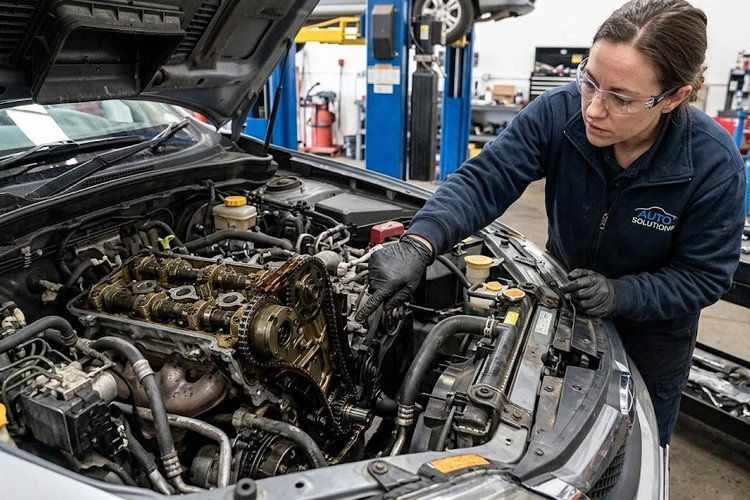
Not every rattle originates at the timing chain; heat shield rattle symptoms produce a strikingly similar metallic flutter that peaks at idle and dissipates at higher RPM, frequently leading technicians and owners to misdiagnose the source without using a stethoscope or chassis ears to isolate the location. True timing chain noise typically originates from the front of the engine block, near the timing cover, and exhibits a characteristic relationship to oil pressure and engine temperature that heat shield vibration does not replicate.
Timing chain noise symptoms span a spectrum from early-stage warnings to indicators of imminent mechanical failure. Recognizing where a given engine falls on that spectrum determines whether a scheduled service appointment is appropriate or whether driving the vehicle further risks catastrophic valve-to-piston contact.
A rattle lasting two to five seconds immediately after a cold start, then disappearing as oil pressure builds, is one of the earliest and most actionable timing chain noise symptoms. This pattern indicates that the hydraulic tensioner is losing oil pressure bleed-down — meaning it no longer holds chain tension through overnight cold-soak periods. The symptom is intermittent at first and becomes more consistent as tensioner check-valve wear progresses.
When timing chain noise symptoms persist beyond the initial cold-start period and remain audible at operating temperature — particularly under acceleration load — chain stretch has typically advanced to the point where the tensioner's mechanical travel range is exhausted. Six additional symptoms commonly accompany or follow this progression:
Pro tip: Cutting open the old oil filter during every timing chain inspection is a low-cost step that reveals plastic guide debris or metallic chain wear particles before a borescope or teardown is necessary.
A mechanic's stethoscope — a rigid probe type, not a membrane model — remains the most cost-effective tool for isolating timing chain noise symptoms from other front-of-engine sources including the water pump, alternator, and accessory belt tensioner. Chassis ears with multiple sensor clips allow simultaneous comparison of the timing cover area against the valve cover and accessory drive bracket while the engine runs at various RPM points. Technicians typically probe three reference points:
A professional-grade bidirectional scanner capable of reading live cam and crank timing data provides the most objective confirmation of timing chain stretch. Just as diagnosing a squeaky belt benefits from isolating the accessory drive system before attributing noise to the timing system, confirming DTCs before disassembly prevents unnecessary timing cover removal on engines where the noise originates elsewhere.
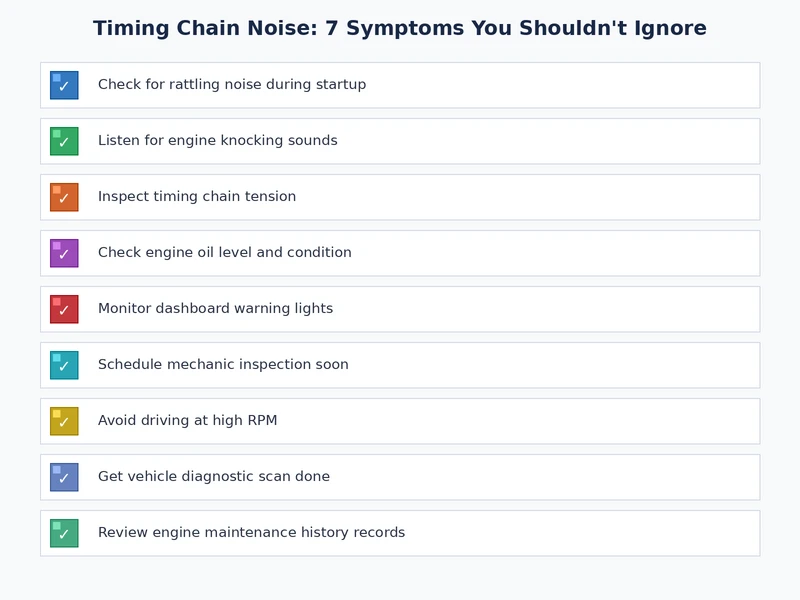
When timing chain noise symptoms first present, three immediate checks determine whether continued driving is safe or risks accelerating the failure mode significantly.
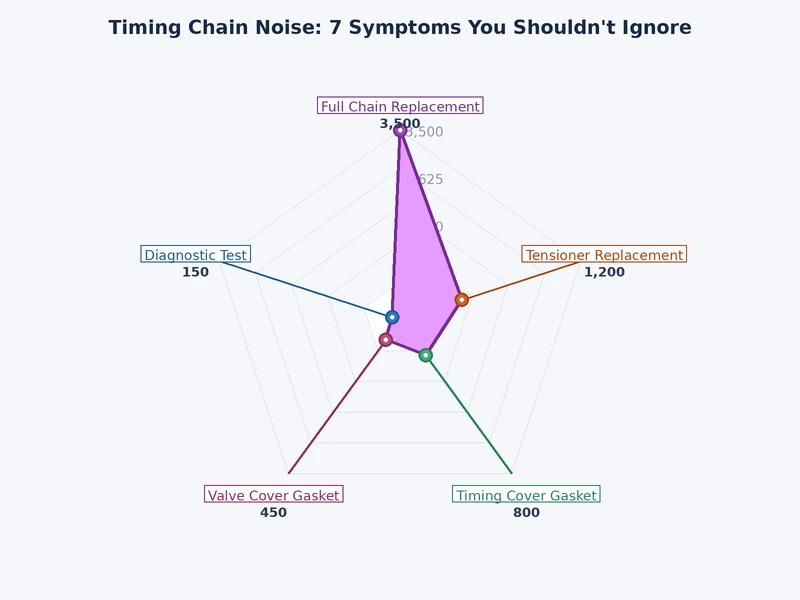
A thorough timing chain diagnosis at an independent shop or dealership typically includes a stethoscope inspection, DTC scan with live data capture, and often a borescope inspection through the oil filler cap to view chain slack and guide condition without timing cover removal. Labor rates for diagnosis alone range from $75 to $150 in most U.S. markets; full timing chain kit replacement, covering chain, tensioner, guides, and seals, runs $600–$1,800 depending on engine architecture and labor hours required.
Hydraulic timing chain tensioners depend on clean, full-viscosity oil delivered at adequate pressure within the first few seconds of startup, making oil change compliance the single highest-impact preventive measure against timing chain noise symptoms developing in the first place. Full synthetic oil at OEM-specified viscosity, changed at manufacturer-recommended intervals — typically 5,000–7,500 miles for most modern gasoline engines — maintains tensioner check valve function and reduces chain wear rate measurably compared to extended-interval conventional oil use.
Engines known for timing chain durability issues — including Ford 2.0T EcoBoost, GM 3.6 V6, and Chrysler 3.6 Pentastar — benefit from proactive tensioner inspection at 60,000–80,000 miles even without audible symptoms, particularly when the vehicle's oil change history is incomplete or unknown. Replacement of the full timing chain kit (chain, tensioner, all guides, front seals) at this interval costs far less than engine replacement following a jumped or broken chain.
| Factor | Timing Chain | Timing Belt |
|---|---|---|
| Design service life | Engine lifetime (with proper oil maintenance) | 60,000–105,000 miles (scheduled replacement) |
| Replacement cost (parts + labor) | $600–$1,800 (when worn) | $300–$900 (preventive interval) |
| Primary failure warning | Audible rattle, DTCs, slack visible via borescope | Often none — snap occurs without audible warning |
| Interference engine failure risk | High if chain skips or breaks | High if belt breaks past service interval |
| Maintenance dependency | Oil change compliance critical | Mileage/time interval compliance critical |
| Common noise complaint | Cold-start rattle, persistent slap at load | Chirping or squealing (tensioner/idler worn) |
Timing chain noise symptoms are generally distinguishable from timing belt noise by location, character, and operating temperature relationship. Belt drive systems produce higher-frequency chirping and squealing sounds that are consistent across temperature ranges, while chain noise is characteristically more pronounced during cold starts and under rapid load changes. When noise source identification remains ambiguous, a stethoscope probe isolating the timing cover versus the belt cover eliminates overlap in diagnosis.
Yes — documented cases across multiple platforms show tensioner failure and chain stretch occurring well before 60,000 miles when extended oil change intervals, incorrect oil viscosity, or repeated short-trip operation prevent the hydraulic tensioner from receiving adequate lubrication on cold starts. Mileage alone is not a reliable predictor of timing chain condition.
Cold-start-only rattle that resolves within three to five seconds and produces no DTCs represents an early warning stage where limited driving to a shop is generally considered acceptable by most technicians; however, continued daily operation without diagnosis allows tensioner check valve wear to progress, eventually converting an intermittent cold-start rattle into a persistent noise present at operating temperature, which significantly increases repair urgency and cost.
P0016 (crankshaft/camshaft position correlation fault, Bank 1 intake cam) and P0017 (Bank 1 exhaust cam) are the most definitive DTC indicators that chain stretch has exceeded the ECU's variable valve timing compensation range; P0011 and P0012 (cam over-advanced or over-retarded) may also appear on VVT-equipped engines where the phaser cannot hold commanded cam position due to chain slack.
 |
 |
 |
 |

About Sarah Whitfield
Sarah Whitfield is a diagnostics and troubleshooting specialist who spent ten years as an ASE-certified technician before joining the editorial team. She specializes in OBD-II analysis, electrical gremlins, and the kind of intermittent problems that make most owners give up.
Get some FREE car parts & gear.. Or check out the latest free automotive manuals and build guides here.
Disable your ad blocker to unlock all the hidden deals. Hit the button below 🚗
| | | |
