by Joshua Thomas
If you've ever crouched down beside your car and noticed the tread wearing unevenly across your tires, you already know something is wrong — but figuring out exactly what requires understanding tire wear patterns meaning. Each wear pattern is essentially a diagnostic clue pointing to a specific mechanical issue, inflation problem, or driving habit. Learning to read these patterns can save you money, prevent blowouts, and extend the life of your tires significantly.
Tires are your only contact patch with the road. When they degrade unevenly, handling, braking, and fuel economy all suffer. The good news is that most abnormal wear patterns are preventable once you know what causes them. This guide breaks down every major pattern, explains the root cause, and tells you exactly how to fix it.
For a related maintenance task that directly impacts wear evenness, see our guide on how to rotate tires at home — proper rotation is the single easiest way to extend tire life.
Contents
Every tire wears down over time — that's expected. What's not normal is when wear happens faster in one zone than another. Abnormal wear patterns arise from three main categories of problems: inflation errors, alignment or suspension issues, and driving behavior. Understanding tire wear patterns meaning gives you a head start on diagnosing these problems before they escalate into a costly repair or a dangerous road failure.
According to the National Highway Traffic Safety Administration (NHTSA), tire failure is a contributing factor in thousands of crashes annually — many of which could be prevented with regular inspection. Checking your tires takes less than two minutes and requires no tools.
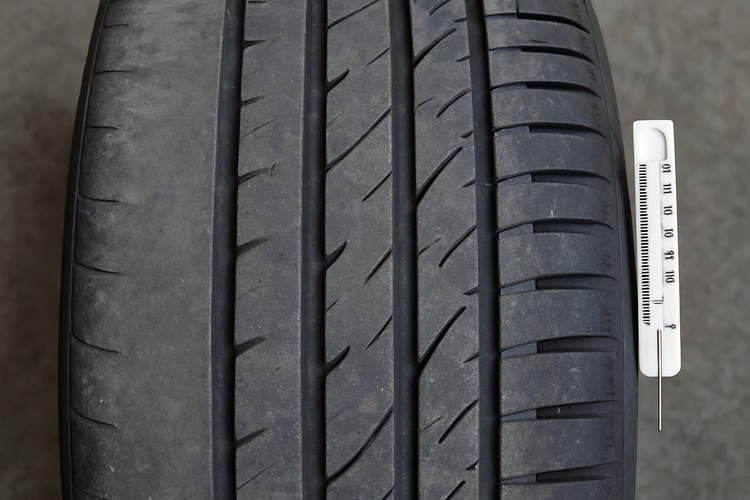
Run your hand across the full width of each tire. Feel for smooth ridges, sharp edges, dips, or patches that feel different from the rest of the tread. Then look at the tread depth across the width. Any noticeable difference in depth from one side to the other — or from the center to the edges — signals a specific problem.
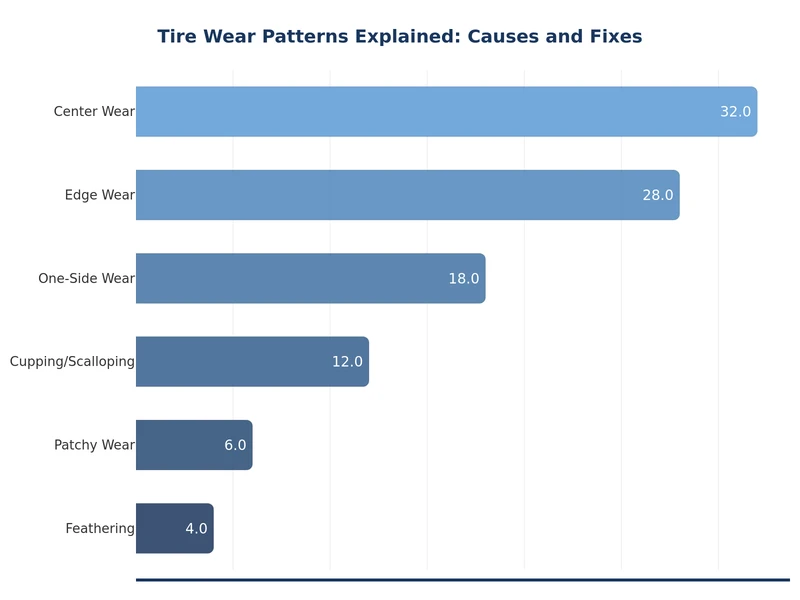
Inflation is the most common cause of abnormal tire wear — and the easiest to fix. Always check pressure with a quality gauge when tires are cold, since heat from driving raises pressure readings by 4–6 PSI. For proper technique, see our guide on how to check and inflate tire pressure properly.
When a tire is overinflated, the tread balloons outward and only the center strip makes full contact with the road. The edges barely touch. Over time, the center tread wears down significantly faster than the shoulders, creating a visible "bald stripe" running down the middle of the tire.
Fix: Deflate to the manufacturer's recommended PSI (found on the door jamb sticker, not the tire sidewall). Check pressure monthly and after significant temperature changes — for every 10°F drop, tires lose about 1 PSI.
Underinflation causes the opposite problem. The tire sags under load, putting the bulk of contact pressure on both outer edges while the center lifts slightly. Both shoulders wear faster than the middle, creating a "two-stripe" pattern on either edge.
Underinflation is also more dangerous — it generates excess heat, increases rolling resistance, and can cause sidewall cracking or sudden blowout at highway speeds. It's one of the most common causes of tire failure.
Fix: Inflate to spec and inspect for slow leaks. If pressure drops repeatedly, check the valve stem and have the bead seal inspected at a tire shop.
When wear is heavier on one side of the tire than the other — either inner or outer edge — the cause is almost always a wheel alignment problem. The two most common culprits are camber angle and toe angle.
Camber is the vertical tilt of the wheel when viewed from the front. A small amount of negative camber (top of wheel tilted inward) is normal and improves cornering. But excessive camber — positive or negative — forces the load onto one edge of the tire.
Camber can shift over time due to worn ball joints, strut damage, or bent suspension components. A simple visual check: park on a flat surface and look at each tire from the front. The tire should appear nearly vertical.
Fix: Have a four-wheel alignment performed. If camber is out of spec, the technician will also inspect suspension components for damage or wear.
Toe refers to whether the fronts of the tires point inward (toe-in) or outward (toe-out) when viewed from above. Even a slight toe misalignment causes the tire to scrub sideways as it rolls, producing a distinctive pattern called feathering — where each tread block is worn on one side but rounded on the other.
Run your hand across the tread blocks perpendicular to the direction of travel. If they feel like saw teeth — sharp on one side, smooth on the other — you have toe misalignment.
Fix: Toe is the most common alignment adjustment. A standard alignment corrects it. Also check tie rod ends, which are frequently the underlying cause of toe drift.
Cupping — also called scalloping — appears as a series of dips or high spots distributed around the tire's circumference. The tread looks wavy when you look at it edge-on. You may also feel vibration or hear a rhythmic thumping sound at highway speeds.
This pattern indicates the tire is bouncing as it rolls rather than maintaining consistent contact with the road. The root cause is almost always worn or faulty shock absorbers or struts. When damping is inadequate, the suspension oscillates, and the tire leaves the road surface momentarily at regular intervals.
Secondary causes include out-of-balance tires, loose wheel bearings, or worn control arm bushings. If you've recently had new tires installed and already see early cupping, suspect a balance issue first.
Fix: Replace worn shocks or struts. Balance all four tires. Inspect wheel bearings and control arm bushings. Note that cupping damage to the tire itself is not reversible — if wear is deep, the tire will need replacement.
Flat spots appear as a localized worn patch on one section of the tread, creating a slight vibration that pulses at intervals matching wheel rotation speed. There are two types:
If you store seasonal tires or a secondary vehicle, see our tips on how to store tires properly to prevent static flat spotting during long-term storage.
Fix: For braking-induced flat spots, check ABS function and brake system. For storage flat spots, drive the vehicle gently for several miles — mild flat spots often self-correct. Severe flat spots require tire replacement.
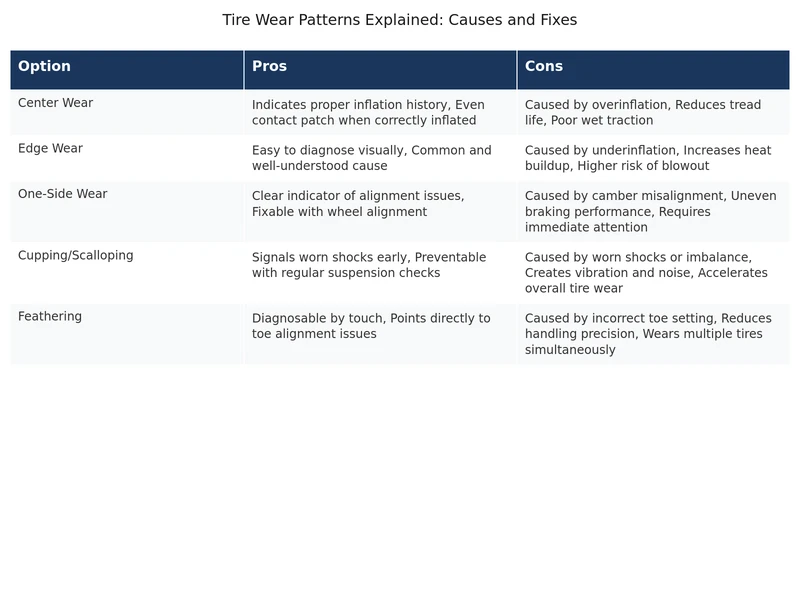
| Wear Pattern | Location | Primary Cause | Fix |
|---|---|---|---|
| Center wear | Middle of tread | Overinflation | Reduce to spec PSI |
| Edge wear (both sides) | Both shoulders | Underinflation | Inflate to spec, check for leaks |
| One-sided wear (inner) | Inner edge only | Excessive negative camber | Four-wheel alignment |
| One-sided wear (outer) | Outer edge only | Excessive positive camber | Four-wheel alignment |
| Feathering | Tread block edges | Toe misalignment | Toe alignment, check tie rods |
| Cupping / Scalloping | Circumferential dips | Worn shocks/struts | Replace shocks, balance tires |
| Flat spot | Single patch | Hard braking or static storage | Check ABS, drive or replace |
| Heel-and-toe wear | Tread block front/back | Normal wear, poor rotation schedule | Increase rotation frequency |
Understanding tire wear patterns meaning is only useful if you act on what you find. Here's a practical schedule to prevent abnormal wear before it starts:
Staying on this schedule costs far less than replacing a set of tires prematurely. A single alignment job typically costs $75–$100. A set of four mid-range tires can run $400–$800 or more. The math is straightforward.
If your wheels show brake dust buildup that makes inspection difficult, cleaning them first helps you see the full sidewall and tread clearly — here's our guide on how to remove brake dust from wheels for a clean starting point.
Each pattern maps to a specific mechanical cause. Center wear points to overinflation, edge wear to underinflation, one-sided wear to camber or alignment faults, and cupping to suspension problems. A mechanic uses the wear pattern to confirm a diagnosis before inspecting components.
No — replacing tires without fixing the root cause means the new tires will develop the same pattern just as quickly. Always correct the underlying issue (inflation, alignment, suspension) before or at the same time as replacing tires.
Every 5,000 to 7,500 miles is the standard recommendation for most vehicles. Front tires on front-wheel-drive cars wear faster than rears because they handle both steering and drive forces. Regular rotation evens out this difference significantly.
Mild cupping is drivable short-term but should be addressed promptly. It indicates worn shocks or struts, which reduce braking effectiveness and handling stability. Severe cupping compromises grip, especially in wet conditions, and the tire should be replaced.
Inner-edge wear almost always points to excessive negative camber — the top of the wheel is tilted too far inward. This shifts the contact patch to the inner shoulder. It's corrected through a wheel alignment. If camber cannot be brought within spec, inspect the strut, ball joints, and control arm bushings for wear or damage.
Cold weather itself doesn't directly cause abnormal wear, but it does lower tire pressure — roughly 1 PSI per 10°F drop. If you don't compensate by inflating to spec in winter, you'll effectively be driving underinflated, which causes shoulder wear. Check pressure more frequently during seasonal temperature swings.
 |
 |
 |
 |

About Joshua Thomas
Joshua Thomas just simply loves cars and willing to work on them whenever there's chance... sometimes for free.
He started CarCareTotal back in 2017 from the advices of total strangers who witnessed his amazing skills in car repairs here and there.
His goal with this creation is to help car owners better learn how to maintain and repair their cars; as such, the site would cover alot of areas: troubleshooting, product recommendations, tips & tricks.
Joshua received Bachelor of Science in Mechanical Engineering at San Diego State University.


Get some FREE car parts & gear.. Or check out the latest free automotive manuals and build guides here.
Disable your ad blocker to unlock all the hidden deals. Hit the button below 🚗
| | | |
