by Sarah Whitfield
When an automatic transmission won't downshift, the vehicle loses the ability to drop into a lower gear on demand, leaving the engine struggling under load and acceleration feeling sluggish or absent. The cause is often simpler than it first appears — low fluid, a faulty sensor, or a sticking solenoid (a small electrically controlled valve) accounts for the majority of cases, and many of them can be addressed without pulling the transmission from the vehicle.
Drivers dealing with this issue typically notice the engine revving harder than normal without a matching increase in speed, or the car feeling rough and jerky when decelerating. Checking for signs of low transmission fluid is always the most logical starting point, since fluid problems are common, inexpensive to address, and easy to rule out before moving on to electrical or mechanical diagnosis.
Contents
Automatic transmissions rely on pressurized fluid to engage and release clutch packs — the sets of friction discs that physically place the unit into each gear. This pressure is regulated by the valve body, a machined aluminum block containing dozens of internal passages and spring-loaded check balls. When fluid pressure drops or valve body passages become restricted by debris or varnish deposits (hardened residue left by degraded fluid), the transmission may hold a higher gear because it cannot generate enough pressure to engage the lower-gear clutch pack reliably.
The transmission control module (TCM), a dedicated onboard computer, monitors vehicle speed, throttle position, engine load, and fluid temperature to determine when a gear change is needed. It then sends electrical commands to shift solenoids, which open and close hydraulic passages inside the valve body. Any interruption in that communication chain — whether from a failing solenoid, corrupted sensor data, or a fluid pressure shortfall — can prevent the transmission from responding to a downshift command even when the mechanical internals are in acceptable condition.
According to the National Highway Traffic Safety Administration, transmission-related defects represent a significant share of mechanical complaints in modern vehicles, reflecting just how interdependent the electronic and hydraulic systems inside these units have become.
The throttle position sensor (TPS) tells the TCM how far the accelerator pedal is pressed, while the vehicle speed sensor (VSS) reports the car's current road speed. Together, they give the TCM the information it needs to decide when a downshift is appropriate and how aggressive it should be. When either sensor sends erratic or out-of-range data, the TCM may simply hold a higher gear because its logic cannot confirm that shifting conditions are met.
This sensor-related confusion can feel deceptively similar to a sticking gas pedal — the driver presses the accelerator and the car responds poorly — even though the underlying causes sit in entirely different systems. Reading live sensor data with an OBD-II scanner separates the two scenarios quickly and points the diagnosis in the right direction from the start.
The most noticeable symptom for most drivers is the absence of a kickdown — the automatic downshift that occurs when the accelerator is pressed firmly while cruising at highway speed. A healthy transmission drops one or two gears almost immediately, delivering a surge of torque (rotational force from the engine) to allow brisk passing acceleration. When the transmission won't downshift during this maneuver, engine revs climb noticeably while vehicle speed barely responds, creating a genuinely dangerous situation on a two-lane road.
Downshifting also occurs progressively as the vehicle decelerates, stepping through each lower gear in sequence as road speed drops. When this process fails, the car can feel rough or jerky during braking, almost as though the engine is resisting the slowing motion rather than contributing to it. In older vehicles with simpler control logic, holding too high a gear at very low speeds occasionally causes the engine to stall during the final seconds before a complete stop.
Tip: If the downshift problem only appears during hard acceleration but the car shifts normally while cruising and decelerating, a faulty throttle position sensor is a strong candidate — scan for fault codes before replacing any transmission component.
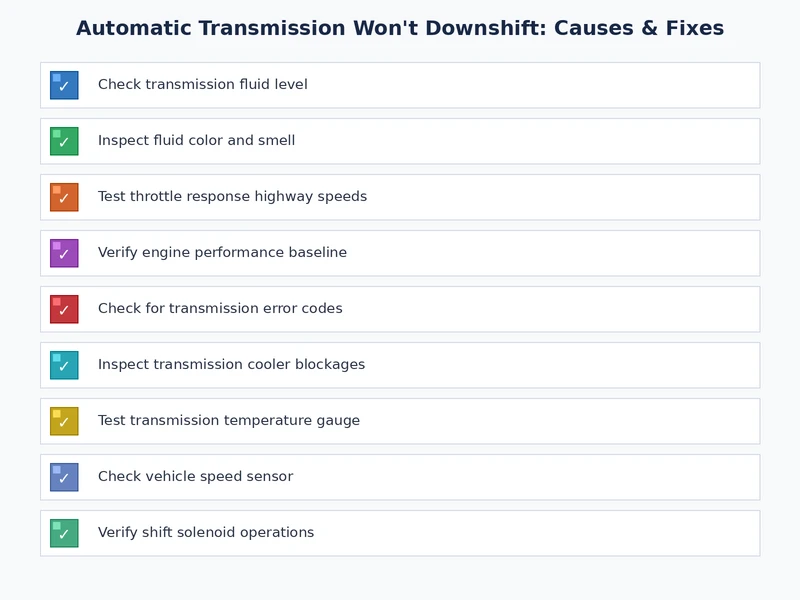
Transmission fluid provides the hydraulic pressure the entire system depends on, and low or degraded fluid is one of the most common reasons a transmission won't downshift correctly. Most vehicles with a transmission dipstick should be checked with the engine warm and running, selector in Park, using the marks on the dipstick as a reference. Fresh fluid is typically bright red and nearly odorless; fluid that has turned dark brown or black and smells burnt has broken down and should be replaced along with the filter.
A dirty throttle body can also contribute to shifting problems by skewing the sensor data the TCM uses for gear decisions — the guide on dirty throttle body symptoms and cleaning covers the warning signs and the cleaning process in practical detail, and addressing it is inexpensive enough that it belongs near the top of any early diagnosis checklist.
An OBD-II scanner — a device that reads the car's onboard diagnostic system through a port typically found under the dashboard on the driver's side — retrieves stored trouble codes without requiring any disassembly. Many auto parts retailers offer this service at no charge. Codes in the P07xx range, such as P0750 or P0756, point directly to shift solenoid or transmission control circuit faults. Occasionally, codes like P0300 appear alongside transmission codes; the guide on random engine misfire causes helps determine whether a separate ignition or fuel issue is also contributing to the shifting complaint.
The first action is to verify and correct the fluid level, clear any stored codes, and then drive the vehicle through a range of speeds to see whether the downshift problem returns. A surprising number of cases resolve entirely at this stage, particularly on vehicles that have exceeded their recommended fluid service interval. If the fluid is due for a change, replacing the filter at the same time removes another potential restriction from the hydraulic circuit and should be done regardless of whether it solves the shifting problem on its own.
A scanner with live data capability allows TPS and VSS readings to be watched in real time while the vehicle is driven through normal speed ranges. The throttle position reading should rise smoothly and consistently as the accelerator opens, without any jumps or flatlines at any throttle angle. The speed sensor reading should track vehicle speed without gaps or sudden drops. Any sensor producing erratic data during this test warrants a closer look at the wiring connections and a resistance check against the manufacturer's specification before the sensor itself is condemned.
Shift solenoids can be tested for electrical resistance using a multimeter (a handheld measuring device), and most professional-grade scanners include bidirectional control that can command individual solenoids to activate so the technician can listen for the quiet click indicating the valve is working. A solenoid measuring outside the specified resistance range, or one that fails to activate on command, should be replaced. On higher-mileage vehicles, replacing the complete solenoid set at once is often the more practical choice, since the labor cost to access them is the same whether one or all are changed.
Transmission fluid degrades through repeated heat and friction cycles, and degraded fluid is one of the primary contributors to solenoid sticking and varnish buildup inside the valve body over time. Most manufacturers recommend a fluid and filter change every 30,000 to 60,000 miles under normal driving conditions, though towing, frequent short trips, and sustained stop-and-go commuting accelerate degradation and call for shorter intervals than the standard guideline suggests.
Warning: Adding the wrong type of transmission fluid — even a single quart — can alter hydraulic pressure and shift quality almost immediately; always confirm the exact fluid specification in the owner's manual before adding anything to the transmission.
Allowing the transmission a brief warm-up in cold weather before demanding heavy use, avoiding repeated aggressive launches from a standstill, and staying within the vehicle's rated towing capacity all reduce the thermal and mechanical stress that wears solenoids and clutch packs before their time. These habits require nothing beyond attention, and they extend the service life of the components most often responsible when a transmission won't downshift correctly.
Costs vary considerably depending on the root cause, the vehicle make and model, and the type of shop performing the work. The table below reflects typical ranges in the United States and is intended as a general reference rather than a firm estimate for any specific vehicle.
| Repair | Typical Cost Range | Notes |
|---|---|---|
| Transmission fluid and filter service | $80–$200 | Always the first step; resolves many downshift problems on its own |
| Throttle position sensor replacement | $100–$250 | Parts and labor; usually a straightforward swap |
| Vehicle speed sensor replacement | $90–$250 | Cost varies by sensor location on the transmission housing |
| Shift solenoid (single or full set) | $150–$450 | Full set replacement often makes more sense on higher-mileage vehicles |
| Valve body repair or replacement | $400–$900 | Labor-intensive; common on transmissions above 100,000 miles |
| Full transmission rebuild or replacement | $1,500–$4,000+ | Last resort; necessary only when internal mechanical damage is confirmed |
A rebuild is rarely the right first answer when the transmission won't downshift, and most experienced technicians exhaust the electronic and fluid-related causes before recommending one. The cases where a rebuild becomes unavoidable typically involve a transmission that has been operated for an extended period with severely degraded fluid, causing internal clutch pack damage or significant wear to the planetary gear set (the gear arrangement that produces different gear ratios). A pressure test performed by a transmission specialist can confirm internal mechanical failure and help justify the investment before any major work is approved.
Yes — low fluid reduces hydraulic pressure throughout the transmission, and the valve body requires adequate pressure to engage the clutch packs that correspond to lower gears. Even a quart or two below the proper fill level can produce delayed or absent downshifts, particularly under heavy acceleration loads.
A scanner showing erratic throttle position or speed sensor readings in live data points toward a sensor issue, while P07xx trouble codes or solenoid activation failures during bidirectional testing point toward the solenoid itself. The two failures produce overlapping symptoms, but they have distinct diagnostic signatures that a capable scanner can usually separate without any disassembly.
Short, easy drives to a shop are generally acceptable, but sustained driving — especially on the highway — is not advisable. Holding a high gear under load accelerates clutch pack wear and degrades fluid faster, and the inability to kickdown for passing creates a real safety risk in traffic.
A single solenoid replacement usually takes one to two hours at an independent shop, provided the solenoid is accessible without removing the transmission from the vehicle. Replacing a full solenoid pack adds roughly an hour of additional labor on most front-wheel-drive cars, with rear-wheel-drive trucks sometimes requiring more time depending on transmission access.
 |
 |
 |
 |

About Sarah Whitfield
Sarah Whitfield is a diagnostics and troubleshooting specialist who spent ten years as an ASE-certified technician before joining the editorial team. She specializes in OBD-II analysis, electrical gremlins, and the kind of intermittent problems that make most owners give up.
Get some FREE car parts & gear.. Or check out the latest free automotive manuals and build guides here.
Disable your ad blocker to unlock all the hidden deals. Hit the button below 🚗
| | | |
