by Diego Ramirez
Studies suggest a single-bucket hand wash introduces more than 300 micro-scratches (tiny abrasive marks invisible to the naked eye individually but collectively visible as a hazy dullness) into a vehicle's clear coat in a single session, and the mechanism behind that damage is almost always contaminated wash water recycled directly onto the paint. The two bucket car wash method was developed to break that cycle entirely by keeping clean soapy water and grit-laden rinse water in separate containers at all times. Detailing professionals have relied on this approach for decades, and it now functions as the baseline standard for anyone serious about preserving painted surfaces. Drivers who want a broader foundation before adopting this technique can start with the complete guide on how to wash a car properly, which covers the full context of safe washing practices.
The appeal of the two-bucket approach extends well beyond scratch prevention alone. When executed correctly, it reduces water spotting, cuts drying time, and extends the working life of protective coatings like wax and paint sealant. The equipment investment is modest, the learning curve is short, and the difference in results becomes visible after the very first wash.
Contents
Most car owners grow up using a single bucket of soapy water, dipping a sponge or mitt repeatedly as they work panel by panel across the vehicle. The problem with that approach is not the soap or the effort — it is the way contaminated water builds up in the bucket as the session progresses. After the first panel, the bucket already contains road grit, brake dust, and fine particles lifted from the paint surface. Every subsequent dip of the mitt pulls that debris back up and carries it across fresh paint, functioning in practice like very fine sandpaper on the clear coat.
According to automotive finishing researchers, swirl marks — the circular fine scratches that appear as a hazy web when light hits painted surfaces at an angle — result primarily from improper washing technique rather than road debris impact. The two bucket car wash method directly addresses the contamination transfer chain, making it the most impactful single change available to car owners who want to protect their paint without investing in professional services.
Grit follows a predictable route: road surface to tire spray to lower panels to wash mitt to rinse water and then back to the mitt and onto upper panels. Without a dedicated rinse bucket, that chain remains unbroken throughout the entire wash. A grit guard (a plastic grid insert that sits on the bucket floor and traps particles below the active water zone) helps slow contamination transfer, but it performs substantially better when combined with a separate rinse bucket rather than used in isolation.
A grit guard alone reduces contamination transfer by roughly half; pairing it with a dedicated rinse bucket reduces transfer by over 90 percent, according to long-term detailing community testing data.
The equipment list for the two bucket car wash method is intentionally short. Overcomplicating the setup is a frequent beginner mistake that slows down the actual wash process without adding meaningful protection to the paint surface.
One of the primary reasons the two bucket car wash method has become so widely adopted among home detailers is its low barrier to entry. A functional starter kit can be assembled for under $50 at most auto parts retailers, and the components last for years with minimal care. The table below breaks down typical costs across three build levels.
| Item | Entry Level | Mid Level | Enthusiast Level |
|---|---|---|---|
| Two 5-gallon buckets | $8–$12 | $15–$22 (branded detailing) | $30–$45 (translucent, locking lid) |
| Two grit guards | $8–$10 | $10–$14 | $14–$20 |
| Car wash soap (32 oz) | $5–$9 | $12–$20 | $22–$38 |
| Microfiber wash mitt | $5–$9 | $10–$16 | $20–$35 |
| Drying towels (2-pack) | $8–$14 | $16–$28 | $32–$55 |
| Estimated Total | $34–$54 | $63–$100 | $118–$193 |
A single professional detail wash at a quality shop typically runs $45–$90, meaning the entry-level kit pays for itself within one or two washes. Drivers dealing with heavy road salt exposure before washing should consult the dedicated guide on removing salt stains from car paint and body panels, since salt deposits often require a targeted pre-treatment step before the standard two-bucket sequence can work effectively.
Executing the two bucket car wash method correctly depends less on physical effort and more on following the contamination-management sequence consistently across every panel. Skipping even one step allows grit to reenter the paint contact cycle and partially negates the protection the method is designed to provide.
Pre-rinsing removes up to 70 percent of surface contamination before the mitt touches the paint — making it the single highest-impact step in the entire two-bucket process.
After completing all body panels, perform a final rinse from top to bottom by letting the hose flow without a nozzle, which encourages sheeting action (water running off in thin continuous sheets rather than individual droplets) and dramatically reduces the surface area that needs to be dried manually. Dry immediately using a clean microfiber towel in straight passes, working panel by panel from the top down. Drivers who plan to apply wax or sealant after washing should first address any old product degradation, as the guide on removing old wax buildup from car paint explains why applying fresh product over a degraded base produces diminished protection and uneven results.
Several persistent misconceptions either discourage drivers from adopting this technique or lead them to apply it incorrectly even after they have made the switch from single-bucket washing.
Myth: Dish soap is a suitable substitute for car wash soap. Dish detergent is engineered to cut through cooking grease aggressively, which means it also strips automotive wax coatings, dries out rubber door seals, and can leave a surfactant film on paint that attracts fresh contamination more quickly than a pH-neutral soap would leave behind.
Myth: Using more soap produces a cleaner finish. Soap concentration beyond the manufacturer's recommended ratio does not improve cleaning performance — it only generates additional foam that is more difficult to rinse completely, potentially leaving a residue that interferes with wax adhesion during follow-up protection steps.
Myth: The two-bucket method is reserved for show cars or enthusiasts. Any painted vehicle benefits from reducing unnecessary abrasive contact with the clear coat, regardless of age or market value. Daily drivers that accumulate fine scratches over several years lose depth and clarity in the paint, which also affects how well seasonal treatments like underbody rust protection adhere to surrounding surfaces during application.
Using a foam sponge instead of a microfiber mitt effectively cancels out the protection of the two-bucket system — sponges trap grit between their flat surface and the paint rather than releasing it into the rinse water.
Myth: A pressure washer replaces the need for two buckets. A pressure washer is a highly effective pre-rinse and post-wash tool, but it cannot replicate the agitate-and-release cycle that the two-bucket method uses to manage contamination during contact washing — the phase where most paint damage actually occurs.
Modest changes to an existing routine often outperform expensive equipment upgrades in terms of actual paint protection gained per wash session. The following adjustments require minimal additional time or investment and apply regardless of experience level.
Drivers who notice persistent odors inside the vehicle during or after washing sessions — particularly where pets have been transported — may find the separate guide on removing pet odor from the car interior useful, since exterior cleaning routines frequently prompt simultaneous attention to interior conditions.
Understanding where the two bucket car wash method sits relative to other available options helps drivers make informed decisions when time constraints or access limitations make the full process impractical on a given day.
Automatic tunnel wash (brush type): The most convenient option and consistently ranked as the highest-risk method for paint damage by professional detailers, due to recycled water, worn brush contact, and no ability to control pressure or technique on individual panels.
Touchless automatic wash: Eliminates brush contact but compensates with high-concentration chemical solutions and aggressive water pressure, which tends to strip wax and sealant coatings and can leave residue on rubber trim around windows and door frames.
Single-bucket hand wash: Offers full manual control but progressively concentrates contamination in the wash water throughout the session, increasing scratch risk with every subsequent panel dipped after the first few.
Waterless or rinseless wash products: Appropriate for lightly dusty vehicles in areas with water restrictions or limited outdoor space. Not suitable as a primary washing method when road contamination, brake dust, or bird dropping exposure is present, since the chemical load needed to clean heavily soiled paint without water often risks paint surface integrity.
Two-bucket hand wash: The consistent professional recommendation for vehicles where paint preservation carries meaningful priority, offering complete control over pressure, stroke direction, and contamination management at every stage. Drivers who also maintain vehicle interior components during their detailing routine may find the guide on cleaning car speakers without causing damage relevant as a companion step to the exterior washing session.
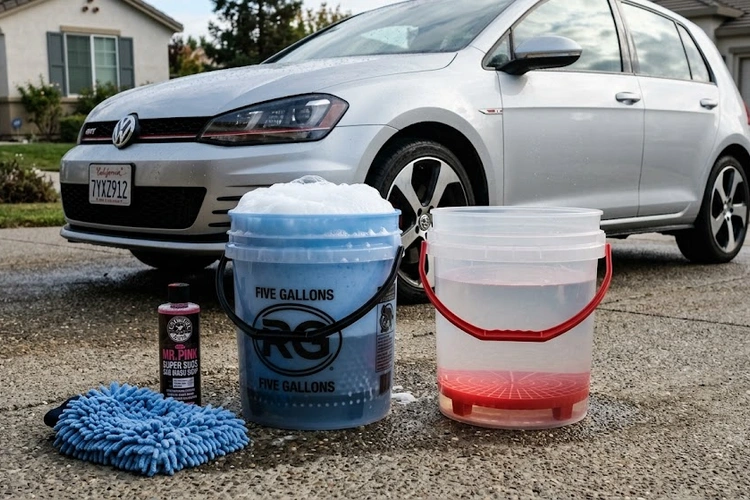
The two bucket car wash method is a hand washing technique that uses one bucket filled with soapy water for washing and a second bucket filled with plain water for rinsing the mitt after each panel. This separation prevents contaminated rinse water from being carried back onto the paint, which is the primary cause of fine scratches during conventional single-bucket washing.
Installing grit guards in both the wash bucket and the rinse bucket is the standard recommendation among professional detailers. The guard in the rinse bucket traps dislodged particles below the active water zone so they cannot be picked up again when the mitt is reloaded, while the guard in the wash bucket provides secondary filtration if any residual grit transfers during reloading.
For average-sized vehicles in typical road conditions, changing the rinse bucket water once at the midpoint of the wash — after completing the upper half of the vehicle — is sufficient. Heavily contaminated vehicles, particularly those driven in winter road salt conditions, may benefit from starting with fresh rinse water when transitioning to lower panels.
The two-bucket method is specifically designed for water-based washing using a mitt and soap solution. Waterless wash products use a different chemistry — they encapsulate surface particles in lubricant and are wiped off with a microfiber towel rather than rinsed. Combining the two approaches in the same session is generally unnecessary and can dilute the effectiveness of the waterless product's lubricating agents.
Microfiber is the strongly preferred material for the two-bucket method because its deep pile structure lifts and holds grit away from the paint contact surface during the wash stroke, then releases that grit into the rinse bucket during agitation. Wool mitts offer comparable performance for many users, but foam sponges and traditional cotton rags trap grit against the paint surface and largely negate the contamination-management advantage the method provides.
Two-bucket washing removes surface contamination effectively but does not address bonded contaminants (particles that have embedded into or adhered chemically to the clear coat surface), such as industrial fallout, tree sap, or rail dust. A clay bar treatment, performed on a clean wet surface after washing, is the appropriate tool for removing bonded contamination that washing alone cannot dislodge.
Cold temperatures slow soap activity, cause water to cool rapidly on the paint surface, and can lead to water freezing in door jambs and around weatherstripping in sub-freezing conditions. In cold weather, using slightly warmer water in the wash bucket helps maintain soap effectiveness, and drying the vehicle thoroughly — including door edges and jambs — becomes more important to prevent ice formation around seals.
Matte and satin finishes benefit from the two-bucket method even more than glossy clear coats in some respects, because scratch marks and surface contamination are far more difficult to correct on non-glossy surfaces without professional intervention. The same technique applies, but the soap must be specifically formulated for matte finishes — standard gloss-enhancing soaps and any subsequent wax or polish application are incompatible with matte paint chemistry.
 |
 |
 |
 |

About Diego Ramirez
Diego Ramirez is a maintenance and care specialist who has been wrenching on cars since he was sixteen. He focuses on fluid changes, preventive care routines, paint protection, and the small habits that turn a five-year-old car into a fifteen-year-old car.
Get some FREE car parts & gear.. Or check out the latest free automotive manuals and build guides here.
Disable your ad blocker to unlock all the hidden deals. Hit the button below 🚗
| | | |
