by Sarah Whitfield
Ever noticed a faint burning smell after parking, or spotted dark grime baked onto the engine bay? Those are classic valve cover gasket leak symptoms — and they're worth acting on. The valve cover gasket seals the junction between the valve cover and cylinder head, keeping oil inside the engine where it belongs. When it fails, oil escapes. What follows ranges from a minor inconvenience to a costly repair, depending entirely on how quickly the problem gets addressed.
This guide covers every major symptom, explains what causes the gasket to give out, and breaks down realistic repair costs — whether drivers go the DIY route or hand the job to a shop.

Contents
Catching valve cover gasket leak symptoms early is what keeps this repair affordable. These are the signs that show up most consistently across a wide range of makes and models.
The most visible sign is oily buildup along the perimeter of the valve cover. It often looks like dark, baked-on grime or a wet sheen running along the gasket seam. On some engines, the leak drips directly onto the exhaust manifold below — which is where the burning smell originates. On others, the oil pools in the engine bay and gets flung around by the accessory belt, coating nearby components with a greasy film that attracts dirt and makes future inspections harder.
Pro tip: A clean engine makes leaks far easier to pinpoint. Degreasing the engine before an inspection removes the background grime so fresh oil seeps stand out immediately.
When oil contacts a hot exhaust manifold, it burns off almost instantly. The smell is sharp and acrid — distinctly different from burning coolant, which tends to smell sweeter and more syrupy. The burning oil smell usually peaks after hard driving when exhaust temperatures are highest. If it shows up consistently after highway runs, a leaking valve cover gasket is a strong candidate. For comparison, a similar smell can also accompany coolant reservoir bubbling, but the scent profile is quite different once you've experienced both.
On many engines, the valve cover also seals individual spark plug wells. When the gasket fails around those wells, oil seeps down and soaks the plugs — one of the more serious valve cover gasket leak symptoms because it directly disrupts ignition. Fouled plugs misfire, and misfires trigger check engine lights. For a focused look at that specific problem, the guide on oil on spark plugs covers causes and fixes in detail. A misfire code often follows shortly after — the P0300 random misfire guide explains exactly what to expect and how to diagnose it.
If the oil level keeps dropping between changes but there's no visible puddle under the car, the leak is likely minor — burning off on hot engine surfaces before it ever reaches the ground. Many drivers discover this only when the oil light flickers or they notice how frequently they're topping off. Consistently losing oil without an obvious external source is always worth investigating rather than ignoring.
Understanding the root cause helps drivers know what to watch for — and what habits to avoid. According to Wikipedia's overview of gaskets, most automotive gaskets are made from rubber, cork, or composite materials that degrade with repeated thermal cycling over time.
The valve cover gasket endures extreme temperature swings every time the engine runs. Over tens of thousands of heat cycles, rubber or cork gasket material hardens, shrinks, and cracks. Most gaskets hold up reliably between 50,000 and 100,000 miles, but engines that run hotter than average — due to towing, aggressive driving, or a cooling system that isn't fully healthy — tend to wear them faster. Plain old age is the most common failure mode by a wide margin.
Over-torquing the valve cover bolts is a surprisingly frequent cause of premature failure, especially after a previous DIY repair. Too much clamping force crushes the gasket material unevenly, creating pressure points that eventually split or gap. Stripped bolt holes make things worse by allowing the cover to shift slightly under engine vibration. Always use a torque spec when reinstalling — typical values run between 18 and 35 inch-pounds depending on the engine, and tightening in a crossing pattern matters as much as the final torque figure.
Before spending money, confirming the exact source is worth a few minutes. Not every oil leak originates at the valve cover — the intake manifold gasket is another common culprit with overlapping symptoms. Here's how to narrow it down.
Start with a cool engine and a flashlight. Look along the entire perimeter of the valve cover for oil streaks, dried residue, or wet spots. Corners and the area around camshaft position sensors are common failure points. Check the spark plug wells if accessible — a thin film of oil inside a well confirms the tube seal at that location has failed. Tracing oil streaks upward toward their origin is often more reliable than looking at where the oil has pooled.
Warning: Never inspect near the exhaust manifold with bare hands on a recently run engine. Let everything cool for at least 30 minutes before reaching into tight spaces.
For seeps too small to spot visually, UV dye offers a reliable solution. A small amount of UV-reactive dye goes into the oil, the engine runs for a few minutes, and a UV light reveals every escape point in glowing yellow-green. Professional shops often use a smoke machine instead — pressurizing the crankcase through the PCV system and watching for smoke to billow out of any gap along the gasket seam. Both methods catch leaks that a flashlight alone would miss entirely.
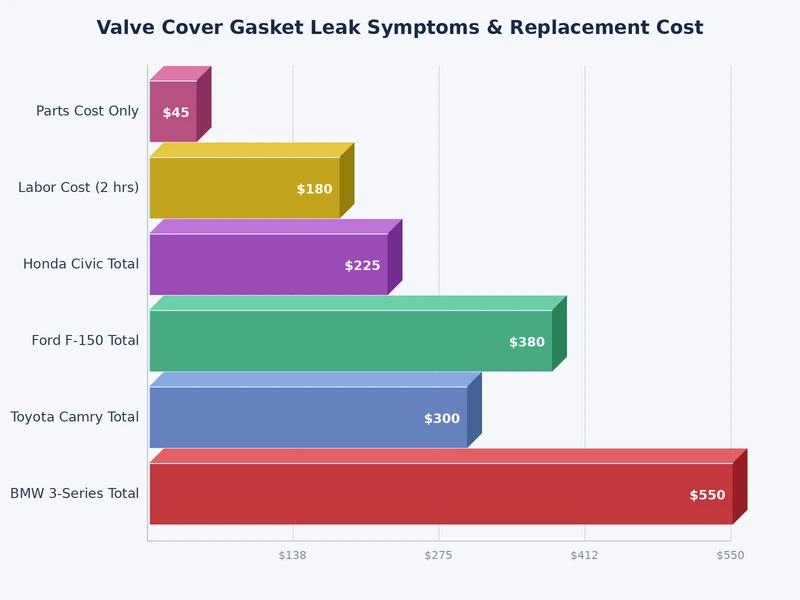
Repair costs vary widely by vehicle, engine layout, and shop location. Here's a realistic picture of what most drivers encounter.
The gasket itself is inexpensive — typically between $10 and $60 for most passenger cars. Labor is where the cost climbs. On a four-cylinder engine with easy valve cover access, the job might take an hour. On a V6 or V8 with one or both valve covers buried under intake plumbing, two to four hours of labor is common. Some European makes carry significantly higher parts costs due to proprietary materials and integrated components.
| Vehicle Type | Parts Cost | Labor Cost | Total Estimate |
|---|---|---|---|
| Economy Sedan (4-cyl) | $10–$30 | $60–$120 | $70–$150 |
| Midsize SUV / Truck (V6) | $25–$60 | $100–$220 | $125–$280 |
| Full-Size Truck / V8 | $30–$80 | $150–$300 | $180–$380 |
| European Luxury (BMW, Audi, Mercedes) | $60–$180 | $200–$500 | $260–$680 |
Engine accessibility drives the labor cost more than anything else. A transversely mounted V6 in a front-wheel-drive platform often requires removing the intake plenum just to reach the rear valve cover — a job that multiplies labor time quickly. Cam-in-block designs on older American V8s are much more straightforward. If the timing cover shares a sealing surface with the valve cover, the complexity rises further. Related lubrication issues sometimes surface during this repair too — timing chain noise can be an early sign that oil starvation from an unaddressed leak has been affecting upper engine components.
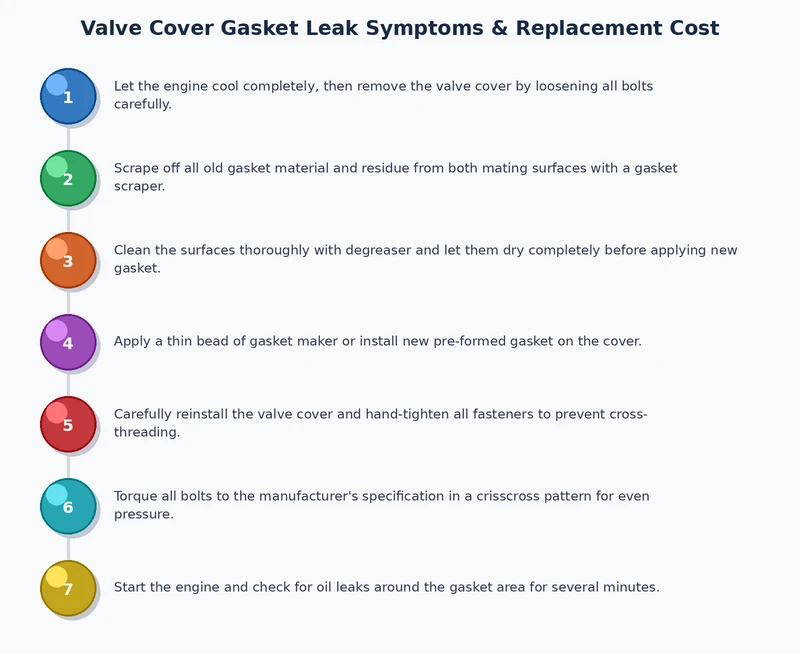
A valve cover gasket replacement ranks among the more approachable DIY engine jobs — but engine complexity determines whether it stays that way.
On most four-cylinder engines, the valve cover sits on top and is reachable with basic hand tools. A complete gasket kit costs under $40 at any auto parts store. The process is logical: disconnect any hoses or wiring attached to the cover, remove the bolts in a crossing pattern, lift the cover, peel off the old gasket, clean both mating surfaces thoroughly, seat the new gasket, and reinstall with the specified torque. The entire job takes about 90 minutes for anyone comfortable working around engines. It's also worth inspecting the PCV valve and hoses while the cover is off — a clogged PCV system increases crankcase pressure and accelerates gasket wear. Oil contamination through this system can also reach the throttle body over time, so reviewing the dirty throttle body symptoms guide alongside this repair is worthwhile.
V6 and V8 engines with tight underhood packaging are a different story. When reaching the valve cover requires removing the intake manifold, fuel rail, or coil packs, the risk of introducing new problems rises sharply. European vehicles with aluminum covers, integrated wiring harness brackets, and delicate plastic clips are particularly unforgiving of rough handling. For these engines, professional labor is usually the more cost-effective path — a DIY mistake at this complexity level can easily exceed what the shop would have charged.
Tip: When getting quotes, ask if the spark plug tube seals are included in the kit — many shops skip them, but a failed tube seal is what allows oil to migrate into the plug wells.
A small seep might seem harmless enough to put off. The consequences of inaction, however, tend to compound over time.
The most immediate risk is oil contaminating the spark plugs. Once oil reaches the plug wells, it degrades the ignition coil boots and fouls the plugs themselves. Misfires follow — rough idle, reduced power, and a check engine light become the new normal. Replacing a full set of spark plugs and ignition coils can add $200–$400 to what would have been a straightforward gasket job. There's also a genuine fire risk if oil drips onto a catalytic converter or exhaust header running at operating temperature.
Persistent low oil from an unaddressed leak gradually starves the upper engine of lubrication. Camshafts and valve train components — exactly what the valve cover is designed to protect — are the first to show wear. Repairs at that stage move into the thousands. Oil pulled through a compromised PCV system also fouls the mass air flow sensor and throttle body over an extended period. For broader context on how fluid leaks escalate when left unaddressed, the differential fluid leak symptoms guide illustrates the same pattern in a different system.
It depends on the severity. A minor seep that loses little oil and stays away from ignition components poses minimal immediate risk. A significant leak that reaches spark plugs or drips onto the exhaust system needs prompt attention — misfires, fire risk, and accelerating engine wear are all on the table if it goes unaddressed.
Short distances are generally manageable, but the repair should happen soon rather than later. The biggest concern is oil loss and potential plug fouling. Monitoring the oil level closely and topping it off as needed buys some time, but it doesn't fix the underlying problem.
On a straightforward four-cylinder engine, an experienced mechanic completes the job in under an hour. More complex engines — V6 and V8 configurations with limited access — typically require two to four hours depending on what needs to be removed to reach the cover.
Not necessarily. Many leaks burn off on hot exhaust surfaces before reaching the ground. The more reliable clues are a persistent burning smell, oil residue baked onto the engine exterior, and unexplained oil consumption between changes — all without any visible puddle underneath the vehicle.
Valve cover gasket leaks are among the more manageable engine repairs — but only when addressed before they cascade into plug fouling, misfires, or oil starvation. Drivers who spot the symptoms early typically spend $100–$300 on the fix; those who wait often spend several times that correcting downstream damage. Take a few minutes to inspect the valve cover area at the next oil change, and if that burning smell keeps coming back after a drive, don't wait to find out why.
 |
 |
 |
 |

About Sarah Whitfield
Sarah Whitfield is a diagnostics and troubleshooting specialist who spent ten years as an ASE-certified technician before joining the editorial team. She specializes in OBD-II analysis, electrical gremlins, and the kind of intermittent problems that make most owners give up.
Get some FREE car parts & gear.. Or check out the latest free automotive manuals and build guides here.
Disable your ad blocker to unlock all the hidden deals. Hit the button below 🚗
| | | |
