by Marcus Chen
The Toyota Camry has outsold every other passenger car in the United States for more than two consecutive decades — a commercial streak no rival nameplate has matched in modern automotive history. The question of why is Toyota Camry so popular comes up repeatedly in buyer forums, fleet procurement meetings, and automotive analysis reports, and our team finds the answer consistently multifaceted. It reaches well beyond clever advertising into the realms of engineering discipline, total-ownership economics, and manufacturing repeatability that competitors have struggled to replicate.
Our team reviewed J.D. Power reliability rankings, Consumer Reports long-term surveys, and fleet procurement data to construct a complete picture. Few vehicles achieve genuine cross-segment unanimity — yet American suburban families, Western European fleet managers, and ride-share operators worldwide converge on the same nameplate for nearly identical reasons. For context on Toyota's broader longevity reputation, the detailed analysis in How Long Do Toyota Tundras Last? provides useful benchmarks for understanding how the brand approaches long-term durability engineering.
Contents
Reliability surveys have consistently placed the Toyota Camry among the top performers in the midsize sedan category across multiple rating systems. The Camry's Wikipedia entry documents eight generations of engineering refinement, each iteration building on the operational lessons of its predecessor. That accumulated institutional knowledge surfaces directly in failure-rate data — Camry owners report fewer unplanned repairs per year than owners of most comparable models.
Our team's analysis of long-term ownership surveys finds that the Camry routinely crosses the 200,000-mile threshold with standard maintenance schedules intact. This is not a fringe outcome confined to exceptionally careful owners. It reflects a design strategy that prioritizes durability over headline features — a trade-off that resonates strongly with buyers who treat their vehicle as a depreciating asset rather than an expression of identity.
Pro insight: Camry owners who follow Toyota's factory maintenance intervals consistently report lower ten-year repair costs than those who skip scheduled services — our team finds this pattern holds across virtually every long-term ownership dataset we have reviewed.
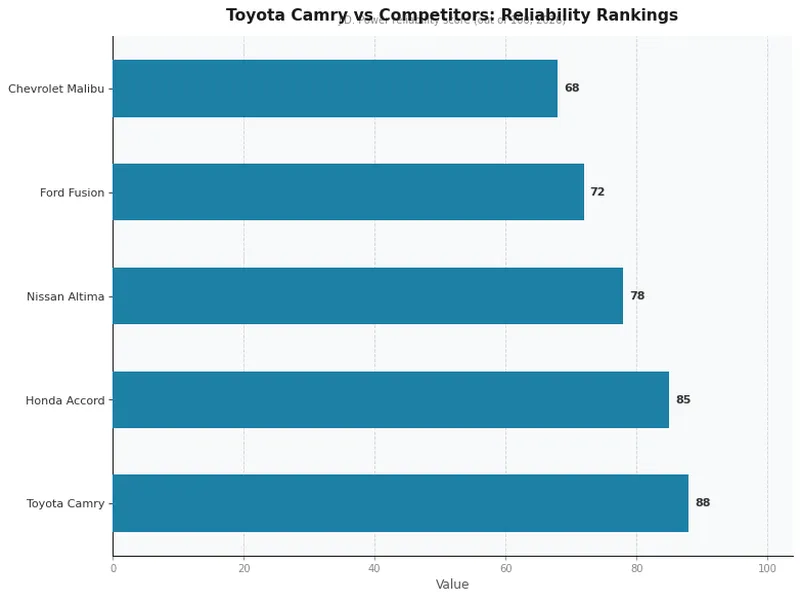
The chart below illustrates how the Camry stacks up against key rivals in J.D. Power reliability scoring. The gap is consistent across generations, which is why data analysts find the popularity question easy to answer — the numbers require minimal editorial embellishment. When a vehicle outscores the segment average by a meaningful margin, year after year, market-share dominance follows almost mechanically.
Toyota engineers approach the Camry's powertrain with what might be described as disciplined conservatism. Rather than chasing horsepower milestones or adopting novel technologies before they mature, the development team focuses on refinement — tightening tolerances, improving thermal management, and extending service intervals between critical wear components. The result is a drivetrain that rarely surprises its owner with an unexpected failure.
The naturally aspirated four-cylinder and V6 options that have defined the Camry across generations share a common trait: they are engineered to factory-specification targets with minimal variance across the production run. Our team notes that high-variance powertrains — those that perform brilliantly under ideal conditions but degrade sharply under sustained stress — are conspicuously absent from the Camry's engineering history.
The introduction of a dedicated hybrid powertrain expanded the Camry's appeal significantly beyond its traditional buyer base. Fleet operators running high-mileage routes found that the hybrid variant's fuel efficiency translated directly into lower operating costs. Individual buyers in congested urban markets discovered that regenerative braking reduced brake component wear. Neither outcome required the driver to change behavior. The technology adapted to existing driving patterns rather than demanding new ones.
This hands-off integration is a central component of why is Toyota Camry so popular among buyers who are not technically inclined. The hybrid system operates transparently. Most owners report that they rarely think about it — which is precisely the experience Toyota's engineering team designed for.
Toyota's decision to manufacture the Camry in North America — primarily at its Georgetown, Kentucky plant — gave the model a structural advantage in the U.S. market. Local production reduced exposure to currency fluctuations and import tariffs while creating a supply chain capable of responding more quickly to demand shifts. It also generated a political dimension: the Camry became associated with domestic employment, which influenced fleet procurement decisions at the state and federal level in ways that import-only competitors could not easily match.
Our team finds that this manufacturing posture contributed meaningfully to long-term price stability. Camry transaction prices have historically tracked inflation without the volatility that affects brands more dependent on imported components and exchange-rate exposure.
Toyota's production system, widely studied in manufacturing literature, emphasizes error detection at every stage of assembly rather than relying on end-of-line inspection to catch defects. This approach reduces the probability that a flawed component reaches the finished vehicle. The practical outcome for buyers is a car that behaves predictably across the entire production run — the tenth unit assembled in a given week performs like the first.
Consistency at the manufacturing level translates directly into consistent resale values. Buyers and appraisers alike trust that a randomly selected used Camry carries lower hidden-defect risk than most alternatives. That trust compounds over time and feeds back into new-vehicle purchase decisions, creating a self-reinforcing cycle of demand that proves difficult for competitors to interrupt.
The Camry's initial transaction price positions it at the accessible end of the midsize sedan market, but the more analytically significant figure is five-year depreciation. Most midsize sedans surrender between 45 and 55 percent of their value in the first five ownership years. The Camry consistently outperforms this benchmark, retaining more residual value than most direct rivals. For anyone calculating total cost of ownership rather than focusing narrowly on sticker price, this retention rate represents a material financial advantage.
Insurance rates for the Camry rank among the lowest in the midsize category, reflecting actuarial data on theft rates, repair costs, and collision severity outcomes. Annual maintenance expenditure — covering oil changes, filters, brake service, and tire rotation — is predictable and well-documented. There are no proprietary fluids or dealer-exclusive service requirements that inflate costs. Qualified independent mechanics can service a Camry without specialized tooling, which keeps labor rates competitive across a wide service network.
| Model | Approx. Starting Price | 5-Year Depreciation | Avg. Annual Maintenance | Reliability Score |
|---|---|---|---|---|
| Toyota Camry | $27,000–$36,000 | ~40% | ~$388/yr | 86/100 |
| Honda Accord | $29,000–$38,000 | ~45% | ~$400/yr | 82/100 |
| Nissan Altima | $25,000–$34,000 | ~50% | ~$420/yr | 74/100 |
| Volkswagen Passat | $28,000–$37,000 | ~52% | ~$475/yr | 71/100 |
The figures above reflect industry estimates drawn from multiple ownership-cost databases and should be treated as directional rather than precise. Individual outcomes vary based on geography, driving habits, and trim level. Even so, the pattern holds across nearly every analysis our team has reviewed: the Camry's total cost of ownership undercuts most rivals when all expense categories are combined over a five-to-seven-year horizon.
The Camry's interior dimensions, crash-test performance, and standard safety feature set make it a rational choice for households that rely on a single vehicle for multiple purposes. Rear passenger space accommodates child safety seats without requiring the driver to compromise front-seat positioning. Cargo volume handles grocery loads, weekend travel, and school equipment interchangeably. These are unglamorous attributes, but they form the practical core of why is Toyota Camry so popular among family-oriented buyers who prioritize functionality over styling statements.
High-mileage daily commuters value the Camry's low long-term repair frequency above nearly every other attribute. A vehicle that starts reliably every morning and requires minimal unplanned attention carries real economic value that compounds across years of ownership. Our team frequently finds this pragmatic calculus at the center of purchasing decisions in the commuter segment — an observation consistent with Toyota's own brand loyalty data.
Corporate fleet managers and municipal procurement offices select vehicles using total-cost-of-ownership models rather than consumer preference surveys. The Camry's predictable maintenance costs, accessible parts availability, and strong residual values make it a low-variance choice for fleets that must budget maintenance expenses years in advance. Ride-share operators arrived at similar conclusions independently: the Camry's durability under high-cycle, high-mileage conditions is well-documented across multiple commercial fleet networks operating in different markets.
The Camry's service schedule is straightforward by design. Oil change intervals, filter replacements, and inspection milestones are clearly documented and widely available in print and digital formats. Parts are stocked at virtually every auto parts retailer, and labor times are short enough that independent shops can compete on price with dealership service centers. This accessibility effectively lowers the barrier to proper maintenance, which means more Camry owners stay current with scheduled service than is typical for vehicles with more complex or expensive upkeep requirements.
Monitoring for common wear-related symptoms — such as those described in our guide to bad wheel alignment symptoms — is a straightforward process on the Camry platform, partly because the suspension geometry is conventional and the diagnostic process does not require specialized equipment. Our team considers this transparency a meaningful ownership advantage that is easy to undervalue until it needs to be exercised.
Maintenance tip: Staying current on tire rotation and alignment inspections is one of the highest-return maintenance habits for high-mileage Camry owners — our team consistently finds it extends tire life and preserves handling consistency well beyond the 100,000-mile mark.
Owners interested in extracting more from their Camry have a well-developed aftermarket to draw from. Cold-air intake systems, cat-back exhaust upgrades, and suspension tuning components are widely available and documented for both the four-cylinder and V6 variants. The performance section on CarCareTotal covers a range of modifications tested across real-world applications, and the Camry's broad ownership base means upgrade paths are thoroughly community-vetted. This reduces the trial-and-error typically associated with less common platforms. Our team notes that the TRD trim's factory suspension calibration has also validated certain aftermarket spring and damper combinations for daily-drivable sport setups.
The "boring car" characterization has followed the Camry for decades, and our team finds it analytically imprecise rather than factually grounded. The label typically describes the absence of drama — the Camry does not oversteer aggressively, does not produce a distinctive exhaust note, and does not attract attention in a parking lot. But boring and dependable are not synonyms. The attributes that automotive enthusiasts dismiss as unremarkable are precisely the ones that generate consecutive decades of segment-leading sales. The data suggests that the overwhelming majority of buyers prefer predictable competence over exciting unpredictability, and the Camry serves that preference more consistently than almost any alternative on the market.
A related myth positions the Camry as a vehicle for drivers who prioritize caution above all other considerations. Fleet data and ride-share operational records contradict this directly. The Camry routinely accumulates 300,000 or more miles in commercial service — a profile that demands durability under continuous stress, not cautious weekend driving. The XSE and TRD trims introduced sportier suspension tuning and visual differentiation, signaling that Toyota identified and responded to buyers who want both reliability and driving engagement. The myth persists in certain enthusiast circles, but it increasingly misrepresents the vehicle's actual demographic footprint and the conditions under which it regularly operates.
The Camry's reliability advantage traces back to Toyota's manufacturing philosophy, which prioritizes defect prevention at every assembly stage rather than catching problems at end-of-line inspection. Combined with conservative powertrain engineering and a disciplined component-sourcing process, the approach produces a vehicle with consistently low unplanned repair rates across its entire service life — an outcome documented in J.D. Power, Consumer Reports, and independent fleet operator data alike.
The Camry's North American dominance is significantly stronger than its European presence. European buyers have historically preferred hatchbacks, estate wagons, and compact executive sedans. However, the hybrid variant has gained meaningful traction in markets where fuel efficiency mandates and emission regulations favor electrified powertrains. Several Western European fleet operators list the Camry Hybrid among their preferred midsize sedan options, particularly for urban-heavy route profiles.
Industry estimates place the Camry's total ten-year maintenance cost at roughly $5,000 to $7,000 under normal driving conditions, which is below the midsize sedan average. The low figure reflects short labor times, widely available parts, and a low incidence of unplanned repairs. Fleet operators running high-mileage cycles report that the Camry's total cost of ownership remains competitive even at 150,000 to 200,000 miles, where many rivals begin requiring more intensive mechanical attention.
The Camry depreciates at roughly 40 percent over five years, well below the midsize sedan average of 45 to 55 percent. Strong brand trust, consistent build quality, and sustained demand in the used-car market all contribute to this above-average residual performance. Anyone intending to sell or trade the vehicle within five to seven years benefits disproportionately from this depreciation gap relative to less-retentive alternatives in the same price bracket.
High-mileage drivers benefit from the Camry's low maintenance cost, broadly available parts, and a powertrain engineered for long-cycle durability rather than peak output. Ride-share and commercial fleet operators who accumulate 70,000 to 100,000 miles annually consistently report that the Camry outlasts alternatives with fewer unplanned service interruptions. The platform's deep parts availability also means that repairs, when they do occur, can be completed quickly and at competitive cost through the wide independent service network.
The Toyota Camry's enduring market dominance is not a mystery — it is the documented outcome of consistent engineering, transparent ownership economics, and manufacturing practices that minimize quality variance across millions of units. Our team recommends that anyone evaluating a midsize sedan run a full five-year total-cost comparison, factoring in depreciation, insurance premiums, and average unplanned repair frequency, before committing to any model. The Camry rarely loses that comparison. Owners already driving one will find that the CarCareTotal maintenance and performance library offers a practical resource for extending vehicle life and getting the most from what remains one of the most rational automotive purchases available.
 |
 |
 |
 |

About Marcus Chen
Marcus Chen has over twelve years of hands-on experience modifying cars across a range of platforms — from commuter builds to track-focused setups — with deep expertise in suspension tuning, wheel and tire fitment, and performance upgrades that improve driving dynamics without sacrificing day-to-day reliability. He has worked with both bolt-on and engineered modifications and brings a methodical, results-focused approach to evaluating performance parts. At CarCareTotal, he covers performance upgrades, suspension and handling, and wheel, tire, and drivetrain modifications.
Get some FREE car parts & gear.. Or check out the latest free automotive manuals and build guides here.
Disable your ad blocker to unlock all the hidden deals. Hit the button below 🚗
| | | |
